
PC Slower Than It Used to Be?
A free scan shows the junk files, broken settings and background clutter dragging Windows down - then fixes them in one click.Free scan · Windows 10 & 11Crashes, No Sound, or Screen Glitches?
Random freezes, missing sound and display glitches usually trace back to one bad driver. Find and replace yours safely.Free scan · under a minuteiTechGuides is reader-supported. When you buy through links on our site, we may earn an affiliate commission. As an Amazon Associate I earn from qualifying purchases. Learn more
Use Python to check IEC 61850 configuration, compare expected GOOSE flows with captured traffic, and organize controlled functional tests—not to replace a protection IED or make an unvalidated trip decision. A dependable pipeline starts with the project’s SCL/SCD configuration and network design, then checks observed behavior against them. A packet that parses successfully is not proof that a protection application is safe or meets its requirements.
Decide what the Python pipeline is responsible for
“A GOOSE pipeline” can mean several different things. Choose its boundary before choosing software or designing checks; offline analysis, lab support, and operational monitoring have different timing and assurance needs.


- Offline configuration linting: examine SCL/SCD files for configuration consistency and generate an expected-flow inventory.
- Capture analysis: inspect recorded traffic and compare observed GOOSE messages with that inventory.
- Lab test support: collect evidence and help check application behavior during controlled tests.
- Operational monitoring: watch network traffic for flows or IEDs that do not match the configured system. This requires an installation-specific network and assurance design.
Keep protection decisions and trip outputs in the validated IED scheme unless the project’s engineering and assurance process explicitly establishes a different design. The available IEC guidance addresses system engineering and testing; it does not establish a particular Python package or production architecture.
Recommended Free Tools
How GOOSE fits into a protection system
GOOSE is horizontal publisher/subscriber communication: protection devices exchange configured data using Ethernet multicast. ABB’s engineering guide describes its use for relay functions such as interlocking and blocking. A message represents a configured IEC 61850 data set, so understanding a packet depends on the relay’s GOOSE control block, data set, subscriber inputs, and associated configuration—not just on decoding bytes.
#1 Best Overall
This has an important consequence for Python tooling: a parser can tell you what it has decoded from a capture, but configuration is needed to judge whether that traffic is expected and meaningful for the application. Vendor behavior and the applicable IEC 61850 edition also matter.
Build the pipeline around SCL/SCD and observed traffic
Treat the project’s SCL/SCD configuration as the basis for an expected-flow model. IEC TR 61850-90-22:2024 describes SCD-informed management of GOOSE and sampled-value routing and monitoring of network and message paths, including identifying flows or IEDs that are unexpected under the configuration.
Rank #2

- Fitment: Overload relay is replacement for C‑CLASS (W202) 1993/03‑2000/05,Replacement for C‑CLASS T‑Model () 1996/06‑2001/03, etc.Please check the details page for the specific model.
- OEM: relay reference number is 0005406745. Please make sure this accessory fits you.
- Function: Overload relay is mainly to provide overload to the line or electrical equipment, to effectively achieve the purpose of motor
- Sturdy Structure: Overload relay is made of ABS and metal, overload relay has a solid construction, built for long lasting durability.
- Direct Fit:Overvoltage relay can direct replace the old and the bad, perfectly matched to your vehicle.
- Identify the project inputs. Record the applicable IEC 61850 editions and amendments, SCL profile, IED vendors and models, data sets, subscriber configuration, protection use case, and source of each configuration file. IEC’s 2026 series listing is an edition inventory, not a substitute for the normative text of the applicable part.
- Derive expected flows. From the approved SCL/SCD and relevant engineering documentation, establish which publishers, data sets, and subscribers are expected. Check references and assumptions against the project’s applicable standard editions and IED manuals; do not assume every vendor represents or exports configuration identically.
- Decode traffic in a defined context. Analyze captures from the intended network segment and record the capture point and conditions. Use a decoder whose compatibility has been checked for the project’s traffic and requirements; no particular Python library is established here as suitable for protection operation.
- Compare expected and observed behavior. Report configured flows not seen in the capture and observed flows that do not match the expected configuration. Treat these as investigation findings, not automatic proof of a fault: capture coverage, network path, timing, and configuration version affect what the comparison means.
- Keep evidence traceable. Associate each result with the configuration and capture versions, analysis assumptions, and any exceptions reviewed by the responsible engineering team.
This workflow can make configuration review and capture analysis repeatable. It does not, by itself, establish that the decoded data is interpreted correctly by a subscriber or that the protection application behaves correctly.
Do these 3 things before closing this tab:
1Scan for outdated or missing drivers - takes under a minute2Repair Windows errors before they cause bigger problems3Fix the driver behind crashes, sound loss and screen glitchesReview the network for the actual application
Python cannot compensate for an unsuitable substation LAN. IEC TR 61850-90-4:2020 covers substation LAN engineering, including topology, redundancy, synchronization, and protection trip data transported by GOOSE. The required choices depend on the actual application and installation; they are not determined by a generic Python recipe.
- Review the planned topology and the path between each relevant publisher and subscriber.
- Check multicast routing and network configuration against the intended GOOSE flows.
- Assess redundancy and synchronization requirements for the specific installation.
- Plan monitoring so its observation points can reveal relevant path or flow discrepancies.
The IEC document cautions: “This document does not dispense the responsible system integrator from an analysis of the actual application configuration, which is the base for a dependable system.” Network review and SCL/SCD analysis therefore belong together.
Separate software checks from functional protection testing
A successful file check or packet parse verifies only that a particular software check completed. It does not demonstrate end-to-end protection behavior. IEC TR 61850-10-3:2022 provides functional verification and validation guidance for substation applications, including protection and control testing that uses GOOSE or sampled values; this application-level guidance is distinct from device conformance testing.
Rank #4

- MULTIPLE POWER FAULT OBSERVATION: This monitoring unit observes abnormal power supply conditions including reversed power sequence and missing line, delivering reliable defense for linked mechanical units.
- FLEXIBLE TRANSFER CONTACTS: Integrated change-over contacts transmit timely switching signals once power anomalies are captured to activate safety measures.
- UNIVERSAL INSTALLATION: Features standard DIN rail modular design, simple assembly inside control enclosures, saves layout space for various automation housings.
- SOLID CONSTRUCTION: Around 106g net weight; crafted with robust plastic outer shell and internal metal parts, anti-interference for long continuous operation.
- BROAD APPLICATION: Suited to shield motors, compressors, fans and other triple-line power machinery for workshop automation and mechanical systems
Use a controlled lab or other project-approved test environment to verify the application against its requirements. Define the expected behavior and evidence with the responsible protection and system engineers, then use Python outputs as supporting records or repeatable checks—not as a substitute for the system test. No test results or interoperability measurements are established here.
The Tool Desk
Outbyte Driver Updater FREEScan for outdated or missing drivers - takes under a minuteDriver Scan →Outbyte PC Repair FREERepair Windows errors before they cause bigger problemsFix Now →What to establish before relying on the pipeline
- Which IEC 61850 editions and amendments apply to the equipment and project requirements?
- Which approved SCL/SCD version defines expected publishers, data sets, and subscribers?
- Does the chosen decoder work with the actual IEDs, traffic, and capture conditions?
- Do network topology, redundancy, synchronization, and monitoring match the application?
- What controlled functional-test evidence will show that the end-to-end protection application meets its requirements?
IEC’s 2026 series listing helps identify constituent editions and amendments, including IEC 61850-6, IEC 61850-8-1, and IEC 61850-10. Select the editions applicable to the project rather than assuming a series-wide edition applies uniformly. IEEE 2030.100-2017 provides additional implementation-practice context for IED specification, procurement, configuration, and documentation.
Quick Recap
Best Value
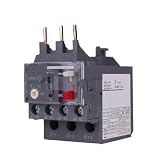
- Material: The motor protection relay features a rugged housing to ensure long-lasting durability in industrial environments
- Operation: The three-phase motor protection device supports manual and automatic reset modes, making it easy to install and use
- Performance: The thermal overload relay provides reliable overload and phase loss protection for three-phase motors
- Design: The adjustable overload relay is equipped with an adjustable current knob that allows for easy setup to match the motor’s rated current
- Wide Application: Designed specifically for the LC1D/LC1E series of AC contactors, it is widely used in water pumps, contactors, and other applications
Product prices and availability are accurate as of the date/time indicated and are subject to change. Any price and availability information displayed on Amazon at the time of purchase will apply.

