
What’s actually slowing this PC down?
Pick the symptom - the matching free tool is one click away.
iTechGuides is reader-supported. When you buy through links on our site, we may earn an affiliate commission. As an Amazon Associate I earn from qualifying purchases. Learn more
You can build a small, testable cyclone-impact forecasting prototype from 61 data points, but the number alone says nothing about whether it can forecast reliably. First define what each point represents, what “impact” means, where and when it applies, and how far ahead the forecast is meant to look. Then establish a simple baseline and evaluate it in a way that keeps records from the same storm together.
Define the forecasting problem before choosing a model
Write down the project’s specification before fitting anything. The title does not establish the makeup of the 61 records or the intended forecast, so these are decisions to resolve rather than assumptions to make.
- Unit of observation: Is each row a distinct storm, a time step along a storm track, a location, or an aggregation?
- Target: Specify the impact outcome and how it is measured. Wind exposure, rainfall, flooding, damage, and population affected are different targets; one cannot stand in for another without a defensible definition.
- Geography and period: Name the basin or area and the dates represented. The scope determines whether the data sources and any evaluation can support the intended use.
- Forecast horizon: State how far ahead the model predicts and when its input information would be available. A prediction of an outcome at a specified lead time is more precise than a general claim to forecast “impact.”
- Intended decision: Explain who would use the forecast and what decision it could inform. A prototype for exploration is not an operational warning system.
Record whether multiple rows belong to the same storm. If so, those records are related observations, not 61 independent examples.
Quick wins for a faster PC:
Clear out junk files and repair common Windows errorsFree Scan →Scan for outdated or missing drivers - takes under a minuteDriver Scan →Repair Windows errors before they cause bigger problemsFix Now →Find out what the available data actually contain
Use IBTrACS for storm history, not as an assumed impact-label source
NOAA’s National Centers for Environmental Information describes the International Best Track Archive for Climate Stewardship (IBTrACS) as “the most complete global collection of tropical cyclones available.” The archive merges best-track information from multiple agencies, including storm locations and intensity. It can help identify storms and construct historical track or intensity features, but it does not, by itself, establish the project’s impact labels. See the NOAA IBTrACS project page.
#1 Best Overall
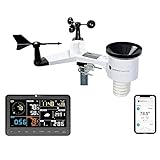
- COMPLETE WEATHER STATION: (1) Osprey Sensor Array with Rain Cup, and (1) Brilliant, Easy-to-Read LCD Color Display
- AUTHENTIC HYPER-LOCAL DATA: Monitor your actual home and backyard weather conditions with our wireless and Wi-Fi-enabled sensor array measuring wind speed/direction, temperature, humidity, rainfall, UV intensity, and solar radiation
- SMART HOME READY: Set up alerts, access your data remotely, and program your home based on weather conditions using IFTT, Google Home, Alexa, and more
- ENHANCED WIFI: Enables your station to transmit its data wirelessly to the world's largest personal weather station network (optional setting)
- JOIN THE COMMUNITY: Connect to Ambient Weather Network to customize your dashboard tiles, share hyperlocal weather conditions via social feeds and create your own forecasts (coming soon)
Before joining IBTrACS to the 61 records, check that the storm identifiers, basin, dates, variables, and units align. NOAA lists IBTrACS v04r01 and provides data in CSV, NetCDF, and shapefile formats. The project page says the archive is usually updated three times each week—typically Sunday, Tuesday, and Thursday—so record the version and the date you accessed it to make a dataset build reproducible. See NOAA’s IBTrACS project page.
Check consistency and missingness in the storm records
IBTrACS is not perfectly uniform across agencies or eras. NOAA notes that agencies use different practices for reporting maximum sustained winds, and that some historical systems—especially from before satellite observations—are absent. A wind value may also have been inferred from a known storm category; NOAA advises caution where wind quality is not well identified. Preserve agency-specific source fields where available, document units and wind averaging periods, and inspect missingness rather than treating every value as directly comparable. These limitations matter particularly when combining basins or comparing long periods. NOAA’s official metadata record for IBTrACS version 4.01 lists a publication date of 2019-02-15; consult the current project page for the version and files you use, rather than treating that metadata date as the release date of every current file. See NOAA’s IBTrACS metadata record.
Rank #2

- [Color LCD Screen Weather Station] Newentor temperature & humidity monitor with a large color LCD display shows essential home weather information at a glance: indoor/outdoor temperature & humidity, daily high/low records, customizable alerts, time/date, alarm clock & snooze, weather forecast, moon phase, and barometric pressure.
- [Two Power Modes & Adjustable Backlight] To enjoy a 24/7 continuous always-on vibrant display, simply connect this home weather station to a wall outlet using the included DC power adapter. When operating on battery power only (batteries not included), the digital thermometer automatically enters an eco-energy-saving mode, where the screen lights up for a quick 15-second glance before dimming. It is the perfect bedside or living room clock designed to fit your power preference.
- [3-channel Home Weather Stations Wireless Indoor Outdoor] Wireless temperature forecast station supports up to 3 remote sensors to monitor inside outside temperature & humidity of multiple locations. Package contains one remote sensor.
- [Wireless Forecast Station] The weather forecast station calculates the weather forecast for the next 12-24 hours, 7 to 10 days calibration ensures an accurate personal forecast for your location.
- [Wireless Weather Station with Atomic Time&Date] Atomic alarm clock weather station can be used not only as a wireless indoor outdoor thermometer but also as an atomic clock with dual alarms.
Use wind-exposure data only when the target and coverage fit
NOAA’s Tropical Cyclone Wind Exposure dataset is a possible contextual source for a wind-exposure project, not a general archive of damage or human impacts. NOAA describes an approach that intersects storm tracks with wind-intensity areas and calculates return intervals. Its listed coverage is 1988–2022 for the North Atlantic and Eastern Pacific, and 2001–2022 for the Western Pacific. Confirm that the geography, dates, and exposure outcome match your project before using it; do not treat it as a label source for flooding, damage, or people affected. See NOAA’s Tropical Cyclone Wind Exposure dataset record.
Build a cautious baseline with 61 points
Once the target, input features, and forecast horizon are explicit, begin with a transparent baseline rather than a complex model. The baseline should make clear what information the forecast uses and what a more elaborate model would need to improve on. Keep the model small relative to the amount and structure of the data, and report the number of storms represented—not just the number of rows.
Rank #3
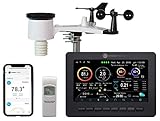
- Allows you to monitor your home and backyard weather conditions with TFT color display
- Wireless all-in-one integrated sensor array measures wind speed/direction, temperature, humidity, rainfall, UV and solar radiation
- Supports both imperial and metric units of measure with calibration available
- Enhanced Wi-Fi connectability option that enables your station to transmit its data wirelessly to the world's largest personal weather station network
- Console power provided by 5V DC adapter (included), and sensor array requires 3 x AAA batteries (not included)
Choose a baseline appropriate to the target. For a numeric outcome, a simple reference prediction can show whether a model adds useful predictive information; for a categorical outcome, compare against a straightforward rule or class-frequency reference. These are methodological starting points, not claims that any particular approach will perform well on this dataset. Do not select a model or claim likely accuracy before the target and evaluation design are defined.
Independent reader supportYour contribution helps us test, update, and keep practical guides available for everyone.Evaluate by storm, not just by row
If several of the 61 records come from the same storm, a random row-level split can place closely related observations in both training and test sets. That can make performance appear stronger than it would be on storms the model has not seen. Where the data structure allows it, keep each storm’s observations together when splitting data for evaluation. Grouping by storm is methodological guidance for avoiding leakage; it is not a NOAA finding.
Rank #4
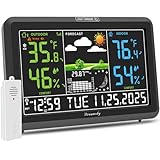
- Illuminated Indoor Outdoor Weather Station for Home with Large Colorful Display: The home weather station delivers large big numbers for weather forecast info, indoor outdoor temperature, atomic time, date, year and calendar day, which is super easy to read from afar.
- Indoor outdoor Thermometer Wireless with High/Low Temperature Alert: The digital weather station supports 3 outdoor sensors which helps to monitor temperature and humidity of multiple locations (one sensor included). With the high/low temperature alert function, the weather station clock keeps you informed about the changes of weather thermometer outdoor.
- WWVB Atomic Weather Station with Auto DST: Weather atomic clock with indoor/outdoor temp always keeps precise time and date by receiving the WWVB atomic signal. The self setting digital weather clock will automatically adjust to daylight saving time with auto DST feature, no more resetting twice a year.
- Personal Weather Forecast Station: This weather stations wireless indoor outdoor predicts the next 12-24 hours weather condition with a 7-day calibration through the pressure of your location which provides you a better outing experience.
- 5 Level Adjustable Backlight Brightness: The weather clock indoor outdoor temperature atomic with backlight dimmer function helps you avoid high-intensity light that disturb your sleep and easily check the weather situation during the day.
With only 61 independent cases, even a storm-grouped test set will be small, and its score may be uncertain. Describe how many storms are in each split and report uncertainty around performance. If the goal is to generalize to other basins, places, or future seasons, a small collection of cases from one scope does not establish that broader performance; independent validation data would be needed.
Document the limits of what the result can support
Publish the data definition alongside any result: what one point means, how the impact label was measured, which storms and dates are included, the basin or geography, the forecast lead time, and how records were divided for evaluation. For sources such as IBTrACS, also note the version and access date, relevant agency fields, units, and known missingness. This makes it possible to distinguish a limited prototype from a forecast that has been shown to work for a particular operational decision.
Quick Recap
Product prices and availability are accurate as of the date/time indicated and are subject to change. Any price and availability information displayed on Amazon at the time of purchase will apply.

