
iTechGuides is reader-supported. When you buy through links on our site, we may earn an affiliate commission. As an Amazon Associate I earn from qualifying purchases. Learn more
A natural language interface (NLI) lets a person communicate with a computer system using ordinary human language. It can accept speech, text, or another input method, and return speech, text, or another kind of response. It is a way of interacting with a system—not a particular device or AI model.
What counts as a natural language interface?
The W3C defines a natural language interface as one in which the user and system communicate via natural human language. The interaction does not have to be spoken: people might type a request, say it aloud, or use language alongside other controls. A website chatbot, a voice agent, and a telephone service that understands spoken requests can all use an NLI. W3C’s Natural Language Interface Accessibility User Requirements also describes interfaces that combine language with gestures or graphical elements such as a map.
How is an NLI different from a voice interface?
A voice interface is one possible form of NLI, but the terms are not interchangeable. Voice interaction uses speech as an input or output; natural-language interaction is defined by communication in human language. A typed chatbot can therefore be an NLI without being voice-controlled, and a multimodal system can combine speech or text with buttons, maps, or gestures.
How does a natural-language request become an action?
An NLI has to interpret what the person means and connect that meaning to something the system can do. For example, an interface to a web API may translate a user’s request into API parameters and then compose those parameters into a call. Microsoft Research describes this approach as natural-language interfaces to web APIs, or NL2APIs; it is one implementation pattern, not a requirement for every NLI. In its study of an interactive API interface, users had higher task success and lower task completion time than with a non-interactive version. That finding applies to the study’s setting, not to every natural-language interface. Microsoft Research: “Democratizing APIs with Natural Language Interfaces”.
#1 Best Overall
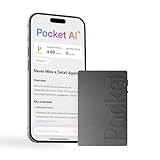
- YOUR AI PERSONAL ASSISTANT FOR EVERYDAY PRODUCTIVITY: More than a voice recorder, Pocket works as your AI personal assistant to capture, transcribe, and summarize meetings, calls, and ideas instantly. Core features are included out of the box, with optional advanced tools available for power users.
- ONE-TAP RECORDING FOR REAL-LIFE MOMENTS: Capture meetings, phone calls, and in-person conversations instantly with a simple tap, no typing, no interruptions, just effortless note-taking anywhere you go.
- SMART AI INSIGHTS & ORGANIZATION: Pocket automatically turns recordings into clear summaries, key action items and structured conversation maps so you can quickly review what matters without digging through audio.
- TURN CONVERSATIONS INTO ACTION WITH “ASK POCKET”: Don’t just record, understand. Instantly ask questions across your meetings, extract key insights and generate next steps in seconds. All grounded in your recordings, so answers stay accurate and reliable.
- MAGSAFE COMPATIBLE FOR SEAMLESS USE: Easily attach Pocket to your iPhone or other MagSafe compatible devices for convenient, hands-free recording on the go. Perfect for capturing meetings, calls, and ideas without needing to hold your device.
What are the main design challenges?
Different wording can express the same intent
People do not all phrase a request the same way. An interface that only handles a narrow set of expected commands can be difficult to use, even if natural language removes the need to memorize those commands. Designers should make supported tasks discoverable, provide examples and help, and handle common alternative phrasings.
Requests can be ambiguous or misunderstood
When a system cannot confidently interpret a request, it should ask a focused clarification question or offer relevant choices rather than guess. People also need a way to correct recognition errors and, for consequential actions, review and confirm what the system is about to do. Where possible, provide a way to reverse an action.
Rank #2
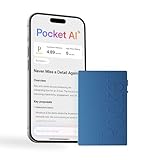
- YOUR AI PERSONAL ASSISTANT FOR EVERYDAY PRODUCTIVITY: More than a voice recorder, Pocket works as your AI personal assistant to capture, transcribe, and summarize meetings, calls, and ideas instantly. Core features are included out of the box, with optional advanced tools available for power users.
- ONE-TAP RECORDING FOR REAL-LIFE MOMENTS: Capture meetings, phone calls, and in-person conversations instantly with a simple tap, no typing, no interruptions, just effortless note-taking anywhere you go.
- SMART AI INSIGHTS & ORGANIZATION: Pocket automatically turns recordings into clear summaries, key action items and structured conversation maps so you can quickly review what matters without digging through audio.
- TURN CONVERSATIONS INTO ACTION WITH “ASK POCKET”: Don’t just record, understand. Instantly ask questions across your meetings, extract key insights and generate next steps in seconds. All grounded in your recordings, so answers stay accurate and reliable.
- MAGSAFE COMPATIBLE FOR SEAMLESS USE: Easily attach Pocket to your iPhone or other MagSafe compatible devices for convenient, hands-free recording on the go. Perfect for capturing meetings, calls, and ideas without needing to hold your device.
What makes an NLI accessible?
Accessibility depends on the whole interaction and the task outcome, not just on whether speech recognition works. The W3C’s requirements point to support for alternative input and output methods, assistive technology, clear prompts, step-by-step instructions, adjustable text or speech presentation, and adequate time to respond. A speech-only design can exclude people who are deaf, have speech disabilities, or are in noisy environments. Depending on the user and setting, keyboard and text alternatives may be essential.
How to assess a natural language interface
When comparing or evaluating NLIs, look beyond whether the system can answer a sample question. Check whether it supports varied phrasing, explains what it can do, recovers gracefully from ambiguity or errors, and allows people to complete the entire task using accessible input and output options. For actions with meaningful consequences, check whether the system lets users review, correct, confirm, or undo them.
Quick Recap
Best Value

- | Comulytic AI Voice Recorder Notes Assistant | — Lifetime Free Starter Plan Comulytic Note Pro is a smart voice recorder, AI note taker, and AI recorder built for professionals, students, and journalists. One tap captures calls, interviews, lectures, and voice memos. Get Unlimited Transcription and Basic Summaries free on the Starter Plan (0/mo). Upgrade anytime to the optional Premium Plan to unlock Deep Dive Analysis, Ask Comulytic Assistant, and Contact Insight Hub (14.99/mo or $120/yr)
- Comulytic AI Recorder — Magnetic, Ultra-Slim, Always Ready This mini voice recorder is just 3 mm thin and slips into any pocket, notebook, or shirt. The 0.78-inch display is shielded by Corning Gorilla Glass, and the aluminum body feels premium in hand. Three magnetic accessories let you snap it to your phone, laptop, or meeting notebook — one tap and the AI starts recording. Pocket-sized power, office-quality sound
- Digital Voice Recorder with 10× Faster Wi-Fi Sync & 64GB Local Storage | Forget slow Bluetooth. Transfer recordings to the Comulytic app over Wi-Fi at up to 10× Bluetooth speed while you keep talking. 64GB of built-in storage holds thousands of hours of recordings, giving you room to record, review, and export files locally. Cloud sync and storage are available through the Comulytic app and depend on your plan
- AI Adaptive Recording with Triple-Mic Array, Noise Cancellation & 45-Hour Battery The AI note taker automatically detects calls, meetings, video conferences, and interviews — no manual mode switching. A triple-mic array with AI noise reduction captures every word clearly within 5 meters, even in a crowded room. 45 hours of continuous recording, 107 days of standby, and a full charge in just 90 minutes — built for back-to-back workdays
- AI Transcription — 98% Accurate, 113 Languages & Spanish Translator Built-In A vertical knowledge base (Insurance, Real Estate, Auto Sales, Financial Advisor, Lawyer, Headhunter, Consultant) captures industry terms precisely. The Comulytic app delivers fast transcription, AI summaries, action items, and to-do lists. Includes a real-time language translator device mode — a pocket traductor de idiomas and traductor de ingles espanol — for global travelers, ESL students, and bilingual pros
Rank #4

- 🎙️ Hands-Free Voice Typing for Windows & Mac – Powered by iOS & Android dictation technology, AI VoiceWriter allows fast, accurate speech-to-text directly on your desktop. Simply speak, and your words appear in real time. Compatible with Windows 10 & above, macOS 13 & above.
- ✍️ AI Writing Assistant for Effortless Editing – Boost productivity with AI proofreading, rephrasing, and formatting. Perfect for emails, reports, creative writing, and professional content.
- 💻 Works Seamlessly in Any Desktop App – Type with your voice in Microsoft Word, Google Docs, PowerPoint, Teams, emails, and more. Just place your cursor in any text field and start speaking!
- 📱 Mobile App for Enhanced Voice Input – The AI VoiceWriter mobile app enhances voice recognition by using your phone’s microphone as an input device for clearer, more accurate dictation—while typing on your desktop. Supports iOS 15 & above, Android 9.0 & above.
- 🌎 Multilingual Voice Typing & AI Assistance – Supports 33 languages for dictation, plus AI-powered features in Chinese, English, Japanese, Korean, French, German, Spanish, Italian and, Swedish.
Rank #3

- Designed for Home Assistant Voice & Music Workflows: Preloaded with Home Assistant Voice Assistant and Music Assistant. Functions as both a voice input terminal and an audio playback endpoint.
- Dual Microphones for Voice Capture: Built with dual digital microphones for wake word or button-activated voice capture. Audio is streamed to the Home Assistant voice pipeline.
- Integrated 3W Speaker for Direct Playback: The built-in 3W/4Ω speaker supports TTS playback, Music Assistant streaming, and system audio without external speakers.
- Linux-Based Local Operation: Runs a lightweight Linux system on a quad-core ARM A53 CPU with 256MB RAM and 512MB flash for local audio processing.
- Development & Debugging Capabilities: Supports firmware flashing, and also provides access to live logs, on-device editing—suitable for routine development or issue diagnosis.
Product prices and availability are accurate as of the date/time indicated and are subject to change. Any price and availability information displayed on Amazon at the time of purchase will apply.

