
What’s actually slowing this PC down?
Pick the symptom - the matching free tool is one click away.
A high-resolution delta-sigma ADC can help measure a thermocouple’s tiny voltage, but bit depth alone does not make a temperature reading accurate. A reliable measurement also needs the correct cold-junction compensation (CJC), a thermally representative CJC sensor, suitable input range and gain, type-specific conversion data, and careful circuit design.
How do you measure temperature with a thermocouple and a 24-bit ADC?
A thermocouple produces a small voltage related to the temperature difference between its hot measuring junction and its colder reference junction. A differential ADC measures that voltage. To calculate the hot-junction temperature, the system must also measure the cold-junction temperature and account for it in voltage space before converting the result to temperature.
- Connect the thermocouple to a suitable differential input. Select the thermocouple type and expected temperature range first, then choose an ADC input range and gain that can capture the expected signal without exceeding the programmable-gain amplifier’s common-mode or absolute input limits.
- Measure the thermocouple voltage. The voltage is small and depends on thermocouple type. For example, TI’s K-type cookbook circuit gives an approximate range of −6.5 mV to +55 mV over approximately −270°C to 1370°C; those endpoints are for that K-type circuit, not for every thermocouple type. Texas Instruments’ ADS1120 thermocouple cookbook circuit, revised September 2024, describes this implementation.
- Measure the cold junction’s temperature. Use a sensor positioned and thermally coupled so that its reading represents the temperature at the thermocouple-to-board connection. The ADC’s internal sensor can be convenient, but it only represents the junction reliably when the thermal arrangement supports that.
- Convert and compensate. Convert the measured cold-junction temperature to its equivalent voltage for the same thermocouple type, add that voltage to the measured thermocouple voltage, then convert the compensated voltage to temperature using the appropriate table or polynomial.
- Validate the complete implementation. Sensor tolerance, CJC error, lead resistance and bias current, ADC limits, filtering, protection, and board layout all contribute to the result. A component’s nominal resolution is not a substitute for checking the assembled system.
TI’s 24-bit ADS1220-based TIDA-00168 K-type reference design reports 0.02°C noise-free resolution across its stated −200°C to 1372°C K-type range. This is a design-specific resolution figure, not a guarantee of absolute accuracy for another circuit or probe. TI says the assembled reference board was developed for testing and performance validation and is not available for sale.
Why does a thermocouple need cold-junction compensation?
A thermocouple measures a temperature difference, not an absolute temperature at its hot junction. Its voltage arises from the difference between the hot and cold junctions. The ADC’s voltage reading therefore cannot identify the hot-junction temperature by itself unless the cold-junction condition is also known.
The Tool Desk
Outbyte PC Repair FREEClear out junk files and repair common Windows errorsFree Scan →Outbyte Driver Updater FREEFix the driver behind crashes, sound loss and screen glitchesFind Drivers →#1 Best Overall

- Valued Carpenter Pencil Set: You will get 2 pcs solid carpenter pencils with 26 piece 2.8 mm refills, 1 replaceable sharpener, 1 plastic storage box.The complete carpenter pencils combination allows you to finish your work faster and more easily
- Deep Hole Marker Pencil: The deep-hole construction pencils adopts 45mm elongated tip design, which is more convenient to mark in the small hole or in other tight areas that other carpenter markers cannot reach
- Carpenter Pencils with Sharpener: The sharpener is screwed into the top of the work pencil, which won't get lost either. Built-in pencil sharpener that keep the lead with pointed and smooth to Improves line of sight in fine work
- Stronger Solid Lead: This work pencil is matched with a 2.8 mm thick lead , which is much thicker and stronger during the drawing process of construction work, it will not break or damage easily
- Marks on Various Surfaces: 3 colors solid construction pencil can marks on various surfaces,such as metal, plastic, wood, paper etc. Ideals for woodworkers, contractors, craftsmen, builders, merchants and masons
Cold-junction compensation accounts for that reference temperature. In TI’s explanation, the cold-junction temperature is converted to the corresponding thermocouple voltage and combined with the measured voltage before the temperature conversion. The process depends on using the correct thermocouple type because voltage-to-temperature behavior is type-specific. TI’s cookbook circuit states that CJC must be performed to obtain an accurate thermocouple temperature measurement.
Can I just add the cold-junction temperature to the thermocouple reading?
No. Do not add a temperature value directly to the temperature calculated from the uncompensated thermocouple voltage. First convert the cold-junction temperature into its equivalent thermocouple voltage, add the voltages, and then convert the compensated voltage to temperature. The conversion is nonlinear, so adding temperatures is not the equivalent operation.
Rank #2

- Ergonomically Designed: Work in tight areas with a compact design that gets into tough spots
- Compact and Lightweight: Both tools are designed to fit into difficult to reach spaces. The 1/4" impact driver has a length of 5.55 in. and weighs just 2.8 lbs, while the 1/2" drill/driver measures only 7.5 in. and weighs 3.6 lbs
- Both the DEWALT impact driver and electric drill driver feature integrated LED work lights with a convenient 20-second delay, ensuring enhanced visibility in dimly lit or challenging work areas
- One-Handed Loading - Keep one hand free with a 1/4 in. hex chuck that accepts 1 in. bit tips
- Power drill cordless with 1/2" single sleeve ratcheting chuck provides tight bit gripping strength, making bit changes faster and more secure
Does a 24-bit ADC guarantee high temperature accuracy?
No. A 24-bit ADC offers a high-resolution digital output, but usable temperature accuracy depends on the entire measurement chain. Sensor error, CJC sensor accuracy and placement, input range and gain, ADC and front-end errors, lead resistance, bias current, interference, and conversion data can all affect the final reading.
TI reports better than ±1°C thermocouple measurement accuracy for its TIDA-00018 reference design. That claim belongs to that design and its context; it is not a universal specification for thermocouples or 24-bit ADCs. Similarly, the 0.02°C noise-free resolution reported for TIDA-00168 describes that design’s ability to distinguish changes under its specified conditions, not its absolute agreement with the true temperature.
Rank #3

- 【Great Compatibility】This Katerk 1/4 inch hex shank bit holder is specifically designed for 1/4 inch hex shank drill bits. It's compatible with most 1/4 fast hex handles, hex sockets, various electric screwdrivers, and handheld screwdrivers. The bit holder makes it a valuable addition for any handyman.
- 【Secure and Safe】Built with a secure backup nut design, each drill bit holder securely locks onto your bits, ensuring they stay firmly in place. Additionally, our bit holder incorporates a high-quality steel ball rolling design that holds up to several kilograms of weight, ensuring your various drill bits don't fall off.
- 【Easy One-Handed Operation】The bit holder for impact driver allows you to change bits single-handedly, simplifying your workflow. Its multi-color design further allows for quick identification of the drill bit you need.
- 【Compact and Convenient】Thanks to its compact size, this 1/4 inch bit holder is easy to carry around. The bit holder allows for easy attachment to various tools, making this a convenient addition to your construction accessories. The Katerk bit holder is cast from high-quality alloy material, promising a long product lifespan. Despite its rugged strength, the bit holder remains lightweight, making it portable.
- 【Cool Christmas Gift For Men Stocking Stuffers】 This screwdriver bit holder, driver bit holder, impact bit holder, can be given as a gift to your loved one, especially for anyone involved in construction or electrical work. It's a must-have for stocking stuffers for men and women, tools gifts for dad, tech gadgets for men, gifts for dad, gifts for him, gifts for husband, gifts for boyfriend, cool gadgets for men, and cool gifts for dad.
The ADC and CJC examples also should not be conflated: TI’s TIDA-00168 uses a 24-bit ADS1220, while the September 2024 cookbook circuit uses a 16-bit ADS1120. Both illustrate thermocouple measurement, but their components and reported figures belong to separate designs.
Should I use an RTD or an internal temperature sensor for cold-junction compensation?
Either can be appropriate; the important issue is whether the CJC sensor accurately represents the temperature at the cold junction and whether its accuracy suits the application.
Rank #4

- Long Nib and Deep Hole Marker: Our mechanical carpenter pencil with 45mm nib is designed for easy marking of deep holes or narrow areas. These construction pencils are the great choice for woodworking tools, construction tools, carpenter tools, contractor tools, wood carpentry tools and architect tools
- Extra Refills in 2 Colors for Versatile Marking: The construction mechanical pencil comes with 12 extra 2.8mm refills, including 6 red and 6 black refills. The black refill is suitable for light surfaces, while the red wax is perfect for dark surfaces. Our carpenter mechanical pencil makes sure that you'll have an ample supply for extended use
- Built-in Sharpener: Our construction pencil comes with a built-in sharpener to ensure the mechanical pencil tip is always sharp and ready for use. Never buy an extra pencil sharpener again. A great tool for any woodworker pencil, contractor pencils. The refill can easily be extended or retracted with a simple click of the pencils mechanical, allowing you to work more efficiently and accurately
- Portable Clip Design: Our deep hole construction pencil features a portable clip design, easy to carry and attach to your pocket or tool box, so that you can keep the carpenter pencils mechanical close at hand, making it a convenient tool to have on the go. Great gifts choice for carpenters
- Stronger Pencil Lead: The black refills are made of lead, sturdy and smooth. The red refills are made of wax, clear and light. These marking pencils are much thicker and stronger than normal pencils during the marking process of construction work, suitable for various surfaces, such as glasses, metal, boards, floors, walls, furniture, etc. The written marks can be easily wiped with a wet paper towel when needed
- Internal ADC temperature sensor: It can reduce external components. In the ADS1120 cookbook discussion, TI gives a typical internal sensor accuracy of 0.25°C from 0°C to 75°C and notes that no maximum error is specified there. Good thermal contact with the thermocouple connection is essential.
- RTD or separate sensor: A separately placed sensor may be preferable when the board’s internal sensor cannot be thermally coupled well to the connection point or when the application calls for a different sensing arrangement. TI describes RTD and other sensor options using additional inputs.
Whichever approach you choose, account for the CJC sensor’s accuracy and thermal placement in the system’s error budget. A precise ADC cannot correct a cold-junction temperature that does not match the actual junction.
Independent reader supportYour contribution helps us test, update, and keep practical guides available for everyone.What else affects a dependable thermocouple measurement?
Choose gain, range, and biasing for the actual sensor
Set gain for the thermocouple type and temperature range, and verify the ADC’s input and PGA limits across expected operating conditions. Pullup or pulldown biasing can help detect a broken thermocouple, but bias current flowing through resistive leads can create an error voltage. TI’s guide gives typical bias-resistor values of 500 kΩ to 10 MΩ for the topology it discusses; these are design guidance, not universal values. Select values in light of the ADC’s input current and settling requirements. Texas Instruments’ A Basic Guide to Thermocouple Measurements, revised March 2023, covers these circuit considerations.
Best Value
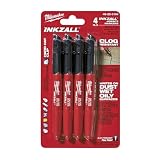
- Milwaukee Ink all Fine Point Marker, Black, 4 Per Pack
- 4 per pack Features Clog Resistant Marker Tip Writes through Dusty, Wet and Oily Surfaces Durable Marker Tip for Writing on Concrete, OSB and Rough Surfaces
- Clog resistant tip writes on dusty, wet and oily surfaces and is optimized for rough surfaces such as OSB, cinderblock and concrete
- Hard hat clip- attaches for easy access
- Quick dry time with reduced smearing and marking
Filter noise and protect the inputs
Use an appropriate anti-alias filter and stable input capacitors, and consider electrical transients in the intended environment. TI’s reference designs discuss filtering and protection; TIDA-00168 describes EFT, ESD, and surge work in an industrial context. That design context does not establish that another board has the same protection performance.
Use the right conversion data
Convert voltage using tables or polynomial equations for the chosen thermocouple type and valid range. TI points to the NIST ITS-90 thermocouple database for reference tables and conversion data. Check the type and temperature limits rather than applying K-type values to another sensor. NIST ITS-90 Thermocouple Database provides type-specific data.
Plan the physical connection and board layout
For a K-type build, confirm that the probe, connector, and extension wire are compatible with the thermocouple type. Consider the probe’s environment and temperature range alongside the ADC input requirements. Arrange the board so the CJC sensor remains thermally representative of the connection, and account for protection and layout effects that may disturb small differential signals.
What should you expect from a reference design?
Reference designs show what a particular combination of sensor interface, ADC, CJC method, and layout is intended to do; their performance figures should not be treated as a guarantee for a different build. TI advises in its March 2023 guide that customers validate and test their design implementation to confirm system functionality. That means checking the chosen thermocouple and CJC sensor together, verifying behavior across the intended input range, and confirming that the circuit’s noise and error meet the application’s needs.
Quick wins for a faster PC:
Clear out junk files and repair common Windows errorsFree Scan →Fix the driver behind crashes, sound loss and screen glitchesFind Drivers →Repair Windows errors before they cause bigger problemsFix Now →Quick Recap
Product prices and availability are accurate as of the date/time indicated and are subject to change. Any price and availability information displayed on Amazon at the time of purchase will apply.

