
What’s actually slowing this PC down?
Pick the symptom - the matching free tool is one click away.
iTechGuides is reader-supported. When you buy through links on our site, we may earn an affiliate commission. As an Amazon Associate I earn from qualifying purchases. Learn more
A database index gives the engine an alternate path to find rows without checking every row in a table. For selective searches, joins, and some ordering operations, that path can reduce the work substantially. It is not a guarantee: indexes take space, add work to writes, and may be slower than a table scan when a query needs much of the table.
What a database index is
An index is a searchable structure associated with a table. It stores values from one or more columns in an arrangement that helps the database locate candidate rows. Many ordinary relational rowstore indexes use a balanced tree, commonly called a B-tree. The index also provides a way to reach the corresponding table rows, or may contain enough data to answer a query directly.


PostgreSQL describes the basic benefit this way: “An index allows the database server to find and retrieve specific rows much faster than it could do without an index.” That advantage applies when the query and index are a good fit, not to every query. See the PostgreSQL 18 documentation on indexes.
How an index can reduce query work
Without a useful index, a database may need to scan table rows and test each one against a condition. With an index on the relevant key, it can search the index for matching values and then retrieve the corresponding rows. For a selective condition—one that matches a relatively small share of the table—this can avoid examining many unrelated rows.
#1 Best Overall
For example, imagine a customer table and a query looking up one account by email address. If there is a suitable index on the email column, the engine may be able to find the matching row through the index rather than checking every customer. This is an illustrative scenario, not a measured benchmark.
Indexes can also help with joins or ordering when the indexed keys align with the query. Whether they do depends on the database engine, the index definition, and the query’s conditions.
Rank #2
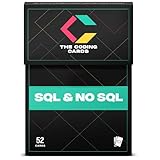
- Comprehensive Coverage: SQL Flashcards and NoSQL Flashcards designed for beginners and interview prep, covering core database concepts, queries, indexing, normalization, and real-world use cases. From relational structures, JOINs, and indexing to NoSQL document models, key-value stores, and distributed systems, these flashcards give you a solid foundation and advanced knowledge to handle any database challenge confidently.
- Interactive Learning: Enhance your understanding with an interactive, hands-on approach. Each card includes practical query examples, schema illustrations, and exercises that let you immediately apply what you learn. This active learning style helps you strengthen your querying skills and build intuition for solving real data problems. Beginner-friendly explanations that help you learn SQL and NoSQL faster without overwhelming theory or dense textbooks
- Portable Convenience: Study databases anytime, anywhere. Whether you’re at home, commuting, or taking a break, these portable flashcards make it easy to learn on the go. Perfect for busy students, developers, or professionals fitting learning into a tight schedule.
- Versatile Audience: Designed for all learners from students preparing for exams to data analysts, backend engineers, and tech enthusiasts. Whether you're building your first query or optimizing production databases, these flashcards guide you at every stage of your learning journey. Perfect for SQL interview preparation for software engineers, data analysts, backend developers, and computer science students
- Skill Enhancement: Boost your confidence and stay current with evolving database technologies. Ideal for self-study, bootcamps, university courses, and last-minute interview revision with concise, memorable flashcard format
Why the database might scan instead
The optimizer compares estimated costs and chooses a plan; it does not have to use every index that exists. If a report returns most of a table, reading the table sequentially may cost less than traversing an index and fetching a large number of rows individually. A scan can also be reasonable for a small table.
Estimates depend on factors such as available statistics, data distribution, and the database engine. PostgreSQL’s planner documentation explains that it chooses an index when it estimates that the index path is more efficient than a sequential scan, and that current statistics help it make informed choices. See PostgreSQL 17’s index introduction. An index’s presence alone therefore does not show that a query will use it or run faster.
Index types and design choices
Index terminology and capabilities differ by database, so names from one product are not always interchangeable with names from another. These official documents describe examples for particular engines:
- PostgreSQL: documents B-tree, hash, GiST, SP-GiST, GIN, and BRIN indexes, plus multicolumn, expression, partial, and index-only techniques. A partial index contains only rows matching its condition. A covering index can contain values needed by a query; PostgreSQL may use an index-only scan when its visibility and storage conditions allow it.
- MySQL: describes common PRIMARY KEY, UNIQUE, INDEX, and FULLTEXT forms as generally stored in B-trees, with exceptions including spatial indexes and MEMORY-table cases.
- SQL Server: distinguishes clustered and nonclustered rowstore indexes and also documents columnstore indexes.
For details, consult the PostgreSQL index documentation, MySQL 8.4 documentation on how indexes are used, and Microsoft’s SQL Server index architecture and design guide and clustered and nonclustered index explanation.
Rank #4
Composite indexes
A composite index contains keys from more than one column, in a chosen order. It can suit recurring queries that filter or sort on those keys, but the order matters and the rules depend on the engine. Design it around actual predicates and access patterns rather than assuming one column-order rule works everywhere.
Do these 3 things before closing this tab:
1Repair Windows errors before they cause bigger problems2Scan for outdated or missing drivers - takes under a minute3Clear out junk files and repair common Windows errorsPartial or filtered indexes
Where supported, a partial or filtered index stores entries only for rows meeting a condition. This can make an index more targeted, but it is useful only when the query’s conditions align with that index and the engine supports the feature.
Best Value

- Funny programmer gift for software developers and computer scientists. This coding design shows a fun SQL query for database admins and nerds.
- Cool SQL Database gift for men and women who love SQL. The perfect SQL Query gift for programmers, hackers and SQL database fans who love relational databases.
- Lightweight, Classic fit, Double-needle sleeve and bottom hem
Covering indexes
An index that includes the values a query needs may allow some reads to be satisfied from the index without fetching full table rows. PostgreSQL calls the related plan an index-only scan; whether it can use that plan depends on visibility and storage behavior. Extra included or indexed values also have storage and maintenance costs.
Independent reader supportYour contribution helps us test, update, and keep practical guides available for everyone.What indexes cost
Indexes consume disk space and may use memory. The database must keep them current as data changes: inserts add entries, deletes remove them, and updates may require changing entries when indexed values are affected. Maintaining indexes can therefore add write work, and unnecessary indexes also complicate index selection.
The practical tradeoff is workload-specific: faster reads for target queries versus write overhead, storage footprint, and the effort of monitoring and maintaining indexes. Microsoft characterizes index design as “a complex balancing act between query speed, index update cost, and storage cost.” There is no universal ideal number of indexes or guaranteed speedup that applies to every database.
How to check whether an index helps
- Identify a real query pattern. Start with a slow or important query and its filtering, joining, and ordering conditions. Do not add indexes to every column by default.
- Inspect the plan. In PostgreSQL and MySQL, use
EXPLAINto inspect the optimizer’s chosen strategy. In SQL Server, examine an estimated or actual execution plan to see which indexes and operators are used. Microsoft explains plan inspection in its index design guide. - Check the estimate and context. A scan is not automatically a problem; it may be the cheaper choice for a broad query. Where applicable, make sure optimizer statistics are current enough to represent the data and its distribution.
- Compare workload behavior. After a candidate index change, compare the relevant plans and measure the workload under appropriate conditions, including write activity. A plan shows the selected strategy; it is not by itself proof of an overall performance improvement.
Index design is not a speed switch. A well-matched index can reduce lookup work, while a scan may be the right plan for another query. Use plans and workload measurements to decide whether a specific index earns its storage and update cost.
Quick Recap
Product prices and availability are accurate as of the date/time indicated and are subject to change. Any price and availability information displayed on Amazon at the time of purchase will apply.

