
Omnidirectional wheels let an automated guided vehicle (AGV) move sideways and rotate without first steering its wheels into a new direction. By coordinating wheel speeds, a properly designed drive can combine forward, lateral and rotational motion. That helps a vehicle approach loads from different angles and maneuver in tight spaces—but the benefit depends on the wheel layout, floor, payload and control system.
How does an omnidirectional drive move an AGV?
Each wheel turns under motor power, while small rollers around its circumference redirect part of the contact force sideways. The rollers are not powered independently; rather, the vehicle combines the forces from multiple driven wheels. A controller sets each wheel’s speed to produce the requested motion across the floor.
With suitable geometry and synchronized control, the vehicle can translate forward or sideways, rotate in place, or combine translation and rotation. KUKA describes its production omniMove platform as able to move in any direction, including from a standing start. Its Mecanum drive uses independent barrel-shaped rollers and does not need to steer the whole platform to change direction. OmniAGV similarly says wheel-speed selection on its Aptius wheel can produce planar vehicle motion.
“Omnidirectional” describes a motion capability, not a guarantee that every vehicle can move in every direction equally well under every load or floor condition. Wheel geometry, traction, chassis layout and control calibration all affect practical performance.
Free tools Windows power users keep installed
One-click scans. No signup required.
#1 Best Overall

- 【What You Get】You will get: 4pcs 80mm mecanum omni-directional wheels, 4pcs 6mm metal couplings for DC motor connection with screws. One can DIY immediately the mecanum wheeled car using the metal panel for robot learning.
- 【Robotics Learning】Mecanum is very popular. One can DIY smart RoS robot based on the mecanum wheels. By using SLAM algorithms, one can realize the functions of warehouse handling robot. Schools can use these wheeled robots for competition and teaching.
- 【AGV Robot】AGV robot is used in the warehouse. Use the mecanum omni directional wheels, electronics development board controller, and SLAM algorithms. One can realize the AGV robot carrying items functions.
- 【Code Programming】Based on the mecanum wheeled robot car chassis, one can use the Arduino uno R3, raspberry pie, or other main board controller to control the robot by code programming. Can learn the different algorithms, embedded knowledge code programming.
- 【Maker Education】One can learn the robotic structure, to design the robotics platform, and assemble the robotics. Smart AI RoS robot learning is helpful for people, especially for students, makers, hobbyists and teachers. This mecanum wheel set is a research and learning kit for adult college students.
What flexibility does this give an AGV?
Maneuver in a smaller working envelope
Lateral travel and in-place rotation can reduce the clearance needed for a turn or approach. Instead of making a multi-point maneuver, an AGV may be able to move directly alongside a rack, machine, trolley or fixture and then rotate to align. KUKA positions omniMove for precise movement in tight spaces and offers a modular system whose dimensions can be configured.
Fit the vehicle around the job
When the vehicle must pass beneath a trolley or work within an existing equipment layout, its height and the placement of its wheels, motors, bearings and battery matter as much as its turning behavior. OmniAGV describes an under-trolley approach in which the vehicle moves beneath a trolley, lifts it and transports it through a facility.
Rank #2

- Packing list: The package contains 2 left wheels and 2 right wheels (you need to choose the size of the omnidirectional wheels), 4 metal hexagonal couplings
- The Mecanum wheel has a compact design, and the roller is made of high-strength polyurethane, which has a strong load capacity, no degumming, quiet and wear-resistant, and reduces ground damage
- Omni-directional mobile automatic guided vehicle was born. As the key component of omni-directional movement, omni-directional wheels can easily change direction and move widely. In order to adapt to the narrow space and improve the flexibility and stability of movement
- The mecanum wheel has become the first choice for DIY Smart Robot Car Chassis, providing more direction choices for raspberry pi arduino jetson programming electronic competition projects
- Yahboom provide some tutorials as a reference, which contains a variety of mobile control methods such as, left and right translation, large-angle drift, oblique 45° direction movement, square track movement, etc.
Separate travel direction from chassis orientation
A conventional steer-and-drive vehicle generally has to reorient its wheels or chassis to change its travel direction. A holonomic omnidirectional arrangement can instead translate sideways while keeping the chassis orientation, or rotate while moving. That can simplify approaches to constrained pickup and drop-off points, though the vehicle still needs enough clearance and traction to execute the commanded path.
Omni wheels and Mecanum wheels: what is the difference?
The terms are sometimes used loosely in product descriptions. In general, an omni wheel has rollers distributed around its circumference, while a Mecanum wheel has angled rollers—commonly arranged at about 45 degrees—and is often used in a four-wheel layout. Both can contribute to omnidirectional motion when wheel forces and speeds are coordinated. The names alone do not establish how a complete AGV will perform.
What’s actually slowing this PC down?
Pick the symptom - the matching free tool is one click away.
Rank #3
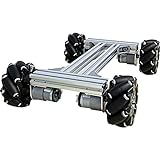
- 【What You Get】You will get: 1set of metal frame, 4pcs diameter =97mm mecanum wheels, 4pcs 37 DC encoder motors, and screw kit. It's easy to assemble the mecanum wheeled car chassis, just put the robot parts by this Amazon link product. Then, fix it with screws.
- 【AGV Function】AGV now is very popular in the warehouse to carry the goods. With this robot car chassis based on the mecanum omni-directional wheels and 4pcs encoder motors, you will have use the electronics controller to control the smart car chassis move. It is another choice for the AGV function realization, but with low cost price.
- 【Robot Learning】This mecanum wheel smart robot car chassis kit belongs to the robotics. You can learn how to assemble it, the robotic structure, the model, the function, then you can design or improve the robot as you like. Specially, you can learn the controllers, like Arduino uno R3, raspberry pie, 51 MCU.
- 【Code Programming】STEAM education is for adults code programming, robotics learning. Based on this robot chassis, by help of the controller, e.g., Arduino, then you can learn to code programming to realize the robot function. Move, left turn, right turn, and other functions.
- 【Solid but Not Expensive】This metal robot chassis is very solid, together with the high torque DC encoder motor, and 4pcs 97mm mecanum wheels. The big load maybe about 0-10kg. It can be a suitable choice for robot chassis. This robot chassis is a research and learning kit for adult college students.
| Selection consideration | Mecanum arrangement | Omni-wheel arrangement |
|---|---|---|
| Typical wheel geometry | Angled rollers; commonly used in four-wheel arrangements. | Rollers distributed around the wheel circumference; layouts may use three, four or another engineered number of wheels. |
| What to assess on the floor | Roller contact, traction, vibration, scrub and sensitivity to unevenness. | Roller contact, traction and how the chosen layout distributes load; lateral resistance depends on geometry and installation. |
| Mechanical integration | Franke identifies minimum installation space, rigid bearing arrangements and higher tilting moments from eccentric loads as design requirements for Mecanum-wheel AGVs. | Check wheel dimensions and the mounting, hub, bore and motor interfaces against the chassis and duty. |
This is a design comparison, not a universal performance ranking. A wheel that works well on a smooth, level floor may be a poor choice where joints, debris or uneven surfaces interrupt roller contact. Compare complete vehicle layouts under the intended load and route rather than choosing by wheel name alone.
What do example AGV configurations show?
The following figures are manufacturer specifications for particular products, not independent test results or interchangeable system benchmarks. Values may depend on the chosen configuration.
Rank #4

- High-strength aluminum alloy bracket for durability and stability,Precision ball bearings ensure smooth and quiet rotation.
- Large and small rollers arranged alternately for 360° flexible movement.
- Rubber tire with excellent wear resistance and impact resistance,Aluminum alloy hub: rust-proof, corrosion-resistant and oxidation-resistant.
- Strict quality control process; impact-resistant and deformation-resistant for long-lasting use.
- Airless tire design – no inflation needed, no puncture worry,Easy screw mounting installation.
| Example | Published specifications or architecture | How to interpret it |
|---|---|---|
| OmniAGV compact industrial configuration | Maximum speed: 1 m/s; autonomy: 4 hours; load capacity: 500 kg; lift: 60 mm; dimensions: 199 mm high, 402 mm wide and 1514 mm long. OmniAGV describes two transmission blocks, each comprising two overlapping gearmotors, with each gearmotor driving its own omnidirectional wheel. | These are figures for the product configuration described on OmniAGV’s current product page. Confirm payload, runtime and dimensions for the exact build and operating conditions. |
| KUKA omniMove variants | Up to 90 tonnes carrying capacity and positioning to ±3 mm, depending on configuration. | These are manufacturer specifications for available variants, not independent test results or a single specification that applies to every platform. |
OmniAGV describes its Aptius wheel as an evolution of Bengt Ilon’s Mecanum wheel, patented under WO 2021/116847. The manufacturer claims that, at the same diameter, it can support significantly heavier loads, or, at the same load, use a smaller footprint. The published description does not provide an independently controlled benchmark, so treat the comparison as a manufacturer claim rather than a general performance result.
Independent reader supportYour contribution helps us test, update, and keep practical guides available for everyone.What should you compare before selecting an omnidirectional drive?
Start with the task and operating environment, then confirm that the wheel, mechanics and control system work together. Check these items with the vehicle supplier:
Best Value

- 【What You Get】You will get: 1set of metal frame, 4pcs diameter =97mm mecanum wheels, 4pcs 37 DC encoder motors, and screw kit. It's easy to assemble the mecanum wheeled car chassis, just put the robot parts by this Amazon link product. Then, fix it with screws.
- 【AGV Function】AGV now is very popular in the warehouse to carry the goods. With this robot car chassis based on the mecanum omni-directional wheels and 4pcs encoder motors, you will have use the electronics controller to control the smart car chassis move. It is another choice for the AGV function realization, but with low cost price.
- 【Robot Learning】This mecanum wheel smart robot car chassis kit belongs to the robotics. You can learn how to assemble it, the robotic structure, the model, the function, then you can design or improve the robot as you like. Specially, you can learn the controllers, like Arduino uno R3, raspberry pie, 51 MCU.
- 【Code Programming】STEAM education is for adults code programming, robotics learning. Based on this robot chassis, by help of the controller, e.g., Arduino, then you can learn to code programming to realize the robot function. Move, left turn, right turn, and other functions.
- 【Solid but Not Expensive】This metal robot chassis is very solid, together with the high torque DC encoder motor, and 4pcs 97mm mecanum wheels. The big load maybe about 0-10kg. It can be a suitable choice for robot chassis. This robot chassis is a research and learning kit for adult college students.
- Payload and load position: Specify the maximum payload, its eccentricity and the acceleration and braking loads. An off-center load changes wheel and bearing demands.
- Wheel and drive components: Confirm wheel diameter, roller material, bore, hub, motor torque and bearing rating. MECAWHEEL lists these as configuration dimensions and offers custom bores, rollers and hubs. Franke’s Mecanum application uses an LER2-120 double-bearing arrangement; Franke says its compact rectangular profile addresses load requirements and its one-piece plastic cage with retained rolling elements facilitates mounting in the wheel.
- Floor and traction: Check flatness, joints, ramps, contamination and surface grip on the actual route. Include transitions and turning areas, not only a representative clear floor.
- Required motion and stopping: Quantify lateral speed, turning radius, stopping distance and positioning accuracy. Validate these requirements with the loaded vehicle and the intended route.
- Packaging: Measure the required chassis height and clearance beneath or between pallets, racks, trolleys and equipment. Check battery, motor and sensor placement as part of the complete envelope.
- Control and navigation: Verify calibrated wheel geometry, synchronized drive control and navigation software that can command combined translation and rotation. Validate safety scanners, emergency stops and traffic management with the selected kinematics.
- Service access and lifetime cost: Plan access for roller, bearing, motor, battery and sensor maintenance. Include spare wheels and rollers, bearings, controls and commissioning when comparing full-life cost.
How do wheel and component suppliers fit into the decision?
Component descriptions can narrow a shortlist, but suitability still depends on the intended vehicle and duty cycle. MECAWHEEL presents more than 145 industrial wheel configurations and identifies Mecanum wheels for AGVs and robotic platforms, omni wheels for transfer movement, and hubs and accessories for shaft connections. Its listed configuration options—such as diameter, load, roller material, bore and mounting interface—are useful starting points for specifying a wheel.
OMNIA describes its industrial omni wheels as suitable for robotics, AGVs and AMRs, with an all-polymer design, polyurethane or Santoprene roller choices, bushed rollers and high impact resistance. It also describes integration with existing conveyor systems. These are supplier claims; confirm load capacity, floor compatibility and service life for the actual application rather than assuming a material or feature will suit every route.
When is an omnidirectional AGV the right fit?
Consider this drive when the task benefits from sideways approaches, in-place rotation or close maneuvering around fixed equipment, and when the floor and payload are compatible with the selected wheels. It is not enough to confirm that a wheel is called “omnidirectional”: the complete vehicle must deliver the required motion while carrying the load, stopping safely and remaining maintainable in its operating environment.
Manufacturer specifications and application examples show that omnidirectional platforms range from compact under-trolley vehicles to heavy-duty transport systems. They do not establish a market-wide figure for how much flexibility an AGV fleet gains. Make the decision against measured route constraints and vehicle requirements, and verify the resulting configuration with the supplier.
The Tool Desk
Outbyte PC Repair FREERepair Windows errors before they cause bigger problemsFix Now →Outbyte Driver Updater FREEFix the driver behind crashes, sound loss and screen glitchesFind Drivers →Quick Recap
Product prices and availability are accurate as of the date/time indicated and are subject to change. Any price and availability information displayed on Amazon at the time of purchase will apply.

