
iTechGuides is reader-supported. When you buy through links on our site, we may earn an affiliate commission. As an Amazon Associate I earn from qualifying purchases. Learn more
Astronauts reach the International Space Station (ISS) in a crew spacecraft launched by a rocket, but reaching orbit is only the beginning. The spacecraft then raises or adjusts its orbit, approaches the station, docks, and—after arrival operations—opens its hatch so the crew can enter. The exact spacecraft and travel time depend on the mission: NASA’s 2026 Crew-13 report describes a Dragon trip of about 7 hours 50 minutes, while its Soyuz MS-29 report describes a two-orbit trip of about three hours.
How do astronauts get to the International Space Station?
The journey has four broad stages: launch, orbital maneuvers and rendezvous, docking, and entry into the station. A rocket puts the crew spacecraft into orbit; the spacecraft then navigates to the ISS, which is also orbiting Earth. Once the spacecraft is securely docked, the crew completes arrival operations before opening the hatch.
NASA’s U.S. Commercial Crew Program uses SpaceX Dragon and Boeing Starliner. NASA says it awarded Commercial Crew Transportation Capability contracts to Boeing and SpaceX in 2014. Starliner is intended to transport people and cargo to low Earth orbit; the Crew-13 and Soyuz MS-29 reports offer specific examples of completed crew journeys, not a single schedule that applies to every NASA mission. NASA’s Commercial Crew Program
Recommended Free Tools
What happens from launch to arrival?
1. Launch into orbit
The crew spacecraft rides a rocket from a launch site. For Crew-13, SpaceX launched a Dragon spacecraft on a Falcon 9 from Cape Canaveral Space Force Station in Florida. NASA and SpaceX teams monitor the launch and ascent, with responsibilities that include flight safety and station operations.
#1 Best Overall

- Replica of the tile structure
- Detailed cockpit
- Cockpit canopy optionally removable
- 2 crew figures
- Opening cargo bay doors
Launch readiness includes more than checking the rocket. NASA says teams assess weather and public-safety criteria near the launch pad and along the rocket’s flight path. Mission managers review departure opportunities and possible splashdown sites, and conduct go/no-go polls during operations. NASA and SpaceX lead safety efforts for Dragon launch, ascent, return, and splashdown in coordination with other agencies and international partners. NASA’s Crew-13 weather and safety review
2. Orbital maneuvers and rendezvous
After separation from the rocket, the spacecraft is in orbit, but it is not automatically at the ISS. It must adjust its path and approach the station, a process called rendezvous. Dragon carries out automatic maneuvers for the approach. SpaceX monitors those maneuvers while NASA monitors station operations.
Rank #2

- Watch It Launch Before Your Eyes: This 3D puzzle isn't just a static model. Touch the sensor button to trigger a full vertical launch sequence: the track slowly lifts the shuttle into launch position, three-axis mechanical arms rotate 90° into closed position, and the rocket ignites with real flame effects. A mesmerizing, fully automated space launch you build yourself
- Gift for Space Lovers & Sci-Fi Fans: Perfect for anyone obsessed with space exploration, aerospace history, science fiction, collctors or mechanical puzzles. Makes an unforgettable birthday, Christmas, Father’s Day or graduation gift for teens and adults
- A Rewarding Build: The control tower flashes yellow 6 times to count down to ignition, then the rocket base bursts to life with vibrant orange and blue LED flames that mimic a real shuttle launch. 446 precision-cut wooden pieces come together over approximately 8 hours of focused, screen-free assembly. The finished model stands an impressive 9.8" × 7.72" × 10.71"
- Retro Sci-Fi Architecture: Faithfully recreated 1:420 scale space shuttle, paired with a rugged industrial launch tower featuring seven distinct levels for command and testing. it's a statement piece for any desk, shelf, office or space-themed room
- Step-by-step Manual: The warm tower lights glow through every window, creating an atmospheric display that looks incredible day or night. Powered by a standard Type-C connection (cable not included) ROKR provides replacement parts for manufacturing defects
3. Docking
Dragon is designed to dock autonomously at the station’s Harmony module. The crew can take manual control and pilot the spacecraft if necessary. NASA’s Soyuz MS-29 report describes an automatic docking at the Prichal module. These are the docking methods reported for those missions; they should not be treated as a complete description of every spacecraft or contingency.
Outdated Drivers Are Slowing You Down
One free scan finds every outdated or missing driver and matches the right update for your exact hardware.Free scan · exact hardware matchPC Slower Than It Used to Be?
A free scan shows the junk files, broken settings and background clutter dragging Windows down - then fixes them in one click.Free scan · Windows 10 & 114. Hatch opening and entry
Docking joins the spacecraft to the station, but the crew does not enter immediately. Arrival operations take place first; the hatch opens after those operations, allowing the crew to come aboard the ISS.
Rank #3
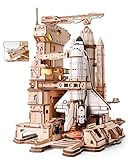
- RELIEVE THE HISTORIC MISSION - Experience the magic and majesty of the 1981 Space Shuttle launch. This isn't just a model; it's a time machine for your desk, capturing the awe and ambition of a defining moment in space exploration history.
- DYNAMIC, INTERACTIVE LAUNCH SEQUENCE - Be the mission commander! A simple touch activates the mesmerizing automated launch sequence. Watch the service structure move, see the shuttle tilt into position, follow the countdown lights, and feel the thrill as the rocket engines ignite with a brilliant orange and blue LED glow.
- PERFECT GIFT FOR EVERY DREAMER & OCCASION - Designed for display, engineered for wonder. This stunning wooden model becomes the centerpiece of any office, study, or living room. It’s the unforgettable gift for birthday, Christmas, Thanksgiving Day, Father’s Day, graduations, and retirements. Perfect for space enthusiasts, engineers, collectors, and anyone who dares to dream big.
- SATISFYING BUILD & PREMIUM MATERIALS - Enjoy a rewarding building experience with 446 precisely laser-cut wooden pieces that fit together smoothly. The assembly is an engaging 8-hour journey, resulting in an impressive display measuring 9.8" x 7.72" x 10.71". While this is a challenging project designed for enthusiasts, our clear, step-by-step instructions make the process achievable and deeply satisfying. All you need is patience to transform pieces into a functional masterpiece.
- COMPLETE READY-TO-BUILD KIT & WORRY-FREE SUPPORT - Everything you need to build and display is in the box. Note: Powered by a Type-C cable(not included) as part of our sustainability efforts but is commonly available. Our customer support proudly offers free replacement pieces for any missing or damaged wooden pieces, ensuring a smooth and enjoyable building experience.
How long does it take to get to the ISS?
There is no single travel time for NASA crew missions. The two NASA mission reports below describe different spacecraft and mission profiles, so their durations are examples—not a head-to-head measure of which vehicle is generally faster.
| Mission example | Launch and spacecraft | Reported trip to the station | Docking reported |
|---|---|---|---|
| Crew-13 (NASA, 2026) | SpaceX Falcon 9 and Dragon; Cape Canaveral Space Force Station, Florida | Approximately 7 hours, 50 minutes for this mission | Dragon autonomous docking at Harmony, with crew manual control available if necessary |
| Soyuz MS-29 (NASA, 2026) | Soyuz; Baikonur Cosmodrome, Kazakhstan | Two orbits and approximately three hours for this mission | Automatic docking at Prichal |
The travel time depends on the particular flight profile. NASA’s reported Crew-13 and Soyuz MS-29 durations do not establish a standard Dragon or Soyuz journey time. NASA’s Crew-13 mission report · NASA’s Soyuz MS-29 mission report
Rank #4

- HOBBY MODEL KIT – Unassembled model packed in an envelope with easy to follow instructions. Ideal for ages 14 and up.
- NO GLUE OR SOLDER NEEDED – Parts can be easily clipped from the metal sheets. Tweezers are the recommended tool for bending and twisting the connection tabs.
- PREMIUM SERIES SPACE SHUTTLE LAUNCH KIT - 3 Sheet Model with a moderate difficulty level. Once assembled, dimensions are 3.54 W x 4.13 L x 6.70 H inches. 1:342 Scale.
- FROM STEEL SHEETS TO 3D – Pop out the pieces and connect using tabs and holes. Includes illustrated instructions
- HIGHLY DETAILED ETCHED MODEL – Display your 3D model once completed - collect and build them all.
What distinguishes Dragon from Soyuz in these examples?
The missions differ in launch location, spacecraft, reported journey duration, and docking destination. Crew-13 launched on a Falcon 9 from Florida and used Dragon’s autonomous docking capability at Harmony, with manual crew control available if needed. Soyuz MS-29 launched from Baikonur in Kazakhstan and was reported to have docked automatically at Prichal after two orbits. The differing times describe those flights’ profiles; they do not prove that one spacecraft is universally faster.
NASA says Dragon can carry up to seven passengers, but it carries up to four crew on NASA missions. Those figures describe capacity, not the crew complement of every individual flight. NASA Commercial Crew Program Press Kit
Why does the journey matter beyond the ride?
Getting a crew to the ISS depends on a coordinated sequence: rocket launch, spacecraft navigation, station operations, and docking. NASA Associate Administrator Dr. Lori Glaze described the role of these flights this way: “Our steady cadence of commercial crew launches demonstrates the essential role the International Space Station plays in sustaining our presence in Earth’s orbit and sharpening the tools we’ll take forward to the Moon and Mars.” NASA’s Crew-13 launch statement
Quick Recap
Product prices and availability are accurate as of the date/time indicated and are subject to change. Any price and availability information displayed on Amazon at the time of purchase will apply.

