
Do these 3 things before closing this tab:
1Scan for outdated or missing drivers - takes under a minute2Clear out junk files and repair common Windows errors3Fix the driver behind crashes, sound loss and screen glitchesiTechGuides is reader-supported. When you buy through links on our site, we may earn an affiliate commission. As an Amazon Associate I earn from qualifying purchases. Learn more
There is no single data-use figure for website audio: it depends mainly on the audio’s encoded bitrate and how long it plays. For a quick estimate, multiply bitrate in kilobits per second by playback seconds, then divide by eight to get kilobytes. That estimates the audio payload only—not the whole page download or the exact amount recorded by a mobile carrier.
How to estimate audio data use
“Bandwidth” is often used to mean total data transferred, but the terms describe different things: bitrate is a transfer rate, while megabytes describe a volume accumulated over time. For a known-rate audio file, use:
- Data in kilobits = bitrate in kbps × seconds played
- Data in kilobytes ≈ (bitrate in kbps × seconds played) ÷ 8
- Decimal megabytes ≈ kilobytes ÷ 1,000
For example, 64 kbps × 3,600 seconds ÷ 8 = 28,800 kilobytes, or about 28.8 MB for an hour. These are arithmetic estimates, not measurements of a particular website or stream.
Free tools Windows power users keep installed
One-click scans. No signup required.
Approximate audio payload by bitrate
| Encoded bitrate | 10 minutes | 1 hour |
|---|---|---|
| 64 kbps | About 4.8 MB | About 28.8 MB |
| 128 kbps | About 9.6 MB | About 57.6 MB |
| 320 kbps | About 24 MB | About 144 MB |
All figures are approximate decimal megabytes, calculated from bitrate and duration assuming a constant rate. They count encoded audio payload before network, container, buffering, and page overhead. The 320 kbps row is an illustrative comparison, not a recommendation.
#1 Best Overall

- Pro performance with great pre-amps - Achieve a brighter recording thanks to the high performing mic pre-amps of the Scarlett 3rd Gen. A switchable Air mode will add extra clarity to your acoustic instruments when recording with your Solo 3rd Gen
- Get the perfect guitar and vocal take with - With two high-headroom instrument inputs to plug in your guitar or bass so that they shine through. Capture your voice and instruments without any unwanted clipping or distortion thanks to our Gain Halos
- Studio quality recording for your music & podcasts - Achieve pro sounding recordings with Scarlett 3rd Gen’s high-performance converters enabling you to record and mix at up to 24-bit/192kHz. Your recordings will retain all of their sonic qualities
- Low-noise for crystal clear listening - 2 low-noise balanced outputs provide clean audio playback with 3rd Gen. Hear all the nuances of your tracks or music from Spotify, Apple & Amazon Music. Plug-in headphones for private listening in high-fidelity
- Everything in the box: Includes Pro Tools Intro+, Ableton Live Lite, Cubase LE, and Hitmaker Expansion: a suite of essential effects, powerful software instruments, and easy-to-use mastering tools
Why speech and music can use different amounts
Audio quality, media type, and channel format affect the bitrate and therefore the data volume. MDN Web Docs lists the following recommended Opus rates for WebRTC with a 20 ms frame size; these are recommendations for that context, not guaranteed rates for every website or recording.
| Audio type | MDN-recommended Opus rate for WebRTC |
|---|---|
| Narrow-band speech | 8–12 kbps |
| Wide-band speech | 16–20 kbps |
| Full-band speech | 28–40 kbps |
| Full-band mono music | 48–64 kbps |
| Full-band stereo music | 64–128 kbps |
At the lower end of a rate range, payload use is lower; at the higher end, it is higher. The trade-off is that bitrate and encoder settings influence sound quality and compression artifacts. MDN advises choosing a streaming-music codec that limits bandwidth while avoiding as many audible artifacts as possible, and allowing room for network fluctuations and other applications. MDN’s audio codec guide discusses those trade-offs.
Rank #2

- The new generation of the songwriter's interface: Plug in your mic and guitar and let Scarlett Solo 4th Gen bring big studio sound to wherever you make music
- Studio-quality sound: With a huge 120dB dynamic range, the newest generation of Scarlett uses the same converters as Focusrite’s flagship interfaces, found in the world's biggest studios
- Find your signature sound: Scarlett 4th Gen's improved Air mode lifts vocals and guitars to the front of the mix, adding musical presence and rich harmonic drive to your recordings
- All you need to record, mix and master your music: Includes industry-leading recording software and a full collection of record-making plugins
- Everything in the box: Includes Pro Tools Intro+, Ableton Live Lite, Cubase LE, and Hitmaker Expansion: a suite of essential effects, powerful software instruments, and easy-to-use mastering tools
Why actual data use can differ from the estimate
- Variable or adaptive rates: An audio stream may not stay at one bitrate. Opus supports WebRTC rates from 6 to 510 kbps and can adjust dynamically; higher rates typically improve quality. An adaptive player may also select among encodings. A constant-rate calculation is therefore an estimate when the rate changes. MDN
- Buffering and downloads: A player may download audio ahead of what has played. Count data downloaded, not only the seconds you heard. The amount buffered depends on the player; there is no universal buffer allowance established here.
- Transport and file overhead: Network framing, requests, and media containers add traffic beyond the encoded audio payload. There is no universal overhead percentage to apply.
- Other page content: Images, scripts, stylesheets, advertising, and other media also count toward a page visit’s total data transfer.
So if a page remains open, audio data use depends on whether playback or downloading continues. An idle page that has stopped fetching audio is different from one still playing or buffering it; the player’s behavior determines which applies.
Prerecorded audio and live browser calls are different
Audio files played on a website
For a prerecorded file, its encoded bitrate and playback duration give a useful payload estimate. The actual amount transferred also depends on the file’s encoding and how the player downloads and buffers it.
Rank #3
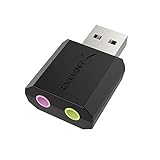
- PLUG IN AND HEAR SOUND IN SECONDS - USB Type-A connector with a 3.5mm stereo headphone output and a separate 3.5mm mono microphone input. No drivers, no software, no external power - the adapter is USB bus-powered and is recognized as a standard USB audio device.
- WORKS ON WINDOWS, MAC AND LINUX - Driverless on Windows 98SE/ME/2000/XP/Server 2003/Vista/7/8, Linux and Mac OSX, and compliant with the USB Audio Device Class 1.0 specification, so any system that supports class-compliant USB audio will see it. Select it as the sound output and input device after plugging it in.
- TWO JACKS, TWO JOBS - The green jack is stereo OUT for headphones or powered speakers; the pink jack is mono microphone IN for a 3.5mm mic. It does NOT support 4-pole headsets on a single combo plug, it does NOT power passive speakers, and it does NOT add surround sound - it is a stereo 2-channel adapter.
- FOR LAPTOPS AND DESKTOPS THAT NEED AN AUDIO PORT BACK - Adds a headphone and mic port to a laptop, desktop, or mini PC whose onboard jack has failed or was never there. Managed and work-issued computers can block new USB audio devices by policy - check with your IT department before ordering for a company machine.
- SABRENT SUPPORT AND WARRANTY - What is in the box: one USB audio sound adapter. Backed by a 1-year limited warranty, extended to 2 years when you register within 90 days on the manufacturer's website.
WebRTC calls
Live WebRTC audio is real-time media, and its bitrate may change dynamically. MDN describes 64 kbps as the standard G.711 rate for WebRTC and gives codec-specific Opus guidance; those figures should not be treated as a universal call rate. MDN’s WebRTC codec guide explains codec support and rates. RFC 7874 requires WebRTC endpoints to implement Opus and PCMA/PCMU, while discontinuous transmission is optional. RFC 7874
A separate WebRTC audio-only sample reports approximate Chrome results of about 30 kbps for Opus and about 64 kbps for G.722 and PCMU. The sample says it was not tested in Opera, Firefox, Safari, or Edge, so these are limited observations—not browser-wide benchmarks or promises for a particular call.
Quick Recap
Best Value

- The new generation of the artist's interface: Connect your mic to Scarlett's 4th Gen mic pres. Plug in your guitar. Fire up the included software. Start making your first big hit
- Studio-quality sound: With a huge 120dB dynamic range, the newest generation of Scarlett uses the same converters as Focusrite’s flagship interfaces, found in the world's biggest studios
- Never lose a great take: Scarlett 4th Gen's Auto Gain sets the perfect level for your mic or guitar, and Clip Safe prevents clipping, so you can focus on the music
- Find your signature sound: Air mode lifts vocals and guitars to the front of the mix, adding musical presence and rich harmonic drive to your recordings
- With Scarlett 4th Gen, you have all you need to record, mix and master your music: Includes industry-leading recording software and a full collection of record-making plugins
Rank #4

- Podcast, Record, Live Stream, This Portable Audio Interface Covers it All - USB sound card for Mac or PC delivers 48kHz audio resolution for pristine recording every time
- Be ready for anything with this versatile M-AUDIO interface - Record guitar, vocals or line input signals with two combo XLR / Line / Instrument Inputs with phantom power
- Everything you Demand from an Audio Interface for Fuss-Free Monitoring - 1/4" headphone output and stereo 1/4" outputs for total monitoring flexibility; USB/Direct switch for zero latency monitoring
- Get the best out of your Microphones - M-Track Duo’s transparent Crystal Preamps guarantee optimal sound from all your microphones including condenser mics
- The MPC Production Experience - Includes MPC Beats Software complete with the essential production tools from Akai Professional
What the estimate does—and does not—tell you
- Use bitrate multiplied by playback time to estimate audio payload for a known-rate file.
- Use a range or a measured transfer when the bitrate varies or the player’s buffering matters.
- Do not equate the audio payload with a page’s total transfer or a carrier’s billed data; those can include additional traffic.
Product prices and availability are accurate as of the date/time indicated and are subject to change. Any price and availability information displayed on Amazon at the time of purchase will apply.

