
Free tools Windows power users keep installed
One-click scans. No signup required.
iTechGuides is reader-supported. When you buy through links on our site, we may earn an affiliate commission. As an Amazon Associate I earn from qualifying purchases. Learn more
Lioran S3’s documented read path looks up an object’s metadata, checks its state, resolves the stored file path, and opens that file asynchronously. A GET returns a reader that can stream bytes; a range read follows the same path, then seeks to the requested start and caps how many bytes the reader can return. This describes the project author’s V1 Pre-Alpha implementation, not a guarantee about production performance or every HTTP response detail.
How does a GET work?
In the author-described implementation, a GET starts with the logical bucket and key. Lioran S3 looks up their metadata record before opening the object payload. Metadata—not the raw key itself—identifies the payload’s relative physical path.
- Look up metadata. The server searches for the bucket-and-key record. If no record exists, the described result is
ObjectNotFound. - Validate the record’s state. Deleted records and records not marked
Committeddo not proceed as normal GET responses. - Resolve the payload path. The server resolves the relative path from metadata under its configured storage root.
- Open and stream the file. The implementation uses Tokio’s asynchronous file API and returns metadata with a boxed
AsyncRead + Send + Unpinreader. That lets the HTTP layer stream bytes without first assembling the entire object in a RustVec.
This is an author-reported description of the current implementation, not independently verified behavior in a stable production release. The project’s release description characterizes Lioran S3 as a self-hosted, single-node pre-alpha: RocksDB stores metadata, while object payloads live on the filesystem and are streamed through bounded buffers. The project warns that APIs, formats, SDK behavior, and operating assumptions may change. Its current server exposes a native REST API; the release does not claim drop-in AWS S3 API compatibility. Lioran S3 project
The Tool Desk
Outbyte PC Repair FREERepair Windows errors before they cause bigger problemsFix Now →Outbyte Driver Updater FREEFix the driver behind crashes, sound loss and screen glitchesFind Drivers →What happens if the payload file is missing?
The implementation distinguishes an absent key from broken storage state. If there is no metadata record, the described error is ObjectNotFound. If a committed record exists but its physical file is missing, the author describes that as a storage error instead. The metadata says the object should be present, but the bytes it points to cannot be opened.
#1 Best Overall

- Reliable LoRa Communication: The ThinkNode M5 compatible for LoRa Meshtastic uses ESP32-S3 processor with Bluetooth support, paired with SX1262 LoRa module and 915 MHz antenna. It supports the Meshtastic protocol for stable long-range communication, ideal for outdoor and off-grid use
- High-Precision GPS Navigation: Built-in GPS supports GPS, GLONASS, BeiDou, and QZSS systems. The devices compatible for meshtastic deliver accurate positioning and seamless location sharing for navigation, exploration, or search missions, ensuring dependable off-grid performance anywhere
- 1.54-inch E-Ink Display: The kit compatible for meshtastic features a 1.54-inch E-ink display that stays clear under sunlight, shows real-time status, node info, and GPS data. With low power use and adjustable brightness, it offers efficient visibility for all environments
- Long-Lasting Battery Life: The device compatible for meshtastic includes a 1200mAh rechargeable battery for over 48 hours of use. Designed for fieldwork, hiking, and emergency response, it ensures continuous operation and reliable power during extended outdoor activities
- Easy Setup & Smart Control: No assembly required. The kit compatible for meshtastic connects easily via Bluetooth 5 using the Mesh tastic app to configure settings, send messages, and view maps. The built-in RTC clock ensures a faster hot start, supporting automatic wake-up and uninterrupted operation
That distinction matters when diagnosing failures: a missing key and metadata that points to missing bytes are different conditions. The available description does not specify the HTTP status code or response body for either condition.
How do range reads work?
A range read reuses the metadata validation and physical-path resolution used by GET. After opening the file, the described path seeks to start with SeekFrom::Start(start), then applies file.take(length) to limit the reader to the requested length. In other words, the implementation reads a portion of the same stored object; it does not describe creating a separate range object. Lioran S3 project
Rank #2
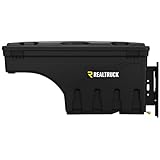
- Fits 2016 - 2025 Nissan Titan Drivers Side (Will not fit with Titan Box)
- Made in the USA with Global Materials
- TRUCK BED COVER COMPATIBLE | The UnderCover SwingCase maintains a 3-inch clearance from the truck bed & works with virtually all tonneau covers: soft, hard, folding, and rolling.
- ULTIMATE ACCESSIBILITY | This toolbox swings out nearly 180° towards you for easy access from the tailgate & swings back into a locking position over the wheel well for maximum bed access.
- SECURE STORAGE SOLUTION | The SwingCase has a key-lockable lid & can hold up to 75 lbs. of cargo. It features an organizational tray, as well as a moisture seal to help keep contents dry & protected against the elements.
The project’s TypeScript guide also demonstrates bucket.getRange for partial reads and bucket.head(key) for metadata. Those examples establish method names, not a complete account of HTTP protocol behavior. Lioran S3 TypeScript guide
Outdated Drivers Are Slowing You Down
One free scan finds every outdated or missing driver and matches the right update for your exact hardware.Free scan · exact hardware matchPC Slower Than It Used to Be?
A free scan shows the junk files, broken settings and background clutter dragging Windows down - then fixes them in one click.Free scan · Windows 10 & 11The read-path description does not establish how HTTP Range headers are parsed, whether an end offset is inclusive, whether multiple ranges are supported, how invalid ranges are handled, which status codes or Content-Range headers are returned, or whether conditional requests work. Do not assume these details match another S3 implementation.
Rank #3
- Fits 2004 - 2021 Nissan Titan Drivers Side (Also Fits 04-21 Frontier)
- Made in the USA with Global Materials
- TRUCK BED COVER COMPATIBLE | The UnderCover SwingCase maintains a 3-inch clearance from the truck bed & works with virtually all tonneau covers: soft, hard, folding, and rolling.
- ULTIMATE ACCESSIBILITY | This toolbox swings out nearly 180° towards you for easy access from the tailgate & swings back into a locking position over the wheel well for maximum bed access.
- SECURE STORAGE SOLUTION | The SwingCase has a key-lockable lid & can hold up to 75 lbs. of cargo. It features an organizational tray, as well as a moisture seal to help keep contents dry & protected against the elements.
When should you use HEAD instead of GET?
Use the described head_object path when you need object metadata but not its payload. The author says it stops after metadata validation, avoiding a payload-file open and stream. Use GET when you need the object’s bytes, and a range-read method when you need only a portion. The TypeScript guide’s examples use bucket.head(key) and bucket.getRange, respectively; they do not establish additional response semantics. Lioran S3 TypeScript guide
What determines read latency?
The available sources provide no numeric GET benchmark or measured performance figure. The author identifies the relevant stages qualitatively: metadata lookup, filesystem open, seek for a range, disk or cache reads, network transfer, TLS or reverse-proxy overhead, and client receive behavior. A warm operating-system page cache and a cold read can involve different physical-storage work, so the file-streaming design alone does not determine end-to-end speed.
As Swaraj Puppalwar, Founder & CTO of Lioran Group / Lioran Developer Solutions, puts it: “A fast read from the wrong physical object is not a successful optimization.” The practical implication is to verify the metadata-to-path mapping and distinguish storage errors from absent keys before attributing a slow or failed read to streaming performance.
Quick Recap
Product prices and availability are accurate as of the date/time indicated and are subject to change. Any price and availability information displayed on Amazon at the time of purchase will apply.

