
Lightning can give forecasters an early clue that a thunderstorm is strengthening. A rapid rise in a storm’s total lightning flash rate—called a lightning jump—often accompanies a pulse in its updraft and has been observed tens of minutes before severe weather reaches the ground. It is a reason to watch a storm more closely, not a guarantee that it will produce damaging wind, hail, or a tornado.
What a lightning jump tells forecasters
Thunderstorm lightning forms through electrical processes involving ice particles inside the storm. As those particles grow and move, the storm’s electrical activity changes. Tracking the rate and patterns of flashes can therefore help reveal how a storm is evolving, including changes associated with its updraft.
NOAA’s National Severe Storms Laboratory (NSSL) says, “We have shown that rapid increases in total lightning activity are often observed tens of minutes in advance of severe weather occurring at the ground.” A lightning jump is that rapid increase in a storm’s total flash rate. Because it can occur alongside an updraft pulse, it can flag a storm that may be intensifying while forecasters assess other evidence.
“Total lightning” includes intracloud flashes as well as cloud-to-ground strikes. Looking only for ground strikes misses some of the electrical activity that lightning-monitoring systems can track. NSSL also describes mapped patterns that may help researchers and forecasters study storm structure: some supercells have lightning holes near updrafts where precipitation is scarce, flashes near updrafts may be smaller, and flash altitudes can change over a storm’s life cycle. These are clues seen in some storms, not rules that apply to every thunderstorm. NOAA NSSL: Lightning research
Do these 3 things before closing this tab:
1Fix the driver behind crashes, sound loss and screen glitches2Clear out junk files and repair common Windows errors3Scan for outdated or missing drivers - takes under a minute#1 Best Overall
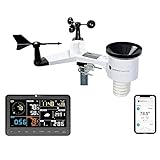
- COMPLETE WEATHER STATION: (1) Osprey Sensor Array with Rain Cup, and (1) Brilliant, Easy-to-Read LCD Color Display
- AUTHENTIC HYPER-LOCAL DATA: Monitor your actual home and backyard weather conditions with our wireless and Wi-Fi-enabled sensor array measuring wind speed/direction, temperature, humidity, rainfall, UV intensity, and solar radiation
- SMART HOME READY: Set up alerts, access your data remotely, and program your home based on weather conditions using IFTT, Google Home, Alexa, and more
- ENHANCED WIFI: Enables your station to transmit its data wirelessly to the world's largest personal weather station network (optional setting)
- JOIN THE COMMUNITY: Connect to Ambient Weather Network to customize your dashboard tiles, share hyperlocal weather conditions via social feeds and create your own forecasts (coming soon)
How lightning data fits into storm monitoring
Lightning observations add a view of storm activity; they do not replace radar or other weather data. Forecasters combine lightning trends with radar, satellite imagery, surface observations, and forecast guidance to judge whether a storm is changing and what hazards may be developing.
Satellite and ground-based observations
NOAA’s Geostationary Lightning Mapper (GLM), aboard the GOES-R series, provides rapidly updated, broad-area lightning observations. That coverage can be especially useful where radar or surface observations are limited, such as rural or mountainous areas and the open ocean. Ground-based networks provide another way to observe lightning; each observing system contributes data that forecasters interpret alongside other sources rather than as a complete picture on its own. NOAA NESDIS: Geostationary Lightning Mapper
Rank #2

- [Color LCD Screen Weather Station] Newentor temperature & humidity monitor with a large color LCD display shows essential home weather information at a glance: indoor/outdoor temperature & humidity, daily high/low records, customizable alerts, time/date, alarm clock & snooze, weather forecast, moon phase, and barometric pressure.
- [Two Power Modes & Adjustable Backlight] To enjoy a 24/7 continuous always-on vibrant display, simply connect this home weather station to a wall outlet using the included DC power adapter. When operating on battery power only (batteries not included), the digital thermometer automatically enters an eco-energy-saving mode, where the screen lights up for a quick 15-second glance before dimming. It is the perfect bedside or living room clock designed to fit your power preference.
- [3-channel Home Weather Stations Wireless Indoor Outdoor] Wireless temperature forecast station supports up to 3 remote sensors to monitor inside outside temperature & humidity of multiple locations. Package contains one remote sensor.
- [Wireless Forecast Station] The weather forecast station calculates the weather forecast for the next 12-24 hours, 7 to 10 days calibration ensures an accurate personal forecast for your location.
- [Wireless Weather Station with Atomic Time&Date] Atomic alarm clock weather station can be used not only as a wireless indoor outdoor thermometer but also as an atomic clock with dual alarms.
Lightning jumps and lightning-occurrence guidance answer different questions
A lightning-jump product looks for a rapid increase in a storm’s flash rate relative to a recent baseline, helping forecasters identify storms that may be intensifying. One NOAA Warning Decision Training Division product description specifies a flag when the current rate is more than two standard deviations above the previous 10-minute period, for storms producing at least 10 flashes per minute. Those are settings for that product configuration—not a universal definition of a lightning jump.
NOAA’s experimental LightningCast guidance addresses a different question: where lightning is likely to occur, including before the first observed flash. It provides probability guidance about lightning occurrence; a lightning jump is a monitoring signal for possible storm intensification. NOAA NESDIS: LightningCast
Rank #3
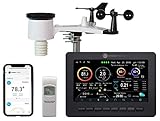
- Allows you to monitor your home and backyard weather conditions with TFT color display
- Wireless all-in-one integrated sensor array measures wind speed/direction, temperature, humidity, rainfall, UV and solar radiation
- Supports both imperial and metric units of measure with calibration available
- Enhanced Wi-Fi connectability option that enables your station to transmit its data wirelessly to the world's largest personal weather station network
- Console power provided by 5V DC adapter (included), and sensor array requires 3 x AAA batteries (not included)
Can lightning predict severe weather?
It can support short-term situational awareness, but it cannot determine by itself whether a storm will produce severe weather. A jump raises a concern to investigate; forecasters check whether radar, satellite, surface observations, and other guidance support the same interpretation. Lightning-based signals are probabilistic, so a jump may occur without a severe-weather report, and severe weather can occur without a forecaster treating a jump as a decisive signal.
Performance depends on the algorithm, data source, region, time period, and how outcomes are verified. In a study of the 2015 convective season in the northeastern United States, Pamela Eck, Brian H. Tang, and Lance F. Bosart reported a 75% probability of detection and a 55% false alarm rate for lightning jumps. Those figures describe that study’s sample and method, not the expected performance everywhere. The authors also noted that severe-weather reports can have gaps and that lightning jumps have limited value when used alone. Eck, Tang, and Bosart (2017): Lightning jumps in the northeastern United States
Rank #4
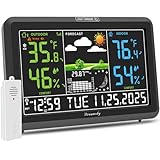
- Illuminated Indoor Outdoor Weather Station for Home with Large Colorful Display: The home weather station delivers large big numbers for weather forecast info, indoor outdoor temperature, atomic time, date, year and calendar day, which is super easy to read from afar.
- Indoor outdoor Thermometer Wireless with High/Low Temperature Alert: The digital weather station supports 3 outdoor sensors which helps to monitor temperature and humidity of multiple locations (one sensor included). With the high/low temperature alert function, the weather station clock keeps you informed about the changes of weather thermometer outdoor.
- WWVB Atomic Weather Station with Auto DST: Weather atomic clock with indoor/outdoor temp always keeps precise time and date by receiving the WWVB atomic signal. The self setting digital weather clock will automatically adjust to daylight saving time with auto DST feature, no more resetting twice a year.
- Personal Weather Forecast Station: This weather stations wireless indoor outdoor predicts the next 12-24 hours weather condition with a 7-day calibration through the pressure of your location which provides you a better outing experience.
- 5 Level Adjustable Backlight Brightness: The weather clock indoor outdoor temperature atomic with backlight dimmer function helps you avoid high-intensity light that disturb your sleep and easily check the weather situation during the day.
Operational guidance also depends on the data and product. NOAA’s Warning Decision Training Division says the false-alarm rate increased at lower sigma levels, including two standard deviations, after its lightning-jump product switched to Earth Networks Total Lightning data. For that product, the guide says jumps of at least three standard deviations—and possibly four to five—may be more useful. These are product-specific operational observations, not settled thresholds for every network or storm. NOAA WDTD Virtual Lab: Lightning Jump
Independent reader supportYour contribution helps us test, update, and keep practical guides available for everyone.Why lightning forecasts remain uncertain
Forecasters cannot predict individual lightning strikes. Lightning is frequent, widespread, and unpredictable at the strike-by-strike level. Estimating where lightning is likely instead relies on patterns and probabilities, informed by a storm’s history, growth, movement, age, height relative to freezing temperatures, and the presence of ice and updrafts. The atmosphere is chaotic, so modest changes in a storm or its environment can alter what happens next. NOAA NSSL: Severe weather and lightning forecasting
Recommended Free Tools
The time horizon depends on the question. A lightning jump can be a short-term clue to possible severe weather tens of minutes ahead in observed cases. Model-based approaches can estimate lightning probabilities farther out, but there is no single lead time that applies to all lightning or severe-storm forecasts. NSSL also describes combining lightning with radar data in model data assimilation to improve storm initial conditions and forecasts. NOAA Hazardous Weather Testbed: EWP projects
Quick Recap
Product prices and availability are accurate as of the date/time indicated and are subject to change. Any price and availability information displayed on Amazon at the time of purchase will apply.

