
iTechGuides is reader-supported. When you buy through links on our site, we may earn an affiliate commission. As an Amazon Associate I earn from qualifying purchases. Learn more
A focused laser pulse can create a tiny cavitation bubble inside a microfluidic channel. As the bubble expands and collapses, it drives jets, vortices and rapid local flow that can disrupt the smooth, parallel streams normally found in a chip. Reports on 2007 experiments describe mixing on microsecond timescales, but those figures apply to specific research setups—not every chip or liquid.
How does a collapsing bubble mix liquid?
In a microchannel, liquid commonly moves in laminar streams: neighboring fluids flow alongside one another with limited cross-stream mixing. Diffusion eventually blends them, but it can be slow over the short distances and times available in a lab-on-a-chip device.
In the reported laser technique, a focused nanosecond pulse creates a short-lived plasma bubble in the liquid. The bubble first expands, then collapses. That rapid change drives local fluid motion; near a channel wall, collapse can form a jet and circular, vortical flow. The resulting disturbance pulls and stretches the neighboring streams, helping them mix rather than remain neatly layered. Chemistry World’s 2007 account describes rapid eddy formation in micrometre-scale channels and says the effect was also used to initiate chemical reactions (Chemistry World, June 12, 2007).
How fast can the laser method mix fluids?
Contemporaneous coverage describes mixing on microsecond timescales, but the primary papers are needed to assess the exact fluids, channel dimensions, operating conditions and definition of mixing behind that timescale. It should be understood as a result reported for particular experiments, not a guaranteed mixing time for other devices.
#1 Best Overall

- Standard matched fittings, perfect fit most common PDMS microfluidic chips set.
- Stable sealing performance, Practical integrated design, meet daily microscale fluid testing needs.
- Do not push samples into the chip manually. Under normal use, keep pressure ≤ 2 bar and maximum flow rate ≤ 2 ml/min. Exceeding these parameters will cause permanent damage to the chip.
Science|Business reported that the laser-induced cavitation experiments produced fluid speeds of up to 20 metres per second, with stronger effects near a channel wall where a jet and circular flow form (Science|Business, May 29, 2007). That is a reported maximum from the described research, not a typical speed or a result established for all microfluidic setups.
What equipment and trade-offs does it involve?
The technique’s distinguishing feature is that the bubble is created where the laser is focused, rather than being a permanent mixing element built into the channel. The 2007 Chemistry World report says this approach avoids placing specialized ultrasound or electromagnetic-field hardware on the chip and does not require carefully patterned or valved channels for the mixing action.
Rank #2

- Replacement accessory kit for microfluidic chips includes PTFE tubing, blunt needles, needle tips, syringes and syringe filters in one package
- PTFE tubing 0.7 meter, ID 0.5mm, OD 1.0mm, fits standard 22G microfluidic fittings and 0.7mm chip inlet and outlet ports
- Six 22G stainless steel blunt needles and three needle tips connect syringes to tubing with luer-lock fittings for secure fluid delivery
- Three 2mL luer-lock syringes and three 0.22 micrometer PES syringe filters for sample loading and filtration before chip injection
- Works with LabCore Materials microfluidic chips and other standard PDMS or glass microfluidic devices for research use only
It still requires external equipment: a pulsed laser and a way to focus the pulse into the liquid. The same report relays researcher Vasan Venugopalan’s estimate that concentrating the energy of a full laser pulse into one nanolitre would raise its temperature by no more than five degrees Celsius. That is an attributed estimate from the reported setup, not a general thermal-safety guarantee for other laser energies, liquids or chips.
The Tool Desk
Outbyte Driver Updater FREEFix the driver behind crashes, sound loss and screen glitchesFind Drivers →Outbyte PC Repair FREEClear out junk files and repair common Windows errorsFree Scan →How does laser cavitation compare with other bubble mixers?
Bubble-based mixing is a family of techniques, not a single device. Other studies use acoustic vibration or gas generated on a centrifugal disk. Their reported outcomes measure different things under different conditions, so they cannot be ranked as a controlled head-to-head comparison.
Rank #3

- Standard matched fittings, perfect fit most common PDMS microfluidic chips set.
- Stable sealing performance, Practical integrated design, meet daily microscale fluid testing needs.
- Do not push samples into the chip manually. Under normal use, keep pressure ≤ 2 bar and maximum flow rate ≤ 2 ml/min. Exceeding these parameters will cause permanent damage to the chip.
| Approach and reported result | How mixing is produced | Important context |
|---|---|---|
| Bubble-induced acoustic micromixing (2002): a 22 μL chamber was mixed in tens of seconds, compared with hours for diffusion alone. | A piezoelectric disk vibrates trapped air bubbles, creating acoustic microstreaming. | The chamber volume, bubble positions, acoustic drive and diffusion-only baseline define the comparison. (Liu et al., Lab on a Chip, 2002) |
| Single-bubble acoustic micromixer (2009): mixing was reported in a few milliseconds. | Acoustic waves excite a trapped bubble in a horseshoe structure between two laminar streams. | Bubble geometry, resonance conditions, stream layout and the mixing-time measure matter. (Ahmed et al., Lab on a Chip, 2009) |
| Acoustic sidewall bubble inception and cavitation (2014): mixing efficiency of 0.92 and mixing in less than 100 ms were reported for viscous PEG solutions. | Acoustic waves generate and cavitate bubbles at rough, wavy channel walls. | The result depends on fluid viscosity, acoustic actuation, wall geometry, the definition of efficiency and flow regime. (Li et al., Analytical Chemistry, 2014) |
| Centrifugal-chip gas-bubble mixing (2013): a particular DNA-extraction study reported more than 20% higher DNA yield when lysis and binding mixing were done on disk rather than by manual vortex mixing. | An on-chip reaction generates oxygen; centrifugation drives bubble rise and breakup to produce convective mixing. | This is an assay-specific yield comparison, not a general mixing-time or mixing-efficiency measurement. (Liebeskind et al., μTAS 2013) |
These results show how actuation, bubble placement, channel design, fluid properties and outcome measures vary across bubble mixers. A chamber’s mixing time, a reported efficiency and a DNA yield are not interchangeable performance metrics.
Independent reader supportYour contribution helps us test, update, and keep practical guides available for everyone.Is this a chip or product readers can buy?
The evidence describes experimental research, not a retail-ready chip or a consumer product. It does not establish that a packaged device is available for purchase to reproduce the laser-cavitation results. The reported method is best understood as a laboratory technique whose outcome depends on the laser, focusing, channel and fluid conditions.
Quick Recap
Best Value
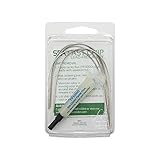
- The Fast Chip SMD Removal Kit is a quick and inexpensive way to remove SMD components from a PCB without a hot air station using only your soldering iron.
- Removes QFP's, PLCC's, SOIC's, and chip components under 300 degrees Fahrenheit
- Enough material to remove 8-10 SMD'S
- The Kit Contains: 2.7 ft. Fast Chip Removal Alloy - 1 2cc tube of SRA TF5000 No Clean Rework Paste Flux and complete Instructions for SMD Removal and Cleanup
- Lead Free
Rank #4

- Double herringbone microchannel design enhances passive fluid mixing efficiency under laminar flow conditions, supporting stable and repeatable laboratory experiments.
- PDMS microfluidic chip features high optical transparency and flexible sealing performance, making it suitable for microscopy observation and laboratory research.
- Compatible with syringe pumps, laboratory tubing systems and common microfluidic accessories for fluid handling, chip testing and experimental development.
- Suitable for microfluidic research, liposome preparation, nanoparticle studies, laboratory demonstrations and academic research applications.
Product prices and availability are accurate as of the date/time indicated and are subject to change. Any price and availability information displayed on Amazon at the time of purchase will apply.

