
PC Slower Than It Used to Be?
A free scan shows the junk files, broken settings and background clutter dragging Windows down - then fixes them in one click.Free scan · Windows 10 & 11Crashes, No Sound, or Screen Glitches?
Random freezes, missing sound and display glitches usually trace back to one bad driver. Find and replace yours safely.Free scan · under a minuteiTechGuides is reader-supported. When you buy through links on our site, we may earn an affiliate commission. As an Amazon Associate I earn from qualifying purchases. Learn more
Armed conflict can reduce food production both by damaging farmland directly and by making it harder to farm: farmers may lose access to fields, labor, roads, irrigation, livestock, inputs, and markets. Satellite imagery can help measure changes in cultivation where ground access is limited, but cultivated area is not the same as crop output or food security. The available studies show important effects in particular periods and places; they do not establish a single current global total for conflict-caused farmland loss or foregone food production.
How conflict reduces farmland use and food production
Conflict can affect a farm before, during, and after a crop is planted. Some effects are visible in the land itself; others interrupt the people, equipment, and connections needed to turn a cultivated field into food. These channels can compound one another: damaged irrigation can make a field unusable, displacement can leave it without labor, and disrupted roads can make inputs or harvested crops difficult to move.
Direct damage to fields, crops, and farm assets
Fighting can damage standing crops and agricultural land, while mines and other contamination can make fields unsafe to enter. Livestock and farm assets may also be lost. Even where soil remains cultivable, damage to equipment or irrigation can delay planting or reduce what can be harvested.
Recommended Free Tools
Restricted access, displacement, and labor loss
Farmers may be unable to reach fields because of insecurity, front lines, checkpoints, or displacement. When households leave, their labor and local knowledge leave with them. A field that appears intact in an image may therefore remain unworked, or receive less attention than it needs.
#1 Best Overall

- Quick, at home results for Soil pH, Nitrogen, Phosphorous and Potash Innovative and inexpensive soil test kit features an easy-to-use capsule system and patented color comparators
- Contains all components needed for 20 tests. 5 for each of pH, N, P and K
- Contains all components needed to test all variables in several spots in the yard or garden
- Simple, detailed instructions included. Great for beginners and experienced gardeners alike.
- Soil pH preference list for over 450 plants included
Disrupted inputs, infrastructure, and markets
Production depends on more than land. Conflict can disrupt access to seed and other inputs, rural roads, irrigation, storage, and markets. If farmers cannot obtain what they need in time, irrigate reliably, or sell a harvest, they may plant less or not plant at all. These effects also shape food availability and access beyond the farms directly affected.
Why cultivated area is not the same as food lost
Cultivated area is a useful, observable measure of whether land appears to be in use. It is not a direct measure of yield, total output, or the amount of food available to people. A cultivated field can produce less because of damaged irrigation, missing inputs, labor shortages, or weather. Conversely, land may go uncultivated for reasons other than conflict. And even when national food supply falls, that measure alone does not show whether households can afford or physically access food.
Rank #2
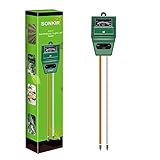
- Kindly NOTE: This soil tester can not be applied to test pH value of any other liquid. If the soil is too dry the indicator will not move, and water it before testing.
- 3 METERS IN ONE: Soil moisture level, Soil pH value and Sunlight level could be tested easily according to your need by switching the function button of this soil meter.
- NO BATTERY NEEDED: Simply insert the meter into soil, wait few minutes, accurate test results will be displayed on the readout panel. No battery is needed.
- STURDY AND SCIENTIFIC DESIGN: Reliable materials and upgraded technology used for this soil meter make it advanced and high-quality for long-term use.
- MULTIPURPOSE SOIL TEST KIT: Portable and compact design enables you to use this soil meter for house garden, farm, lawn and any other soil & plant analysis. Ideal for indoor and outdoor use.
Those distinctions matter when interpreting remote sensing. Satellite observations can indicate crop cover or damage signals, but they do not directly count all lost harvests or explain every reason a field changed. Weather and other non-conflict factors also influence production. A study that compares changes over time against a counterfactual can help estimate conflict’s contribution, but its result remains an estimate tied to its measures, coverage, and assumptions.
What satellite analysis found in Ukraine
A 2025 World Bank study, Using Remotely Sensed Data to Assess War-Induced Damage to Agricultural Cultivation: Evidence from Ukraine, examines close to 10,000 Ukrainian village councils. It uses annual crop maps for summer and winter crops from 2019–24 and combines optical, thermal, and radar satellite observations to construct conflict-damage measures. The analysis estimates changes in cultivated area with a difference-in-differences design at village-council level.
Rank #3

- KNOW BEFORE YOU GROW | Grow the healthiest, sustainable lawn and garden with the most accurate and easy to use professional soil test kit on the market
- FAST & ACCURATE | Unlike at-home pH meters and test strips, our mail-in professional lab analysis accurately measures 13 plant-available nutrient levels, including Nitrogen and pH. Results in 6-8 days
- FOR ANY GROWING SCENARIO | Tests any soil type and growing condition - lawn & turf, vegetable gardening, flowers, compost, trees, vines, ornamental landscape, house plants, soil-less media or hydroponics
- SAVE TIME & MONEY | Stop applying products you don’t need. Learn exactly what products and amounts you need to grow the healthiest plants possible
- CUSTOM RECOMMENDATIONS | What to apply, how much to apply, and when to apply it. Provides both organic and non-organic fertilizer recommendations to effectively amend your soil
The paper reports persistent negative effects on cultivation and spillovers beyond village councils directly affected. Its preferred satellite-image-based conflict indicator produces a predicted impact three times larger than the estimate using a media-based indicator. That is a comparison between two exposure measures within this Ukraine study—not a general multiplier for other wars, regions, or satellite estimates. The results also differ in distribution across domains depending on the indicator used.
The method is valuable where field visits are difficult or unsafe, but satellite-derived damage and crop maps are proxies. Classification error, incomplete ground-truth data, and the challenge of attributing observed changes to conflict rather than other causes all affect interpretation. The paper measures cultivation outcomes in Ukraine over its stated period; it should not be read as a direct count of food output lost worldwide.
Rank #4

- 【7-in-1 Features】This is a 7-in-1 multi-function soil tester. Our soil tester quickly measures soil moisture, pH, temperature and light intensity, and its fertility function helps you take better care of your plants. With this device you can measure the soil moisture, pH, temperature and light intensity for your plants and with the EC and TDS functions you will know when it is time to water the soil.
- 【Large Screen & LCD Backlight】The Soil Moisture Meter has a large LCD display with white backlight that clearly shows the numerical parameters in both daylight and darkness. It is powered by 4 x 1.5V AAA batteries (not included) and warns you when the batteries are low. The large screen allows you to read the data more easily and clearly, so you no longer have to struggle with hard to read data!
- 【Fast and accurate measurement】With the latest 2025 probe technology, it can quickly and accurately measure soil pH, moisture, temperature and soil fertility, and measure the TDS and EC function of water quality. Combined with the light intensity analysis of the integrated light sensor, the device can help you determine the optimal watering time, control acidity and temperature, and ensure that your plants receive sufficient light for science-based plant care.
- 【Easy to use】Simply insert the probe about 10 cm deep into the soil, wait 10 seconds and you will receive precise readings. (Note: The soil tester must not be used directly to measure liquids. If the soil is too dry or hard, do not force the probe in. Moisten the test area slightly before measuring and wait 10 minutes to avoid damaging the device).
- 【Optimal readability】The display has an intuitive design with clear numbers and intuitive symbols that make it easy for even beginners to understand the minimum values. The extra-large screen makes reading the data clearer and easier. The displays of the water and soil analyser are backlit in white so that they are also easy to read at night.
What broader food-security studies add
Cross-country research connects conflict to food availability at a broader scale, but it measures different outcomes from the Ukraine cultivation study. The studies below cover distinct periods, geographies, and indicators, so their figures are not directly interchangeable.
What’s actually slowing this PC down?
Pick the symptom - the matching free tool is one click away.
| Study | Coverage and measure | What it reports | How to interpret it |
|---|---|---|---|
| FAO, Food security and armed conflict: a cross-country analysis (2018) | 106 countries in Africa, Asia, and Central and South America, 1961–2011; national dietary energy supply | Reports a large estimated reduction in national dietary energy supply associated with conflict. | Offers historical, cross-country evidence connecting conflict and food availability. It does not quantify local farmland abandonment or provide a current global farmland-loss total. |
| FAO, Armed Conflicts and Food Security (2003) | Historical estimates of agricultural production and calorie availability during conflict | Estimates that per-capita agricultural production falls by about 1.5 percent per year during conflict, and calorie availability per capita per day falls by an average of about 7 percent as a result of conflict. | These are estimates published in 2003, not universal rates for current conflicts. The paper also estimates per-capita GDP declined by about 2.2 percent per year during conflict; that is contextual economic evidence, not an agriculture-specific effect. |
| World Bank, Future of Food: Building Stronger Food Systems in Fragility, Conflict, and Violence Settings (2021) | Global food-systems discussion in settings affected by fragility, conflict, and violence | The World Bank states that “Two-thirds of the increase in global hunger since 2014 is due to increasing fragility, conflict, and violence (FCV).” | This is the World Bank’s attributed headline statistic, not an independently verified causal estimate in this article. |
Taken together, the studies support the conclusion that conflict can undermine both cultivation and broader food security. They do not support a single comparable estimate of today’s global conflict-driven farmland loss. The Ukraine study is local and recent, while the FAO cross-country evidence is historical and measures national dietary energy supply rather than land use.
Best Value

- Comprehensive Soil Analysis: Liquid soil test kits offer a comprehensive analysis of essential soil parameters, including pH, ammonia, nitrogen, phosphorus, and potassium. Having all these measurements in one kit provides a holistic understanding of the soil's fertility and health.
- Customized Fertilizer Recommendations: With data on pH and nutrient levels, liquid soil test kits help users apply the right type and amount of fertilizers, optimizing plant growth, and preventing over-fertilization, which could harm both plants and the environment. Whether its for lawns, garden, grass, plants, vegetables, turf, flowers, compost trees vines ornamental landscape house plants or hydroponics you will be able to get the results you want.
- Time and Cost-Effective: Liquid soil test kits are relatively quick and easy to use, saving time for gardeners and agricultural professionals. Compared to sending samples to a laboratory, these kits provide rapid results, allowing for prompt action. Additionally, they are cost-effective for routine testing, making it feasible to monitor soil health regularly.
- Optimal Plant Health and Yield: By knowing the soil's pH and nutrient levels, gardeners and farmers can fine-tune their agricultural practices to create an environment conducive to optimal plant growth. Adequate levels of ammonia, nitrogen, phosphorus, and potassium are essential for healthy plant development and higher crop yields.
- Accurate and Precise Results: Liquid test kits are designed to provide accurate and precise measurements when used correctly. They are calibrated to detect specific nutrient levels, ensuring reliable data for informed decision-making in plant nutrition and soil management. You get a total of about 140 test. which is 40 test for each parameter and about 20 or so for nitrogen
How to assess claims about conflict-related crop losses
When a study or headline gives a figure, check what it actually counts and how it links the change to conflict. These questions help distinguish observed land-use changes from estimated production or food-security effects:
- Outcome: Is the measure cultivated area, yield, crop output, dietary energy supply, food insecurity, or market prices? These capture different parts of the food system.
- Geography and time: Does the estimate cover a village-level panel or national data, and which conflict and follow-up years are included?
- Conflict exposure: Does the study use satellite-detected damage, territorial or frontline data, event records, or media-based indicators? Different definitions can produce different estimates, as in the Ukraine analysis.
- Attribution: Is the result a before-and-after description, or does the study compare affected areas with a counterfactual intended to estimate what might have happened without conflict?
- Coverage and uncertainty: Are ground observations available? How precise are crop maps, and how does the analysis account for weather, inaccessible territory, classification error, or effects spilling into nearby areas?
What recovery requires beyond planting
Restoring production is not simply a matter of putting seed in the ground. FAO’s 2003 paper states: “Agricultural sector recovery depends on successful demobilization of soldiers, land de-mining and the reconstruction of rural infrastructure, in particular roads and irrigation.” The sequence and feasibility of those steps vary with security, contamination, land tenure, water availability, labor, and market access.
The World Bank’s 2021 food-systems publication also discusses support for next-season production, replacing or upgrading assets, improving access to inputs, and building climate resilience. These are policy-level priorities rather than universal prescriptions: the relevant mix depends on what has been damaged and what farmers can safely reach and use.
Quick Recap
Product prices and availability are accurate as of the date/time indicated and are subject to change. Any price and availability information displayed on Amazon at the time of purchase will apply.

