
Free tools Windows power users keep installed
One-click scans. No signup required.
iTechGuides is reader-supported. When you buy through links on our site, we may earn an affiliate commission. As an Amazon Associate I earn from qualifying purchases. Learn more
A synthetic polymer called poly(vinyl alcohol), or PVA, helped improve post-freezing recovery of sheep and human red blood cells in a 2014 laboratory study. The proposed benefit is that PVA slows ice-crystal growth during thawing, when growing crystals can damage cells. That result is promising research—not proof that retail PVA, or a general-purpose antifreeze, can preserve blood, other cells, or organs in clinical use.
How can an antifreeze polymer protect cells as they thaw?
Freezing can injure cells as ice forms, changes shape, and grows. During warming, small ice crystals can merge into larger ones, a process called recrystallization. The 2014 PVA study describes the polymer as a synthetic, biomimetic material: it slows ice-crystal growth in a way analogous to antifreeze (glyco)proteins. The authors proposed that limiting this growth could help cells survive freezing and thawing.
In the authors’ words, “Here we employ a synthetic, biomimetic, polymer, which is capable of slowing the growth of ice crystals in a manner similar to antifreeze (glyco)proteins to enhance the cryopreservation of sheep and human red blood cells.” The study appeared in Nature Communications on 3 February 2014.
Recommended Free Tools
What did the PVA red-blood-cell study find?
Deller and colleagues reported that 0.1 wt% PVA was sufficient for significant post-freezing recovery in their experiments. Their abstract reports recovery above 40% for ovine and human erythrocytes with that PVA concentration and without an organic solvent. The paper contrasted this with solvent-based strategies using over 20 wt% organic solvent; that comparison is the authors’ framing and does not describe every cryopreservation protocol.
#1 Best Overall

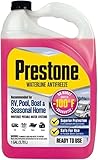
- Premium Winterization Protection: Designed for winterizing boats, RVs, swimming pools, boilers, and potable water systems with burst protection down to -50°F.
- Alcohol & Glycerin Free Formula: Premium propylene glycol-based antifreeze formulated without alcohol or glycerin for dependable seasonal protection.
- Safe for Potable Water Systems: Suitable for use in recreational water systems and plumbing systems, including potable water lines. Safe on copper, brass, and most plastics except acetate.
- Corrosion Protection Technology: Helps protect plumbing components, marine engines, and water system parts from corrosion during storage and winterization.
- Non-Flammable Ready-to-Use Formula: Ready to use with no mixing required and designed to provide protection during off-season storage.
These are results from defined laboratory experiments, not evidence of clinical effectiveness. They concern red blood cells, and the reported endpoint is post-freezing recovery; the figures do not establish that PVA preserves every cell type, maintains all cell functions, or works for whole blood or organs.
How does PVA compare with antifreeze proteins?
PVA is a synthetic polymer designed to mimic some activity of natural antifreeze proteins. Other studies have tested antifreeze proteins themselves. The findings below come from different experiments and cell formats, so they are not head-to-head comparisons or a basis for ranking the materials.
Rank #2

- BURST PROTECTION PERFORMANCE (-50°F) – Helps protect pipes and systems from freezing damage during cold weather storage
- DESIGNED FOR MULTIPLE SYSTEMS – Suitable for RVs, boats, pools, spas, and seasonal plumbing applications
- SYSTEM PROTECTION FORMULA – Helps support protection of pipes, seals, and system components during winterization
- EASY APPLICATION – Designed for straightforward use when preparing systems for cold weather conditions
- RELIABLE WINTERIZING SOLUTION – Helps maintain system integrity during off-season storage
| Approach and study | Cells and format | Reported finding | What the result establishes |
|---|---|---|---|
| PVA; Deller et al., 2014 | Sheep and human red blood cells in suspension | At 0.1 wt% PVA, the abstract reports post-freezing recovery above 40% without organic solvent. | Laboratory recovery in the studied red-cell system; not clinical efficacy. |
| Extracellular type III antifreeze protein; 2019 study | Mammalian cell monolayers; the same cells were also studied in suspension | At 0.8 mg/mL, monolayer recovery increased from 25% to over 60%. Intracellular delivery showed less benefit, and the protein was less effective in suspension. | In that system, both cell format and where the protein was delivered mattered; it is not directly comparable to the PVA red-cell result. |
| Antifreeze proteins; 2022 studies | One study examined HEK 293T cells with and without DMSO; another assessed the proposed mechanism of antifreeze-protein cryoprotection. | The studies examined protein effects in specific experimental conditions; the supplied study descriptions do not state a comparable recovery figure. | They add evidence about particular systems and mechanisms, not a general clinical result. |
| Recombinant snow flea antifreeze protein; 2025 report | EA.hy926 cells | The report examined the protein’s role in cryopreservation; the supplied description does not state a comparable recovery figure. | Early cell research, not established clinical use. |
The 2019 study’s reported results are described in “Extracellular Antifreeze Protein Significantly Enhances the Cryopreservation of Cell Monolayers”. A monolayer result should not be assumed to apply to cells stored in suspension: the authors found less benefit in suspension for the cells they tested.
Quick wins for a faster PC:
Repair Windows errors before they cause bigger problemsFix Now →Scan for outdated or missing drivers - takes under a minuteDriver Scan →Does slowing ice growth explain all the protection?
Not necessarily. A 1992 red-blood-cell study found that antifreeze-protein effects depended on concentration and warming conditions. It discussed both possible inhibition of recrystallization and the possibility that, at high concentrations, harmful ice growth around cells could occur. More recent work also questions whether ice-recrystallization inhibition alone explains antifreeze-protein cryoprotection; interactions with cell membranes may contribute.
Rank #3

- Designed for use with recreational vehicles, boats, spas, pools, and vacation homes
- Formulated for -50 degree F burst protection
- Convenient, ready-to-use solution
- Proprietary plant-derived additive. Improves user safety when compared to ethylene glycol-based products
- Safe for incidental contact with people, pets, and wildlife. Readily biodegradable and non-toxic to aquatic life
That means “antifreeze” is not a guarantee of protection. The outcome can depend on the material, its concentration, the cell type, whether cells are in suspension or a monolayer, where the material is delivered, and the freezing and warming conditions. The available study summaries do not support a single recipe that can be transferred across those settings.
Independent reader supportYour contribution helps us test, update, and keep practical guides available for everyone.Can antifreeze polymers or proteins preserve blood or organs for clinical use?
The cited results do not establish routine clinical use of PVA-based cryopreservation for human blood or organs. They also do not show that ordinary retail PVA powder is suitable for biological use or equivalent to the material used in a research protocol. The 2014 result is about specific red-cell experiments; the later protein studies concern other defined laboratory systems.
Rank #4
For now, these materials are best understood as research approaches to a specific cryopreservation problem—not as consumer antifreeze products or proven clinical treatments. A laboratory result in one cell system cannot by itself establish safety, effectiveness, or suitability for transfusion, tissue storage, or organ preservation.
What’s actually slowing this PC down?
Pick the symptom - the matching free tool is one click away.
Quick Recap
Best Value

- CONCENTRATE ANTIFREEZE AND COOLANT: Efficient formula is compatible with all vehicle cooling systems, providing fast-acting and long-lasting protection on all cooling system metals against rust and corrosion
- NON-ABRASIVE FORMULA: Created with Organic Acid Technology, this ethylene glycol-based coolant formula is compatible with other antifreeze and coolant formulations. This item contains a bittering agent called Denatonium Benzoate.
- ALL VEHICLE: Versatile and formulated for use in all American, Asian, and European automobiles including cars and low/medium to heavy duty trucks of all makes, models, and years
- SAFE FOR FILLS AND TOP-OFFS: The amber color will not effect the antifreeze currently in your cooling system
- LIFETIME PERFORMANCE: Provides cooling system protection for your automobile's entire lifetime with proper maintenance
Product prices and availability are accurate as of the date/time indicated and are subject to change. Any price and availability information displayed on Amazon at the time of purchase will apply.

