
The Tool Desk
Outbyte PC Repair FREEClear out junk files and repair common Windows errorsFree Scan →Outbyte Driver Updater FREEScan for outdated or missing drivers - takes under a minuteDriver Scan →iTechGuides is reader-supported. When you buy through links on our site, we may earn an affiliate commission. As an Amazon Associate I earn from qualifying purchases. Learn more
A 2018 molecular-trap study showed how red and blue light can steer one reversible chemical reaction toward bond formation or bond cleavage. The trick is not that light makes equilibrium disappear: a photoswitchable carbonyl changes reactivity under illumination, coupling a light-driven tautomerization cycle to a reversible reaction. The reported system achieved selective, nearly quantitative formation and scission, even when the underlying condensation/hydrolysis equilibrium favored the other side.
How the molecular trap steers the reaction
In an ordinary reversible reaction, the mixture approaches thermal equilibrium: the relative stability of reactants and products determines which side is favored. The molecular trap adds a photoswitchable carbonyl electrophile and couples its reactivity to light-driven tautomerization. The Eindhoven University of Technology research record describes the light-driven cycle as a way to activate reactants or remove products, depending on the illumination wavelength. That shifts the system toward intermolecular bond formation under one color and bond scission under the other. Eindhoven University of Technology Research Portal
The study’s abstract says red or blue light can produce “selective and nearly quantitative” bond formation or scission, even when the underlying condensation/hydrolysis equilibrium is thermodynamically disfavored. “Nearly quantitative” is the report’s qualitative description; the accessible record does not give an exact percentage or substrate-specific yields. The result applies to this reported molecular trap, not to photoswitches or reversible reactions generally. Eindhoven University of Technology Research Portal
Why illumination can favor the thermodynamically less stable side
Thermal equilibrium describes a system without sustained external driving. Under illumination, the reaction is instead part of a photodynamic system: photons continually change the photoswitch’s state and therefore the relative reactivity of the reaction partners. Light supplies energy and changes the pathways available, so the illuminated mixture need not match the composition favored by thermal equilibrium alone.
#1 Best Overall
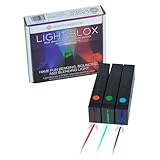
- Learn How Light Bounces And Bends: Three colors of LED sources make narrow lines of light to explore reflection and refraction when used with mirrors, lenses and prisms. Master the physics of light to understand how microscopes and telescopes work with the human eye!
- Make White Light By Mixing Colors: Remove the caps to project soft, uniform single-color rectangles. When these rectangles overlap, you can make new colors! Mix red, green and blue light together to make white light!
- 6 Lessons Included: Start their discovery of light and color to prepare them for a world filled with LED lighting and LED-based technologies. 6 lessons are included for digital download from the box insert using household supplies, and up to 10 additional lessons are possible when used with lenses, mirrors, and diffraction gratings.
- Sticks To Magnetic Surfaces: Laminated magnets along the bottom lets you stick these to magnetic whiteboards for classroom demonstrations or helps secure them from falls on metal desks. This 2nd-generation version has stronger magnets than before to avoid slipping on weakly magnetic white boards.
- Kid-Friendly Design: These simple LED light sources are not hazardous to your eyes and the tough plastic housing is durable in falls. Alkaline AA batteries (not included) are securely housed inside a strong cover. Low-power laminated magnetic strips are glued into place on the bottom.
A photostationary state is a balance under continued illumination, not a point where molecules stop reacting. Forward and reverse photochemical steps may continue; the resulting mixture depends on how strongly each state absorbs at the chosen wavelength and on the reactions’ quantum yields. This is general photoswitch behavior described in a 2017 review, not a measured kinetic result specific to the molecular trap. Chemical Society Reviews
What the report establishes—and what it does not
The institutional record and the 2018 Chemistry World report establish the central idea: wavelength-controlled tautomerization changes electrophile reactivity, enabling reversible bond formation and cleavage. They do not, in the accessible material, provide the exact red and blue wavelengths, solvent, concentrations, light intensity, substrate-by-substrate yields, or a complete experimental procedure. Those details would be needed to reproduce the work or compare its performance quantitatively with another system.
Rank #2

- The durable lights, lenses, mirrors and more in this light and optics kit make teaching and learning the science of reflection, refraction and color concrete, hands-on and easy to teach and learn! Grades 2-8.
- Bright, beautiful, classroom LED light sources! LEDs in the three primary colors of light (red, green, and blue) for exploring optics, color mixing, and more!
- Students easily uncover the law of reflection or measure the angle of refraction. Explore, inquire and observe all the properties of light with one simple tool - no expensive equipment needed. Make the science of light and optics fun!
- With the caps on, Light Blox double as a ray box! They project an easy-to-see beam in each of the primary colors of light (red, green, and blue), good for exploring how light bounces (reflects) and bends (refracts).
- Lighting technology is moving fast, and understanding the fundamentals of light will be a cornerstone for science and engineering careers. Light Blox let you easily demystify how light works to prepare for a bright future.
The study was reported by Katrina Krämer in Chemistry World on 20 August 2018. Team leader Stefan Hecht’s comment, “If you are at thermodynamic minimum there is no life,” expresses the broader motivation for driving systems away from a minimum; it is not a quantitative description of the reaction. Chemistry World
How this differs from other visible-light photoswitches
Other photoswitch studies offer useful context, but they address different chemistry. The 2017 hemiindigo work measured switching between E and Z isomers rather than using a switch to control a coupled intermolecular bond-forming reaction. Its authors reported more than 90% E isomer after 470–530 nm irradiation and 99% Z isomer after 590–680 nm irradiation; they also reported half-lives up to 83 years at 25 °C for the investigated derivatives. Those figures belong to those hemiindigo compounds, not the molecular trap. PubMed
Rank #3

- Package Includes: 4 pieces copper sheet, 4 pieces zinc sheet,1 piece Electronic clock,2 pieces RGB LED,4 pieces Wire, 2 pieces wires with clip, 1 piece English assembly instructions
- Easy to operate: you only need to prepare fruits, vegetables or drinks to assemble a battery to work with led or electronic watches, such as: apples, oranges, potatoes, lemons, tomatoes, cola, pears, pineapples, or salt solutions, etc.
- By completing the Fruit battery Science Experiment Project with student, let student experience the mystery of science, develop theirs imagination and hands-on ability, and make them more interested in scientific experiments.
- Read the instructions carefully before building the project to avoid damage to the electronic watch or to prevent the LED from working.
- Fruit selection:we suggest you use fruit with more juice, tomato will be your first choice, if you choose lemon and orange, please insert copper and zinc tablets in the same petal flesh (there is a membrane between the different petals that will hinder the transfer of electrons), as far as possible, insert copper and zinc tablets all the way into the fruit.The LED lighting effect is more visible in dim environments.
A 2023 diaryl-hemiindigo study explored four-state switching responsive to visible light, pH, and heat, as well as inscription in transparent polymers. It is another distinct approach, not a follow-up performance measurement of the molecular trap. These systems cannot be ranked directly: they differ in what switching changes, what inputs are used, and what outcomes are measured, and the cited studies do not compare them under shared conditions. Nature Communications
Independent reader supportYour contribution helps us test, update, and keep practical guides available for everyone.Why bidirectional control matters
Many photoswitch demonstrations change a molecule’s shape or isomer ratio. The molecular trap’s notable feature is that switching is coupled to a reversible chemical reaction: illumination can influence whether an intermolecular bond forms or breaks. That offers a way to manipulate dynamic covalent systems beyond the direction favored by their underlying thermal equilibrium, while keeping the claim specific to the studied chemistry.
Quick Recap
Best Value

- ⚡ 8 Set 3-in-1 Science Discovery: Explore the wonders of green energy by creating power from three different sources: Saltwater Power, Cola Power, and Fruit Batteries!
- 🧪 Complete STEM Learning Kit: Includes everything needed for a successful experiment: Zinc (Zn) and Copper (Cu) plates, connector wires with clips, LED lights, measuring cups, and a detailed instruction guide.
- 🎓 Hands-On Education: Perfect for kids aged 8+, this kit teaches real-world physics and chemistry concepts through engaging, tactile play that builds confidence and critical thinking.
- 📦 Bulk Value for Groups: Our set comes with 8 individual experiment packs and extra cups, making it an ideal choice for science classrooms, homeschooling groups, or birthday party activities.
- ✅ Safe & Easy to Use: No complex tools or dangerous chemicals required! The step-by-step visual guide ensures a frustration-free experience for parents and children alike.
Rank #4
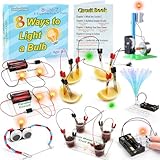
- 8 Circuit Experiments in 7 Packs ( AA batteries are required but not included. ) – Includes 8 fun and educational experiments to teach kids about circuits and electricity. Projects include Series Circuit, Parallel Circuit, Saltwater Power Generation, Fruit Battery, and more.
- Engaging Circuit Book – Comes with a detailed Circuit Book for guided learning. Suitable for ages 8+ with easy-to-follow instructions.
- Promotes Critical Thinking – Encourages problem-solving, creativity, and exploration of how electrical circuits work.
- Ideal for STEM Education – A great tool for learning about electrical engineering, conductivity, and energy. Perfect for young learners to explore science and technology.
- Perfect for Home or Classroom Use – Great for science fairs, school projects, or fun experiments at home. Ideal for teaching basic electrical concepts in an engaging way.
Product prices and availability are accurate as of the date/time indicated and are subject to change. Any price and availability information displayed on Amazon at the time of purchase will apply.
Recommended Free Tools

