
iTechGuides is reader-supported. When you buy through links on our site, we may earn an affiliate commission. As an Amazon Associate I earn from qualifying purchases. Learn more
A 2015 study showed how changing the structure of a sulfide precursor can control when metal-sulfide quantum dots begin to form. By tuning that reaction, researchers could influence how many crystals nucleate and target a desired particle size while using the reactants to full conversion. The approach was presented as a route to better consistency and potentially lower precursor costs—not proof that quantum dots or products made by this method became cheap or widely commercialized.
Why controlling quantum-dot size matters
Quantum dots are nanoscale crystals whose optical behavior depends on their size. In the 2015 account of the work, particle size affects the wavelengths of light the dots absorb and emit. A synthesis that reliably controls size can therefore help produce dots with the optical properties needed for applications such as displays.
Making a batch with a target size is not just a matter of choosing ingredients. The timing and rate of crystal formation affect how many nuclei form and how the particles grow. If precursor reactivity is difficult to control, batches can vary, and stopping growth at the right point can leave reactants unused.
Free tools Windows power users keep installed
One-click scans. No signup required.
How substituted thioureas control nanocrystal formation
Hendricks, Campos, Cleveland, Jen-La Plante, and Owen reported their study in Science on 12 June 2015. They developed a library of substituted thioureas that act as tunable sulfide precursors for metal-sulfide nanocrystals. As the thiourea converts, it supplies the sulfide needed to form the crystals.
#1 Best Overall

- Optics Elements for Interference Diffraction Optical Physical Experiment.
- Single Slit/Double Slits Interference Diffraction.
- Suitable for: who are prepared for physics by understanding the interference and diffraction of light in advance.
- This kit is used in class to illustrate the phenomenon of light interference.
- This film is made of PET material, please do not use high power laser to avoid damage to the film.
The key variable is conversion rate. The substitution pattern changes how readily a thiourea converts into a sulfide source. The paper’s abstract reports that this reactivity could be tuned across more than five orders of magnitude. Faster conversion promotes more nucleation; by adjusting conversion kinetics, the researchers could adjust nanocrystal concentration and prepare crystals of a desired size at full conversion.
In practical terms, the method uses precursor chemistry to influence the start of crystal formation, rather than relying only on ending growth at a chosen time. That distinction matters because a target size and full conversion can, in principle, be pursued together.
Rank #2
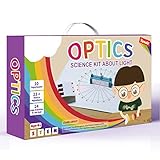
- Explore the Science of Light: Discover the fascinating world of optics with 15+ hands-on light experiments and learn how light travels, reflects, refracts, and forms images through real scientific exploration.
- Create Rainbows & Optical Effects: Use the included prism, lenses, mirrors, and transparent optical blocks to observe amazing optical phenomena such as rainbow formation, color mixing, and light refraction.
- Complete Optical Science Lab Kit: This STEM kit includes more than 25 experimental components, allowing kids to build their own mini physics laboratory and perform a wide variety of optics experiments at home or in school.
- Easy-to-Follow Experiment Guide: The 32-page full-color manual provides clear step-by-step instructions and explanations that help students understand key physics concepts while encouraging curiosity and scientific thinking.
- Perfect STEM Gift for Curious Kids: A fun and educational science kit designed for boys and girls ages 8-16, ideal for STEM learning, science projects, homeschooling, classroom demonstrations, birthdays, and holiday gifts.
What the 2015 results claimed—and what they do not prove
The paper’s abstract says controlled precursor reactivity and quantitative conversion improved batch-to-batch consistency at industrially relevant reaction scales. A contemporaneous Chemistry World report described reproducible adjustment of reaction rates and resulting absorption peaks, with yields “approaching 100%.” That qualification refers to reported study yields, not a guarantee for every material, batch, or production setting.
The same report said the precursor chemicals could be up to 100 times cheaper than some sulfide precursors then in use. This was a 2015 comparison reported by Chemistry World, not a current market-price survey. It does not establish present-day costs, commercial availability, or savings for a particular manufacturer.
Rank #3

- Investigate the building blocks of life and learn the ABC's of DNA!
- Isolate plant DNA in a test tube.
- Learn about biological inheritance.
- Assemble a DNA model to see its elegant double-stranded helical structure.
- A 48-page, full-color manual guides you through 20 experiments and teaches about the basics of genetics and DNA.
How the approach compares with conventional growth control
The comparison below reflects the qualitative claims in the 2015 paper and report. They do not provide a complete, quantified head-to-head dataset for every measure.
| Measure | Conventional growth termination | Substituted-thiourea approach |
|---|---|---|
| How size is controlled | Growth is stopped at a chosen point; the report describes difficulties controlling the reaction and variability in particle size. | Precursor reactivity is tuned to influence nucleation and target size. |
| Conversion and yield | The report identifies yield loss associated with conventional approaches; it gives no complete numerical baseline for comparison. | The paper describes quantitative conversion; Chemistry World reports yields approaching 100% in the study. |
| Batch consistency | The report describes batch-to-batch size variability as a challenge. | The paper says controlled reactivity and quantitative conversion improve batch-to-batch consistency. |
| Scale relevance | No comparable scale figure is given in the cited accounts. | The paper characterizes the reaction scales as industrially relevant, without supplying a complete scale-up comparison in its abstract. |
Why the precursors were considered promising
Chemistry World described the substituted thioureas as air-stable and said they could be made at room temperature from industrially available isothiocyanates and amines. The report presented these traits, together with tunable reactivity, as practical advantages over some sulfide precursors in use at the time. They do not by themselves establish the cost, safety, supply, or production suitability of any particular compound today.
Rank #4

- This is a multi-functional learning kit,three power generation modes, energy conversion, circuit learning, and understanding of the conversion between sound, light and electricity.
- Solar power generation, using solar panels to convert the solar energy into electrical energy.
- Hand-cranked generator, kinetic energy is converted into electrical energy to light an LED or turn the fan
- The windmill generator,harness wind power and light an LED
- An excellent Family & Kids program,great for Primary and secondary schools projects,With Paper Instructions
What the work meant for displays and solar applications
The 2015 report said display manufacturers were interested in quantum dots for vivid colors. It also discussed potential solar-cell efficiency and described solar cells and photodetectors as laboratory designs for the future. Those were application prospects, not evidence that this specific synthesis had already produced commercial solar cells or photodetectors.
Quick wins for a faster PC:
Scan for outdated or missing drivers - takes under a minuteDriver Scan →Repair Windows errors before they cause bigger problemsFix Now →Fix the driver behind crashes, sound loss and screen glitchesFind Drivers →The report attributed optimism about wider precursor use to Jonathan S. Owen, a Columbia University researcher, who said, “There’s no question that thioureas will replace many of the sulfur precursors people are using now.” That was a forecast, not a later confirmation of market adoption. The available accounts establish the study’s reported results in 2015 but do not establish whether this exact method is in present-day commercial use.
Quick Recap
Best Value

- TOYS THAT TEACH: MindWare’s Zoom, Ooze & Explore Ultimate Science Lab is a Science Academy experiment kit that makes understanding science basics fun, easy and safe. Learn to hypothesize, measure and record your results!
- HANDS-ON SCIENCE: Experience amazing hands-on science! You’ll mix concoctions, send balloon rockets zooming across the room and much more.
- AMAZING CHEMISTRY: This Ultimate MindWare Lab explores chemistry with simple and safe experiments! Each activity, from DIY thermometers to bending water and more, gives hands-on lessons in chemistry and biology.
- GUIDEBOOK AND LAB STATION: The multi-level lab station will keep you organized as you go through the illustrated step-by-step instructions in the guidebook and learn mini lessons about the chemistry behind your experiments.
- INCLUDES: All ingredients and supplies needed for your chemistry experiments! All ingredients are safe and non-toxic. Includes safety goggles and latex-free gloves. (Ages 8 and up)
Sources
- Mark P. Hendricks et al., “A tunable library of substituted thiourea precursors to metal sulfide nanocrystals,” Science 348(6240), 1226–1230 (2015), DOI: 10.1126/science.aaa2951.
- Tim Wogan, “New synthesis heralds low-cost quantum dots,” Chemistry World, 12 June 2015.
Product prices and availability are accurate as of the date/time indicated and are subject to change. Any price and availability information displayed on Amazon at the time of purchase will apply.

