
iTechGuides is reader-supported. When you buy through links on our site, we may earn an affiliate commission. As an Amazon Associate I earn from qualifying purchases. Learn more
Short answer: Google Stitch can turn a natural-language description, screenshot, sketch, code sample, or voice instruction into high-fidelity software interface concepts, connected prototypes, and front-end-oriented output. It can make a non-designer productive very quickly. It cannot, by itself, replace a professional UI/UX designer, researcher, accessibility specialist, or developer.
Stitch is a real browser-based Google Labs experiment. It launched on May 20, 2025, received a major AI-native canvas redesign on March 18, 2026, and gained further developer-handoff and real-time features on May 19, 2026. The most accurate description is now Google’s evolving AI-native UI design canvas—not a finished replacement for Figma, a design team, or a full-stack app builder.
What Google Stitch actually is
Stitch is an AI design tool focused on software interfaces: websites, mobile-app screens, dashboards, landing pages, and multi-screen user flows. It uses Google’s Gemini-powered design capabilities, although the available model choices and modes can change as the Labs product evolves.
Recommended Free Tools
Its important distinction from a typical chatbot is the canvas. Stitch is not limited to answering a question or returning one screenshot. It can maintain a project containing screens, alternatives, text, images, code, prototypes, and design-system context. You can ask it to create a direction, compare variations, critique a design, revise a screen, connect pages, or prepare material for a development workflow.
#1 Best Overall

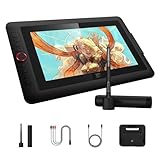
- PLEASE NOTE:XPPen Artist13.3 Pro drawing tablet Need to connect with computer,you need to use it with your computer or laptop, the 3 in 1 cable is included
- Drawing Tablet with Screen: Tilt Function- XPPen Artist 13.3 Pro supports up to 60 degrees of tilt function, so now you don't need to adjust the brush direction in the software again and again. Simply tilt to add shading to your creation and enjoy smoother and more natural transitions between lines and strokes
- Graphics Tablets: High Color Gamut- The 13.3 inch fully-laminated FHD Display pairs a superb color accuracy of 88% NTSC (Adobe RGB≧91%,sRGB≧123%) with a 178-degree viewing angle and delivers rich colors, vivid images, and dazzling details in a wider view. Your creative world is now as powerful as it is colorful
- Drawing Pad: One is enough- The sleek Red Dial on the display is expertly designed with creators in mind, its strategic placement allows for natural drawing postures. With just one wheel, you can effortlessly zoom in and out, adjust brush sizes, and flip the canvas—all tailored to suit the habits of everyday artists. The 8 customizable shortcut keys allow you to personalize your setup, streamlining your workflow and enhancing creative efficiency
- Universal Compatibility & Software Support:supports Windows 7 (or later), Mac OS X 10.10 (or later), Chrome OS 88 (or later), and Linux systems. Fully compatible with major creative software including Photoshop, Illustrator, SAI, and Blender 3D. Register your device to access additional programs like ArtRage 5 and openCanvas for expanded creative possibilities.
Google positions Stitch as a way to reduce the gap between an idea and something a team can see, discuss, prototype, and eventually implement. The useful workflow looks like this:
Product idea
→ prompt, image, sketch, code, or voice instruction
→ multiple UI directions
→ targeted refinement
→ linked prototype
→ design or developer handoff
That is considerably more useful than simply asking an image generator to draw an attractive app screen. But it is still a design-assistance workflow, not a guarantee that the resulting interface is usable, accessible, technically sound, or appropriate for real users.
What changed in Stitch?
| Date | What Google announced |
|---|---|
| May 20, 2025 | Stitch launched as a Google Labs experiment that could turn prompts and images into UI designs and front-end code. The original workflow also included a Paste to Figma handoff. |
| December 10, 2025 | Google announced Gemini 3 in Stitch and introduced Prototypes for connecting screens into navigable flows. Read Google’s announcement. |
| March 18, 2026 | Google announced the AI-native infinite canvas, a design agent, Agent manager, voice design, design-system portability through DESIGN.md, MCP tooling, the Stitch SDK, and broader developer workflows. Read the canvas announcement. |
| May 19, 2026 | Google announced real-time streaming to the canvas, live agent steering, AI Studio sharing, Antigravity export, Netlify publishing, and global availability of the latest updates. Read the update announcement. |
That timeline matters because older articles often describe Stitch as a simple prompt-to-mockup generator. The current product story is broader: Stitch is becoming an AI design workspace that can sit between product ideation and development.
Quick wins for a faster PC:
Repair Windows errors before they cause bigger problemsFix Now →Fix the driver behind crashes, sound loss and screen glitchesFind Drivers →Clear out junk files and repair common Windows errorsFree Scan →What can you give Stitch as input?
Google’s current descriptions identify several input types:
- Natural-language prompts: Describe the product, users, task, screens, mood, and constraints.
- Images and screenshots: Use a visual reference for hierarchy, layout, composition, or style.
- Rough sketches and wireframes: Give Stitch a structural starting point before visual polish.
- Text on the canvas: Add requirements, notes, product goals, or content guidance alongside the screens.
- Existing code: Provide implementation context or use code-to-design workflows.
- Website and design-system context: Give it a URL or design rules to extract or apply where supported.
- Voice instructions: Speak requests such as creating a page, changing a palette, or critiquing a flow.
- Existing project context: Ask the design agent to reason over the wider project instead of treating every screen as an isolated image.
These inputs serve different purposes. A screenshot may be a reference; a hand-drawn wireframe is primarily structural; a file of colors and type rules supplies design-system context; and a statement such as “make onboarding feel trustworthy” expresses product intent.
Google’s “vibe design” positioning emphasizes beginning with a business objective, desired user feeling, or visual inspiration rather than requiring a detailed wireframe first. That can be valuable when a team is still exploring. It also means the generated result should be treated as a hypothesis about the design—not proof that the underlying product decisions are correct.
Can Stitch generate an entire application?
It can generate much of the interface concept and a starting point for the front end, but it does not independently establish a complete production application.
Stitch can produce:
- Individual screens and screen variations.
- Related screens for a user journey.
- Clickable prototypes that demonstrate transitions.
- Front-end-oriented code and design artifacts.
- HTML and screen images through its developer tooling.
- Design context that can be handed to other Google development tools.
A real application also needs authentication, persistent state, database design, APIs, payments where relevant, security controls, permissions, server-side logic, monitoring, automated tests, deployment configuration, data protection, legal review, and reliable behavior across browsers and devices. Stitch does not remove those requirements.
Google’s own workflow places Google AI Studio and Antigravity downstream of Stitch when the goal is to add application logic and move toward a working product. Netlify publishing can put a result on the web, but publishing a generated project is not the same as validating it for production.
The infinite canvas: useful for exploration, harder to govern
The March 2026 redesign introduced an AI-native infinite canvas where a project can contain screens, variants, images, text, code, early concepts, prototypes, and design-system material. Its intended workflow is to support both:
- Divergence: Generate and compare several possible directions.
- Convergence: Select the strongest direction and refine it into a coherent flow.
This is a sensible model for early product work. Teams can put competing navigation approaches or dashboard layouts beside one another instead of prematurely committing to the first plausible result.
What’s actually slowing this PC down?
Pick the symptom - the matching free tool is one click away.
An infinite canvas is not automatically a mature design-file organization system, however. Before using Stitch for a large project, check how well the current product handles screen discovery, project structure, version history, locking, shared navigation, and consistent styles. Community reports have raised problems involving screen persistence, navigation consistency, awareness of deleted screens, and finding screens on a crowded canvas. These are user reports rather than proof of universal behavior, but they are reasonable reasons to keep local snapshots and avoid treating one experimental canvas as the only source of truth. See the Google AI Developers Forum discussion.
What the Stitch design agent can do
Stitch includes a design agent that Google says can reason over a project’s evolution. The Agent manager supports multiple design directions in parallel. In practical terms, the agent can:
- Track context across a project.
- Propose or execute design iterations.
- Reflow a design while working.
- Critique a screen or flow.
- Generate alternatives.
- Respond to typed or spoken instructions.
- Work with the wider canvas instead of only one isolated screen.
The limitation is important: project-level context does not guarantee perfect object persistence. An instruction such as “change only the button” can still cause unrelated changes to typography, layout, copy, or navigation. Google’s prompt guidance recommends small, specific, incremental edits instead of combining many unrelated requests.
Rank #2

- [Perfect Compatibility]: Our silver pen display riser is compatible with a wide range of laptops, including Macbook, Dell, HP, and Lenovo. It's also suitable for 10 to 15.6-inch drawing tablets or displays, such as the XPPen Artist 2nd Gen Series, Artist 12/12 Pro/13.3 Pro/15.6 Pro/16TP, and more.
- [Lightweight and Portable]: Our aluminum pen tablet stand weighs only 0.8 lbs and comes with a storage bag, making it easy to take with you to the office or on the go.
- [Stable and Secure]: With anti-slip silicone pads, our silver stand can hold your computer, tablet, or display steady on any surface.
- [Improved Cooling]: The alloy material helps your display or tablet cool better, preventing overheating and improving performance.
- [Designed for XPPen Artists]: Our stand is fully compatible with XPPen Artist 10 2nd, Artist 12, Artist 12 2nd, Artist 13 2nd, Artist 13.3 Pro, Artist 15.6 Pro, Innovator 16, and Artist Pro 16, making it the perfect accessory for any XPPen artist.
What voice controls are good for
Google says users can speak directly to the canvas, request critiques, create new pages, compare menu options, and change palettes in real time. Voice is best understood as a rapid conversational control and critique mechanism—not a hands-free replacement for reviewing the work.
Free tools Windows power users keep installed
One-click scans. No signup required.
Useful voice or text instructions include:
Give me three alternative navigation patterns for this dashboard.Keep the layout, but show three color palettes suitable for a healthcare product.Critique this onboarding screen for clarity, trust, and cognitive load.Create a desktop version without changing the information hierarchy.Interview me about the landing page before generating it.The last example is particularly useful: asking the tool to expose missing requirements can be more valuable than immediately asking for visual polish.
Prototypes: a clickable flow, not a finished application
Stitch’s Prototypes feature lets users connect screens into navigable flows and preview them in a Play-style experience. Google says Stitch can also generate logical next screens based on user interactions.
This makes Prototypes useful for demonstrating:
- Whether the proposed navigation makes sense.
- What happens after a primary action.
- How a stakeholder moves through onboarding or checkout.
- Whether a screen inventory is missing an obvious state.
Do not confuse a clickable prototype with working application logic. A prototype does not necessarily prove that forms submit, data persists, permissions work, APIs respond, or error handling is correct.
Prototype export is also version-sensitive. A Google forum response in March 2026 said that exporting the prototype itself was not supported, although individual screens could be exported. Check the live product before promising a portable prototype file or a particular handoff format. See the forum response.
The Tool Desk
Outbyte PC Repair FREERepair Windows errors before they cause bigger problemsFix Now →Outbyte Driver Updater FREEFix the driver behind crashes, sound loss and screen glitchesFind Drivers →DESIGN.md: portable design rules, not automatic design governance
Google introduced DESIGN.md as an agent-friendly representation of design rules. Stitch can extract a design system from a URL, and users can export or import design rules for reuse between projects and coding tools.
A useful DESIGN.md file can carry context such as:
- Color tokens and contrast expectations.
- Typography and type scale.
- Spacing rules.
- Component patterns.
- Responsive behavior.
- States and variants.
- Accessibility requirements.
- Voice and content rules.
- Usage restrictions and brand guidance.
But importing or extracting design rules does not automatically create a complete enterprise design system. Someone still needs to check whether the rules are accurate, whether tokens cover all states, whether contrast is acceptable, whether components behave responsively, and whether the organization has agreed on how those rules should be used.
Google’s official Stitch skills repository includes workflows for extracting design systems from code and applying DESIGN.md to Stitch projects.
How to use Google Stitch effectively
1. Start with the product decision, not decoration
A weak prompt asks for “a modern dashboard.” A stronger prompt identifies who is using the product, what they need to accomplish, what information matters, and what constraints must be respected.
Create a responsive web dashboard for independent physical therapists.

Primary users are clinic owners who need to see appointments, cancellations,
patient follow-ups, and outstanding insurance tasks at a glance.

The main goal is to reduce missed follow-ups, not to maximize data density.

Use a calm, trustworthy visual style with dark navy text, warm white surfaces,
one accessible teal accent, clear status labels, and large touch targets.

Create:
1. Overview dashboard
2. Appointment detail screen
3. Follow-up task list
4. Empty state
5. Error state

Use desktop and mobile layouts. Keep the navigation simple and make the next
recommended action obvious on every screen.
This prompt specifies the product type, users, core task, platform, visual direction, screens, responsive requirement, and a measurable priority. It gives Stitch enough context to produce a meaningful first direction without pretending that every detail is already settled.
2. Generate several directions
Do not treat the first result as the product. Generate alternatives when you are exploring. Compare them using criteria that matter to the project:
- Is the information hierarchy clear?
- Can the intended user find the primary action?
- Does the direction fit the brand?
- Does it work for both desktop and mobile?
- Will a developer be able to implement it sensibly?
- Does it handle accessibility and content-length concerns?
- Is it genuinely distinctive, or merely a familiar AI-generated pattern?
3. Refine one major thing at a time
Specific, bounded instructions reduce accidental changes.
Good:
On the appointment detail screen, keep everything else unchanged.
Increase the visual prominence of the next recommended action.
Also good:
Keep the current layout and copy. Change only the primary accent color
to an accessible deep teal and update related interactive states.
Risky:
Make the navigation simpler, add filters, redesign the cards, change the
typography, add dark mode, improve mobile responsiveness, and rewrite the copy.
Save or duplicate an acceptable state before a major experiment. If a broad prompt causes regressions, revert and make smaller changes instead of layering more instructions onto a damaged screen.
Windows Errors? Fix Them Before They Spread
Repair common Windows errors and clear accumulated junk for a smoother, more stable PC - no reinstall needed.Free scan · no reinstallOutdated Drivers Are Slowing You Down
One free scan finds every outdated or missing driver and matches the right update for your exact hardware.Free scan · exact hardware match4. Use references with explicit boundaries
You can provide a legal-to-use screenshot, rough wireframe, sketch, existing code, website, or design-system reference. Tell Stitch what the reference should control:
Rank #3
- Word-first 16K Pressure Levels: 1.5x* faster than ever. Initial response rate decreases to 90ms*. Accuracy increases by 20% to bring out every art project precisely what you want. Virtually no lag or broken lines. X3 pro smart chip stylus delivers much more precise and smooth lines than ever before - exceling athyper-nuanced creation and beyond
- Easy Control, One Scroll for All: Easy & efficiency Red Dial Quick Key simplifies the interface for beginners, like aspiring graphic designers and junior illustrators, allowing them to master essential controls such as brush size, navigation and zoom In/Out. This design ensures a natural hand position, reducing wrist strain during prolonged use. Additionally, with 8 customizable keys, users can easily assign frequently used functions, streamlining their workflow and minimizing interruptions
- User-friendly Setup: Understanding that many artists and designers, especially beginners, may not be tech-savvy,the new 13-inch drawing tablet features clear setup instructions for hassle-free installation. With an updated driver and intuitive interface, users can easily configure the drawing screen, and pens with a single installation. Quick access to settings allows adjustments to brightness, contrast, and color temperature (Windows only), enabling even newcomers to start creating right away
- Stunning Color Accuracy: Featuring 125% sRGB, 107% Adobe RGB, 95%display P3 color gamut, this tablet ensures every stroke has exceptional color fidelity. With 16.7 million colors at 8-bit depth, you can enjoy smooth gradients and rich transitions. The 250 cd/m² brightness and 1000:1 contrast ratio provide clearer, more vivid images, allowing artists to see their creations accurately. Ideal for both professionals and hobbyists
- Exceptional Visual Experience: Our 13.3-inch drawing tablet features a full-laminated screen with AG Film, reduces parallax and glare for a paper-like feel. With Full HD resolution and an IPS panel, enjoy vibrant colors and sharp details from a wide 178° viewing angle, ideal for drawing, animation, photography, fashion, architecture design, and much more
Use this image only for the information hierarchy and card arrangement.
Do not copy its branding, logo, text, imagery, or color palette.
This both improves the result and helps avoid accidentally asking an AI tool to reproduce another company’s identity or copyrighted material. Use fictional content when experimenting with sensitive work.
5. Add the states that promotional screenshots omit
Before calling a screen successful, request and review:
- Loading state.
- Empty state.
- Error state.
- Success state.
- Permission-denied state.
- Long text and localization stress cases.
- No-image state.
- First-time and returning-user experiences.
- Back navigation and recovery paths.
- Mobile navigation and small-screen behavior.
A polished default screen is not evidence of a usable product. The difficult design work often appears when data is missing, a request fails, the user makes a mistake, or the content is longer than the generated placeholder.
Do these 3 things before closing this tab:
1Clear out junk files and repair common Windows errors2Scan for outdated or missing drivers - takes under a minute3Repair Windows errors before they cause bigger problems6. Connect the user flow
Link the screens in Prototypes and walk through the journey as a first-time user, a returning user, and a user who makes an error. Check whether every primary action leads somewhere sensible, whether back navigation works conceptually, and whether the flow exposes missing screens.
7. Export a small sample before committing to a workflow
Export one representative screen first. Compare the result with the Stitch canvas for typography, spacing, images, layout, component structure, and responsive behavior. This is especially important when handing a project to another tool.
A community report described substantial visual divergence after exporting a Stitch design to AI Studio. That is an anecdotal report, not a universal product result, but it illustrates why a small handoff test is safer than exporting an entire project and assuming pixel-perfect fidelity. Read the reported issue.
8. Document the design decision
Before handoff, record:
- Target platform and screen sizes.
- Screen inventory.
- Navigation model.
- Component names and key states.
- Color and typography choices.
- Accessibility assumptions.
- Known unresolved problems.
- Which parts are concepts rather than approved requirements.
This prevents generated output from silently becoming the team’s accidental source of truth.
Prompt patterns that produce better results
For a screen-specific revision
Change only the appointment filter on the task-list screen.
Keep the current navigation, card dimensions, typography, copy, and colors unchanged.
Add a clear selected state and an accessible focus state.
For accessibility-focused critique
Review this flow for keyboard navigation, focus visibility, color contrast,
touch-target size, form-label clarity, error recovery, and screen-reader meaning.
List specific issues before proposing visual changes.
For responsive behavior
Create a mobile layout for this desktop dashboard.
Preserve the information hierarchy and primary task.
Explain what moves below the fold, what becomes collapsible, and what must remain visible.
Do not simply scale the desktop layout down.
For design-system reuse
Apply the supplied design rules consistently across every screen.
Use the defined color tokens, type scale, spacing system, component states,
and responsive rules. Flag any screen where the rules are insufficient instead
of inventing a conflicting pattern.
For critique before redesign
Critique this onboarding flow against the goals of clarity, trust, completion rate,
and error prevention. Identify the three highest-impact problems and explain why.
Do not redesign it yet.
Asking for an explanation or critique before a redesign can make the tool more useful as a thinking partner. It also gives a human reviewer something concrete to challenge.
Export and developer handoff: what is actually supported?
Figma
The original Stitch launch included Paste to Figma for refinement and collaboration. However, a later Google forum response said Figma export was available in Standard Mode and not Experimental Mode. Because Stitch is changing, treat Figma export as mode- and version-sensitive; verify the option in the current interface before promising it to a team. Original Figma announcement and later mode guidance.
Downloaded project
A Google forum response describes downloading the complete project through the three-line menu on the canvas. Product labels can change, so look for a current Download Project or equivalent command. Keep local copies after meaningful milestones instead of relying exclusively on an experimental cloud workspace. See the reported menu path.
HTML and screenshots
The official Stitch SDK exposes methods for retrieving generated HTML and screen images programmatically. These artifacts can help with inspection, documentation, or a downstream development workflow, but retrieved HTML should not be assumed to have the component architecture, semantics, accessibility behavior, and maintainability of a reviewed production codebase.
Google AI Studio
Google says Stitch can generate a shareable link through AI Studio and export screens into AI Studio-related workflows. AI Studio is the more appropriate environment for continuing toward a functional application, including application logic and deployment-oriented work. The handoff still needs to be checked for visual fidelity and code quality.
Google Antigravity
Google says designs can be exported into Antigravity to add backend logic and continue development. This reinforces the boundary between Stitch’s interface-and-design role and the engineering work required to make an application function.
Netlify
Google’s May 2026 announcement says users can publish work to the web directly with Netlify. Treat this as an announced integration, not a promise that every generated result is production-ready or that hosting, environment variables, security, monitoring, and application configuration are automatically solved for every account.
Rank #4

- Universal Compatibility: It's compatible with Windows 7/8/10/11, Mac 10.10 or later, Linux. Compatible with Photoshop, Illustrator, SAI, Painter, MediBang, Clip Studio, and more. It's ideal for digital drawing, animation, sketching, photo editing, 3D sculpting, and more (XP-PEN Artist12 drawing tablet must be connected to a computer to work).
- 11.6 HD IPS display: Artist12 drawing tablet is the XP-PEN’s latest smallest 1920x1080 HD display paired with 72% NTSC(100%SRGB) Color Gamut, presenting vivid images, vibrant colors and extreme detail for a stunning display of your artwork. It's pre-installed anti-reflective screen protector already. The slim touch bar can be programmed to zoom in and out, scroll up and down. Its 6 shortcut keys are customizable, XP-PEN driver allows the shortcut keys to be attuned to other different software
- Battery-free stylus with a digital eraser at the end: XP-PEN advanced P06 passive pen was made for a traditional pencil-like feel! Featuring a unique hexagonal design, non-slip & tack-free flexible glue grip, partial transparent pen tip, and an eraser at the end! Delivering technical sense, high efficiency, with a fashionable and comfortable grip, and there are 8 replacement pen nibs included with the multi-function pen holder
- XP-PEN Artist12 drawing tablet with screen is ideal for online education and remote work. Set the Artist12 drawing screen as an extended display when working from home, visually present your handwritten notes on the screen directly. Teachers and students can write and edit complicated functional equations with ease. It's compatible with XSplit, Zoom, Twitch, Microsoft Teams, ezTalks Webinar, Idroo, Scribbiar, wiziQ, and more
- XP-PEN provides a one-year warranty and lifetime technical support for all our drawing pen tablets/displays. Register your XP-PEN Artist12 drawing tablet on xp-pen web to apply for an ArtRage 5, openCanvas, or Explain Everything. Your laptop/desktop needs to have HDMI and USB-A ports available for the connection, or you need an extra converter(such as Thunderbolt to HDMI, depends on what ports that your laptop/desktop has) for the connection
MCP and the Stitch SDK
Google publishes an official Stitch SDK and MCP-related tooling. The SDK supports project and screen operations, generation, editing, variants, HTML retrieval, image retrieval, tool discovery, and agent integration.
Do these 3 things before closing this tab:
1Repair Windows errors before they cause bigger problems2Fix the driver behind crashes, sound loss and screen glitches3Clear out junk files and repair common Windows errorsFor a developer, the documented installation begins with:
npm install @google/stitch-sdkA simplified example from the official SDK documentation looks like this:
import { stitch } from '@google/stitch-sdk';

const project = stitch.project('your-project-id');
const screen = await project.generate(
  'A login page with email and password fields'
);

const html = await screen.getHtml();
const imageUrl = await screen.getImage();
This is not the normal path for a casual Stitch user. It requires authentication and a project ID. The SDK documentation lists STITCH_API_KEY, OAuth access tokens, and GOOGLE_CLOUD_PROJECT as configuration options. Use the repository documentation for the current setup rather than assuming the example is sufficient for a production integration.
Where Stitch falls short of a professional designer
The claim that Stitch can turn anyone into a “professional UI designer” confuses professional-looking output with professional design competence.
A professional designer must make and defend decisions about:
- User goals and evidence from research.
- Information architecture and navigation.
- Content hierarchy and wording.
- Interaction states and error prevention.
- Accessibility and assistive-technology behavior.
- Responsive behavior across devices.
- Brand consistency and design-system governance.
- Business, technical, legal, and regulatory constraints.
- Implementation feasibility and long-term maintainability.
- Usability testing and iteration based on observed behavior.
Stitch can produce a plausible visual answer without proving that any of those decisions are correct. It may use generic labels, familiar card layouts, arbitrary spacing, weak empty states, or visual patterns that look polished but do not support the actual task.
Independent reviews have reached a similar broad conclusion: Stitch is impressive for first-pass ideation but less compelling when users require precise editing, reliable control, mature design-system workflows, and deeper accessibility judgment. See reviews from Bitovi, LogRocket, and Human Augmented.
Stitch’s biggest trade-offs
| Area | Advantage | Trade-off |
|---|---|---|
| Speed | Creates a visual direction quickly. | The first result may be generic, inconsistent, or based on weak assumptions. |
| Iteration | Prompt, voice, and agent-based changes are fast. | Broad instructions can alter unrelated layout, copy, or navigation. |
| Canvas | Supports many ideas and assets in one workspace. | Large projects may become difficult to organize and search. |
| Prototyping | Illustrates flows and transitions rapidly. | A clickable flow is not application logic or reliable state management. |
| Code handoff | Bridges visual exploration and development. | Generated code needs review, restructuring, testing, and accessibility work. |
| Figma handoff | Can reduce the need to recreate an initial concept manually. | Export availability may depend on mode and current product behavior. |
| Design systems | DESIGN.md makes rules more portable. |
Imported rules still need verification, governance, and coverage of states. |
| Cost | Historically available as a free Google Labs product. | Quotas, modes, limits, and future pricing are not stable enough to assume. |
| Collaboration | Project context can move into other Google tools. | That does not automatically provide the governance and collaboration depth of a mature design platform. |
Pricing and generation limits
Do not rely on a single quota number copied from an older article. Stitch has historically been offered free through Google Labs with separate monthly generation allowances for its modes, but Google’s publicly indexed statements have changed:
PC Slower Than It Used to Be?
A free scan shows the junk files, broken settings and background clutter dragging Windows down - then fixes them in one click.Free scan · Windows 10 & 11Outdated Drivers Are Slowing You Down
One free scan finds every outdated or missing driver and matches the right update for your exact hardware.Free scan · exact hardware match- An August 2025 Google forum response stated 350 Standard-mode generations and 50 Experimental-mode generations per month.
- A September 2025 response said Experimental capacity had increased to 200 per month.
- An October 2025 response listed 350 Standard and 200 Experimental generations and said there was no paid increase option at that time.
These historical figures are documented in the August discussion, the September discussion, and the October discussion. They should not be presented as the definitive August 2026 limit.
Safe conclusion: check the quota shown in the live account before planning a project around a specific number. Do not promise unlimited generations, a paid Pro plan, a fixed 2026 price, a guaranteed free tier, or a particular model unless the current Stitch interface explicitly confirms it.
Availability, privacy, and confidential work
Google’s May 2026 announcement says the latest updates were available to global users beginning that day. Earlier Google forum guidance described Stitch as available to users aged 18 and older in more than 200 countries, but not everywhere. Access can still vary by country, age, account, and Google product availability. A Google account is not a guarantee that every feature will appear.
The public Stitch pages do not provide enough detail to safely summarize how every prompt, attachment, generated screen, or feedback submission is handled. A Google AI Developers Forum response directs users to the in-product Privacy Notice through the profile menu. Read that notice before uploading sensitive material.
Until the current terms and privacy treatment are clear for your account and use case:
Best Value

- PLEASE NOTE: The XPPen Artist 15.6 Pro needs to connect with a computer to use. You need to use it with your Computer or Laptop. It is NOT a standalone drawing tablet
- Outstanding Visuals: The immersive 15.6 inch large screen with 1920x1080 p full HD resolution presents your creation in the depth of detail, provides you with clarity to see every detail of your work
- 8 customized express keys: The Artist 15.6 Pro monitor features 8 fully customizable shortcut keys and puts more customization options at your fingertips to suit you preferred work style, allowing you to capture and express your ideas easier and faster for optimized workflow
- Full-laminated Technology: XPPen Artist15.6 Pro art tablet is adopting full-laminated technology, seamlessly combines the glass and the screen, to create a distraction-free working environment that's also easy on the eyes
- Advanced Pen Performance: With up to 16384 levels of pressure sensitivity, the Battery-free Stylus provides you with increased accuracy and enhanced performance to create the finest sketches and lines
- Do not upload confidential client material or unreleased product plans.
- Remove names, account numbers, medical information, credentials, and internal URLs.
- Use fictional content for experiments.
- Do not submit proprietary source code without approval.
- Treat public sharing links as public unless the current interface clearly says otherwise.
- Do not infer enterprise confidentiality guarantees merely because Google operates the product.
For the in-product Privacy Notice guidance, see the Google forum response.
Common failure modes and how to recover
A prompt changes unrelated parts of the design
Likely cause: The instruction is too broad, the agent reinterprets the screen, or an object is not preserved precisely.
- Save or duplicate the last acceptable state.
- Name the exact screen.
- Identify the exact component to change.
- State what must remain unchanged.
- Make one change.
- Revert if the result damages the layout instead of stacking more corrective prompts.
A screen disappears or does not render
Forum reports mention incomplete or missing screens. Try refreshing the project, locating or recentering the screen on the canvas, and regenerating only the incomplete screen or element. A Google forum response suggested selecting incomplete elements and requesting regeneration. Keep a downloaded project or screenshot after each successful milestone. See the reported recovery advice.
A generation hangs or silently resets
Reported causes include exhausted generation limits and service outages. Check the account’s current quota, re-authenticate, and retry later if there is an outage. Preserve the existing project before starting over, and avoid repeatedly resubmitting the same prompt if each attempt may consume quota. See the forum report.
The exported design does not match the canvas
Export a small, representative screen first. Compare fonts, spacing, images, layout, responsive behavior, and interactions. Keep Stitch as a visual reference and treat the receiving tool’s output as a starting point rather than a guaranteed pixel-perfect transfer.
Figma export is missing
Check the current mode. Later Google forum guidance tied Figma export to Standard Mode, although this may change. Do not promise universal Figma export for Experimental-mode or image-based workflows without verifying it in the live interface.
The project download or duplication fails
Some users reported download, duplication, and missing-screen problems in 2026. These reports do not establish universal failure, but they support a practical rule: maintain local screenshots, exported artifacts, or project downloads after important milestones. See the reported project-management issue.
Recommended Free Tools
Who should use Stitch?
Strong fits
- Founders: Turn an abstract product idea into something concrete for discussion.
- Developers: Explore interface directions before building components.
- Product managers: Explain a proposed flow to stakeholders.
- Professional designers: Generate alternatives and escape the blank canvas.
- Students: Study hierarchy, screen states, and user flows while learning design fundamentals.
- Small teams: Create early concepts and prototypes without setting up a full design process.
- Design-to-code teams: Carry visual context into code-oriented tools through the SDK, MCP, or
DESIGN.md.
Poor replacements
- A mature design system with strict governance and a large component library.
- User research, usability testing, or content strategy.
- Accessibility auditing and assistive-technology testing.
- Complex interaction design with many dependent states.
- High-precision production design requiring reliable object-level control.
- Regulated or safety-critical product review.
- Production-grade engineering, security, testing, monitoring, and operations.
- Work involving confidential data that has not been cleared for external AI processing.
A practical professional-quality checklist
Before calling a Stitch result ready for a real project, ask:
- Does the design solve a demonstrated user problem?
- Is the information architecture understandable without the creator’s explanation?
- Are primary, secondary, disabled, loading, success, and error states defined?
- Can keyboard users navigate the interface and see focus?
- Do color contrast, labels, headings, and controls meet the project’s accessibility requirements?
- Does the layout work at the actual target breakpoints?
- What happens with long text, missing images, slow networks, and rejected permissions?
- Are the words clear, accurate, and appropriate for the audience?
- Are components and tokens consistent across screens?
- Can a developer maintain the generated output?
- Has someone tested the flow with representative users?
- Have security, privacy, legal, and regulatory requirements been reviewed?
If the answer to several of these is “not yet,” the result is a promising concept—not a professional finished interface.
Verdict: useful design collaborator, not an autonomous designer
Stitch is most valuable when it reduces the blank-canvas problem. It lets a founder, developer, student, product manager, or designer move quickly from a sentence or sketch to several concrete interface directions. Its newer canvas, agent, voice controls, prototypes, design-system files, SDK, and development exports make it more than a screenshot generator.
But the headline claim goes too far. Stitch can make professional-looking UI appear quickly; it cannot make someone professionally competent at UI/UX design. The reliable workflow remains:
The Tool Desk
Outbyte PC Repair FREEClear out junk files and repair common Windows errorsFree Scan →Outbyte Driver Updater FREEFix the driver behind crashes, sound loss and screen glitchesFind Drivers →Generate → critique → compare → refine → test → revise → implementUse Stitch for ideation, flow exploration, prototyping, and design-to-code handoff. Use human design judgment, research, accessibility review, and engineering discipline to decide whether the result deserves to ship.
Frequently Asked Questions
Is Google Stitch free?
Stitch has historically been offered free through Google Labs, with separate generation allowances for its modes. Google’s publicly indexed quota statements have changed, so check the live account for the current allowance rather than relying on an old number or assuming unlimited use.
Does Stitch replace Figma?
No. Stitch can hand work off to Figma in supported workflows, and later guidance tied that capability to Standard Mode. Stitch is better viewed as an AI exploration and handoff tool that can complement a mature design platform.
Can Stitch build a production-ready app?
It can generate screens, prototypes, front-end-oriented output, HTML, and developer handoff material. Production applications still require backend logic, data storage, authentication, security, accessibility testing, automated tests, monitoring, and human engineering review.
Free tools Windows power users keep installed
One-click scans. No signup required.
Can Stitch export a clickable prototype?
Google introduced clickable Prototypes, but a March 2026 forum response said exporting the prototype itself was not supported even though individual screens could be exported. Verify the current product because export capabilities are changing.
The Bottom Line
Bottom line: Google Stitch is a powerful way to turn product intent into UI concepts and early flows. It is not a shortcut to professional design competence or production software. Use it to explore faster, then let designers, researchers, accessibility specialists, and developers validate and finish the work.
Quick Recap
Product prices and availability are accurate as of the date/time indicated and are subject to change. Any price and availability information displayed on Amazon at the time of purchase will apply.

