
The Tool Desk
Outbyte Driver Updater FREEFix the driver behind crashes, sound loss and screen glitchesFind Drivers →Outbyte PC Repair FREERepair Windows errors before they cause bigger problemsFix Now →Embedded audio is moving beyond playback: devices increasingly use microphones to hear commands, detect events and adapt sound to their surroundings. The five trends identified by HARMAN Embedded Audio author David Owens—voice in unexpected places, voice as a primary interface, 3D audio, noise suppression, and closer hardware-software integration—remain a useful way to understand the field. Recent examples in automotive sensing, wireless reference designs and embedded audio APIs show how those ideas are being implemented, though they do not establish how common each approach is across the market.
1. Voice is appearing in more kinds of devices and environments
Voice-enabled audio is no longer limited to smart speakers. The idea is to place microphones and voice-aware software in the environments where people already work or use devices: appliances, bathrooms, furniture, healthcare interactions, vehicles, helmets, kiosks and service settings. In each case, the device must capture useful sound in its physical context; adding a microphone alone does not make an interaction reliable.
Listening beyond the vehicle cabin
HARMAN announced a Sound and Vibration Sensor and an External Microphone on January 4, 2023. HARMAN says the products can support emergency-vehicle siren detection, exterior speech commands, glass-break detection and vehicle-impact detection. The company describes the sensor as sealed and designed for unobtrusive exterior integration. This is a notable extension of embedded audio: sound is used not only for entertainment or a spoken command, but also as a signal about what is happening around a vehicle. The announcement describes product capabilities; it does not establish detection accuracy or performance under particular road conditions.
2. Voice can become the primary user interface
In a hands-free setting, spoken commands can reduce reliance on touchscreens or physical controls. That can suit vehicles, kitchens, helmets, kiosks, robots and service interactions, but whether voice should be the main interface depends on the task and environment. A command interface must recognize speech amid competing sound, respond clearly and provide an alternative when speaking is inconvenient or recognition fails.
#1 Best Overall

- Powerful Processor: Equipped with ESP32-S3R8 Xtensa 32-bit LX7 dual-core processor, up to 240MHz main frequency. Supports 2.4GHz Wi-Fi (802.11 b/g/n) and Bluetooth 5 (LE), with onboard antenna. Built-in 512KB of SRAM and 384KB ROM, with onboard 8MB PSRAM and an external 16MB Flash memory.
- Driver and Touch LCD: Onboard 1.83inch IPS Capacitive Touch Display, 240 × 284 resolution, 65K color. Built-in ST7789P display driver and CST816D capacitive touch chip, using SPI and I2C communication respectively, effectively saving the IO resources. Adopts Type-C port to improve user convenience and device compatibility.
- Supports Offline Speech recognition and AI Speech Interaction: Allows access to online large model platforms such as ChatGPT, DeepSeek, Doubao, etc. Onboard ES8311 audio codec chip and ES7210 echo cancellation circuit to meet daily audio application scenarios.
- Multifunctional Sensor: Onboard QMI8658 6-axis IMU (3-axis accelerometer and 3-axis gyroscope) for detecting motion gestures, counting steps, etc; PCF85063 RTC chip connected to the battry via the AXP2101 for uninterrupted power supply; Onboard PWR and BOOT programmable buttons for easy custom function development.
- Rich Peripheral Interface: Reserved 1 × I2C, 1 × UART and 1 × USB pads for external device connection and debugging, enabling flexible peripheral configuration. Onboard TF card slot for extended storage and fast data transfer, suitable for applications such as data recording and media playback, simplifying circuit design.
DSP Concepts identifies voice assistants, natural ordering, robots that hear and respond, and connected living environments as deployment contexts for embedded audio processing. These examples illustrate the breadth of the interaction model, not a claim that voice has replaced other controls in those settings.
3. 3D audio extends spatial sound beyond games and films
3D audio uses spatial cues to make sound seem to come from particular directions or positions, rather than simply from a left-right stereo image. That can support a stronger sense of presence in entertainment, but spatial audio also has potential in interactive interfaces, recordings, playback and device feedback. The practical value depends on the experience being designed: a spatial effect is useful when location or movement adds information or immersion, not merely because a system can render it.
Rank #2

- 🖥️ Professional HUB75 LED Matrix Controller: Designed as a LED matrix controller board, this module supports HUB75 RGB LED matrix panels for smart displays, animated signs, dashboards, and custom interface projects. Optimized for embedded display control and graphical applications with smooth performance.
- 🎤 Dual Microphone Audio Interaction Board: Built as an audio interaction development board, it features an onboard dual microphones array, ES7210 echo cancellation chip, and ES8311 codec chip for voice pickup, sound processing, and speaker output. Suitable for smart voice interfaces and multimedia display systems.
- 💾 High Performance Development Board: This ESP32-S3 development board integrates 32MB Flash, 16MB PSRAM, TF card slot, USB Type-C, UART, I2C, GPIO, and programmable buttons, giving developers flexible storage, debugging, and expansion options for advanced embedded projects.
- 🧭 Sensor Rich Smart Display Board: As a smart display board, it includes onboard 6-axis IMU motion sensor, temperature and humidity sensor, plus RTC clock chip for gesture sensing, environment monitoring, and real-time clock functions. Ideal for interactive dashboards and AIoT systems.
- ⚙️ LVGL GUI Development Platform: This LVGL development board supports ESP-IDF, Arduino, and LVGL GUI development, helping users quickly build custom user interfaces and scalable RGB matrix display systems. Dual power input design supports cascading panels for larger installations.
The Khronos Group’s OpenSL ES documentation lists 3D positional audio among embedded capabilities and names interactive audio, gaming, recording, playback and device UI audio as target applications. Khronos describes OpenSL ES as a royalty-free, cross-platform, hardware-accelerated audio API tuned for embedded systems. The API documentation establishes support and intended application areas; it does not mean every device implementing it has the same spatial features or output hardware.
4. Noise suppression makes far-field voice capture more practical
Far-field microphones must capture a speaker from a distance while handling room noise, loud background sound and audio played by the device itself. Owens’ five-trend framework groups several techniques under noise suppression: noise cancellation, echo cancellation, ambient-noise reduction and beamforming. These address different parts of the problem. Echo cancellation targets audio from the device’s own loudspeaker returning into its microphones; ambient-noise reduction seeks to lessen unwanted surrounding sound; beamforming uses microphone-array processing to emphasize sound from a chosen direction.
Rank #3

- Built for Custom Integration: Keep control of the enclosure, mounting and final device layout. The open-board format fits robots, kiosks, custom voice devices and embedded prototypes where flexible mechanical integration matters.
- Onboard Voice Processing: XVF3800 performs AEC, beamforming, de-reverberation, DoA, VAD, AGC and noise suppression before audio reaches your application, helping reduce downstream audio preprocessing.
- 360° Far-Field Voice Capture: Four MEMS microphones in a circular array support speech pickup from different directions at distances up to 5 m, so users do not need to speak toward one fixed microphone position.
- XIAO ESP32S3 for Embedded Voice: The pre-soldered XIAO adds Wi-Fi, Bluetooth Low Energy and MCU-side control for connected voice interfaces, local wake-word projects and custom embedded applications.
- Firmware Options: Ships with Standard I2S firmware for XIAO ESP32S3 and is not a USB audio device by default; switch to USB firmware for host audio or use dedicated 48 kHz HA I2S firmware for Home Assistant and ESPHome Voice; configurations are separate.
Reliable capture is a system-level task. Microphone placement and acoustic design affect what reaches the sensors, while signal processing and software tuning determine how the device treats that signal. As a result, adding one processing feature is not by itself proof that a device will hear a distant speaker clearly in every environment. The relevant evaluation should reflect the actual acoustic setting and use case.
5. Hardware and software are being designed together
Microphones, speakers, codecs and processors set the physical and compute boundaries for an audio product; software shapes how it listens, processes and reproduces sound. HARMAN’s original trend description points to software functions such as enhancement, automatic equalization, noise reduction and conferencing. Current Audio Weaver materials from DSP Concepts describe real-time processing, adaptive listening, spatial sound and machine learning, with deployment contexts including automotive, personal devices, collaborative rooms, robots, hospitality and smart homes.
Rank #4

- High-performance ADAU1467 DSP Core Board designed for advanced processing applications.
- Supports a wide range of formats and provides exceptional sound quality for professional systems.
- Low power consumption design ensures efficient operation, making it ideal for embedded solutions.
- Versatile compatibility with various devices, enhancing your projects with ease.
- Compact and user-friendly design, perfect for engineers and developers looking to integrate DSP technology into their products.
Automotive audio becomes a connected system
STMicroelectronics describes Audio over Ethernet as a way to distribute synchronized, multichannel audio among vehicle zonal controllers, amplifiers, microphones and other endpoints while reducing dedicated wiring. Its described architecture uses IEEE 1722 AVTP for audio-video transport and IEEE 802.1AS/PTP for timing. This approach makes synchronization and network design part of the audio system, rather than treating each audio endpoint as an isolated component.
Low-power designs balance always-on listening with energy use
Renesas’ Bluetooth LE Audio Player reference design targets smart helmets and voice-controlled speakers. Its undated current product page specifies an always-on codec at 650 µW and also lists a 35 µA quiescent-current power variant. Those figures describe different electrical quantities and should not be treated as directly comparable or as a complete estimate of a finished product’s power consumption. They illustrate why embedded audio designs must account for both the function expected to remain available and the power budget of the full device.
Recommended Free Tools
Best Value
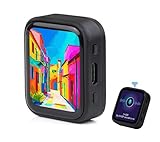
- ESP32-S3R8 Processor--- Equipped with ESP32-S3R8 Xtensa 32-bit LX7 dual-core processor, up to 240MHz main frequency. Supports 2.4GHz W-i-F-i (802.11 b/g/n) and Blue--tooth 5 (LE), with onboard antenna. Built in 512KB of SRAM and 384KB ROM, with onboard 8MB PSRAM and an external 16MB Flash memory.
- AMOLED Touch Screen--- Onboard 1.8inch AMOLED display for clear color picture display, 368 x 448 resolution, 16.7M color, 178° wide viewing angle. Compared to those traditional LCD displays, the AMOLED screen features precise light-control capability, representing more delicate colors, more picture details, and more vivid video image.
- Onboard Audio Codec---Supports high-quality audio processing, providing clear and high-quality audio input and output. Supports Offline Speech recognition and AI Speech Interaction---Allows access to online large model platforms to support more AI application scenarios.
- For Various Smart Devices---Suitable For Various Smart Devices Development, Can Realize Human-Computer Interaction Function. Supports installing ba|tte|ry inside the case for independent operation. (Note: this version doesn't include ba|tte|ry ) Dedicated Black Case---with removable back cover for easy embedded into the projects and DIY design.
- Sensor and Chip---Onboard QMI8658 6-axis IMU (3-axis accelerometer and 3-axis gyroscope) for detecting motion gesture, counting steps, etc. Built-in SH8601 display driver and FT3168 capacitive touch chip, using QSPI and I2C communication respectively, effectively saving the IO resources.
Portability and deployment still depend on the implementation
Khronos positions OpenSL ES as a cross-platform embedded API with low-latency access, recording, playback and 3D positional audio. An API can provide a common software interface, but actual behavior still depends on the device, operating environment, hardware support and chosen processing chain. For a product team, the practical comparison is therefore broader than audio quality alone: interaction mode, spatial capability, resistance to noise and echo, compute and power budgets, latency and synchronization, connectivity, portability, privacy and deployment context all matter.
Independent reader supportYour contribution helps us test, update, and keep practical guides available for everyone.How the five trends fit together
The trends are related but not interchangeable. Putting a microphone in a new location creates a need to understand the local sound environment; making voice the main interface raises the cost of recognition failures; noise suppression helps address difficult capture conditions; spatial audio changes how playback communicates position; and hardware-software integration determines whether these capabilities can work together within power, latency and connectivity limits.
HARMAN and Futuresource Consulting reported in 2019 that 90 percent of more than 8,000 consumers surveyed across six countries considered sound integral to life. That is a dated corporate survey result, not a current market estimate. It offers context for why audio matters to product design, but it does not measure adoption of any of these five embedded-audio trends.
Quick Recap
Product prices and availability are accurate as of the date/time indicated and are subject to change. Any price and availability information displayed on Amazon at the time of purchase will apply.
Quick wins for a faster PC:
Fix the driver behind crashes, sound loss and screen glitchesFind Drivers →Clear out junk files and repair common Windows errorsFree Scan →Scan for outdated or missing drivers - takes under a minuteDriver Scan →
