
Recommended Free Tools
iTechGuides is reader-supported. When you buy through links on our site, we may earn an affiliate commission. As an Amazon Associate I earn from qualifying purchases. Learn more
Genetically engineered Escherichia coli can produce a biomolecule that researchers process into a palladium-binding biosorbent, according to a report by Chemistry World. The proposed use is to capture palladium from polluted water and help remove it. This is a research approach, not an established commercial treatment: the available reporting does not provide verified performance figures or evidence of industrial deployment.
How the engineered-bacteria approach works
The bacteria are production hosts: engineered E. coli makes the palladium-binding biomolecule, which is then used as the active material in a biosorbent. The reported process breaks down the cells after production rather than relying on living bacteria as the final capture medium. Chemistry World describes the biomolecule’s proposed role as binding palladium and helping remove it from the environment.
That distinction matters. The reported concept is not simply to add bacteria to contaminated water and let them absorb metal. It uses an engineered organism to manufacture a capture material, then processes the cells to obtain that material.
What the available evidence establishes
The title-specific account is secondary reporting; the original research paper is not available in the cited material. It therefore supports a description of the concept, but not detailed claims about how well the material performs. No verified adsorption capacity, selectivity, production yield, number of reuse cycles, cost comparison, or field-scale result is established for this engineered E. coli biosorbent.
#1 Best Overall

- Contains the following
- COVERS EVERY COMMON GOLD KARAT--Five separate testing solutions cover the full range of gold purity you'll encounter, from low-grade scrap to high-purity antique and bullion pieces.10K,14K, 18K, 22K, SLV, PLT
- SILVER TESTING INCLUDED — Quickly tell .999 pure silver from .925 sterling with our included silver acid solution. Perfect for coins, bullion, jewelry, scrap.
- PLATINUM SOLUTION INCLUDED — Instantly verify authentic platinum jewelry, bands, and bullion with a clear, reliable acid reaction.
- (2 x 4)TESTSTONE INCLUDED-- Easy to use, compact for on the go, durable and lightweight.
In particular, results from other microbial palladium studies cannot fill those gaps. Performance depends on the organism, capture mechanism, and water or waste mixture tested. A result from one laboratory system is not a measured result for this engineered biomolecule.
How it differs from other microbial palladium research
Several research lines use biological systems to recover palladium, but they are not interchangeable. The studies below are separate investigations, not head-to-head comparisons with the engineered E. coli biosorbent.
Rank #2

- -- Contains the following --
- -- GOLD FULL SPECTRUM COVERAGE — Our touchstone verifies every major karat (9K, 10K, 12K, 14K, 18K, 20K, 22K–24K) for fast, organized, foolproof acid testing. Great for first timers or professional jewlers.
- -- SILVER TESTING INCLUDED — Quickly tell .999 pure silver from .925 sterling with our included silver acid solution. Perfect for coins, bullion, jewelry, scrap.
- -- PLATINUM SOLUTION INCLUDED — Instantly verify authentic platinum jewelry, bands, and bullion with a clear, reliable acid reaction.
- -- ACID NEUTRALIZER 8 OZ PACKET INCLUDED — Safely stop acid reactions after each test to protect your jewelry, touchstone, and work surface.
| System | Mechanism | What the cited study tested or reported |
|---|---|---|
| Engineered E. coli biomolecule | Cells produce a palladium-binding biomolecule that is processed into a biosorbent. | Concept reported by Chemistry World; quantitative performance details are not established in the available account. Source |
| Baker’s yeast, Saccharomyces cerevisiae | Pd(II) collection through biosorption and bioreductive deposition. | A 2020 laboratory study under specified experimental conditions; this is a different organism and process. Study |
| Geobacter sulfurreducens | Enzymatic bioreduction forms metal nanoparticles. | A study published in 2025 examined recovery of Pd, Pt, and Rh. Its authors reported bimetallic catalysts that performed comparably to bio-Pd in a 4-nitrophenol reaction while using half the palladium content. That catalytic result does not validate the engineered E. coli biosorbent. Study |
| Enterococcus faecalis Z5 | Palladium nanoparticle recovery from simulated industrial waste streams. | A 2017 study reported different recovery efficiencies for different simulated wastewater sources, illustrating the importance of the test mixture. Abstract |
Why wastewater composition changes the result
The 2017 E. faecalis study reported 99.8% biosorption efficiency after six hours for a simulated industrial-processing leachate, 99.7% after eight hours for a simulated spent-automotive-catalyst stream, and 90.3% after 12 hours for a printed-circuit-board-scrap simulation. These are results for that organism and those laboratory mixtures—not performance figures for the engineered E. coli material.
Windows Errors? Fix Them Before They Spread
Repair common Windows errors and clear accumulated junk for a smoother, more stable PC - no reinstall needed.Free scan · no reinstallCrashes, No Sound, or Screen Glitches?
Random freezes, missing sound and display glitches usually trace back to one bad driver. Find and replace yours safely.Free scan · under a minuteThe same study reported 96.7% methylene-blue degradation within 80 minutes after the recovered nanoparticles were doped with ferriferous oxide. That was a downstream catalytic test, not a palladium recovery rate. Together, the differing results across simulated streams show why recovery percentages should always be tied to the specific feed composition and experimental conditions.
Rank #3
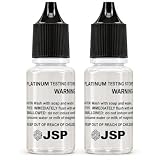
- ✅ PLATINUM AND PALLADIUM EVALUATION – Formulated for preliminary, comparative testing of sample marks made from jewelry, components and scrap metal.
- ✅ OBSERVE THE SAMPLE MARK – A mark with no color change may be consistent with platinum, while a red reaction may indicate possible palladium.
- ✅ COMPARATIVE INTERPRETATION – A mark that weakens or dissolves may indicate a non-platinum metal or a lower-purity alloy; results can vary according to sample composition.
- ✅ SIMPLE THREE-STEP PROCESS – Make a mark on a compatible testing stone, apply one drop to the mark and observe the resulting response.
- ✅ CONTROLLED APPLICATION – Sturdy plastic dropper bottle features an internal flow-control baffle to help dispense the small amount needed for each evaluation.
Does this mean the biosorbent is ready for use?
No. The available sources describe research, but do not establish a commercial product, industrial-scale deployment, or readiness for treating polluted water outside the laboratory. Nor do they establish how the material would perform in real wastewater containing competing substances, or how it would be recovered and reused in practice.
The approach is potentially relevant to precious-metal recovery from aqueous waste, but its practical value cannot be judged from the concept alone. It would require verified measurements for the engineered material and evidence in the actual waste streams and operating conditions where it is intended to work.
Quick Recap
Best Value

- FUN, FAST, AND ACCURATE! DETERMINES THE KARAT OF GOLD, SILVER, & PLATINUM JEWELRY IN SECONDS!
- ALL-IN-ONE GOLD, SILVER, PLATINUM TESTING & APPRAISAL KIT
- 2 AUTHENTIC *LARGE* GTE 2''x 4'' JEWELRY TOUCHSTONES FOR SAFE TESTING THAT WON'T DAMAGE YOUR JEWELRY
- BONUS* GTE ACID NEUTRALIZER QUICKLY CLEANS STONE
- A MUST-HAVE FOR ANYONE WHO WANTS TO INVEST IN GOLD, SILVER, & PLATINUM
Rank #4

- ✅ PLATINUM AND PALLADIUM EVALUATION – Formulated for preliminary, comparative testing of sample marks made from jewelry, components and scrap metal.
- ✅ OBSERVE THE SAMPLE MARK – A mark with no color change may be consistent with platinum, while a red reaction may indicate possible palladium.
- ✅ COMPARATIVE INTERPRETATION – A mark that weakens or dissolves may indicate a non-platinum metal or a lower-purity alloy; results can vary according to sample composition.
- ✅ SIMPLE THREE-STEP PROCESS – Make a mark on a compatible testing stone, apply one drop to the mark and observe the resulting response.
- ✅ CONTROLLED APPLICATION – Sturdy plastic dropper bottle features an internal flow-control baffle to help dispense the small amount needed for each evaluation.
Product prices and availability are accurate as of the date/time indicated and are subject to change. Any price and availability information displayed on Amazon at the time of purchase will apply.

