
iTechGuides is reader-supported. When you buy through links on our site, we may earn an affiliate commission. As an Amazon Associate I earn from qualifying purchases. Learn more
AI inference is moving toward the network edge, but not away from cloud altogether. Edge inference means running a model near the device, data source or user; a practical system often divides work among endpoints, local servers, telco edge sites and regional or cloud infrastructure. The right placement depends on how quickly a response is needed, how much data must move, and what the organization can operate securely.
What edge inference means
Inference is the stage at which a trained AI model processes new input to produce a result. In edge inference, some or all of that processing happens close to where the input is generated or used. The “edge” can mean a camera, sensor, phone, gateway, enterprise site server or nearby telco multi-access edge computing (MEC) location; it does not mean only AI running directly on a device. AWS’s explanation of edge inference describes the approach and its trade-offs.
Moving inference closer can reduce the need to send continuous video or sensor streams to a distant data center, shorten the network path for time-sensitive responses, and help keep some data within a site. Those are architectural possibilities, not automatic outcomes: actual latency, privacy and cost depend on the hardware, software, network and data flows involved.
The Tool Desk
Outbyte Driver Updater FREEFix the driver behind crashes, sound loss and screen glitchesFind Drivers →Outbyte PC Repair FREEClear out junk files and repair common Windows errorsFree Scan →Why more inference is being placed near users and data
Cameras, sensors and other connected systems can generate data continuously. Shipping every raw stream to a central service can consume bandwidth and add delay, while some applications need to respond even when a wide-area connection is impaired. Privacy, sovereignty or internal data-handling requirements can also favor processing on premises. Network World reports these drivers and quotes ABI Research analyst Paul Schell saying that keeping data on premises can avoid transfer problems and loss of connectivity that could affect safety-related use cases.
#1 Best Overall
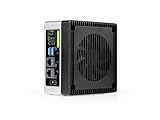
- Supercharged AI Performance: Powered by NVIDIA Jetson Orin NX 16GB, delivers up to 157 TOPS in MAXN Super Mode — ideal for vision AI, robotics, autonomous machines, and generative AI workloads.
- Advanced Thermal Engineering for Full-Power Operation: Equipped with a vacuum copper heat pipe system, ultra-low thermal resistance medium, and high-emissivity black-coated surface combined with high-performance active cooling — ensuring stable full compute power even at 60°C ambient temperature.
- Energy-Efficient & Flexible Power Modes: Adjustable power profile from 10W to 40W, enabling a perfect balance between performance and efficiency for edge AI computing in diverse environments.
- Industrial-Grade Reliability & Design: Ruggedized for operation from -20°C to 60°C at 40W (up to 65°C at 25W), providing dependable performance in industrial automation and outdoor AI deployments.
- Rich Connectivity & AI-Ready Platform: Features 2×RJ45, SIM slot, 4×USB 3.2, HDMI 2.1, CAN, M.2 Key E/M, Mini-PCIe, and 4×CSI camera ports — supporting multi-camera vision, IoT, and robotics projects. Pre-installed with JetPack 6.2 and 128GB NVMe SSD, fully compatible with NVIDIA Isaac, ROS 1/2, and Hugging Face frameworks.
Several widely cited growth figures are forecasts, not measurements of what has already happened. Network World attributes to Gartner a forecast that more than two-thirds of enterprise-managed data will be created and processed outside the data center or cloud by 2028, and that more than two-thirds of enterprises globally will deploy edge AI by 2029, compared with 10% in 2025. The same article reports an IDC 2026 forecast that half of enterprise AI inference workloads will run on endpoints or edge nodes by 2030. These are secondhand attributions; they should be read as projections rather than verified adoption totals. Network World’s coverage also discusses the drivers and analyst commentary.
How inference is divided across the edge-to-cloud continuum
Most deployments are better understood as a continuum than as a choice between “device” and “cloud.” A workload can keep immediate decisions local while sending selected results, events or less time-sensitive work upstream.
Device and far edge
Cameras, sensors, phones, gateways and embedded computers can handle data collection and lightweight inference close to its source. This can avoid transmitting every input and support a quick first response. Endpoints are often constrained by power, physical size, memory and compute capacity, so they may not be suitable for larger models or tasks that combine many streams.
What’s actually slowing this PC down?
Pick the symptom - the matching free tool is one click away.
Near edge and telco MEC
A server at an enterprise site or a nearby telco MEC location can aggregate multiple streams and run models too demanding for individual devices. It can also provide local orchestration or caching. AWS’s Smart-X architecture illustrates device and far-edge processing working with a near-edge 5G MEC tier and an AWS Region; it is an example architecture, not evidence of a general adoption rate. AWS’s March 20, 2025 Smart-X example describes the tiers and their roles.
Rank #2

- AI-POWERED PRODUCTIVITY & MOBILITY - Experience next-generation computing with the Samsung Galaxy Book4 Edge, featuring a Qualcomm Hexagon NPU with up to 45 TOPS of AI performance to accelerate on-device AI experiences and unlock powerful Copilot+ PC capabilities. Designed to simplify everyday tasks and enhance productivity, it combines intelligent performance with up to 28 hours of battery life in a slim, lightweight design, making it an ideal companion for work, study, travel, and everyday use.
- POWERFUL PERFORMANCE - Powered by the Qualcomm Snapdragon X processor and integrated Qualcomm Adreno graphics, the Samsung Galaxy Book4 Edge handles everyday productivity, streaming, and entertainment with ease. Equipped with 16GB LPDDR5X 8448MHz RAM and 512GB UFS storage, it keeps apps and browser tabs running smoothly while providing ample space for files, apps, and everyday essentials.
- EXCELLENT VISUAL - Enjoy stunning visuals on the 15.6" FHD (1920 x 1080) IPS Anti-glare LED display with 300-nit brightness. USB4 and HDMI support two external 4K monitors @60Hz (without docking station). The enhanced 1080p FHD camera delivers clear, detailed video, while Windows Studio Effects, including background blur and automatic framing, help you look professional during video calls and virtual meetings.
- VERSATILE CONNECTIVITY - Equipped with two USB-C (USB4) ports, USB-A, HDMI, and a 3.5mm audio combo jack for seamless compatibility with monitors, docks, and essential peripherals. Wi-Fi 7 and Bluetooth 5.4 deliver fast, reliable wireless connectivity to keep you productive wherever you work. A full-size keyboard with a dedicated numeric keypad boosts productivity.
- OPERATING SYSTEM - Windows 11 Home provides built-in Copilot AI to help simplify everyday tasks, organize information, and enhance productivity. Built-in security features help protect your device and data, while an intuitive, user-friendly experience makes it easy to work, study, create, and stay connected throughout the day.
Regional and cloud infrastructure
Regional and cloud systems can supply shared or more elastic capacity, support centralized lifecycle management, and handle work that can tolerate a longer network path. A distributed pipeline need not send every raw input upstream: it can forward selected events, summaries or outputs while keeping the latency-sensitive step local.
Where each deployment pattern fits
Cloud-only, hybrid and edge-first designs make different trade-offs. The comparison below reflects categories used in Cisco’s interactive AI design discussion; it is not a universal performance guarantee. Cisco’s September 2026 holographic AI design paper describes its approach and qualifications.
| Placement | Strengths | Costs and risks |
|---|---|---|
| Cloud-only | Elastic capacity and centralized operations. | Each live interaction depends on WAN latency, jitter, connectivity and data movement. |
| Regional or hybrid | Shares resources while retaining some local control. | Introduces more service boundaries and failure dependencies to operate. |
| Edge-first or site-local | Can provide predictable timing, locality and autonomy, including continued core behavior through WAN degradation. | Requires local capacity planning and site operations, and brings hardware limits, fleet security and update responsibilities. |
How to decide what belongs at the edge
Start with the user-visible service and its failure behavior, not a model benchmark in isolation. A fast model can still produce a slow or unreliable experience if the request must cross a congested network, wait on retrieval, or depend on a remote service.
- Response time and jitter: Measure end-to-end behavior, including input capture, network transit, retrieval, inference and response delivery. Look at tail latency as well as averages.
- Bandwidth and data movement: Estimate the volume of raw streams, the portion that can be filtered locally, and any transfer or network costs.
- Data boundaries: Map which inputs and outputs may leave a device, site, region or country. Local inference alone does not guarantee that data stays local; logging, updates and downstream services matter too.
- Capacity and power: Confirm that the local hardware can sustain the expected model, request volume and peak load within site power and thermal limits.
- Connectivity failures: Decide which functions must remain useful during WAN degradation and what happens when a device, local server or MEC service fails.
- Security and operations: Account for physical exposure, patching, access control, model updates and monitoring across a distributed fleet.
- Total cost: Compare infrastructure, bandwidth, operations and redundancy at the expected request volume rather than assuming either edge or cloud is cheaper.
Keep the hot path local when a WAN round trip would undermine an interactive or safety-related experience. Centralize work when shared capacity, elasticity or simpler operations outweigh the need for an immediate local response. In Cisco’s holographic AI design, latency-sensitive application, retrieval and inference remain on site, while central systems handle policy and fleet lifecycle management.
Rank #3
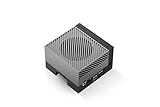
- The NVIDIA Jetson AGX Orin 64GB Developer Kit makes it easy to get started with Jetson Orin. Compact size, lots of connectors, and up to 275 TOPS of AI performance make this developer kit perfect for prototyping advanced AI-powered robots and other autonomous machines.
- The developer kit includes a Jetson AGX Orin 64GB module, and can emulate all the Jetson Orin modules. It supports multiple concurrent AI application pipelines with the NVIDIA Ampere GPU architecture, next-generation deep learning and vision accelerators, high-speed IO and fast memory bandwidth. Now you can develop solutions using your largest and most complex AI models to solve problems such as natural language understanding, 3D perception, and multi-sensor fusion.
- Jetson runs the NVIDIA AI software stack, and use-case specific application frameworks are available, including Isaac for robotics, DeepStream for vision AI, and Riva for conversational AI. You can save significant time with NVIDIA Omniverse Replicator for synthetic data generation (SDG), and by using NVIDIA TAO toolkit to fine-tune pretrained AI models from the NGC catalog.
- Jetson ecosystem partners offer additional AI and system software, developer tools, and custom software development. They can also help with cameras and other sensors, as well as carrier boards and design services for your product.
- With the computing capability of more than 8 Jetson AGX Xavier systems in a developer kit that integrates the latest NVIDIA GPU technology with the world’s most advanced deep learning software stack, you’ll have the flexibility to create tomorrow’s AI solution as well as today’s.
What current examples show—and what they do not
Recent announcements illustrate a range of approaches, but company descriptions and performance claims should not be treated as independent proof that one deployment is best for every workload.
- On-premises appliance: Qualcomm announced an AI On-Prem Appliance Solution on January 6, 2025, aimed at enterprise and industrial generative AI and computer vision, with a software suite spanning on-premises and cloud deployment. Qualcomm named Aetina, Honeywell and IBM as early supporters. The announcement does not establish current availability, specifications or pricing. Qualcomm’s announcement includes the offering details.
- Inference closer to users: Akamai announced Cloud Inference in 2025 as a way to run AI applications closer to end users. Its press release claims up to 3× throughput, up to 2.5× lower latency and up to 86% savings versus traditional hyperscaler infrastructure. Those figures are Akamai’s own claims; they are not an independent comparison established here. Akamai’s launch announcement sets out its claims.
- Distributed orchestration: Akamai announced AI Grid on March 16, 2026, describing workload routing across edge, regional and core infrastructure. The company said rollout includes NVIDIA RTX PRO 6000 Blackwell Server Edition GPUs across 4,400 locations. These are company-announced capability and rollout statements. Akamai’s AI Grid announcement provides its description.
- Telco edge for physical AI: In an October 7, 2026 blog, Ericsson argues that mobile-network-integrated compute can put inference nearer to physical AI devices and supply radio or network context. Its chart projects a compute-speed ceiling from 2026 to 2030 using Ericsson’s scenario assumptions; it is not an independently verified benchmark. Ericsson’s telco-edge discussion explains its position.
How to interpret latency targets
Cisco’s September 2026 design paper sets a less-than-one-second end-to-end interaction target and a less-than-64-millisecond local inference latency to first chunk target. It also gives an expected serving baseline of about 24 tokens per second at concurrency one for AFM 4.5B on an AMX-enabled Intel Xeon platform. Cisco labels these as design targets or expected baselines, not guarantees. They apply to that described design and hardware; they are not general edge-inference performance figures. The paper’s performance discussion provides that scope.
The useful comparison for another deployment is its own end-to-end response time, peak and tail behavior, availability, data path and operating cost. A model’s token rate or first-token time by itself does not show whether the complete application meets its service needs.
Do these 3 things before closing this tab:
1Scan for outdated or missing drivers - takes under a minute2Repair Windows errors before they cause bigger problems3Fix the driver behind crashes, sound loss and screen glitchesWhy edge is not automatically faster, cheaper or safer
Local systems may have less capable hardware, tighter power budgets and weaker physical protections than cloud infrastructure. They also multiply operational work: teams must plan capacity, patch and secure equipment, monitor failures and keep models consistent across locations. AWS notes these hardware and security constraints in its overview. AWS’s edge inference overview covers benefits alongside limitations.
Conversely, cloud-only designs make live service behavior depend on network conditions and data transfer. Neither pattern is universally superior. Edge is most useful when locality solves a concrete problem—such as response delay, data movement or degraded-connectivity behavior—and when the organization can support the distributed equipment and software.
Quick Recap
Product prices and availability are accurate as of the date/time indicated and are subject to change. Any price and availability information displayed on Amazon at the time of purchase will apply.

