
Recommended Free Tools
iTechGuides is reader-supported. When you buy through links on our site, we may earn an affiliate commission. As an Amazon Associate I earn from qualifying purchases. Learn more
No—binoculars or a telescope are not always necessary. You can watch a lunar occultation with your unaided eyes if the event is visible from your location and its star or planet is bright enough under the conditions. Optics are optional for casual viewing; the right choice depends on what you want to see and whether you plan to record the event.
What you can see without optical aid
The Moon is bright and close enough to be a good naked-eye target, as NASA notes in its Daily Moon Guide FAQ. But that does not mean every star or planet it passes will be easy to see unaided. The occulted object’s brightness, the event’s timing, daylight, weather, and your location all affect visibility.
A lunar occultation happens when the Moon passes in front of a star or planet from an observer’s point of view. In a grazing occultation, the object passes near the lunar edge and may disappear and reappear behind lunar mountains and valleys. The National Astronomical Observatory of Japan explains the event and the visibility regions on its lunar occultation glossary.
Choose equipment for your goal
| Approach | Best suited to | Trade-off |
|---|---|---|
| Unaided eyes | Casual viewing when the target is bright enough and conditions are favorable | No equipment is needed, but faint targets or daylight can make an event difficult to see. NASA’s guidance concerns viewing the Moon generally, not the visibility of every occulted object. |
| Binoculars | A closer view without setting up a telescope | They are optional; the cited guidance specifies no required magnification and does not guarantee that a particular event will be visible through them. |
| Telescope | Closer inspection or more deliberate observing, including some timing work | It takes more setup and technique. Owning a telescope alone does not make a timing observation useful; the event and observer’s location and time must be recorded. |
NASA says the choice of observing device can depend on how you plan to use it, what you want to view, and your budget. For an occasional look at a favorable event, start with your eyes; add binoculars or a telescope only if you want a closer view or have a more specific observing goal.
#1 Best Overall

- BRIGHT, SHARP VIEWS ANYWHERE: Unlike many beginner telescopes, this quality refractor features fully coated glass lenses and a 70mm aperture for crisp, clear views of the Moon, planets, and daytime scenery—all in a lightweight, travel-ready design.
- PERFECT FIRST TELESCOPE FOR BEGINNERS: Designed for adults and kids to enjoy together, this beginner-friendly telescope sets up in minutes and delivers rewarding views with no prior experience required.
- EASY NO-TOOL SETUP: No complicated assembly or tools needed. The full-height tripod and telescope tube set up in seconds and pack neatly into the included backpack—so you’re always ready to observe on the go.
- DUAL EYEPIECES FOR VERSATILE VIEWS: Includes 20mm and 10mm eyepieces for wide and close-up views of celestial and terrestrial targets. Spot craters on the Moon at night or wildlife during the day.
- BONUS BACKPACK AND SOFTWARE: Includes a padded backpack with room for accessories, a finderscope, star diagonal, eyepieces, and a free download of Starry Night software to help you identify celestial objects and plan your next stargazing session.
Check whether the event is visible where you are
Occultations are location-specific: an event can be visible from one region and not another. Before choosing equipment, look up a prediction for your location and local time. Check that the Moon and target will be above the horizon, and consider whether daylight or weather will interfere. The NAOJ’s explanation distinguishes the event’s visibility area from the limits where a graze may be seen.
The 2026 RASC Observer’s Handbook article on lunar occultations provides event-prediction context for that year; its annual event listings are not an evergreen schedule. Use a current local prediction rather than assuming an event listed for a broad region will be visible from your observing spot.
Rank #2

- BRIGHT, SHARP VIEWS ANYWHERE: Unlike many beginner telescopes, this quality refractor features fully coated glass lenses and a 80mm aperture for crisp, clear views of the Moon, planets, and daytime scenery—all in a lightweight, travel-ready design
- PERFECT FIRST TELESCOPE FOR BEGINNERS: Designed for adults and kids to enjoy together, this beginner-friendly telescope sets up in minutes and delivers rewarding views with no prior experience required
- EASY NO-TOOL SETUP: No complicated assembly or tools needed. The full-height tripod and telescope tube set up in seconds and pack neatly into the included backpack—so you’re always ready to observe on the go
- DUAL EYEPIECES FOR VERSATILE VIEWS: Includes 20mm and 10mm eyepieces for wide and close-up views of celestial and terrestrial targets. Spot craters on the Moon at night or wildlife during the day
- BONUS BACKPACK AND SOFTWARE: Includes a padded backpack with room for accessories, a finderscope, star diagonal, eyepieces, a smartphone adapter, and a free download of Starry Night software to help you identify celestial objects and plan your next stargazing session
What changes when you want to record an observation
Watching an occultation is different from contributing a timed observation. For systematic observing, you need to identify the event and record its time and your location. The International Occultation Timing Association (IOTA) observing basics lists a telescope, with or without a tracking platform, for the activity it describes.
Free tools Windows power users keep installed
One-click scans. No signup required.
Timing methods range from visual observation with a stopwatch and time signal to video recording. The British Astronomical Association’s Lunar Section guidance describes these approaches and encourages video when improved timing accuracy is the goal. The 2026 handbook lists seeing conditions, telescope size, timing method, estimated visual reaction time, and timing accuracy as useful supplementary details; it says video provides higher timing accuracy than a simple visual record.
Rank #3
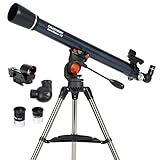
- POWERFUL TELESCOPE FOR BEGINNERS: The AstroMaster 70AZ is the perfect entry-level telescope for adults and kids eager to explore the night sky. You get bright, clear views and simple, intuitive operation.
- HIGH-QUALITY 70MM OPTICS: Enjoy crisp, detailed views through the fully coated 70mm (2.8") achromatic refractor — perfect for observing the Moon, planets, bright star clusters, and even terrestrial landmarks.
- VERSATILE DAY & NIGHT USE: Designed for both astronomical and land-based viewing, the AstroMaster 70AZ lets you explore the stars at night and enjoy daytime views of wildlife or distant landmarks.
- EASY-TO-USE ALT-AZIMUTH MOUNT: Smoothly navigate the sky with a manual alt-azimuth mount and easy-to-use panhandle, which lets you point the telescope up, down, and side to side with precision.
- QUICK SETUP: With just a few key parts to assemble, you can go from box to backyard in minutes—no tools required. The sturdy, adjustable tripod provides stable, comfortable viewing tailored to your height, perfect for adults or kids, standing or seated.
Those requirements matter if you want to make a useful record, not if you simply want to watch. The IOTA’s Lunar Occultation Tutorial covers reporting fields and timing details.
Why observers study occultations and grazes
Recorded observations can help refine knowledge of the Moon’s profile and stellar data. Graze observations are especially revealing because an object can blink in and out behind lunar terrain. The 2026 RASC handbook also describes how occultations can detect double stars and measure their separations. It reports that binaries as close as 0.02 arcseconds have been discovered visually during grazes; that is a result of scientific observing, not a promise about what a consumer telescope can resolve.
Rank #4

- SMARTPHONE-POWERED SKY TOUR: No experience needed! Just dock your phone, launch the StarSense Explorer app, and follow the on-screen arrows to locate stars, planets, nebulae, and more.
- PATENTED STARSENSE TECHNOLOGY: Unlike other astronomy apps, StarSense Explorer uses sky recognition technology to turn your phone into a celestial navigation system, analyzing star patterns overhead to pinpoint your telescope’s position.
- TONIGHT’S BEST TARGETS, INSTANTLY: The app generates a curated list of the top objects to see based on your time and location. See planets, bright nebulae, galaxies, and star clusters from the city—and even more from dark skies.
- SIMPLE SETUP, SMOOTH TRACKING: Features a manual altazimuth mount with altitude slow motion adjustment with a sliding rod. Follow the on-screen arrows to your target; when the bullseye turns green, you can view it clearly through the eyepiece.
- 114MM REFLECTOR WITH IMPRESSIVE VIEWS: The 4.5" Newtonian reflector with high-reflectivity coatings delivers sharp, vivid views of the Moon, planets like Jupiter and Saturn, and deep-sky favorites like the Orion Nebula and Andromeda Galaxy.
Use extra care with daytime events
Some occultations occur in daylight, and the NAOJ notes that daytime conditions and targets that are not bright enough can make events poor observing opportunities. The cited material does not provide a complete procedure for safely aiming binoculars or a telescope during a daytime event. Do not point optical equipment toward the Sun; seek authoritative solar-observing safety guidance before attempting daytime optical observing.
What’s actually slowing this PC down?
Pick the symptom - the matching free tool is one click away.
Quick Recap
Best Value

- POWERFUL TELESCOPE FOR ASTRONOMY BEGINNERS: The AstroMaster 130EQ delivers sharp optics, a stable equatorial mount, and smooth manual controls, making it the top choice for beginners ready to explore the night sky.
- HIGH-QUALITY 130MM OPTICS: Enjoy views through the 130mm (5”) Newtonian reflector, which features high-quality aluminum and SiO₂ coatings and enough light-gathering ability to view all the best celestial objects.
- SMOOTH, ACCURATE POINTING: Effortlessly aim and center your target using the two slow-motion control knobs for right ascension and declination whether you’re observing planets or deep-sky objects.
- QUICK SETUP: With just a few key parts to assemble, you can go from box to backyard in minutes—no tools required. The sturdy, adjustable tripod provides stable, comfortable viewing tailored to your height, perfect for adults or kids, standing or seated.
- INCLUDED ACCESSORIES: 20mm eyepiece with built-in erect image corrector, 10mm eyepiece, and a StarPointer red dot finderscope. You'll also receive a FREE download of one of the top-rated astronomy software programs.
Product prices and availability are accurate as of the date/time indicated and are subject to change. Any price and availability information displayed on Amazon at the time of purchase will apply.

