
Do these 3 things before closing this tab:
1Scan for outdated or missing drivers - takes under a minute2Clear out junk files and repair common Windows errors3Fix the driver behind crashes, sound loss and screen glitchesDirect conversion, also called zero-IF or homodyne reception, tunes a receiver’s local oscillator (LO) to the desired radio channel and converts that channel straight to baseband rather than to a nonzero intermediate frequency. This can reduce external filtering and make a multimode radio easier to integrate, but it brings difficult DC-offset, LO-leakage, linearity and calibration problems into the signal path.
How direct conversion works
A superheterodyne receiver mixes an incoming radio-frequency (RF) signal with a tunable LO to produce an intermediate frequency (IF). Filtering and much of the receiver gain are then applied at that fixed IF. Direct conversion is a special case: the LO is set to the desired RF channel, so the difference frequency is zero. The wanted modulation therefore appears at baseband, around DC.
In a practical receiver, in-phase and quadrature (I/Q) paths preserve the signal’s amplitude and phase information while translating it to baseband. Low-pass filtering and amplification can then be carried out in the baseband circuitry. Resistors and capacitors integrated on a chip can provide those filters, and programmable or otherwise adaptable baseband filtering can support different channel bandwidths without requiring a separate external filter for each mode.
Why choose zero-IF instead of a superheterodyne?
The main attraction is integration. A conventional superhet commonly relies on fixed-frequency IF filtering, while direct conversion moves filtering and gain to baseband. This can reduce the number and size of external IF components, board area and, potentially, power. Those trade-offs made the architecture attractive for compact multimode cellular handsets.
#1 Best Overall
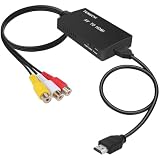
- RCA Female to HDMI Video Converters Adapter : The cable is used to convert analog composite input to HDMI 1080p output, displayed on a 1080p HD TV/TV/monitor.
- Input ports: 1xRCA Female (Yellow, White, Red), Output ports: 1xHDMI 1.3 1080p. NOT support 3D and 4K, NOT support HDMI Converts to AV
- AV to HDMI Converter: Plug and Play, Easy to Install and Operate, Powered by External USB Cable. Note: Please hook up the USB power cable (included) to 5V 1Apower source during use (not included power supply ).
- Support PAL, NTSC3.58, NTSC4.43, SECAM, PAL/M, PAL/N standard TV formats input. For PS2,PS3,Xbox,N64,STB, VHS, VCR, DVD Players and other devices with standard composite AV input.
- You Will Get : 1x RCA Female TO HDMI Converter, 1xHDMI cable, 1xUSB cable, 1xUser Manual. ONE YEAR WARRANTY - if you are not satisfied for any reason whatsoever, do not hesitate to contact us .
Neither direct conversion nor a superheterodyne is automatically better. A superhet separates the desired signal from DC by converting it to a nonzero IF, but may require additional filtering and conversion stages. Direct conversion avoids that fixed IF stage, but DC and baseband impairments become especially important. Low-IF designs occupy a middle ground, converting the signal to a small nonzero frequency rather than exactly to DC; they can still face some of the offset and I/Q issues found in zero-IF systems.
| Design consideration | Direct conversion (zero-IF) | Low-IF | High-IF superheterodyne |
|---|---|---|---|
| Filtering and components | Filtering and much of the gain are at baseband; may reduce bulky external IF filtering. | Uses a nonzero, low IF; filtering and image handling depend on the implementation. | Places much of the gain and filtering at a fixed IF; may require external IF filtering. |
| Integration and power | Can reduce component count and board area and potentially power. | Can offer an integration compromise; no universal power comparison is established here. | Additional IF stages and filters can add components; no universal power comparison is established here. |
| Image rejection | I/Q accuracy matters in quadrature or image-reject implementations. | Image rejection is a central design concern; quadrature matching can vary with process and temperature. | Fixed-IF filtering can provide image selectivity, depending on the chosen conversion plan and filters. |
| DC offset and LO leakage | Particularly sensitive: leaked LO can self-mix to DC, alongside baseband amplifier offsets. | Some direct-conversion problems can remain, though the wanted signal is not centered exactly at DC. | A nonzero IF separates the wanted signal from DC, reducing this specific zero-IF vulnerability. |
| Linearity and calibration | Must manage second- and third-order distortion, offset cancellation and calibration. | Requires suitable linearity and I/Q control; implementation determines calibration needs. | Still requires adequate receiver linearity; filtering and conversion stages create different trade-offs. |
The table describes architectural tendencies, not guaranteed performance. Actual results depend on the radio’s frequencies, filters, interferers, circuit design and calibration.
Why direct conversion creates DC offset
LO leakage and self-mixing
In zero-IF reception, the LO is at the same frequency as the wanted RF channel. If LO energy leaks into the RF path and returns to the mixer, it can mix with itself at zero frequency. The resulting DC component adds to the wanted baseband signal and uses up headroom. This is a distinctive difficulty of placing the wanted channel at DC.
Rank #2

- AV to HDMI Converter: Converts analog RCA composite (Yellow, White, Red) input to HDMI 720P/1080P output, displayed on HDTV/Monitor, which bring back your old and cherish memories. Notice: NOT support HDMI Converts to RCA.
- RCA to HDMI Converter Kit: Contain all necessary cables you need, such as Male RCA cable, HDMI cable and micro USB Power cable, no need to buy extra cable, more convenient to use. In addition, cables can be detached for other uses. Easier to use and more cost-effective.
- Widely Used: Widely applied to PSOne, PS2, PS3, Xbox, N64, Wii, SNES, STB, VHS, VCR, DVD Players and other devices with standard composite AV input. Support PAL, NTSC3.58, NTSC4.43, SECAM, PAL/M, PAL/N standard TV formats input.
- Plug to Play: Setuact RCA to HDMI Adapter, no extra drivers need, just plug and play, easy to use. Please hook up the USB power cable (included) to 5V power source during use the Composite to HDMI Converter.
- Package&After-sales Service: Package Include: 1*RCA to HDMI Converter, 1*RCA Cable(3.3ft/1m), 1*HDMI Cable(3.3ft/1m), 1*USB Power Cable(2.6ft/0.8m), (adapter not included), 1*User Manual. We provide 18 months after-sales service quality guarantee, 24h friendly customer service.
Shielding and careful layout can limit coupling. The 2002 EE Times article by Jon Strange and Doug Grant also describes generating the LO off-channel and using frequency division as ways to reduce the problem. These approaches involve design trade-offs; none removes the need to consider leakage through the complete RF and LO paths.
Offsets inside the baseband chain
Even after LO leakage is reduced, offsets in baseband amplifier stages can remain. They can also drift as temperature changes. Because the wanted signal occupies frequencies close to DC, a receiver cannot simply treat every slowly varying baseband component as unwanted without risking loss of useful signal.
Strange and Grant describe three broad offset-management approaches: continuous feedback, track-and-hold, and open-loop correction. Their suitability depends on how quickly the receiver must respond, how much signal can be disturbed during correction, and how offset changes over time and temperature. Offset cancellation is therefore part of the receiver architecture and calibration strategy, not just a final cleanup step.
Rank #3

- 【Read before You Buy】 Note: This adapter is USB 2.0 version and cannot transmit HDM, VGA, or other video signals. Nevertheless, they are fully capable of charging devices,duplicating files, and can be seamlessly integrated with USB-C earphones, wireless network adapters, and SD card adapters.
- 【Easy to Use and Safe】Thanks to modern manufacturing techniques, we've made these adapters sufficiently compact so that they can remain inserted in your device without noticeable protrusion or inconvenience. This means you don't have to constantly plug and unplug them, reducing the likelihood of wear and misalignment, and making them more convenient to carry around.
- 【Reliable Quality】Engineered for enhanced durability, durable aluminum alloy shell material,get excellent wear resistance and heat dissipation,the male USB C and female USB connectors & the male USB and female USB C connectors are designed to be plugged and unplugged up to 20000 times. Provides data transfer, device charging, memory space expansion, and additional computer peripherals.
- 【Think more for you】Do you need to connect a USB-C-enabled device to an odd device that only has USB-A ports? Then these USB-A male to USB-C female adapters are made for you.Simply insert the adapter into the USB-A port on the device, and you can instantly connect your USB-C device to the device that originally didn't have the correct connection port.
- 【Trusted xiwxi Quality and Service】As a responsible brand seller, you will receive xiwxi's 12-month Quality assurance and lifetime friendly customer service, you're not just buying a product,you're investing in peace of mind with all-round quality and exceptional customer service.
How interferers expose IP2 and IP3 limits
IP2: second-order effects and AM detection
IP2, or second-order intercept point, characterizes a receiver’s susceptibility to second-order distortion. In a mixer, a sufficiently strong amplitude-modulated (AM) interferer can be detected by nonlinear behavior, reproducing an envelope-related component at baseband. In a zero-IF receiver, that component can appear near DC, where it competes with the wanted signal.
The 2002 article illustrates the issue with GSM. An unsynchronized interfering burst can produce a DC step during the wanted signal’s baseband passband. Such a step consumes dynamic range and can cause bit errors or, in the example discussed, dropped calls. The article quotes a GSM AM-suppression test allowing a 3 dB reduction in sensitivity for an unsynchronized burst of −31 dBm. It then estimates a required two-tone IP2 of about +40 dBm referred to the antenna for that example. These are figures from the article’s 2002 GSM analysis, not universal requirements for current cellular receivers.
Windows Errors? Fix Them Before They Spread
Repair common Windows errors and clear accumulated junk for a smoother, more stable PC - no reinstall needed.Free scan · no reinstallOutdated Drivers Are Slowing You Down
One free scan finds every outdated or missing driver and matches the right update for your exact hardware.Free scan · exact hardware matchIP3: third-order products that land in-channel
IP3, or third-order intercept point, describes susceptibility to third-order intermodulation. When two nearby interferers pass through nonlinear receiver stages, a third-order product can fall directly on the desired channel. Once created in-band, that product cannot be removed by a channel filter without also affecting the wanted signal. The low-noise amplifier (LNA) and mixer therefore need enough linearity for the expected interference environment.
Rank #4

- Materials and Design: The adapter is made with anti-interference zinc alloy metallic housing and minimalist design with anti-slippery embossments
- Connectors: Engineered for enhanced durability, the male USB C and female USB3 connectors are designed to be plugged and unplugged up to 10000 times
- Compatibility: This USB C to USB 3.0 adapter is compatible with iPhone 17/17e/17 Air/17 Pro/17 Pro Max and MacBook Pro after 2016 and MacBook Air after 2018 and most of the laptops, tablets and smartphones with a USB Type C port
- USB 3.0 Speed in Two: Came in two fast speed adapters in data transfer and charging with premium materials. A foam container is also included for storage and travel
- Compact and Easy to Use: Plug and play, no driver required; Simple structure, lightweight and portability; Also, you can sync or charge your phone with this USB C to USB adapter
Strange and Grant discuss a CDMA interference case with an approximately +44 dBm requirement. Like the GSM IP2 figure, this is a scenario-specific value from their 2002 analysis, not a general modern design target. They also note that EDGE used the same 200 kHz channels as GSM while adopting 8-PSK modulation to raise the available channel bit rate to 384 kbit/s; that historical example underscores why receiver behavior must be assessed against the relevant waveform and interference conditions.
Independent reader supportYour contribution helps us test, update, and keep practical guides available for everyone.I/Q accuracy, image rejection and calibration
Quadrature receivers rely on matched I and Q paths. If their gains or phases differ, the receiver’s image rejection degrades and unwanted signal energy can leak into the desired channel. In near-zero-IF and image-reject implementations, this matching can vary with manufacturing process and temperature, so nominal circuit design alone may not be enough.
Calibration can compensate for some variations, but it adds design and implementation complexity. A complete strategy has to account for I/Q matching as well as LO leakage, baseband offsets and linearity. The exact methods and performance limits vary by chip and radio; the 2002 article does not establish a single calibration procedure for present-day transceivers.
What’s actually slowing this PC down?
Pick the symptom - the matching free tool is one click away.
Best Value

- USB-IF Certified, connects any USB-C to any standard USB-A enabled devices. For power transfer/charging smartphones, power banks, wall/car chargers, and low-power devices. Suitable for data transfer between smartphones, tablets, laptops, hard drives and more
- In the box: 1 adapter cable, 5.5 inch USB-C to USB-A (USB 3.1 Gen 1) adapter for transferring data, photos, and music. Compatible with USB 3.0 and 2.1
- Fast Charge and Data Transfer: Supports fast charging up to 15W (5V/3A) and data transfer speeds up to 5 Gbps. Do not exceed recommended load (15W, 5V/3A). Limited charging speed for PD enabled devices
- Compact Design: USB-C port is half the width and one-third the height of a standard USB-A connector (slightly larger than Lightning or Micro-USB ports)
- Backed by an Amazon Basics 1-Year Limited Warranty
What the 2002 argument means for radios now
Strange and Grant’s article, published in EE Times on 2 April 2002, is a useful explanation of why direct conversion is attractive and why it is not a free simplification. Its examples use GSM, GPRS, EDGE and IS-95-era cellular conditions. Modern radios may use different standards, more integrated transceivers and different calibration methods, so the article’s numeric figures should be read in their historical scenario rather than applied as current specifications.
The enduring engineering decision is a balance: direct conversion can simplify the external IF chain and support integration, but it concentrates demands on DC management, RF-to-LO isolation, I/Q accuracy and linearity. A sound comparison must use the intended bands, waveform, blocker conditions, power budget, integration goals and calibration capabilities—not architecture labels alone.
Quick Recap
Product prices and availability are accurate as of the date/time indicated and are subject to change. Any price and availability information displayed on Amazon at the time of purchase will apply.

