
iTechGuides is reader-supported. When you buy through links on our site, we may earn an affiliate commission. As an Amazon Associate I earn from qualifying purchases. Learn more
In wireless networking, a logical access point usually means a virtual access point (VAP): a wireless network configured on a physical access point. One physical device can present several logical access points, each with its own network name and settings. Some WLAN mobility papers use the same phrase for something different, an abstraction of a single client’s connection. The surrounding context tells you which meaning applies.
What makes an access point “logical”
A physical access point is the hardware: the enclosure, the radio, and the Ethernet connection to the wired network. A logical access point is a network function that the configuration creates on top of that hardware. It is not necessarily another box or another radio. Aruba Networks’ installation and user guide for the Aruba AP 80 outdoor access point/bridge (a 2007-era document) describes a logical access point as one implemented within a physical device, and says VAP technology lets one physical AP operate as multiple APs.
What a virtual access point typically configures
In the vendor usage, each VAP behaves like a separate wireless network that happens to share the same hardware. The D-Link Unified Access System User Manual (2008-era documentation for the DWL-3500AP and DWL-8500AP) says a VAP can carry its own:
What’s actually slowing this PC down?
Pick the symptom - the matching free tool is one click away.
- SSID, the network name clients see when they scan for Wi-Fi;
- VLAN ID, which places that network’s traffic on a specific wired VLAN;
- Security policy, such as the encryption and authentication settings for that network.
A typical use is a staff network on VLAN 10 with enterprise authentication, alongside a guest network on VLAN 30 with its own passphrase, both broadcast from one access point. The guest clients are kept on a different wired segment without a second access point being installed. This is an illustrative example of the configuration model, not a setup taken from a specific product guide.
#1 Best Overall

- Free Omada Essentials Cloud Management: Free cloud management with no additional fees, everything is managed in the cloud without the need for hardware or software controllers. Simply launch the Omada app, scan the S/N code on the package, and you're ready to deliver
- Ultra-Fast True Wi-Fi 6 Speeds: Designed with the latest wireless Wi-Fi 6 technology featuring 1024-QAM, HE60 and Long OFDM Symbol, the EAP650 boosts dual-band Wi-Fi speeds up to 2976 Mbps
- Ultra-Slim Design: Compact design ensures simple installation while saving space. The elegant appearance makes EAP650 blend into any modern office, hotel, classroom, or cafe
- Integrated into Omada SDN: Omada Software Defined Networking (SDN) platform integrates network devices including access points, switches and gateways with multiple control options offered - Omada Hardware controller, Software Controller or Cloud-based controller. Standalone mode also supported
- Cloud Access Omada Compatibility: Remote Cloud access and Omada app enables centralized cloud management of the whole network from different sites, all controlled from a single interface anywhere, anytime
Limits depend on the product and the radio
The number of VAPs an access point supports is set by the product, not by the term itself. The only specific limit in the sources is the D-Link figure: up to eight VAPs per radio, for those two named models, in that 2008-era manual. The Aruba guide, as cited, describes the VAP concept without giving a count.
| Source | Era and product context | What “logical AP” means there | Documented VAP limit |
|---|---|---|---|
| D-Link Unified Access System User Manual | 2008-era; DWL-3500AP and DWL-8500AP | A VAP with its own SSID, VLAN ID and security policy | Up to 8 per radio, for these models only |
| Aruba AP 80 Outdoor Wireless Access Point/Bridge Installation and User Guide | 2007-era; Aruba AP 80 outdoor AP/bridge | A logical AP implemented within a physical device; VAP technology lets one AP operate as multiple APs | Not stated in the cited guide |
| EURASIP Journal on Wireless Communications and Networking, “Mobility management in IEEE 802.11 WLAN using SDN/NFV technologies” | 2017; academic architecture paper | An abstraction of a mobile client’s connection, represented as a virtual AP associated with a physical AP | Not applicable; the term does not describe a configurable product limit |
Because these sources are from 2007 to 2017, treat the figures as a record of those products. Current access points from any vendor may support a different count, and the figure may be stated per device rather than per radio. Check the datasheet for the model you are considering.
Rank #2

- FREE Omada Essential Platform Centralized Remote Management: Unlock numerous advanced features by integrating with Omada Cloud Management Platform, such as network monitoring, remote network configuration, AI features, ZTP (Zero Touch Provisioning) etc. More possibilities you can find with your network management
- Dual-Band 4-Stream Wi-Fi 7: Up to 5.0 Gbps, 4324 Mbps on 5 GHz + 688 Mbps on 2.4 GHz. Powered by Wi-Fi 7 technology, enjoy faster speeds with Multi-Link Operation, increased reliability with Multi-RUs, and 120% more data capacity with 4K-QAM, delivering enhanced performance for all your devices
- Future Proof 2.5G Port: Equipped with a 2.5 Gigabit Ethernet port to support high-speed networking and future broadband upgrades-no hardware replacement required when switching to multi-gig internet plans
- Abundant Networking Features Available to Develop: Network monitoring, VLAN segmenting, Bandwidth management, Schedule Setup, Security features, PPSK all seated and right there waiting to be developed for you
- Premium WiFi Experience: Seamless roaming, Mesh, Airtime fairness and other business level wifi experience features are provided here
The mobility research meaning
A 2017 paper in the EURASIP Journal on Wireless Communications and Networking, titled “Mobility management in IEEE 802.11 WLAN using SDN/NFV technologies,” uses “logical AP” for a different purpose. In its design, a mobile client’s connection is represented as a virtual AP that is associated with a physical AP, so that the network can manage the client as it moves between physical APs. This is an architecture proposed in that paper. It is not a setting on a router or access point, and you will not find it in a standard AP configuration screen.
The Tool Desk
Outbyte PC Repair FREEClear out junk files and repair common Windows errorsFree Scan →Outbyte Driver Updater FREEFix the driver behind crashes, sound loss and screen glitchesFind Drivers →How to tell which meaning applies
- If the text talks about configuring SSIDs, VLAN IDs or security options for each wireless network on an access point, it means the vendor VAP concept.
- If it describes a mobile client moving between access points while a controller or network function tracks that client, it means the mobility abstraction.
- If a vendor manual uses the term, the model name and radio type define what the term covers. Do not apply one model’s limit to another product.
Checks before relying on a VAP count
- Open the datasheet or user guide for the exact model and firmware version you plan to use, and confirm its date.
- Find out whether the VAP limit is stated per radio or per device. The D-Link figure is per radio, so a dual-radio unit may offer a different total than the per-radio number suggests.
- Confirm that each VAP can be given its own SSID, VLAN ID and security policy on that model, since the set of options varies by vendor.
- Confirm the VLAN mapping on the wired side. A VAP only isolates traffic if the switch port and uplink carry the matching VLANs.
A multi-SSID access point with VAP support is the relevant hardware category when you need several networks on shared equipment. Verify the current model’s capabilities against your required SSID count, VLAN plan and security policy before choosing a device.
Quick Recap
Best Value

- Four stream 802.11AC Wave2 technology
- Supports 200+ concurrent users
- 802.3af PoE compatibility
- Optional covers (sold separately) allow the Unifi nanohd AP TO discreetyly blend into its setting
Rank #4

- Free Omada Essentials Cloud Management: Free cloud management with no additional fees, everything is managed in the cloud without the need for hardware or software controllers. Simply launch the Omada app, scan the S/N code on the package, and you're ready to deliver
- Ultra-Fast True Wi-Fi 6 Speeds For Your Business: Designed with the latest wireless Wi-Fi 6 technology featuring 1024-QAM and Long OFDM Symbol, the EAP610 boosts dual-band Wi-Fi speeds up to 1800 Mbps. With 4 Spatial streams, multi-user throughput is incredibly increased to drive more applications
- Ultra-Slim Design: Compact design ensures simple installation while saving space. The elegant appearance makes EAP610 V2 blend seamlessly into any modern office, hotel, classroom, or cafe
- Integrated into Omada SDN: Omada Software Defined Networking (SDN) platform integrates network devices including access points, switches and gateways with multiple control options offered - Omada Hardware controller, Software Controller or Cloud-based controller. Standalone mode also applies
- Cloud Access Omada Compatibility: Remote Cloud access and the Omada app enable centralized management of your entire network across multiple sites. Control everything from a single interface, anywhere and anytime. Please verify device compatibility with SDN firmware in the product documentation or manufacturer's technical specifications
Rank #3
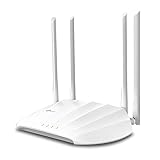
- Superior Speeds with MU-MIMO: Outfitted with the latest 802.11ac Wave 2 MU-MIMO technology, the TL-WA1201 easily delivers dual-band Wi-Fi speeds of up to 1200 Mbps to multiple devices at the same time
- Multi-Mode 4 in 1: Supports Client, Multi-SSID, Range Extender, and AP operation modes to enable various wireless applications to give users a more dynamic and comprehensive experience when using your AP
- PoE for Easy Installation: TL-WA1201 supports Passive PoE power supplies, can be powered by the provided PoE adapter, making deployment effortless and flexible
- Boosted Wi-Fi Coverage: Four external antennas equipped with Beamforming technology concentrate Wi-Fi signals towards your devices to extend reliable Wi-Fi to every corner of your home or office, even over long distances
- Gigabit Ethernet Port: Features a Gigabit Ethernet port that provides high-speed wired connectivity for devices requiring stable and fast network connections
Product prices and availability are accurate as of the date/time indicated and are subject to change. Any price and availability information displayed on Amazon at the time of purchase will apply.

