
Recommended Free Tools
iTechGuides is reader-supported. When you buy through links on our site, we may earn an affiliate commission. As an Amazon Associate I earn from qualifying purchases. Learn more
Ask customer-service candidates the same job-related behavioral and situational questions, then score their answers against criteria set before the interview. Strong answers show how a candidate listens, explains options, works within policy, takes ownership, and follows through—not simply how confident or personable they sound.
How to choose customer service interview questions
Build questions around the actual work, rather than relying on a generic list. A retail associate, technical-support representative, call-center agent, and account-service specialist face different customer problems, channels, authority limits, and escalation paths. The U.S. Office of Personnel Management (OPM) recommends identifying critical competencies through job analysis before writing interview questions. OPM’s structured-interview guidance connects job-based questions with stronger validity, rater reliability, and agreement.

Choose a manageable set of competencies and use questions that invite concrete evidence. OPM’s general rule of thumb is to assess four to six competencies, balancing the number of questions against the time available. Its interview-length FAQ describes that guidance; it is not a required number for every role.
| Method | What it can reveal | Best use |
|---|---|---|
| Behavioral question | The candidate’s account of what they did in a relevant past situation. | When the candidate may have handled comparable work before. |
| Situational question | The approach the candidate says they would take in a hypothetical job-like case. | When you want to assess judgment in a realistic scenario, including candidates without directly comparable experience. |
| Role-play or work sample | How the candidate performs a task resembling the role, observed directly. | For customer-facing work where live interaction is important; give candidates consistent instructions and score against job criteria. |
These methods elicit different kinds of evidence; they are not interchangeable measurements. CIPD gives a challenging customer interaction as an example of a role-play for a customer-facing position and advises that skill tasks resemble the real job. CIPD’s Selection Methods factsheet also discusses structured interviews and candidate experience.
Behavioral customer service interview questions
Behavioral questions ask candidates to describe what they did in the past. Keep the main questions consistent for each candidate. Use planned follow-ups when needed to clarify the candidate’s own actions, decision, or result.
- Handling frustration: “Tell me about a time you helped a customer who was frustrated or upset. What was happening, what did you do, and how did it end?”
- Explaining something complex: “Describe a situation where you had to explain a complicated policy, product, or process in a way a customer could understand.”
- Managing expectations: “Tell me about a time you could not give a customer exactly what they wanted. How did you explain the options?”
- Responding to a mistake: “Describe a time you made a mistake or gave a customer incorrect information. How did you respond, and what happened next?”
- Prioritizing requests: “Tell me about a time you had to balance several customer requests at once. How did you decide what to handle first?”
- Getting help to resolve an issue: “Give an example of when you needed help from another team or a supervisor to resolve a customer issue. How did you keep the customer informed?”
These are sample prompts, not a universal validated question bank. Tailor them to the role’s recurring tasks, service channels, and authority. OPM describes behavioral questions as inquiries into past behavior relevant to the competency being assessed in its structured-interview guidance.
Situational customer service interview questions
Situational questions give candidates a hypothetical work-related case and ask what they would do. Make the scenario realistic for the position, including the applicable policy and escalation options.
Free tools Windows power users keep installed
One-click scans. No signup required.
- Delayed order, unclear tracking: “A customer is angry because an order is late, but the tracking information has not updated. What would you do first, and what would you tell them?”
- Request outside policy: “A customer asks you to make an exception that your policy does not allow. How would you respond?”
- Competing priorities: “You are helping one customer when another says their problem is urgent. How would you prioritize the two?”
- Unfamiliar technical problem: “A customer describes a technical problem you do not recognize. How would you investigate it and decide whether to escalate?”
- Repeated explanations: “A customer says they have already explained the issue to several people. How would you take ownership of the conversation?”
OPM’s situational format asks candidates how they would act in a hypothetical situation similar to work they may encounter. A sound scenario reflects the role rather than testing knowledge of a policy the candidate has not been given. See OPM’s guidance on structured interviews and other assessment methods.
What to look for in candidate answers
Score job-related evidence, not charisma, polish, or perceived similarity to the interviewer. Before interviews begin, define what acceptable and stronger evidence looks like for each competency. These practical indicators should be adapted to the employer’s service standards; they are not a universal validated rating scale.
- Listening and clarification: The candidate checks what the customer needs and confirms important facts before proposing a fix.
- Empathy with boundaries: The candidate recognizes frustration without making promises they cannot keep.
- Clear communication: The candidate explains options, limits, and next steps plainly and checks that the customer understands.
- Judgment and policy use: The candidate seeks a suitable resolution within their authority and can explain why a requested outcome is unavailable.
- Ownership and follow-through: The answer identifies who will do what next, when an update is due, and how the issue will be closed out.
- Appropriate escalation: The candidate recognizes when an issue exceeds their authority or expertise and passes relevant details along rather than abandoning the customer.
- Learning and accountability: In a past example, the candidate owns their part, describes the result honestly, and explains what they changed afterward.
OPM describes scoring answers against benchmarks of proficiency, and CIPD recommends agreeing question criteria in advance. Use the OPM structured-interview resource and CIPD factsheet for those general principles.
Rank #3

- Ample Supply: this set includes 5 call log notebooks, each designed to record up to 500 calls; With a convenient size of 5 5/8 x 8 1/2 inches, these notepads provide plenty of pages to handle all your communication tracking needs, keeping your office organized and well-prepared for high call volumes
- Carbonless Duplicate Copies: made from carbonless copy paper, our call log notebook allows you to effortlessly tear off the clean original sheet to share important details while the duplicate stays securely bound; No more lost notes, keep every record intact and communication reliable, efficient, and tidy
- Easy to Use: each call entry is pre-numbered in sequence, making it simple to locate, review, and follow up on past conversations; This convenient telephone message pad helps you stay organized and ensures no important message is ever missed or overlooked
- Ideal for High Traffic and Team Environments: designed to meet the demands of busy offices and sales teams, these durable call notebooks support long-term, efficient call management; Perfect for high-volume settings, they allow every message to be recorded accurately and accessed anytime, promoting seamless workflow and team coordination
- Professional Call Logging for Multiple Fields: featuring a organized layout for capturing caller details, time, message, and action taken, this telephone logbook is the perfect tool for offices, businesses, and service professionals
A consistent interview and scoring process
- Analyze the job. List recurring tasks, service channels, decision authority, and situations that make the role difficult. Identify the competencies those demands require.
- Select the competencies. OPM’s general guidance suggests four to six, adjusted for available interview time.
- Prepare the core questions and criteria. Ask the same predetermined core questions in the same order and use common rating standards for every candidate.
- Plan follow-up probes. Use clarifying prompts such as “What did you do personally?”, “What options did you consider?”, and “What was the result?” Decide in advance which probes are appropriate and apply them consistently.
- Take evidence-based notes and score independently. Panelists should record evidence against competencies and rate answers before discussing the candidate. CIPD recommends individual scoring before group discussion; OPM describes individual panel ratings followed by discussion of significant differences.
- Discuss differences using the evidence. Return to the criteria and notes when scores differ. Do not let one especially confident answer or a general impression substitute for evidence across the competencies.
- Add a realistic exercise when useful. If real-time interaction is central to the job, give each candidate the same scenario and instructions, then score the exercise against job-related criteria.
OPM’s structured-interview resource, its assessment-method guidance, and CIPD’s Selection Methods factsheet describe these structure and panel practices.
The Tool Desk
Outbyte Driver Updater FREEScan for outdated or missing drivers - takes under a minuteDriver Scan →Outbyte PC Repair FREERepair Windows errors before they cause bigger problemsFix Now →Example four-point rubric
Use one consistent scale, but define the expected evidence separately for each competency before interviewing. The following is an editorial template, not an OPM scale or a validated customer-service instrument.
| Rating | Example evidence |
|---|---|
| 1 — Limited evidence | The answer is unclear or misses the central job problem; it offers no workable next step. |
| 2 — Partial evidence | The candidate identifies part of the issue but misses a relevant customer need, policy boundary, or follow-through step. |
| 3 — Effective evidence | The candidate proposes a reasonable, clear action within policy and explains how they would resolve or escalate the issue. |
| 4 — Strong evidence | The candidate combines listening, sound judgment, ownership, clear communication, and appropriate follow-through, supported by a specific outcome or rationale. |
OPM recommends a shared rating scale and proficiency benchmarks; its assessment-method guide includes a proficiency-scale development approach.
Rank #4
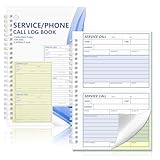
- 100 Two-Part Carbonless Sets in One Book – Each service call log book includes 100 preprinted 2-part carbonless forms Write once and produce a duplicate copy instantly without separate carbon sheets Ideal for service call logs work order records and daily business documentation
- Compact Size for Convenient Daily Use – The 5 5/8 x 8 1/2 inch layout offers a comfortable writing area while fitting neatly on desks service counters and clipboards The portable size makes this service call log book easy to carry for both office staff and field technicians ensuring quick and efficient documentation anywhere
- Includes Writing Shield for Clean Copies – Each book comes with a sturdy backing board that prevents ink bleed-through to other sets and provides a firm writing surface making it convenient for field service technicians and office front desk use
- Durable Spiral Binding for Smooth Use – Strong metal spiral binding keeps all sets secure and allows pages to flip easily and lay flat while writing Sheets tear off cleanly for customer or office copies supporting mobile and on-site communication needs
- Versatile for Service and Office Applications – Suitable for HVAC repairs plumbing electrical maintenance appliance service and more Also functions as a phone call log book or invoice receipt book for small businesses ensuring professional job tracking and customer messaging
Prepare candidates and support a fair process
Tell candidates in advance what to expect: the interview timing, assessment types, any technology they will need, and how to request adjustments. CIPD advises clear communication, a reasonable opportunity to request adjustments, and avoiding unnecessary length. Consistent questions and scoring criteria make assessment more comparable, but sample questions alone do not guarantee fairness or legal compliance. Build the process around the job, prepare interviewers, and consult current local rules before making hiring decisions; general hiring guidance is not jurisdiction-specific legal advice. See CIPD’s Selection Methods factsheet.
Independent reader supportYour contribution helps us test, update, and keep practical guides available for everyone.What structured interviews can—and cannot—tell you
OPM’s USA Hire resource displays a validity value of .51 for structured interviews and .54 for work samples in a table of common assessment types. The reviewed table does not identify its publication year or establish that either value is specific to customer-service hiring. These figures therefore should not be read as a customer-service result or a guarantee of hiring success. The values are displayed in OPM’s Developing Your Assessment Strategy resource.
There is no single universal list of customer-service interview questions that fits every role. The sample prompts and answer indicators here are practical applications of general structured-interview methods; adapt them to the position’s actual duties, policies, and escalation routes.
Best Value

- Custom Receipt Book with Logo Create a custom receipt book with your logo, business name, address, phone number, email, customer information area, payment method, and personalized business layout.
- Carbonless 2-Part Design The 2-part carbonless form design allows duplicate copies without separate carbon paper, helping businesses record payments, services, sales, and customer transactions.
- Great for contractors, repair services, auto shops, cleaning companies, landscaping crews, salons, retail shops, mobile vendors, delivery businesses, and local service providers. Bulk customization is supported for teams, organizations, service companies, and repeat business use.
- Made for Service Industries Perfect for auto detailing, towing, HVAC, home repair, landscaping, cleaning companies, salons, pet grooming, mobile vendors, contractors, and small business owners.
- Multi-Purpose Business Forms Can be used as invoice forms, receipt books, work orders, sales orders, estimate forms, quote forms, service tickets, payment records, and customer copy forms.
Frequently Asked Questions
What questions should I ask in a customer service interview?
Ask a consistent set of job-related behavioral and situational questions that test how candidates clarify needs, handle frustration, explain limits, prioritize work, and escalate or follow through. Select the questions from the competencies the role actually requires.
What should I look for in a customer service interview?
Look for specific evidence of listening, empathy within realistic boundaries, clear explanations, sound judgment, ownership, appropriate escalation, and follow-through. Rate the evidence against criteria established before interviews rather than relying on general impressions.
How many competencies should a structured interview assess?
OPM’s general rule of thumb is four to six competencies, with the number of questions balanced against the time available. The appropriate set depends on the role and the interview length. See OPM’s FAQ on structured-interview length.
Should I use behavioral questions, situational questions, or role-play?
Use behavioral questions for evidence from past experience, situational questions to hear a proposed response to a realistic case, and role-play or work samples when observing performance matters. Choose based on the competency and job; these methods reveal different evidence.
Should every candidate get the same interview questions?
Keep the predetermined core questions, order, and rating criteria consistent so candidates have comparable opportunities to provide evidence. Planned probes can clarify answers when applied consistently.
Quick Recap
Product prices and availability are accurate as of the date/time indicated and are subject to change. Any price and availability information displayed on Amazon at the time of purchase will apply.

