
Plan a PoE switch closet around three limits at once: the switch’s usable PoE budget, the power each endpoint must receive, and the heat the switch and cabling add to the space. For 802.3bt Type 4, the power-sourcing equipment (PSE) can allocate up to 90 W per port, while the powered device (PD) can receive about 71.3 W over four pairs. That does not make every existing cable run suitable for Type 4: cable category, conductor gauge, channel length, bundle size, and temperature rating all matter.
How much PoE power should the switch provide?
Start with the endpoints, not the largest wattage printed on a switch. Record each device’s expected steady-state draw, startup or transient demand, IEEE PoE class, and whether it requests power through LLDP or CDP. Then determine which devices may operate at the same time and total their expected demand.
- Endpoint inventory: Include access points, cameras, phones, lighting, and any other powered devices, along with their maximum or expected operating demand and negotiation method.
- Aggregate budget: Choose a switch whose published total PoE budget can support the simultaneous load, with engineering headroom for growth and variation. A port’s maximum rating does not mean the switch can supply that rating on every port at once.
- Power-supply capacity: Check the exact switch and power-supply configuration. Separate power available to the PoE subsystem from the switch’s own consumption; subtract switch draw from attached supply capacity when calculating what remains for PoE. If the vendor already specifies an aggregate PoE budget for that configuration, use that budget rather than subtracting the switch draw a second time.
- Port allocation: Confirm that the budget supports the expected mix of ports and classes, including simultaneous startup loads. Leave room for devices that may be added later rather than planning to run at the limit.
For 802.3bt Type 4, Cisco describes a maximum 90 W allocation at the PSE and about 71.3 W available at the PD over four pairs. Use the device-side figure when checking whether an endpoint will receive enough power; the PSE allocation is not the wattage delivered to the device. Cisco’s Deploying 90W UPOE+ with Catalyst 9000 Switches also keeps the channel below 100 m. Confirm the applicable distance and power figures against the switch documentation and the deployment’s cabling design.
Will existing Cat5e or Cat6 cabling support PoE++?
There is no safe yes-or-no answer based on the category marking alone. The suitability of an existing run for high-power PoE depends on its conductors, insulation temperature rating, length, bundle size, delivered wattage, and installation conditions. Cisco cautions that legacy building cabling may not be suitable for 90 W PoE, so reassess it before enabling Type 4 rather than assuming a cable that carries data will also meet the deployment’s thermal needs.
PC Slower Than It Used to Be?
A free scan shows the junk files, broken settings and background clutter dragging Windows down - then fixes them in one click.Free scan · Windows 10 & 11Crashes, No Sound, or Screen Glitches?
Random freezes, missing sound and display glitches usually trace back to one bad driver. Find and replace yours safely.Free scan · under a minute#1 Best Overall

- 𝗙𝘂𝗹𝗹 𝗚𝗶𝗴𝗮𝗯𝗶𝘁 𝟴-𝗣𝗼𝗿𝘁 𝗣𝗼𝗘 𝗖𝗼𝗻𝗳𝗶𝗴𝘂𝗿𝗮𝘁𝗶𝗼𝗻 - 8 PoEplus (802.3at/af) Gigabit RJ45 providing up to 30W per port and total PoE power budget of 65W. Up to 16 Gbps switching capacity.
- 𝗘𝘅𝘁𝗲𝗻𝗱𝗲𝗱 𝗣𝗼𝗘 𝗧𝗿𝗮𝗻𝘀𝗺𝗶𝘀𝘀𝗶𝗼𝗻 - Up to 820 ft PoE transmission distance with Extend Mode button on, perfect for surveillance camera deployment in large areas.
- 𝗣𝗼𝗘 𝗔𝘂𝘁𝗼 𝗥𝗲𝗰𝗼𝘃𝗲𝗿𝘆 - Automatically reboots your dropped or unresponsive PoE-powered devices with PoE Auto Recovery Mode on.
- 𝗣𝗹𝘂𝗴 𝗮𝗻𝗱 𝗣𝗹𝗮𝘆 - Simply plug and play for instant connectivity with no configuration required.
- 𝗦𝗶𝗹𝗲𝗻𝘁 𝗢𝗽𝗲𝗿𝗮𝘁𝗶𝗼𝗻 - Fanless design reduces power consumption and ensures silent operation, ideal for noise-sensitive homes or businesses.
For Type 4 runs that also need higher data speeds, Cisco recommends Cat6A with 23 AWG or larger conductors. For lower-speed, efficiency-focused Type 4 designs, Cisco identifies 22 AWG Cat5e as a possible choice when appropriate. These are design recommendations, not a blanket approval of every cable with those markings.
| Type 4 design context | Cable guidance | What to verify |
|---|---|---|
| Higher-speed links | Cat6A with 23 AWG or larger conductors, per Cisco deployment guidance | Actual cable specifications, temperature rating, channel length, bundle conditions, and applicable electrical code |
| Lower-speed, efficiency-focused runs | 22 AWG Cat5e may be used when appropriate, per Cisco deployment guidance | That the particular cable and installation conditions support the required power and thermal limits |
| Existing building cabling | Suitability for 90 W PoE is not established by category alone | Conductor gauge, insulation rating, length, bundle size, cable-maker guidance, and code requirements |
Cisco’s Type 4 guidance keeps the channel under 100 m; stay within the applicable channel limit and account for the actual installed path. Do not infer permitted bundle size or temperature rise from a category label. Consult the cable manufacturer’s data for the specific cable and installation, and apply the electrical code relevant to the site.
Rank #2

- [Flexible Full Gigabit 5-Port PoE Configuration] 4x PoE+ (802.3at/af) 10/100/1000 Mbps RJ45 ports providing up to 30W per port and total PoE power budget of 65W, together w/ 1x Gigabit Non-PoE Port for high-speed connections.
- [Plug and Play] Easy setup with no software installation or configuration needed.
- [Advanced Software Features] Prioritize your traffic and guarantee high quality of video or voice data transmission with Port-based 802.1p/DSCP QoS and IGMP Snooping.
- [Sturdy Metal Case] Durable metal casing and desktop/wall-mounting design are well-suited for different environments.
- [Reliable and Quiet] IEEE 802.3X flow control provides reliable data transfer and Fanless design ensures quiet operation.
How do cable gauge and bundle size affect heat?
Power carried by the cable creates heat, and that heat is affected by conductor gauge, insulation temperature rating, distance, power delivered, and how many cables are bundled together. Dense bundles can retain more heat than separated runs. Longer runs and higher power also change the thermal conditions. The safe bundle size therefore cannot be specified from PoE standard or cable category alone.
Before deploying high-power ports, identify the cable product and use its manufacturer’s thermal and bundle guidance for the intended PoE load and installation environment. If records for an existing cable plant do not establish gauge, rating, or bundle conditions, treat those as unknowns to resolve—not as proof that 90 W operation is safe. Where the installed cable cannot be verified against the intended use, have the cabling assessed and consider replacement or a lower-power design.
The Tool Desk
Outbyte PC Repair FREEClear out junk files and repair common Windows errorsFree Scan →Outbyte Driver Updater FREEFix the driver behind crashes, sound loss and screen glitchesFind Drivers →Rank #3
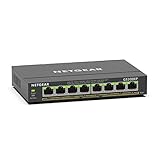
- GIGABIT ETHERNET PORTS: Features 8 x 1.0Gbps Ethernet ports for high-speed connectivity. Auto-negotiating ports detect the optimal speed for connected devices and work with existing Cat5e or Cat6 Ethernet cables.
- POWER-OVER-ETHERNET (PoE): Includes 8 PoE+ ports with 62W total power budget, plus uninterrupted PoE and per-port PoE controls for managed power delivery.
- EASY SMART MANAGED NETWORK SWITCH: Intuitive software interface offers Easy Smart Managed Essentials capabilities to configure VLANs, prioritize traffic with QoS, monitor ports, and manage network security for small businesses.
- FLEXIBLE MOUNTING OPTIONS: Compact metal design supports desktop or wall-mount placement for versatile installation.
- SILENT & ENERGY-EFFICIENT OPERATION: Fanless design ensures silent performance, while IEEE 802.3az Energy Efficient Ethernet reduces power consumption without compromising high-speed network performance.
How should the closet be cooled?
Account for conversion losses as well as the power delivered to endpoints. A Cisco worked example for a 24-port switch with every port delivering 90 W calculates 462 W of heat, or 1,576.34 BTU/hr of recommended cooling for that switch. That is a specific all-ports-at-90-W example, not a universal heat figure for every 24-port switch or an estimate for a partially loaded installation.
Use the actual switch model’s power and efficiency information, the planned load, and the surrounding equipment to assess closet heat. Check rack airflow, unobstructed intake and exhaust clearance, and whether room HVAC can remove the added heat. A switch operating within its own rating can still contribute to an overheated closet if airflow or room cooling is inadequate.
Rank #4

- More Ports, PoE Ready: UGREEN ethernet switch offers 8 PoE+ (802.3at/af) Gigabit ports (up to 30W each) and 2 Gigabit uplink ports, with a total power budget of 60W. Ideal for efficient power delivery and seamless network connectivity
- Intelligent Power Management: If power exceeds 60W, it cuts ports in priority order (8–1) to prevent overload. It auto-detects PoE devices, supplies power to them, and transmits data only to non-PoE devices. Short-circuited ports shut off independently
- PoE Auto Recovery: In Extend Mode, ports 1–6 automatically detect and restart powered devices (such as cameras or access points) when they go offline or freeze, ensuring stable PoE operation without manual monitoring or restart
- One Touch, Three Modes: The unmanaged ethernet switch can easily switch between Standard, Port Isolation (VLAN), and Extend with one button. Port Isolation separates ports 1–8 to prevent network storms. Extend mode supports PoE up to 820 ft, ideal for security systems and long-distance deployment
- High-Speed, Low Latency: The ethernet splitter offers 1000Mbps connectivity for real-time, lag-free monitoring with security cameras, efficient IP phone connections for work, and enhanced performance for wireless access points across your network
- Include switch conversion losses when estimating heat; endpoint wattage alone does not represent all power converted to heat inside the closet.
- Check airflow direction and clearance at the rack and around each switch rather than blocking vents with adjacent equipment or cable bundles.
- Account for other closet equipment and expected ambient conditions in the HVAC assessment.
- Include the planned PoE load in UPS sizing and runtime planning; the UPS must support both switch operation and the attached load for the required outage duration.
What should be monitored and checked during commissioning?
Use managed PoE negotiation and monitoring where available. Cisco documents that a switch can turn off power to a port when it detects undervoltage, overvoltage, overtemperature, oscillator faults, or a short circuit, and can report faults through syslog. The precise indicators and controls vary by switch, so confirm the behavior and monitoring options in the model’s documentation. Automatic shutdown is a protective response, not a substitute for correct cabling, power sizing, and cooling.
- Build the inventory: Record endpoint type, PoE class, expected steady-state demand, startup behavior, and LLDP/CDP negotiation requirements.
- Validate the switch configuration: Check the model, installed power supplies, usable aggregate PoE budget, per-port capabilities, and expected simultaneous load.
- Validate the cabling: Confirm channel length, category, conductor gauge, temperature rating, bundle conditions, and suitability for the planned power using cable-maker data and applicable code.
- Check heat and backup power: Assess switch losses, rack airflow, intake and exhaust clearance, room HVAC capacity, and UPS load and runtime.
- Bring ports online incrementally: Verify endpoint classification and LLDP/CDP requests, allocated power, link stability, temperature, alarms, and logs as devices are added. Investigate unexpected allocations, instability, or thermal alarms before connecting the full load.
Cisco’s Guidelines for PoE, updated September 15, 2025, describes power shutoff for the listed fault conditions and syslog reporting. Check the relevant switch’s current documentation for supported fault handling and exact log or alarm behavior.
Quick Recap
Best Value

- GIGABIT ETHERNET PORTS: Features 5 x 1.0Gbps Ethernet ports for high-speed connectivity. Auto-negotiating ports detect the optimal speed for connected devices and work with existing Cat5e or Cat6 Ethernet cables.
- POWER-OVER-ETHERNET (PoE): Includes 4 PoE+ ports with a 63W total power budget, plus dynamic PoE allocation that redistributes unused power to support more connected devices.
- PLUG-AND-PLAY UNMANAGED NETWORK SWITCH: Simple plug-and-play setup with no software to install or configuration required.
- FLEXIBLE MOUNTING OPTIONS: Compact metal design supports desktop or wall-mount placement for versatile installation.
- SILENT & ENERGY-EFFICIENT OPERATION: Fanless design ensures silent performance, while IEEE 802.3az Energy Efficient Ethernet reduces power consumption without compromising high-speed network performance.
Product prices and availability are accurate as of the date/time indicated and are subject to change. Any price and availability information displayed on Amazon at the time of purchase will apply.

