
iTechGuides is reader-supported. When you buy through links on our site, we may earn an affiliate commission. As an Amazon Associate I earn from qualifying purchases. Learn more
Connecting HDMI to AV requires an active HDMI-to-composite converter, not a passive HDMI-to-RCA cable. The converter changes digital HDMI video and audio into standard-definition composite video and analog stereo: yellow RCA for video, red for right audio, and white for left audio. In North America, the usual output is NTSC 480i.
The setup is useful for connecting a streaming stick, laptop, game console, Blu-ray player, cable box, or other HDMI source to an older television, VCR, projector, or monitor. The picture will be standard definition, however, and protected streaming or disc content may remain unavailable because of HDCP.
Key takeaways
- An HDMI-to-composite converter must actively change digital HDMI into analog AV; a cable that only changes the connector usually cannot do that.
- The correct signal direction is HDMI source HDMI OUT to converter HDMI IN, followed by yellow, red, and white RCA connections to the display.
- Composite output is standard definition: typically NTSC 480i in North America or PAL 576i in many other regions, even when the HDMI source is 1080p.
- A converter normally needs USB or 5-volt external power, and the HDMI source may need a supported resolution and PCM/stereo audio output.
- Menus may appear while protected Netflix, streaming, or Blu-ray video remains blocked by HDCP; a compliant digital display is the appropriate solution for protected content.
What is the correct way of connecting HDMI to AV?
The correct way of connecting HDMI to AV is to place a powered HDMI-to-composite converter between the digital source and the display. The normal signal path is:
What’s actually slowing this PC down?
Pick the symptom - the matching free tool is one click away.
HDMI source HDMI OUT
        ↓
HDMI cable
        ↓
Converter HDMI IN
        ↓
Yellow RCA = composite video
Red RCA = right audio
White RCA = left audio
        ↓
Composite AV input on the TV, VCR, projector, or monitor
The converter receives digital HDMI video, scales or converts that video to standard-definition composite video, converts compatible HDMI audio to analog left/right audio, and usually receives power from USB or a 5-volt supply. According to the Cirago HDMI-to-AV specifications, the documented output is NTSC 480i or PAL 576i; the Tripp Lite P130-000-COMP manual documents the same basic standard-definition output approach.
#1 Best Overall

- HDMI to RCA Converter: This convert HDMI video signal to normal CVBS signal, Available for TV, VHS VCR, DVD recorders, etc.
- HDMI to AV Converter: support two formats of PAL and NTSC output with a selecting switch, usually NTSC for America, PAL for other Countries. Note: If your TV shows black and white, Please change RCA format NTSC to PAL or PAL to NTSC by the N/P switch.
- Esay to use : Plug and play without any drivers,portable and flexible. Please hook up the USB power cable (included) to 5V power source during use(no included).
- HDMI 1.3 Input: Support HDMI input from 480i to 1080P, does not support 3D and 4K. It can work properly for TV Stick (such as Fire Stick).But do not support with mobile phones and iPad series.
- Compatible: HDMI to AV Adapter Suitable for TV Stick, Roku, Blu-Ray, DVD player, Android TV Box, PC, more. Then connect the RCA end into any display with RCA inputs such as Monitor/ Older TV/ Projector and more.
What do the AV, RCA, composite, component, and S-Video connectors mean?
AV is a broad label for audio/video connections. In the setup covered by this guide, AV normally means composite video plus analog stereo audio. RCA describes the physical connector style, not the signal format; RCA plugs can carry composite video, component video, or audio.
| Connector or label | What it carries | How it relates to HDMI-to-AV conversion |
|---|---|---|
| HDMI | Digital video and digital audio | The source connection into the converter |
| Yellow RCA | Composite analog video | The video output from the converter |
| Red RCA | Right-channel analog audio | Connects to the display’s audio-right input |
| White RCA | Left-channel analog audio | Connects to the display’s audio-left input |
| Red/green/blue RCA | Usually component video, often labeled Y/Pb/Pr | Not interchangeable with composite without suitable equipment |
| S-Video | A separate analog video format using a round mini-DIN connector | Not the same as yellow composite video |
Do not automatically plug the yellow composite connector into a green component-video jack. Some televisions document a shared green jack that accepts composite video, but that behavior is model-specific. Check the labels or the television manual before treating a component input as a composite input.
Why is an HDMI-to-RCA cable usually not enough?
An HDMI-to-RCA cable is usually not enough because HDMI carries digital audio and video while composite AV carries analog standard-definition video and analog stereo audio. A passive cable can change a plug shape, but it normally cannot perform the digital-to-analog conversion required by the signal formats.
Quick wins for a faster PC:
Repair Windows errors before they cause bigger problemsFix Now →Fix the driver behind crashes, sound loss and screen glitchesFind Drivers →Clear out junk files and repair common Windows errorsFree Scan →Search for an HDMI-to-AV converter, HDMI-to-composite converter with audio, HDMI-to-RCA converter box, or HDMI CVBS converter. “CVBS” is a common technical term for composite video.
Be cautious with listings described only as “HDMI cable to RCA,” “HDMI plug to three RCA plugs,” or “HDMI-to-component cable.” A product described as an adapter may only change a connector. A product described as a converter should document active conversion, composite output, the NTSC/PAL standard, and external power.
Which direction does the converter support?
The required product direction is HDMI source to composite AV display. An AV-to-HDMI converter solves the opposite problem: connecting a composite source, such as an old DVD player or VCR, to an HDMI television.
| What you have | What you need | Typical signal path |
|---|---|---|
| HDMI source and composite-only display | HDMI-to-composite converter | HDMI OUT → HDMI IN; yellow/red/white OUT → AV IN |
| Composite source and HDMI-only display | Composite-to-HDMI converter | Yellow/red/white OUT → AV IN; HDMI OUT → TV HDMI IN |
| HDMI source and HDMI display | HDMI cable | HDMI OUT → HDMI IN |
Inspect the labels rather than assuming that a box is bidirectional. The source side should say HDMI IN on an HDMI-to-composite converter. The display side should provide composite AV OUT, usually through yellow, red, and white RCA sockets. Reversing the cables does not reverse the conversion process.
Free tools Windows power users keep installed
One-click scans. No signup required.
What equipment can work with an HDMI-to-composite converter?
Common HDMI sources include streaming media players, laptops and desktops, Blu-ray and DVD players, cable and satellite boxes, modern game consoles, digital cameras, and HDMI-equipped set-top boxes. Common composite destinations include older LCD or plasma televisions, CRT televisions, VCRs, DVD recorders, composite-only projectors, older video monitors, and some car or portable displays.
Connector matching alone does not guarantee compatibility. The HDMI source must output a format accepted by the converter, and the converter must produce a format understood by the destination. Product specifications vary: the Cirago specifications and Tripp Lite documentation describe support for HDMI input modes extending through 1080p on their respective products, but individual models can differ.
Special case: USB-C, Mini DisplayPort, and laptop outputs
A laptop with USB-C may need a chain such as:
USB-C video output → USB-C-to-HDMI adapter → HDMI-to-composite converter → AV display
The USB-C port must support DisplayPort Alt Mode or another video-output capability. A USB-C accessory that supports only charging and data will not create an HDMI signal. Mini DisplayPort systems similarly need a compatible Mini DisplayPort-to-HDMI adapter before the HDMI-to-composite converter.
Rank #2
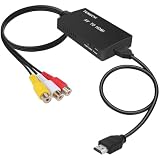
- RCA Female to HDMI Video Converters Adapter : The cable is used to convert analog composite input to HDMI 1080p output, displayed on a 1080p HD TV/TV/monitor.
- Input ports: 1xRCA Female (Yellow, White, Red), Output ports: 1xHDMI 1.3 1080p. NOT support 3D and 4K, NOT support HDMI Converts to AV
- AV to HDMI Converter: Plug and Play, Easy to Install and Operate, Powered by External USB Cable. Note: Please hook up the USB power cable (included) to 5V 1Apower source during use (not included power supply ).
- Support PAL, NTSC3.58, NTSC4.43, SECAM, PAL/M, PAL/N standard TV formats input. For PS2,PS3,Xbox,N64,STB, VHS, VCR, DVD Players and other devices with standard composite AV input.
- You Will Get : 1x RCA Female TO HDMI Converter, 1xHDMI cable, 1xUSB cable, 1xUser Manual. ONE YEAR WARRANTY - if you are not satisfied for any reason whatsoever, do not hesitate to contact us .
How do you install the converter step by step?
1. Check the equipment before connecting
- Confirm that the display has a composite video input, usually a yellow jack, rather than only component video or S-Video.
- Confirm that the converter is labeled HDMI input and composite or AV output.
- Check the converter’s supported HDMI resolutions and refresh rates.
- Confirm that the converter supports the television standard required by the display: NTSC or PAL.
- Check whether USB power or a 5-volt power adapter is included.
- Consider whether the source is likely to send HDCP-protected content.
2. Connect the video and audio cables
Source HDMI OUT → converter HDMI IN
Converter yellow → display yellow VIDEO IN
Converter red → display red AUDIO R IN
Converter white → display white AUDIO L IN
Converter USB or 5V input → suitable power source
The yellow plug carries video only. The red and white plugs carry analog stereo audio only. Match the colors where possible, but rely on the labels if a manufacturer uses nonstandard colors.
3. Apply power correctly
Many compact converters use USB power but do not include a wall charger. A television’s USB port may provide insufficient or unstable power on some models. For troubleshooting, use a known-good 5-volt USB wall adapter that meets the converter’s specified current requirement. The Tripp Lite P130-000-COMP documentation, for example, specifies an external 5V/1A supply.
4. Select the television input
Turn the television to the input labeled AV, Video, Composite, Line In, or Input 1/2. A television can be powered on and still show no picture if the television is set to HDMI, antenna, component, or the wrong AV input.
5. Use a reliable power-up sequence
- Turn on the television and select its composite input.
- Power the converter.
- Turn on or wake the HDMI source.
- Wait several seconds for HDMI negotiation.
If the source has more than one HDMI output, test another output if available. A different HDMI cable can also resolve a failed handshake, although changing cables will not solve an unsupported signal format or HDCP restriction.
Which source settings should you use?
Use a conventional source format that the converter explicitly supports. If the converter produces no picture, try 720p at 60 Hz or 1080p at 60 Hz when those modes are listed by the manufacturer. Disable unusual refresh rates, HDR, deep-color modes, or gaming-specific video modes if the converter does not document support for them.
The Tool Desk
Outbyte Driver Updater FREEScan for outdated or missing drivers - takes under a minuteDriver Scan →Outbyte PC Repair FREERepair Windows errors before they cause bigger problemsFix Now →For audio, select PCM, stereo, or two-channel uncompressed audio when available. A converter that outputs red and white RCA generally cannot pass multichannel Dolby, DTS, or Dolby Atmos as surround sound unless the product specifically documents decoding support. Bitstream or surround output can produce video with no sound.
On a computer, choose Duplicate, Mirror, or a supported external-display mode. Do not assume that every extended-desktop resolution will be accepted by the converter. Menu names vary by operating system, source model, and firmware, so use the source’s display and audio settings rather than following one universal menu path.
Should you select NTSC or PAL?
Select NTSC for a typical U.S. television and PAL for many televisions in Europe and other regions where PAL equipment is used. NTSC output is generally 480i, while PAL output is generally 576i. Imported equipment can complicate the choice, so match the converter’s setting to the display’s documented standard.
A wrong standard can produce a black-and-white, rolling, unstable, or otherwise unusable picture. Some converters use a physical NTSC/PAL switch; others use a button, pinhole control, or menu. The Cirago instructions specifically document switching NTSC/PAL when the picture appears black and white. The Tripp Lite manual also documents NTSC/PAL selection.
What picture quality should you expect?
An HDMI-to-composite converter can make a modern HDMI source visible on an old display, but the output remains standard definition. A 1080p source is reduced to composite 480i or 576i; the converter cannot preserve 1080p or 4K detail through a yellow RCA connection.
Rank #3
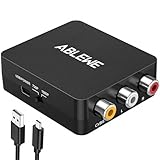
- RCA to HDMI Converter: Converts analog RCA composite (Yellow, White, Red) input to HDMI 720P/1080P (60HZ) output,displayed on HDTV/Monitor,which can bring back your childhood memories.
- Plug to Play: ABLEWE Mini RCA to HDMI converter no extra drivers need, just plug and play,easy to use.Please hook up the USB power cable (included) to 5V power source during use.
- Wide Compatibility: Support source formats of PAL, NTSC3.58, NTSC4.43, SECAM, PAL/M, PAL/N standard TV. Provide advanced signal processing with great precision, colors, resolutions, and details.
- Widely Used:Widely applied to PS2,PS3,Xbox,N64, WII, STB, VHS, VCR, DVD Players and other devices with standard composite AV input.
- Attention & Package:Please ensure to connect this rca to hdmi converter to power source to make it work.Package include:1*RCA to HDMI Converter,1*usb power cable(adapter not included),1*User Manual.
| Source or display expectation | What the composite connection can provide |
|---|---|
| 1080p or 4K source detail | Reduced to standard-definition composite output |
| HDMI digital audio | Usually converted to left/right analog stereo |
| Small computer text | May be soft or difficult to read |
| Modern widescreen content | May show letterboxing, pillarboxing, stretching, or cropping |
| Fast gaming | May show converter or display latency; do not assume zero lag |
Composite video can introduce softness, ringing, color bleed, flicker, and motion artifacts. Features such as noise reduction, adaptive contrast, frame-rate conversion, and overscan or underscan controls may improve usability, but those features cannot restore detail discarded during conversion. The StarTech HD2VID documentation describes image controls on its converter family, while the model page also warns readers to check current availability.
Why does HDCP cause a black screen?
HDCP is an HDMI content-protection system. A converter may display a source’s home screen, settings menu, unprotected home video, or some games, yet show a black screen or warning when protected streaming or disc content starts.
StarTech’s HDCP FAQ explains that HDCP-protected content can block conversion to analog video and may require a digital display. Apple’s external HDMI display guidance likewise states that HDCP playback on an external display requires an HDCP-compatible display.
Crashes, No Sound, or Screen Glitches?
Random freezes, missing sound and display glitches usually trace back to one bad driver. Find and replace yours safely.Free scan · under a minuteWindows Errors? Fix Them Before They Spread
Repair common Windows errors and clear accumulated junk for a smoother, more stable PC - no reinstall needed.Free scan · no reinstallDo not treat claims that a converter “removes” HDCP as a recommended or lawful fix. Test the converter with unprotected content, check the manufacturer’s stated HDCP behavior, and use a compliant digital display for protected streaming or Blu-ray playback. A product listing that says “HDCP compatible” does not guarantee playback of every protected service, app, disc, or source-display combination.
How do you troubleshoot HDMI-to-AV problems?
| Symptom | Likely causes | Best recovery steps |
|---|---|---|
| No picture at all | Wrong TV input, no converter power, wrong port direction, unsupported resolution, failed handshake, HDCP, or defective equipment | Select each AV input; verify yellow-to-yellow; confirm HDMI OUT to converter HDMI IN; check power; test the source menu; try 720p/60 Hz; restart all devices; test another source and cable |
| Black-and-white picture | Wrong NTSC/PAL setting, component input, or regional mismatch | Set the converter and display to the same standard; verify that yellow is in a composite input |
| Picture but no sound | Loose or misrouted red/white plugs, mute, unsupported Dolby/DTS bitstream, or wrong audio input association | Connect red and white to audio inputs; select PCM/stereo; unmute the TV; check the TV’s input pairing |
| Rolling or unstable image | Wrong video standard, unsupported refresh rate, loose cable, unstable power, or display incompatibility | Check NTSC/PAL; use a documented source mode; replace or reseat RCA cables; use stable 5V power |
| “Out of range” or distorted image | Unsupported HDMI resolution or refresh rate | Lower the source to a mode listed by the converter, such as 720p/60 Hz where supported |
| Menus work but movies or streaming do not | HDCP or service-specific content protection | Test unprotected content; check HDCP documentation; use a compliant digital display instead of attempting circumvention |
| Image is cropped or stretched | Aspect ratio, television overscan, or converter scaling | Try the converter’s underscan/overscan control and the TV’s 4:3, 16:9, normal, fit, or just-scan modes |
No picture at all: use this test order
- Select every relevant AV, Video, Composite, or Line In input on the television.
- Confirm that the yellow RCA plug is in a composite video input, not an ordinary component-only jack.
- Confirm that the HDMI cable runs from the source’s HDMI OUT to the converter’s HDMI IN.
- Check the converter’s power indicator and use a known-good 5-volt power source where specified.
- Display the source’s home screen or settings menu. If the menu appears but a program does not, suspect HDCP rather than cabling.
- Try another HDMI cable and restart the television, converter, and source.
- Set the source to a supported mode such as 720p/60 Hz.
- Test the converter with another HDMI source and test the display with another composite source.
StarTech’s troubleshooting documentation identifies unsupported resolution as a cause of “Out of Range” errors and recommends lowering the source resolution. The same documentation and StarTech’s HDCP FAQ identify HDCP as a possible cause when a black screen affects only certain content.
When should you choose a different solution?
| Your priority | Most sensible solution | Why |
|---|---|---|
| Occasional use with an old TV, laptop, camera, or unprotected game | Basic HDMI-to-composite converter | Low complexity and adequate for standard-definition viewing |
| International or imported equipment | Documented NTSC/PAL converter | Matching the video standard reduces black-and-white and unstable-picture problems |
| Continuous installation or business use | Better-documented converter with support and warranty | Power specifications, compatibility information, and technical support matter more |
| Protected streaming or Blu-ray is the main purpose | Modern HDCP-compatible digital display | Analog conversion may be blocked even when menus work |
| HD, 4K, HDR, readable text, surround sound, or modern gaming is required | Replacement display or native digital connection | Composite cannot preserve those capabilities |
| The source already has composite, component, or RF output | Use the source’s native analog output when appropriate | A separate HDMI-to-composite conversion step may be unnecessary |
A converter makes economic sense when the display has sentimental value, the use is occasional, or the source is unprotected. Replacement is usually better when the converter costs a substantial fraction of a reliable modern display or when the user needs daily streaming, clear computer text, HDR, surround sound, HDMI-CEC, variable refresh rate, or low-latency gaming.
Which converter features matter when buying?
Prioritize the following specifications instead of relying on vague “universal” or “plug-and-play” language:
Recommended Free Tools
- Active conversion: The product must explicitly convert HDMI to composite or CVBS.
- Correct direction: Confirm HDMI input and yellow/red/white output.
- NTSC/PAL support: NTSC is important for U.S. displays; PAL may be necessary for many international displays.
- Input resolution: Check whether the converter accepts the source’s actual resolution and refresh rate. “Supports 1080p” generally describes input capability, not 1080p composite output.
- Output format: Look for composite 480i NTSC or 576i PAL and analog stereo audio.
- Audio compatibility: Confirm support for PCM or two-channel audio if the source cannot be configured otherwise.
- Power: Verify whether a USB cable, 5V adapter, or wall-plug adapter is supplied.
- HDCP behavior: Treat protected-content claims cautiously and never assume every streaming service or disc will work.
- Image controls: Overscan, underscan, aspect-ratio, or scaling controls can help with cropping and borders.
- Documentation and availability: Confirm that the exact model is still sold and supported.
“Plug and play” generally means that the converter does not require a computer driver. It does not mean that every source, resolution, audio mode, television standard, and protected-content path will negotiate successfully. HDMI version labels such as HDMI 1.3 or 1.4 also do not establish compatibility with every resolution, audio format, HDCP version, or device.
Independent reader supportYour contribution helps us test, update, and keep practical guides available for everyone.Which documented models fit different use cases?
The following are product examples documented in the supplied research, not universal “best” choices. Prices are an August 18, 2026 snapshot from the cited manufacturer pages or product documentation and can change. StarTech HD2VID is included only as an availability warning because the manufacturer marks that model discontinued.
| Model | Documented characteristics | Best fit | Important limitation | Price signal in dossier |
|---|---|---|---|---|
| Cirago HDM2ACRCA | HDMI input; yellow/red/white output; NTSC 480i/PAL 576i; USB power; input support listed through 1080p; one-year warranty | Consumer setups needing named NTSC/PAL documentation | Not suitable when HD quality, surround sound, or guaranteed protected streaming is required | $69.99 USD on the cited product page, August 18, 2026 snapshot |
| Tripp Lite P130-000-COMP | HDMI-to-composite conversion; NTSC/PAL switch; input support listed through 1080p at 50/60 Hz; 480i/576i output; uncompressed two-channel stereo; external 5V/1A supply; international plug adapters; two-year warranty | International use and buyers prioritizing documented power and support | Not a high-definition output device; no reliable current direct price was provided in the dossier | No reliable current direct price in the cited documentation |
| Adafruit product 3365 | HDMI-to-CVBS; left/right stereo RCA; selectable NTSC/PAL; USB power; input support listed up to 1080p | Budget use with unprotected computers, cameras, or older game systems | Product page explicitly says 3D and HDCP are not supported | $13.95 USD converter; optional listed 5V/1A supply $5.95 USD, August 18, 2026 snapshot |
| StarTech HD2VID2 | HDMI-to-yellow/red/white composite conversion; input support up to 1080p; NTSC/PAL; no drivers required; manufacturer technical support | Buyers valuing documentation and technical support | HDCP-protected content may block analog conversion and require a digital display | $103.51 USD on the cited U.S. manufacturer page, August 18, 2026 snapshot |
| StarTech HD2VID | Older HDMI-to-composite product page | Checking older recommendations against current availability | The manufacturer page marks the model discontinued | Do not treat old listings as proof of current availability |
The cheapest documented option is not automatically the best option. A low-cost converter can be reasonable for unprotected content and occasional use. A better-documented model can justify its price for a permanent installation, international use, or support requirements. For HDCP-protected streaming, spending more on an HDMI-to-composite converter does not guarantee success; a modern compliant digital display is generally the better purchase.
Rank #4

- HDMI to RCA Converter: Convert HDMI video signal to normal CVBs(AV) signal (standard-definition 480i, 576i), available for TV Stick, Roku, Chromecast, Apple TV, PC, Laptop, Xbox, HDTV, DVD-Black etc. But it can not be used as a RCA to HDMI Converter
- Two TV formats output: It support two formats of PAL and NTSC output with a selecting switch, usually NTSC for America, PAL for other Countries.Note: If your TV shows black and white, Please change RCA output format NTSC to PAL or PAL to NTSC by the switch beside the power port.
- Esay to use and portable: Well sized, no need to install drivers, plug and play, portable and flexible. Come with a USB charge cable(MUST BE POWERED FIRST OF ALL)
- Compatible with HDMI 1.3: Support HDMI input from 480i to 1080P. It can work properly for TV Stick, (such as Chromecast), but not support with mobile phones and iPad series
- What You Get: HDMI to RCA/AV converter, USB power cable and user manual. Wonlyus ensures long-time satisfaction of your purchase; Friendly and easy-to-reach customer service to solve your problems timely. If you have any problems, Please contact us we will slove immediately in 24 hours
Can a converter feed a VCR or DVD recorder?
An HDMI-to-composite converter may feed a composite-only VCR or DVD recorder because the converter supplies yellow video and red/white analog audio. Physical compatibility does not guarantee that recording will work, however. HDCP can still block protected content, and recording rights and content-protection rules are separate from the wiring question.
Do these 3 things before closing this tab:
1Clear out junk files and repair common Windows errors2Scan for outdated or missing drivers - takes under a minute3Repair Windows errors before they cause bigger problemsIf the source already has a native composite, component, or RF output, using that output may be simpler. A legacy console with a compatible analog cable or an older DVD/VCR combination unit may avoid unnecessary HDMI conversion.
What if you need audio separately?
An HDMI audio extractor alone does not create composite video. An extractor can send HDMI audio to a receiver or powered speakers, but a setup that also needs yellow composite video requires a product with HDMI-to-composite video conversion or a separate video converter.
Check the product’s actual outputs and audio format support. If a source outputs Dolby, DTS, or another multichannel bitstream while the converter expects PCM stereo, change the source audio setting before diagnosing the red and white cables.
Frequently Asked Questions
Can I use an HDMI-to-RCA cable without a converter box?
Usually no. HDMI is digital, while yellow/red/white composite AV is analog, so the setup normally requires a powered HDMI-to-composite converter containing active conversion electronics. A passive cable that only changes the connector shape generally cannot perform that conversion.
Does HDMI-to-AV work both ways?
No. HDMI-to-AV converts an HDMI source to a composite display, while AV-to-HDMI converts a composite source to an HDMI display. The two product categories use opposite signal directions and cannot normally be substituted by reversing the cables.
Why is my HDMI-to-AV picture black and white?
A black-and-white picture commonly indicates an NTSC/PAL mismatch or a composite-versus-component input mistake. Set the converter and display to the same television standard, and confirm that the yellow plug is connected to a documented composite input.
Can HDMI-to-AV play Netflix or Blu-ray content?
Not reliably. Menus or unprotected content may appear while HDCP-protected streaming or disc video is blocked. Check the converter’s HDCP documentation, but use a compliant digital display for protected content rather than attempting to bypass content protection.
Does an HDMI-to-composite converter output 1080p?
No. A converter may accept a 1080p HDMI input, but composite output remains standard definition—typically NTSC 480i or PAL 576i. The converter cannot preserve 1080p or 4K detail through a yellow RCA connection.
Why is there video but no sound?
Connect the red and white plugs to the display’s audio inputs, confirm that the television is not muted, and set the HDMI source to PCM or stereo. Many converters provide two-channel analog audio and cannot decode Dolby or DTS bitstream output.
Do HDMI-to-AV converters need USB power?
Most compact converters need USB or another 5-volt external power source because active digital-to-analog conversion requires electronics. A television USB port may be insufficient or unstable, so use a suitable powered USB wall adapter when necessary.
The Bottom Line
Bottom line: Buy an active HDMI-to-composite converter with the correct HDMI-in-to-AV-out direction, NTSC/PAL support, documented power requirements, and compatible audio settings. Connect HDMI OUT to HDMI IN, yellow to composite video, and red/white to stereo audio. Expect standard-definition quality, and choose a modern HDCP-compatible display instead when protected streaming, HD detail, or dependable daily use matters.
Quick Recap
Product prices and availability are accurate as of the date/time indicated and are subject to change. Any price and availability information displayed on Amazon at the time of purchase will apply.

