
Quick wins for a faster PC:
Repair Windows errors before they cause bigger problemsFix Now →Fix the driver behind crashes, sound loss and screen glitchesFind Drivers →Clear out junk files and repair common Windows errorsFree Scan →iTechGuides is reader-supported. When you buy through links on our site, we may earn an affiliate commission. As an Amazon Associate I earn from qualifying purchases. Learn more
A click chemistry toolbox is best understood as a set of reaction options, not a collection of interchangeable products. For a biological labeling or conjugation task, the key choice is often whether to use copper-catalyzed azide–alkyne cycloaddition (CuAAC), copper-free strain-promoted azide–alkyne cycloaddition (SPAAC), or inverse-electron-demand Diels–Alder (IEDDA) chemistry. Each balances reaction speed, catalyst needs, reagent design, and compatibility with the intended setting differently.
What does a click chemistry toolbox include?
Click chemistry describes a range of reactions used to join molecular components. Azide–alkyne ligation is prominent, but it is not the whole toolbox: a 2024 review groups established click reactions into cycloadditions, nucleophilic ring-opening reactions, non-aldol carbonyl reactions, and additions to carbon–carbon multiple bonds. The right class depends on the molecule being modified and the chemical and biological conditions it must tolerate.
For common bioconjugation choices, the three reaction families to compare are CuAAC, SPAAC, and IEDDA. Their names refer to different partner pairs and, in CuAAC, a catalyst requirement.
Outdated Drivers Are Slowing You Down
One free scan finds every outdated or missing driver and matches the right update for your exact hardware.Free scan · exact hardware matchWindows Errors? Fix Them Before They Spread
Repair common Windows errors and clear accumulated junk for a smoother, more stable PC - no reinstall needed.Free scan · no reinstallHow do CuAAC, SPAAC, and IEDDA compare?
| Reaction | Partners or catalyst | Useful distinction | Tradeoff |
|---|---|---|---|
| CuAAC | Azide and alkyne; copper catalyst | An established cycloaddition when copper use is acceptable. | The copper requirement can make it less suitable for some biological settings. A 2024 review discusses the comparison. |
| SPAAC | Azide and a strained cyclooctyne, such as DBCO | A copper-free ligation used in biological research. | In the 2024 review’s comparison, SPAAC is approximately 100-fold slower than CuAAC; bulky strained partners can also add steric hindrance and hydrophobicity. The speed comparison is not a guarantee for every reagent pair. Review details. |
| IEDDA | An electron-poor tetrazine and a strained electron-rich partner such as TCO, norbornene, or BCN | Can provide very fast ligation, with reaction rate strongly affected by reagent structure. | Do not assume one pair’s rate applies to another. The 2024 review reports rate constants from 1 to 106 M−1 s−1 in water at 25 °C across different reagent designs. Review details. |
Which reaction is copper-free?
SPAAC avoids an added copper catalyst by pairing an azide with a strained alkyne. That can be useful when copper is unsuitable for the biological context. The tradeoff is that strained partners such as cyclooctynes have structural consequences: their bulk can hinder access to a reaction site, and their hydrophobicity may affect the system. The 2024 review’s approximate 100-fold rate comparison with CuAAC is a broad comparison, not a reagent-independent rule. Read the review.
#1 Best Overall

- Play the role of chemist with this huge, colorful, functional lab station!
- Create glowing slime, fizzing reactions, Oozing Bubbles, colorful chromatography, and more!
- With 57 pieces, This kit has everything you need to conduct experiments like a real scientist, including beakers, test tubes, flasks, pipettes, and more.
- Printed experiment cards clip onto the lab station for easy reference and additional experiments and scientific explanations are included in a separate 16-page, full-color manual.
- Includes non-hazardous chemicals; does not contain borax.
IEDDA is another copper-free option, but it uses different partners: a tetrazine and a strained alkene or related strained electron-rich partner. Its rate is design-dependent. The reported range of 1 to 106 M−1 s−1 applies to different reagent designs in water at 25 °C, not to every tetrazine–partner combination. The review reports the range.
How should you choose a reaction?
Start with the constraints of the actual conjugate rather than selecting a reagent name in isolation. Compare the following factors:
Rank #2

- MIX, FIZZ & DISCOVER 50 EXPERIMENTS – Dive into hands-on chemistry as you make glow-in-the-dark slime, a groovy lava lamp, glowing chalk, an erupting test tube, and more exciting projects!
- EVERYTHING INCLUDED FOR 15 EXPERIMENTS – This chemistry lab includes goggles, tools, lab supplies, and materials for 15 included experiments, so you can start mixing, fizzing, glowing, and discovering right away.
- BONUS GUIDE WITH 35 MORE EXPERIMENTS – Keep exploring chemistry with a bonus guide featuring 35 additional experiments that use easy-to-find household items, including pH science and polymer science activities.
- MAKE GLOWING SLIME, CHALK & MORE – Explore glowing reactions, color changes, fizzing solutions, bouncy balls, putty, and sodium alginate worms as you discover how chemistry creates surprising results.
- STEP-BY-STEP CHEMISTRY LEARNING – Easy-to-follow instructions guide each activity, while the Learning Guide shares cool chemistry facts and introduces inspiring STEM learning through real science concepts.
- Catalyst tolerance: If adding copper is not suitable for the biological setting, consider copper-free SPAAC or IEDDA.
- Required reaction speed: IEDDA can be very fast, but the rate depends strongly on the exact tetrazine and strained partner. SPAAC is generally slower than CuAAC in the cited review’s comparison.
- Partner size and properties: Strained partners may impose steric or hydrophobicity costs. Consider whether those properties could interfere with access or behavior of the molecule being labeled.
- Selectivity and compatibility: Check whether the functional groups and conditions are compatible with the specific molecule and biological environment; the reaction family alone does not establish that a particular conjugation will work.
- Evidence for the exact pair: A broad family-level comparison cannot predict a specific reagent’s yield, rate, or performance. Consult documentation and protocols for the exact pair before planning an experiment.
What reagents appear in a click chemistry toolbox?
Vector Laboratories describes a Click Chemistry Toolbox listing DBCO, TCO, tetrazines, azides, and alkynes, alongside metabolic-labeling reagents and IsoTAG kits. These are categories of reagents, not endorsements of a particular product or pairing. The page is vendor-authored, so its catalog and performance descriptions should be read as supplier information. See Vector Laboratories’ Click Chemistry Toolbox.
Recommended Free Tools
In broad terms, DBCO is a strained alkyne associated with SPAAC, while TCO and other strained partners can pair with tetrazines in IEDDA. Azides and alkynes are functional-group categories used in cycloadditions; whether a specific product is appropriate depends on its structure and intended use.
Rank #3

- 250 REAL CHEMISTRY EXPERIMENTS FOR ASPIRING YOUNG CHEMISTS — Discover how fascinating the world is when you understand the reactions behind ordinary occurrences. CHEM C2000 includes everything in CHEM C1000 plus twice the tools and materials and more than three times the experiments — an excellent intermediate-level kit that creates a strong foundation for high school chemistry, with logical progression toward the advanced CHEM C3000.
- 128-PAGE FULL-COLOR EXPERIMENT MANUAL — Clear step-by-step instructions and engaging scientific explanations guide young chemists through experiments organized across 18 themed chapters. Topics include acids and bases, the chemistry of water, oxygen and air, carbon dioxide, sulfur dioxide and acid rain, chlorine chemistry, iron and copper, the chemistry of foods (sugar, starch, protein), surfactants and soaps, paper chromatography, and the cold light of luminol.
- INTRODUCES THE ALCOHOL BURNER FOR HEAT-BASED EXPERIMENTS — A key step up from beginner sets, the included alcohol burner dramatically expands what's possible: combustion reactions, evaporation, crystallization, and reactions that only proceed with heat. Build true laboratory apparatus with the included tripod components, glass and rubber tubing, stoppers, and electrolysis equipment.
- PROFESSIONAL-QUALITY LAB EQUIPMENT FOR GENUINE REACTIONS — Outfit a real home lab with glass test tubes, two graduated beakers, funnel, dropper pipettes, carbon electrode, alligator-clip wires, immersion heater, test tube stand, protective safety goggles, and a complete set of carefully selected chemicals (full list in product description) for real oxidation, neutralization, electrochemistry, and chromatography experiments — not simulations.
- PARENTS' CHOICE SILVER AWARD WINNER — AGES 11+ WITH ADULT SUPERVISION — Designed and manufactured in Germany to the rigorous EN 71-4 safety standard. Thorough safety rules, first-aid guidance, GHS labeling, and waste-disposal instructions are integrated throughout the manual. Adult supervision required. An ideal gift for homeschoolers, middle schoolers, and curious students ready to go beyond beginner chemistry.
What can click chemistry do in biomedical research?
Copper-free click reactions are used in biomedical research for labeling and work involving imaging, delivery, and diagnostics, in in vitro, in vivo, and ex vivo settings. These uses describe research applications; they do not establish clinical effectiveness for a particular product or prove that one reaction is suitable for every biological setting. The 2024 comparative review and a review of biomedical applications discuss this area.
Independent reader supportYour contribution helps us test, update, and keep practical guides available for everyone.Where can you learn more?
A Thieme reference-library contents page identifies a volume titled Click Chemistry, including coverage of CuAAC and metal-free click reactions. The contents page establishes that the reference volume exists; it does not confirm a current edition, marketplace listing, or price. View the Thieme contents page.
Quick Recap
Best Value

- A COMPLETE CHEMISTRY LAB FOR YOUNG SCIENTISTS – Perfectly crafted for budding scientists aged 4 and up, this kit provides everything needed to start exploring the exciting world of chemistry using common household items like baking soda and vinegar!
- 50 AWESOME HANDS-ON EXPERIMENTS – Dive into a world of discovery with 50 interactive experiments that spark curiosity and engage young minds in the wonders of science.
- EASY-TO-FOLLOW ILLUSTRATED INSTRUCTIONS – Each experiment comes with clear, step-by-step instructions that are fully illustrated, making it easy for young scientists to follow along and achieve successful results on their own.
- INCLUDES 20+ KID-FRIENDLY LAB TOOLS – Equipped with over 20 durable, child-safe lab tools, this kit ensures that kids have everything they need to conduct their experiments like real scientists!
- AMAZON EXCLUSIVE - Blue Marble has developed this product exclusively for Amazon.
Rank #4
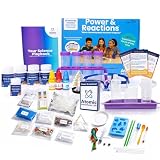
- Complete Science Kit for Kids - This kids science kit provides more materials than standard kits. Equipped with beakers, droppers, cards, & many more, it’s the ideal science kit for 7 to 12-year-old kids.
- 40+ Kids Science Experiments - Turn your home into a science lab with over 40 hands-on activities. From color changes to energy-releasing reactions, this chemistry set makes chemistry approachable & exciting.
- All-Inclusive Chemistry Set - Eliminate the hassle of searching for supplies! Unlike others, our science kits for kids are fully equipped with every tool needed to start your science experiments right out of the box.
- STEM Learning - Foster a love for STEM Activities with our kid science kit, packed with materials & activity cards. Our educational science kits help kids explore foundational STEM concepts through experiments.
- Card-Based Learning - Unlike traditional STEM kits for kids, our science kits feature easy-to-follow experiment cards that guide children step by step. The visual instructions make it easy for kids to explore chemistry.
Product prices and availability are accurate as of the date/time indicated and are subject to change. Any price and availability information displayed on Amazon at the time of purchase will apply.

