
A CI/CD pipeline for an AI-enabled IoT system must release more than application code. It needs to make device and gateway software, infrastructure, configuration, dependencies, deployment artifacts, and model versions traceable and testable as one coordinated change. Because that system may span constrained devices, edge runtimes, and cloud services, the pipeline also needs representative hardware testing, secure promotion, staged fleet rollout, and a way to observe and recover from failures.
What makes CI/CD different for AI-enabled IoT?
In a conventional application, a release may be mostly a service or application artifact. In an AI-enabled IoT system, a single behavior can depend on device firmware or software, an edge runtime, cloud services, configuration, and a model. A mismatch between any of those parts can break the system even if the application code itself passes its tests.

Plan each release as a traceable set of related artifacts: source revisions, infrastructure definitions, configuration, dependency and container versions where applicable, and model version. Record which combinations are intended for which device classes or fleet targets. This makes it possible to identify what is running, reconstruct how it was built, and connect a field issue to the change that introduced it. The AWS IoT Lens application-security guidance recommends source management, infrastructure as code (IaC), automated builds, scans, tests, and deployment.
The system can also be distributed across several inference locations rather than being one centrally hosted application. The International Telecommunication Union’s ITU-T Recommendation Y.4618, version 1.0, approved 2026-06-29, describes AIoT across device, edge, and cloud domains. That is a useful way to organize the design: device-side inference may need lightweight execution and closed-loop behavior; edge systems may coordinate devices and provide observability; cloud services may handle large-scale training and lifecycle management. These roles are design options, not a prescribed product architecture.
#1 Best Overall
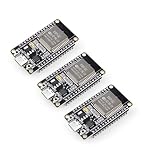
- Dual-Core Performance Up to 240 MHz: Run sensor processing, wireless communication, automation logic and connected-device tasks on a 32-bit dual-core ESP32 platform designed for responsive embedded and IoT projects
- Built-in Wi-Fi and Bluetooth 4.2: Connect to 2.4 GHz Wi-Fi networks or use Bluetooth Classic and BLE for wireless sensors, smart devices, remote controls, home automation and other connected projects
- Flexible Power-Saving Modes: ESP32 power-management features support dynamic clock scaling and low-power operating modes, helping developers reduce energy use in compatible sensing, monitoring and connected-device applications, suitable for battery-powered Internet of Things (IoT) devices.
- USB-C Programming with CP2102: Connect through USB-C for power, sketch uploads and serial monitoring, while GPIO, UART, SPI and I2C interfaces support sensors, displays, motor drivers and other modules (USB-C cable not included)
- Over-the-Air Update Support: Configure OTA functionality through a compatible ESP-32 software framework to update deployed firmware over Wi-Fi without reconnecting the board by USB for every revision
How should the pipeline move a change toward production?
Use automated, repeatable transitions and preserve the evidence they produce. The exact tools depend on the team’s source control, build environment, device runtime, and fleet operations; the controls matter more than choosing a particular vendor’s implementation.
-
Version the complete change
Keep device and gateway source in source control, define repeatable environments with IaC, and associate each release with the configuration and model versions it requires. Make the intended target hardware or device class explicit so a build or model is not promoted to an incompatible target.
-
Build reproducibly and scan early
Automate artifact creation rather than relying on manually repeated release steps. Scan application code and relevant artifacts, such as libraries and container images, for vulnerabilities; generate a software bill of materials (SBOM) where appropriate. AWS IoT Lens recommends scanning during build and at distribution locations, and notes that codifying build, test, and deployment makes the workflow repeatable and auditable.
Rank #2
 2 Pack ESP32-DevKitC-32E Development Board for IoT Smart Home/Industrial Control, Dual-Core 240MHz Wi-Fi + Bluetooth 5.0 with USB-C, Original ESP32-WROOM-32E Module (Arduino/Python/IDF) (8M)
- Certified & Future-Ready: Espressif-certified ESP32-WROOM-32E ensures full hardware compatibility and lifetime firmware support. Upgraded 8MB Flash handles IoT data and OTA updates.
- Dual-Core Speed: 240MHz dual-core processor runs Wi-Fi/BLE and sensors 2x faster. 38 GPIO pins (10 RTC) support SPI/I2C/UART for LCDs, motors, and industrial sensors.
- Plug & Play Dev: USB-C driver pre-installed: upload code instantly on Windows/Mac/Linux. Works with Arduino IDE, MicroPython, and Espressif IDF.
- All-Environment Ready: Run Wi-Fi smart switches (Home Assistant) and BLE tracking on one board. Industrial-grade stability (-40°C~85°C) for outdoor/automated systems.
- Advantages: The ESP32 development board offers high performance, low power consumption, and rich wireless connectivity, making it suitable for developers of all levels, especially beginners.
-
Test software, integration, and model behavior
Run ordinary software checks, connected-component integration tests, and stress tests. Add model inference checks and validate edge-targeted models on a simulator representative of the production device or in a testbed with actual hardware. The testing section below details how to choose coverage for the system’s inference placement.
Do these 3 things before closing this tab:
1Clear out junk files and repair common Windows errors2Scan for outdated or missing drivers - takes under a minute3Repair Windows errors before they cause bigger problemsSpecial offer. See more information about Outbyte and uninstall instructions. Please review EULA and Privacy policy. -
Promote through environments
Move the solution and its associated configuration through development, QA or pre-production, and production, applying the checks appropriate to each transition. Microsoft’s IoT Central CI/CD guidance describes promoting the full solution and configurations through environments; AWS IoT guidance similarly covers automated build, test, staging, and deployment. These are examples of the pattern, not a requirement to use either platform.
-
Require approval when risk justifies it
Use an explicit human approval gate for changes whose impact, uncertainty, or operational consequences warrant review. An AWS edge MLOps example describes simulated or in-lab testing followed by stakeholder approval before production promotion. It illustrates one implementation choice; approval policy should reflect the system’s risks and governance needs.
Rank #3
What should be tested before an IoT model reaches devices?
Test the model in the context where it will execute, not only in the environment where it was trained. A model that behaves acceptably in a cloud notebook may still fail on a target device because the runtime, hardware, inputs, or integration differ. For an edge deployment, combine representative simulation or physical-device testing with checks of the surrounding system.
- Software and artifact checks: verify that the application, dependencies, model file, and configuration build and package as expected for the intended target.
- Integration checks: exercise the connections among the model, edge runtime, device software, cloud services, and relevant configuration.
- Inference checks: confirm that inference executes on the target runtime and that outputs meet the application’s defined expectations. Include the inputs and operating conditions that matter for the deployment.
- Stress checks: exercise the combined system under representative load and operational conditions. A successful single inference is not evidence that an integrated deployment will remain reliable under sustained use.
- Hardware-representative checks: use a simulator that represents the production device or an in-lab testbed with actual hardware when the model runs at the edge. Confirm the target architecture and runtime rather than assuming a test on one device represents every fleet variant.
The AWS published edge MLOps example illustrates simulated or in-lab pre-production testing, integration, stress, and inference-focused checks. It was published about four years before October 2026; use it as an example of testing patterns, not as confirmation of current product availability or naming.
How does inference placement change the pipeline?
Choose device, edge, cloud, or hybrid inference based on the system’s latency, privacy, bandwidth, and compute constraints. The location determines which environment must be represented in tests, where artifacts are delivered, and what telemetry can be collected. There is no placement that is best for every IoT workload.
Rank #4

- 2.4GHz Dual Mode WiFi + Bluetooth Development Board
- Support LWIP protocol, Freertos
- SupportThree Modes: AP, STA, and AP+STA
- Ultra-Low power consumption, Compatible with Arduino IDE
- ESP32 is a safe, reliable, and scalable to a variety of applications
| Inference location | Pipeline and testing emphasis | Operational consideration |
|---|---|---|
| Device | Validate the model and runtime against the target device class; test device-specific integration and the deployed artifact. | Device compute and hardware variation can constrain execution. Plan for the device’s connectivity and update behavior. |
| Edge node or gateway | Test the model with the edge runtime and connected devices, including integration and stress behavior on representative hardware or simulation. | Account for coordination, observability, and whether edge processing must continue when connectivity is unstable or unavailable. |
| Cloud | Test cloud service integration and configuration as part of the solution release; validate the inputs and outputs relied on by devices and edge components. | Evaluate latency, privacy, and bandwidth constraints that affect sending data to cloud inference. |
| Hybrid | Test each model execution location and the handoffs between them, including which version and configuration each component expects. | Keep artifact versions and telemetry paths coordinated across the distributed system. |
The comparison is an engineering framework, not a product ranking. The ITU-T reference model organizes AIoT around device, edge, and cloud domains and describes placement as a trade-off involving latency, privacy, bandwidth, and compute.
How can a fleet rollout limit the impact of a bad update?
Promote a validated release in stages rather than sending it to the entire fleet at once. Begin with a limited target group appropriate to the system, observe deployment progress and device behavior, and expand only when the rollout meets the team’s release criteria. Define in advance what conditions halt progression and what recovery action is available; a rollout is not safe merely because it is automated.
Track deployment status and preserve enough operational information to see which targets received the update, which remain pending, and which failed. AWS IoT Lens recommends staged deployment to limit the scope of problems and provide progress information for operators. AWS IoT Greengrass guidance also presents OTA deployment orchestration and addresses operation through unstable or unavailable internet connectivity. These examples support treating connectivity and recovery as design requirements, not assuming that every device is continuously online.
Windows Errors? Fix Them Before They Spread
Repair common Windows errors and clear accumulated junk for a smoother, more stable PC - no reinstall needed.Free scan · no reinstallCrashes, No Sound, or Screen Glitches?
Random freezes, missing sound and display glitches usually trace back to one bad driver. Find and replace yours safely.Free scan · under a minuteBest Value
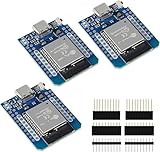
- D1 Mini NodeMCU Type-C ESP32 WLAN WiFi Bluetooth IoT Development Board 5V Compatible for Arduino
- Designed with ultra-low power technology, it offers the full range of performance and features of the ESP32 chip. The pin arrangement provides compatibility with the modules developed for the D1 Mini ESP8266 while also offering fast WLAN, enhanced GPIO, Bluetooth functionality, and with its higher performance, a wider range of applications.
- 100% compatible with Arudino IDE, Lua and Micropython, it shows robustness, versatility, and reliability in a wide variety of applications and power scenarios.
- All I/O pins have interrupt, PWM, I2C and one-wire capability, except the pin DO.
- Designed with ultra-low power technology, it offers the full range of performance and features of the ESP32 chip. The pin arrangement provides compatibility with the modules developed for the D1 Mini ESP8266 while also offering fast WLAN, enhanced GPIO, Bluetooth functionality, and with its higher performance, a wider range of applications.
For updates delivered over the air, account for interrupted connectivity and define how a device resumes or reports an incomplete deployment. Ensure the rollout process can distinguish a device that is offline from one that has applied the update but is malfunctioning. The exact recovery mechanism depends on the device and update architecture, so validate it on representative targets before relying on it in production.
Independent reader supportYour contribution helps us test, update, and keep practical guides available for everyone.What security and audit controls belong in the release path?
Secure the whole path through which a release is built, delivered, and operated. Microsoft’s IoT security guidance identifies assets, connections, edge infrastructure, and cloud services as security areas. In practice, consider the device and physical asset, communications, edge runtime and stored data, cloud components, credentials, build outputs, and update channel together.
- Protect access: control credentials and permissions used by build jobs, cloud services, and devices. Limit permissions to the work each identity must perform.
- Protect artifacts and updates: scan relevant code and artifacts, track what was built, and secure the route used to distribute updates.
- Keep the process inspectable: retain build and scan results, test outcomes, approvals, promotion history, and deployment records so operators can investigate a fault and establish what changed.
- Monitor operation: watch deployment status and system behavior after release, with a response path for suspected faults or security issues.
AWS’s secure edge computing and connectivity guidance assigns customers responsibilities for edge networks and devices, secure connections, software updates, monitoring, and audit in its cloud deployment context. That allocation is specific to the described AWS context; teams should map responsibilities to their own operating model and services. NIST’s SP 800-213 series addresses federal IoT cybersecurity acquisition, deployment, and use and directs federal agencies to apply the Risk Management Framework and related guidance. It does not define one universal CI/CD pipeline or establish obligations for every jurisdiction.
Which vendor examples are useful, and what do they establish?
Official vendor documentation can show how common controls are implemented, but it should not be read as a universal architecture or a comparative ranking.
- AWS IoT: the IoT Lens covers source management, IaC, automation, scanning, SBOMs, and staged deployment. The Greengrass Foundations guidance illustrates CI/CD and OTA deployment in an AWS-specific setting.
- AWS edge MLOps: the edge MLOps article is useful for the model-testing and approval pattern described above. Its age means product-specific details should not be taken as current availability guidance.
- Microsoft Azure: Azure IoT Edge product information describes AI workloads on IoT devices and development activities such as coding, testing, debugging, deployment, and CI/CD. The IoT Central guidance provides an example of configuration promotion across environments.
- NIST DevSecOps: the NCCoE notional reference model presents CI/CD stages for building, testing, releasing, and deploying artifacts while generating evidence, and calls for AI-specific monitoring and threat response in AI-enabled DevSecOps. It is an evolving reference architecture, not a device certification checklist.
When assessing an implementation, compare how it handles the target hardware and runtime, representative test environments, model and configuration versioning, fleet targeting, intermittent connectivity, recovery, artifact integrity, scanning, audit evidence, monitoring, and integration with the team’s existing development and operations systems. Those properties determine whether a pipeline can safely release the particular distributed system being operated.
Quick Recap
Product prices and availability are accurate as of the date/time indicated and are subject to change. Any price and availability information displayed on Amazon at the time of purchase will apply.

