
What’s actually slowing this PC down?
Pick the symptom - the matching free tool is one click away.
iTechGuides is reader-supported. When you buy through links on our site, we may earn an affiliate commission. As an Amazon Associate I earn from qualifying purchases. Learn more
Yes, water droplets can contribute to erosion or other impact damage on a supersonic aircraft, but the damage is not caused by the sonic boom itself. As a droplet passes through the disturbed, high-speed flow around the aircraft, it can deform, accelerate, deflect or break up before reaching a surface. Its condition at impact, the local airflow, the aircraft’s shape and the material struck all affect the result. Research establishes these mechanisms under specific test and modeling conditions; it does not establish a universal safe speed in rain or how often operational supersonic aircraft suffer this damage.
How can a tiny droplet damage a fast aircraft?
The important event is the droplet’s impact with a surface, not simply its presence in the surrounding air. At high relative speed, even a small quantity of water can deliver a brief, concentrated load. Repeated impacts may contribute to erosion or other surface damage, depending on the conditions and material. The result cannot be inferred from droplet size or aircraft speed alone.
A droplet approaching the aircraft does not necessarily retain its original shape or follow a straight path into the skin. The air around a supersonic vehicle is altered by shock waves and by the flow around individual components. As the droplet crosses that region, it may deform, accelerate, turn away from a surface or break apart. Those changes affect where it hits and what shape it has at impact.
A 2013 U.S. Army AMRDEC study emphasized that impact behavior depends strongly on the droplet’s actual shape at impact. That makes the process a coupled flow-and-impact problem: the local flow and the aircraft geometry shape the droplet’s approach, while the impact also depends on the surface material and impact conditions.
#1 Best Overall

- Legendary F-4 Phantom II Replica: A 1:155 scale die-cast model of the iconic McDonnell Douglas F-4 Phantom II, one of the most successful and versatile fighter-bomber designs in military aviation history.
- Southeast Asia Camo Edition: Features authentic Southeast Asia camouflage, representing the aircraft deployed by the USAF Tactical Air Command during the Vietnam War for air support and reconnaissance missions.
- Die-Cast Metal Construction: Crafted from premium die-cast metal with select plastic parts for fine detailing, providing collectors with a durable and realistic model.
- Historic Combat Legacy: Honors the F-4’s impressive service history as the first aircraft simultaneously used by the USAF, US Navy, and USMC, and its record-breaking performance in speed, altitude, and climb.
- Includes Display Stand: Model measures approximately 4 7/8 inches long with a 3 3/16 inch wingspan and comes with a plastic display stand, perfect for collectors and military aviation enthusiasts aged 14 and up.
Do shock waves break up raindrops before they hit?
They can be part of the flow environment that changes a droplet, but it is too broad to say that every drop breaks up. Research describes shock-layer passage as a setting in which droplets may deform, accelerate, deflect or fragment. Which changes occur depends on the droplet and the local flow around the aircraft.
Shock waves are pressure changes in the surrounding flow. They form around aircraft components such as the nose, wings, engine inlets and tail. The familiar sonic boom is the sound associated with shock waves reaching an observer; it is not the mechanism described for water-impact erosion. In this case, the relevant pathway is the altered droplet’s interaction with a surface.
Where can impacts or water ingestion occur?
External surfaces and radomes
Droplets can be directed toward or away from different parts of the aircraft as they pass through the local flow. A nose, wedge-like leading edge, wing or radome will not necessarily encounter the same droplet paths or impact conditions. Research on supersonic and hypersonic vehicles describes erosion gradients associated with shock-layer breakup, acceleration, deflection and deformation. The damage pattern therefore depends on geometry as well as droplet and material properties.
Rank #2

- Legendary F-14 Tomcat Replica: A 1:160 scale die-cast model of the iconic F-14 Tomcat, the supersonic, long-range interceptor fighter aircraft used by the U.S. Navy for air superiority and defending carrier battle groups against anti-ship missiles.
- Jolly Rogers VFA-103 Edition: Features the striking Jolly Rogers livery with the sinister white skull-and-crossbones insignia, adopted by the US Navy Strike Fighter Squadron 103 (VFA-103) in 1995, marking their legacy.
- Die-Cast Metal Construction: Built from durable die-cast metal with select plastic components, offering exceptional detail and realistic craftsmanship for collectors and aviation enthusiasts.
- Variable Geometry Wings: The model captures the F-14’s signature swing-wing design, with wings that automatically adjust between 20 and 68 degrees for high-speed and low-speed flight, though the wings on this model are stationary for display purposes.
- Perfect Display Size: Measures approximately 4 3/4 inches long with a 2 7/8 inch wingspan, ideal for display on shelves, desks, or in a military aviation collection. Recommended for adult collectors and fans aged 14 and up.
Engine inlets
Water can also be directed into an inlet, but inlet ingestion and external-surface impact are different questions. A 1958 NACA study examined an inlet designed for Mach 2 aircraft operation using dye-tracer measurements in a subsonic icing tunnel. Its tests used Mach 0.237 tunnel flow and droplets with an 11–20 micrometer volume-median diameter. The report found that impingement and ingestion efficiencies depended on both droplet size and the ratio of inlet velocity to free-stream velocity.
Those measurements are useful evidence about how inlet flow and droplet size affect water paths; they are not a supersonic flight test. The inlet’s intended operating speed must not be confused with the speed of the tunnel test.
What do the reported speeds and droplet sizes mean?
The figures below describe particular analyses, experiments or test equipment. They are not interchangeable measurements, and none establishes a universal damage threshold for aircraft in rain.
Rank #3
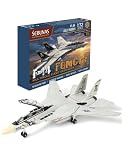
- Experience the legendary F-14 Tomcat through a highly detailed model designed for aviation collectors and hobby enthusiasts. The finished model becomes a striking desktop or showcase centerpiece.
- This 3D puzzle is designed for beginner-level assembly enthusiasts, offering an immersive hands-on building experience that helps cultivate patience, concentration, and mechanical problem-solving skills.
- This product is manufactured using high-quality, environmentally friendly plastic and employs an ultra-fine etching process to ensure durability, structural precision, and realistic aircraft details.
- Encourages understanding of aircraft engineering concepts while improving hand-eye coordination and spatial thinking through engaging mechanical assembly.
- Ideal gift for childs, engineers, collectors, model builders, and puzzle lovers for birthdays, Children’s Day, Christmas, or special hobby occasions.
| Source and year | Reported condition | What it establishes—and what it does not |
|---|---|---|
| NACA analytical study, 1954 | Droplets of 2–100 micrometers; Mach 1.1–2.0 | Analysis of droplet trajectories, local impingement rates and impact velocities on wedges and double-wedge airfoils. These are study ranges, not a universal damage envelope. |
| NACA inlet study, 1958 | 11–20 micrometer volume-median droplet diameter; Mach 0.237 tunnel flow | Subsonic icing-tunnel measurements for an inlet intended for Mach 2 aircraft operation. The reported conditions are not direct supersonic flight results. |
| U.S. Army AMRDEC study, 2013 | Mach 2–7 ballistic-range data | Reports tests involving vehicle shapes, alongside single-droplet and rocket-sled work and modeling. The Mach range is not a safe operating limit or a rain-damage threshold. |
| ASTM technical record, 1974 | Rain-erosion tests up to 1,700 m/s (5,500 ft/s) | Discusses test conditions including velocity, impact angle, heating and shock-layer effects. A test speed does not by itself predict damage to a particular aircraft. |
| Chinese Journal of Aeronautics paper, 2025 | Water-jet test platform simulating impacts below 1,000 m/s | Describes a controlled single-impact method based on a light-gas-gun principle. It does not establish that a particular radome is safe or unsafe in flight. |
The 1954 NACA analysis, 2013 AMRDEC work and 1974 ASTM technical record address different conditions and methods. Comparing their numbers without also comparing the geometry, flow, impact angle, material and type of evidence would give a misleading impression of a single threshold.
How strong is the evidence for real aircraft damage?
There is evidence for mechanisms and controlled impact behavior, but the methods answer different questions:
- Analysis and modeling can estimate trajectories, impingement and the effect of local flow, but depend on their assumptions and require validation against relevant conditions.
- Single-droplet, coupon or water-jet tests can isolate aspects of impact behavior. They do not, by themselves, reproduce every feature of rain exposure on a complete aircraft.
- Rocket-sled and ballistic-range work can investigate high-speed impacts and vehicle shapes under controlled conditions. A tested speed or shape is not automatically representative of operational flight.
- Flight or fleet evidence would be needed to quantify operational incidence or damage rates. The cited studies do not provide a fleet-wide incident rate, damage per flight hour or aircraft-specific safe rain-speed limit.
The 2013 AMRDEC authors describe single-droplet impacts, rocket-sled testing, ballistic-range data and modeling. They also identify detailed validation in shock layers around relevant vehicle geometries as remaining work. That qualification matters: a plausible mechanism and controlled experiments are not the same as a validated prediction for every aircraft in flight.
Rank #4

- Relaxing journey – Take some time to relax with the LEGO Icons Concorde (10318) building project for adults
- What’s in the box? – Everything you need to construct a detailed LEGO replica model of Concorde, the world’s most famous supersonic commercial passenger airplane
- Fun Features – Includes a tiltable droop nose, functioning landing gear, a retractable tail bumper wheel, delta wings with movable elevons, hinged upper and lower rudders and an accessible seating area
- Build and display – This collectible model comes with a stand for display in flight, takeoff or landing modes
- A gift idea for aircraft lovers – Give this LEGO Icons building set as a gift for adult fans of Concorde and model airplanes
Is rain erosion the same as icing?
No. Liquid-drop impact erosion concerns the mechanical interaction of water with a surface. Icing occurs when supercooled liquid water freezes on contact. NASA’s 2026 report describes supercooled large droplets, which can reach 2,000 micrometers and may collect aft of conventional ice-protection systems. It also cites 2–100 micrometers as typical icing-drop sizes. Those icing figures describe a different hazard; they are not estimates of erosive droplet size for supersonic aircraft.
Keep the distinction clear when interpreting a report of water-related aircraft damage: erosion from liquid impacts and accretion of frozen water involve different conditions and failure mechanisms.
What determines the risk in a particular case?
A meaningful assessment needs more than the aircraft’s Mach number. Relevant factors include:
Best Value

- The Boeing F/A-18F Super Hornet are supersonic twin-engine, carrier-capable multirole fighters that entered service in the U.S. Navy fleet in 1999
- 1:100 Scale Military Die-cast Plane Model. The size of the aircraft model is 7.5*5.7*2.2 inches, the weight is 0.45 pounds. This F-18 aircraft model requires no assembly and can be displayed directly after purchase
- The fighter casing is a high quality alloy, The tire and the propeller is engineering plastic. The stand base keeps the model plane in good condition
- F-18 military aircraft model accurately reproduces the appearance and details of the real jet airplane, including the visible cockpit, missiles hanging from the bottom, smooth lines and glossy curved surface
- Metal Airplane model is an excellent gift for aerospace enthusiasts, making it a fantastic birthday present and keepsake. It is suitable for display in the living room, study, or office
- Droplet state: diameter and distribution, temperature, liquid or frozen state, and shape at impact.
- Relative impact conditions: speed, angle and the local flow through the shock layer—not just the aircraft’s nominal flight speed.
- Aircraft geometry: the nose, leading edges, radome, inlet and their local flow fields can steer or alter droplets differently.
- Material and damage measure: coating and substrate, plus whether the reported outcome is erosion, cracking, delamination or another form of damage.
- Evidence type: an analytical prediction, a controlled impact test, a model test or a validated flight result supports different levels of conclusion.
Without those details, a result from one test cannot reliably be transferred to another aircraft, component or weather condition.
What can’t be concluded from these studies?
The documented ranges do not define a universal speed below which flying in rain is safe, nor do they show how commonly operational supersonic aircraft encounter damaging precipitation. They also do not establish a fleet-wide damage rate or a validated, aircraft-specific protection or repair method. Those conclusions require evidence tied to the aircraft, component, materials and operating conditions in question.
Quick Recap
Product prices and availability are accurate as of the date/time indicated and are subject to change. Any price and availability information displayed on Amazon at the time of purchase will apply.

