
Free tools Windows power users keep installed
One-click scans. No signup required.
Yes. A public ESP32 project runs a FLIP fluid solver on a 20×20 simulation grid and displays its output on an 8×8 NeoPixel matrix. That demonstrates feasibility for a deliberately small simulation—not a guaranteed frame rate or performance level for every ESP32 board.
What the ESP32 fluid-simulation example demonstrates
The Vateva ESP32 fluid simulation project uses FLIP, a particle-and-grid method: particles carry motion, while a grid supports the pressure calculation used to enforce incompressibility. Its listed setup has 400 particles on a 20×20 grid, with FLIP/PIC blending and a 15-iteration Gauss-Seidel pressure projection using successive over-relaxation.
The output is an 8×8 NeoPixel LED matrix. The simulation grid and the display are separate: the solver has 400 cells, while the visible image has only 64 pixels. The project also connects a QMI8658 IMU over I²C so tilting the device changes the direction of gravity. That sensor adds an interaction; it is not required to run a basic simulation.
How fast is it?
The repository reports a target frame interval of 23 ms and about 8.16 ms of total computation per frame on its hardware, measured before a later optimization. In that earlier breakdown, the solver took about 1.53 ms and visualization about 2.16 ms; the LED transmission blocked for about 1.9 ms. These are project-reported measurements, not independent tests or a general benchmark for ESP32 boards.
Recommended Free Tools
#1 Best Overall

- 2.4GHz Dual Mode WiFi + Bluetooth Development Board
- Support LWIP protocol, Freertos
- SupportThree Modes: AP, STA, and AP+STA
- Ultra-Low power consumption, Compatible with Arduino IDE
- ESP32 is a safe, reliable, and scalable to a variety of applications
The author subsequently changed grid-to-particle transfer to reuse stencils and moved wall coefficients out of the solver loop. Host-build execution improved, but the optimized on-device version was not re-measured. Do not assume the earlier timing describes the optimized build, or that another board, firmware configuration, or display will match it.
How to build a small simulation
- Start with a modest grid and particle count. A 20×20 grid and 400 particles provide a documented scale to begin experimenting with; they are not published minimum requirements or a universal ESP32 limit.
- Separate the solver from the renderer. Keep simulation data at its chosen resolution, then map the result to the output. The project maps to 8×8 LEDs; drawing a small field on a larger screen or interpolating pixels is an implementation choice.
- Measure stages independently on the target board. Time particle/grid transfer, pressure solve, visualization, and peripheral updates separately. In the project’s reported build, visualization and LED transmission were meaningful parts of the frame cost, not just the pressure solver.
- Add controls only if useful. Fixed gravity is enough for a basic simulation. For tilt control, the cited implementation uses a QMI8658 IMU; its wiring and pin choices are specific to that hardware setup.
- Increase resolution gradually. After each change, check timing and memory use on the board and with the display configuration you intend to ship.
What display works for an ESP32 fluid simulation?
8×8 addressable LED matrix
An 8×8 addressable matrix is the simplest route to the demonstrated pixel-art look. Confirm the matrix voltage and data signaling, available GPIO, and compatibility with the LED library and board. The project’s pin assignments are not universal wiring instructions.
Rank #2
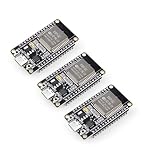
- Dual-Core Performance Up to 240 MHz: Run sensor processing, wireless communication, automation logic and connected-device tasks on a 32-bit dual-core ESP32 platform designed for responsive embedded and IoT projects
- Built-in Wi-Fi and Bluetooth 4.2: Connect to 2.4 GHz Wi-Fi networks or use Bluetooth Classic and BLE for wireless sensors, smart devices, remote controls, home automation and other connected projects
- Flexible Power-Saving Modes: ESP32 power-management features support dynamic clock scaling and low-power operating modes, helping developers reduce energy use in compatible sensing, monitoring and connected-device applications, suitable for battery-powered Internet of Things (IoT) devices.
- USB-C Programming with CP2102: Connect through USB-C for power, sketch uploads and serial monitoring, while GPIO, UART, SPI and I2C interfaces support sensors, displays, motor drivers and other modules (USB-C cable not included)
- Over-the-Air Update Support: Configure OTA functionality through a compatible ESP-32 software framework to update deployed firmware over Wi-Fi without reconnecting the board by USB for every revision
LCD panel
Espressif’s ESP-IDF LCD documentation describes the esp_lcd framework, supported interface types, panel-window drawing, and APIs for sending user buffers to a configured panel. Only a limited set of controller drivers is included out of the box; ST7789 is one documented example, while other drivers may be available through the component registry. Choose the panel first, then confirm its driver and initialization requirements for your ESP-IDF release.
For SPI panels, Espressif’s SPI LCD guide covers panel I/O configuration, pixel clock, transaction queue, and pixel format or bit width. Its ST7789 example uses 16-bit pixel data; that is an example configuration, not a requirement for every panel or simulation.
The Tool Desk
Outbyte PC Repair FREERepair Windows errors before they cause bigger problemsFix Now →Outbyte Driver Updater FREEScan for outdated or missing drivers - takes under a minuteDriver Scan →Rank #3

- Powerful ESP-32 Board: Unlock the world of Internet of Things (IoT) and advanced electronics with the heart of this kit: the ESP-32 board. It features a powerful dual-core processor, integrated Wi-Fi and Bluetooth 4.2, making it perfect for building connected, smart devices that communicate with your phone or the cloud. It's fully compatible with the Arduino IDE for easy programming.
- Super Starter Kit: This kit contains over 35 different modules and electronic components, including sensors, displays, motors, and input devices. From LEDs and buttons to an OLED screen, servo motor, and keypad, you have everything needed to explore a vast range of projects in one box.
- Step by Step Online Tutorial: Jump right in with our detailed, beginner-friendly tutorial. Access 30+ projects with complete code, clear circuit diagrams, and step-by-step instructions. Learn the fundamentals of electronics, coding, and how to utilize the ESP-32's unique capabilities without any prior experience.
- Hands-on Learning for All Skill Levels: Perfect for students, makers, engineers, and hobbyists. Start with basic circuits and coding, then progress to intermediate and advanced IoT applications. Build practical projects like weather stations, smart home controllers, remote-controlled devices, and interactive gadgets. The skills you learn are the foundation for real-world innovation.
- Quality & Great Support: Elegoo is committed to quality. We provide a clear, detailed tutorial guide, refined code, and a well-organized component kit. All modules are carefully selected for reliability and ease of use. Our dedicated technical support team and active online community are ready to help you succeed in your learning journey.
Plan for display memory and transfer time
A compact solver does not eliminate the cost of rendering and sending pixels. Espressif’s ESP-BSP LCD/LVGL performance guidance explains that buffer size and double buffering affect refresh performance as well as RAM use. The right configuration depends on the display, color depth, chip, and workload, so profile display work separately from physics on the actual hardware.
Do not use historical memory totals as an estimate of available application RAM. Espressif’s ESP-IDF 4.0 memory-model article describes a 192 KB IRAM / 328 KB DRAM map for that release; those figures are version-specific and are not current free-memory figures. Check the target chip’s datasheet, the selected framework version, and the free heap after allocating simulation arrays and display buffers.
Quick Recap
Best Value

- 2.4GHz Dual Mode WiFi + Bluetooth Development Board
- Ultra-Low power consumption, works perfectly with the Arduino IDE
- Support LWIP protocol, Freertos
- SupportThree Modes: AP, STA, and AP+STA
- ESP32 is a safe, reliable, and scalable to a variety of applications
Rank #4

- 2.4GHz Dual Mode WiFi + Bluetooth Development Board
- Support LWIP protocol, Freertos;ESP32 is a safe, reliable, and scalable to a variety of applications
- SupportThree Modes: AP, STA, and AP+STA
- Ultra-Low power consumption, Compatible with Arduino IDE
- 1PCS 30Pin ESP32 Development Board 2.4GHz WiFi Dual Cores Microcontroller Integrated with Antenna RF Low Noise Amplifiers Filters
Product prices and availability are accurate as of the date/time indicated and are subject to change. Any price and availability information displayed on Amazon at the time of purchase will apply.

