
Recommended Free Tools
iTechGuides is reader-supported. When you buy through links on our site, we may earn an affiliate commission. As an Amazon Associate I earn from qualifying purchases. Learn more
Usually, no: a standard headphone jack sends sound out and does not accept a microphone signal. Recording requires a microphone input, a compatible headset-combo port, or an external audio device that explicitly supports microphone input. A connector’s shape alone does not tell you which function it supports.
How to tell whether a jack accepts audio input
Check the port’s symbol, label, and the receiving device’s manual. A headphone symbol generally identifies output; a microphone symbol identifies input. Some computers use separate headphone and microphone sockets, while others have a single combo headset port. Microsoft notes that jack labels vary between systems: its Windows sound troubleshooting guidance describes both separate jacks and labeled ports.
- Headphone symbol only: Treat it as output-only unless the manufacturer’s documentation confirms microphone input.
- Microphone symbol: This is the likely input; confirm the port type and compatibility in the manual.
- Headset symbol or one combined socket: It may support both headphone output and microphone input, but check that the device supports a headset microphone.
- Separate headphone and microphone sockets: Connect the microphone to the microphone input, not the headphone output.
Can a headset microphone work through a headphone jack?
Only if the receiving port supports microphone input and the plug wiring matches. A headset with a built-in microphone commonly uses a four-contact TRRS plug to carry stereo headphone audio and a mono microphone signal. A headphone-only port designed for a three-contact TRS plug does not become a microphone input just because a TRRS plug fits into it. Focusrite explains this TRS/TRRS mismatch and the separate microphone signal in its guide to unusual headset audio.
What to use for common setups
| Your device setup | What to do | What it will not do |
|---|---|---|
| One port marked with a headset icon | Check the device manual for headset-microphone support and confirm the plug is compatible. | The icon alone does not prove that the port accepts a microphone. |
| Separate headphone and microphone sockets | Connect a microphone to the mic socket. For a single-plug headset, use a compatible TRRS headset splitter that separates headphone and microphone connections. | A splitter does not turn a headphone-output-only port into an input. |
| Only a headphone output | Use a designated microphone input or a compatible external audio device with microphone input. | Plugging a microphone into the headphone output does not create a recording path. |
| No 3.5 mm socket | Consider a device-compatible USB-C or Lightning to 3.5 mm adapter, after checking that the specific adapter supports the microphone/input function you need. | Not every adapter supports recording input; compatibility with wired headphones does not establish microphone-input support. |
Microsoft’s USB Audio 2.0 driver documentation describes Windows support for USB Audio 2.0 devices. That support does not mean every USB audio adapter has a microphone input. Apple documents wired headphones and adapters for compatible Apple products in Use Apple wired headphones; check the particular adapter’s specifications rather than assuming it accepts recording input.
#1 Best Overall
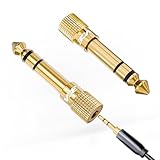
- Seamless Audio Connection: 1/4'' to 3.5mm Audio Jack Adapters allow a 6.35mm stereo port to connect a 3.5mm plug aux cable.
- Premium Sound Fidelity: Featuring 24K gold-plated connectors, this adapter ensures maximum conductivity and resists corrosion. It minimizes signal loss and unwanted noise, delivering clear, crisp, and true stereo sound from your pro-audio equipment to your personal listening devices.
- Durable & User-Friendly Design: Constructed with solid brass and a precision-engineered TRS interface for a secure fit. The knurled, 360-degree grip treads provide a non-slip surface, making plugging and unplugging easy and secure, even in tight spaces behind amplifiers or mixers.
- Broad Device Compatibility: The 6.35mm Male to 3.5mm Female adapter is universally compatible. Use it with electric guitars, bass amps, keyboards, digital pianos, studio monitors, AV receivers, mixers, and more to connect to any standard 3.5mm headphone or auxiliary input.
- Compact And Portable : This 1/4 inch to 3.5mm stereo audio adapter is lightweight and compact, perfect for musicians and audio enthusiasts to carry into pockets, bags, or travel cases
Choosing an adapter without buying the wrong one
Start with the receiving device and the signal you want to record. Look for a USB audio adapter whose specifications explicitly list microphone input, and verify host-device compatibility. If your computer has separate mic and headphone sockets and your headset has one plug, a compatible TRRS splitter may be the simpler, narrower solution. For either accessory, confirm connector type and wiring as well as the supported input function.
- Identify the make and model of the computer or phone receiving the audio.
- Determine whether it has a microphone input, a headset-combo port, separate mic and headphone sockets, or headphone output only.
- Check the source device and the cable or headset plug type.
- Read the adapter documentation for microphone-input support and host compatibility; do not infer recording capability from the connector shape or a headphone-output feature.
Recording audio from another device’s headphone output
This is different from using the receiving device’s headphone jack as an input. A source device’s headphone output may connect to an actual input on a recorder or computer only when the cable and signal levels are suitable for both devices. The receiving device still needs a real audio input; its headphone socket does not become one when a cable is inserted. Check the manuals for the exact source and recorder before connecting them, because the appropriate wiring and level settings depend on the devices.
Quick Recap
Rank #4

- Work for for 3.5mm jack equipment,Connect 3.5mm Male to 6.35mm Female(1/8" male to 1/4" female adapter), allows you connect headphones to audio devices
- made of pure copper and its service life is much longer than plastic and gold plating.Please ensure that the 3.5mm port is fully inserted.
- Pure copper connectors resist corrosion and ensure minimal signal loss.
- Handy and portable, widely work with earphone, headphone, karaoke system and etc
- 100% Lifetime warranty,and friend customer service.
Rank #3

- Gold Plated 3.5mm Stereo Jack to 3.5mm Stereo Jack Adaptor
- It is a reliable and efficient product for you
- Connect two 3.5mm audio cables to extend the connection
- Make the right connection with this 3.5mm audio coupler, and splice together two 3.5mm cables
- 3 adapters in one package
Rank #2

- Pure Copper Adapter
- 1/4" to 1/8" audio adapter is a convenient and cost-effective way to connect smartphones, tablets, iPod or headphones
- Make your favorite headphones or other devices compatible with most pro audio and home audio equipment, such as amplifiers, mixing console, home theater devices or AV receivers.
- 360 degree grip treads help easy plugging and unplugging
- Package Included : 2x 6.35mm to 3.5mm audio adapter
Product prices and availability are accurate as of the date/time indicated and are subject to change. Any price and availability information displayed on Amazon at the time of purchase will apply.

