
iTechGuides is reader-supported. When you buy through links on our site, we may earn an affiliate commission. As an Amazon Associate I earn from qualifying purchases. Learn more
A calculation tool should show not only what each input represents, but where it came from. Power systems engineer Evgenii Buchinskii proposes a deliberately simple model: give each decision-relevant input one provenance class. The labels can help reviewers spot version ambiguity, weak assumptions, hidden overrides, and stale dependent values—but they do not prove that the calculation method is correct.
What provenance classes tell a calculation reviewer
A provenance class describes an input’s source or status, not its engineering quantity. For example, a cable calculation might contain resistance as a quantity; its provenance class says whether that value came from a manufacturer document, a project decision, an assumption, or another source.
Buchinskii’s proposal uses one class per input. It is a lightweight labeling scheme, not a formal IEC or ISO ontology, graph database, or semantic layer. Its purpose is to make the origin and review status of important values visible.
The six classes and the review failures they expose
| Class | What the label means | What it helps a reviewer notice |
|---|---|---|
| Normative | A value or method comes from a clause in a named standard edition. | A saved result may cite a standard without making clear which edition or method it used. |
| Manufacturer | The input comes from a datasheet, catalogue, or type-test report. | A measured value may be confused with a typical value, or the document revision may be missing. |
| Project | The value reflects a decision recorded for a particular project. | A site-specific limit may be mistaken for a general physical constant and reused elsewhere. |
| Assumption | The value was selected because the real value was unavailable. | A weakly supported input may appear as certain as one backed by a reliable source. |
| User override | A user manually replaced a library value. | A changed default may affect results without being obvious during review. |
| Derived | The value was calculated from other inputs. | A dependent value may not update when one of its parent inputs changes. |
Why normative references need an edition
A standard’s name alone may not identify the method behind a saved result. Buchinskii uses IEC 60909-0 as an example: he says its 2016 edition was replaced by the 2026 edition in July 2026. The IEC Webstore lists IEC 60909-0:2016 as withdrawn on 2026-07-23 and identifies IEC 60909-0:2026, Edition 3.0, published on that date. As of October 2026, the IEC catalogue identifies the 2026 edition as the current one.
#1 Best Overall
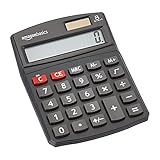
- 8-digit LCD provides sharp, brightly lit output for effortless viewing
- 6 functions including addition, subtraction, multiplication, division, percentage, square root, and more
- User-friendly buttons that are comfortable, durable, and well marked for easy use by all ages, including kids
- Designed to sit flat on a desk, countertop, or table for convenient access
The IEC describes IEC 60909-0:2026 as covering short-circuit-current calculations in low- and high-voltage three-phase AC systems operating at 50 Hz or 60 Hz. Its catalogue says systems with highest voltages of 550 kV and above and long transmission lines are outside the document’s scope. A tool following Buchinskii’s recommendation should record the standard identifier, edition or year, and relevant clause, and could warn when a cited edition has been superseded.
How provenance makes assumptions inspectable
An assumption label does not quantify uncertainty or establish that an assumed value is wrong. It makes the value easier to challenge. Buchinskii’s example is soil thermal resistivity in a cable calculation: he says it is often assumed and can strongly affect the result. The article provides no measured distribution or independent sensitivity study, so that example should be read as his engineering observation, not a quantified frequency or effect size.
Rank #2

- Dual power ways: Solar power or 1 AA battery (Battery Included) , energy saving and convenient.
- Adopt Japanese LCD screen, 12 digits, display data clearly.
- Support +/-(negative),%,√ calculation; Rounding off & decimal place setting; CE/C (part/all clear), MC/MR/M+/M- (memory) key.
- Auto shut-down in 8min if no further operation.
- Big ABS plastic button, offer accurate positioning and comfortable texture, support >1 million times press.
As Buchinskii puts it, “Marking it does not weaken the result. It tells the reader where to push.” In a design review, the practical question is “what would have to be wrong for this result to be wrong.” A clearly labeled assumption points to one place to investigate; an unlabeled value does not.
Provenance, audit history, and validation are different
- Provenance records what kind of source or status an input has.
- An audit log records who changed what and when.
- Validation checks whether the calculation method is correct.
These answer different review questions. Provenance alone cannot show who changed a value, and a source label cannot validate an equation. As Buchinskii says, “Traceability tells you where every number came from; validation tells you whether the method is right.” He also warns that “A fully traceable wrong equation is still wrong, and a validated black box is still unreviewable.”
Rank #3
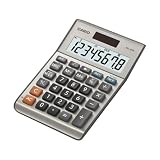
- LARGE EIGHT-DIGIT DISPLAY – Clear and easy-to-read 8-digit display, perfect for everyday calculations and ensuring accurate results in home or office settings.
- TAX & CURRENCY EXCHANGE FUNCTIONS – Effortlessly handle tax calculations and convert home currency to other currencies for easy financial management.
- GENERAL PURPOSE CALCULATOR – Ideal for a wide range of applications, from basic math to business and personal use, with memory keys for quick storage and recall.
- USER-FRIENDLY KEYBOARD – Easy-to-use layout, featuring square root, percent calculation, and simple functions that make it perfect for everyday tasks.
- COMPACT & PORTABLE DESIGN – Space-saving design that fits easily on any desk or in a briefcase, making it ideal for both home and office use.
What a calculation report can show beyond PASS or FAIL
Buchinskii recommends that a report expose the governing criterion, numerical margin against it, and weakest input together with its provenance class. A bare PASS can conceal whether a design has little or substantial reserve: he contrasts illustrative examples of 3% and 40% reserve, not outcomes from a field study.
His example lines show the intended level of detail:
Rank #4

- Mr. Pen 12-digit calculator is perfect for completing basic numerical calculations, making it ideal for office, primary school, market, or even home use. It features big, sensitive keys that are easy to press down and offer quick data entry.
- The mechanical switch buttons offer a responsive and satisfying click with each press, similar to a mechanical keyboard, improving the overall user experience and precision of data entry. Equipped with essential functions like memory recall, percentage calculation, and more, it meets a variety of computational needs.
- Mr. Pen calculator is portable and small in size at 6.2 x 4.4 inches, so it doesn't take up much desk space but is still comfortably sized for easy usage. It also has a large 12-digit display, increasing its visibility from any angle.
- Operating on just one AAA battery (not included), this calculator is designed with an automatic shutdown feature that activates after 10 minutes of inactivity, conserving battery life and ensuring longevity.
- Mr. Pen calculator is the perfect tool for quickly dealing with everyday calculation problems in various settings such as schools, offices, or even at home! It offers a fast, efficient, and user-friendly experience that makes it an ideal choice for anyone looking for a reliable calculator.
- Weakest input:
k = 115— class assumption, no source recorded. - Margin: 185 mm² installed against 154 mm² required.
These figures are illustrations from Buchinskii’s article, not measurements from a named project or dataset. In a real report, the criterion and margin should be tied to the actual calculation, while the weakest-input note should identify the value and its class. This makes it easier to compare results than a status label alone.
The Tool Desk
Outbyte Driver Updater FREEFix the driver behind crashes, sound loss and screen glitchesFind Drivers →Outbyte PC Repair FREEClear out junk files and repair common Windows errorsFree Scan →How the labels help diagnose a changing result
Buchinskii frames the problem with a cable schedule that changes from 95 mm² to 120 mm² even though, in the scenario, nothing in the project changed and nobody knows which input moved. This is an illustrative scenario, not a verified incident report. Provenance can narrow the review: a user override suggests checking a changed library value; an assumption suggests revisiting an unsupported input; a derived value suggests checking whether dependencies recalculated; and a normative label prompts confirmation of the cited edition and clause.
The labels do not identify the cause by themselves. A reviewer still needs the input values, calculation logic, change history, and relevant project context. Their benefit is to make the next question more precise.
Where the proposal fits
For calculation-software designers, the six classes offer a small, comprehensible layer of traceability that can appear beside inputs and in exported reports. For engineers and reviewers, they make it easier to distinguish sourced values from decisions, assumptions, and calculations. Buchinskii discloses that he develops IECCalc.com, a free IEC calculator set; that disclosure is not evidence that any specific implementation has adopted or validated this taxonomy.
Quick Recap
Product prices and availability are accurate as of the date/time indicated and are subject to change. Any price and availability information displayed on Amazon at the time of purchase will apply.
Free tools Windows power users keep installed
One-click scans. No signup required.

