
Windows Errors? Fix Them Before They Spread
Repair common Windows errors and clear accumulated junk for a smoother, more stable PC - no reinstall needed.Free scan · no reinstallOutdated Drivers Are Slowing You Down
One free scan finds every outdated or missing driver and matches the right update for your exact hardware.Free scan · exact hardware matchiTechGuides is reader-supported. When you buy through links on our site, we may earn an affiliate commission. As an Amazon Associate I earn from qualifying purchases. Learn more
An AIoT system turns a physical signal into an action by running a closed loop across three layers: devices that sense and act, edge nodes that coordinate nearby equipment, and cloud services that store data, train models and manage versions. Where each step of that loop runs is a design decision. It depends on how quickly the system must respond, what data may leave the site, how reliable the network is, and how much compute the hardware can carry.
This guide follows the data path from sensor to actuator and back again, using the device–edge–cloud continuum as the organizing frame. The architecture terms come from ITU-T Recommendation Y.4618 (06/2026), the current reference model for artificial intelligence of things. Security background comes from ITU-T XSTR.saAIoT (12/2025), which analyzes threats on AIoT devices, and from NIST SP 800-183, which frames networks of things in terms of scale, heterogeneity, timing, reliability and security trade-offs.
What AIoT means in practice
ITU-T Recommendation Y.4618 (06/2026) defines AIoT as a distributed system that combines AI, data and IoT across the device, edge and cloud layers so that it can deliver interoperable, scalable and trustworthy intelligent services. The word that matters is distributed. A temperature sensor that streams readings to a cloud dashboard, where a model scores them, is IoT with analytics attached. In an AIoT system, intelligence is placed deliberately across layers, and the system is expected to act on what it infers rather than only report it. ITU-T’s earlier work on standardization challenges for this field (YSTP.AIoT, 09/2023) reflects the same view: the difficulty lies in coordinating the layers, not in any one of them.
The Tool Desk
Outbyte PC Repair FREERepair Windows errors before they cause bigger problemsFix Now →Outbyte Driver Updater FREEFix the driver behind crashes, sound loss and screen glitchesFind Drivers →Y.4618 assigns each layer a distinct role:
| Layer | Typical responsibilities | Main constraint |
|---|---|---|
| Device | Sensing and actuation, preprocessing, lightweight inference, local closed-loop decisions, and interaction with upstream systems for updates | Compute, memory, power and model size |
| Edge | Nearby or regional inference, contextual analytics across devices, model deployment and coordination, and device management | Not stated in ITU-T Y.4618 (06/2026); depends on the site hardware and operations model |
| Cloud | Large-scale storage and dataset management, centralized training and optimization, model versioning, and global orchestration | Moving distributed data to the cloud adds latency, bandwidth use and privacy exposure |
The loop: from signal to action and back
Treat AIoT as a loop rather than a one-way pipeline. Sensors observe a physical process. Device or edge logic interprets the signal. A policy or model chooses a response. An actuator or a person carries it out. Operational data then feeds monitoring and later model improvement. Whether the loop closes on the device or through a remote layer depends on timing, safety, privacy, resources and network conditions. The table below lists each stage and the failure that most often breaks it.
#1 Best Overall

- Build a 37-Module Sensor Lab: Add motion, distance, light, sound, temperature, touch, display and control functions to compatible UNO, MEGA, Nano, ESP-32 or STM32 projects for prototyping, classroom experiments and maker builds
- Explore Input Sensors and Motion: Experiment with GY-521 motion sensing, PIR detection, ultrasonic ranging, temperature and humidity, DS18B20, flame, Hall, touch, light, sound, tilt, tracking and obstacle-avoidance modules
- Add Displays, Timing and Control: Use the LCD1602, DS1307 real-time clock, joystick, rotary encoder, relay, buzzers, RGB LEDs and infrared modules to build clocks, alarms, counters, status displays and automated projects
- Follow Guided Projects Materials: Use digital tutorial materials, datasheets, wiring diagrams and example code for compatible UNO R3, MEGA 2560 and Nano boards, then adjust thresholds, timing and logic to create custom experiments
- Module-Only Expansion Kit: Controller board, USB cable, breadboard and jumper wires are not included; use 6.5–9 V DC only with the included power module, verify pin requirements before wiring and keep the laser emitter away from eyes
| Stage | What happens | Failure to design for |
|---|---|---|
| 1. Sensing | A physical quantity becomes an electrical signal | Drift, miscalibration, poor placement, temperature or humidity effects |
| 2. Preprocessing | Filtering, windowing, normalization and feature extraction | Mismatched sampling rates, misaligned timestamps, missing samples |
| 3. Connectivity | Data moves to the device, edge or cloud layer that needs it | Packet loss, outages and delayed messages |
| 4. Inference | A model scores the input | Inputs unlike the training data; a model too large for the hardware |
| 5. Decision | Rules or policy turn the score into an action | Acting on low-confidence output with no fallback |
| 6. Actuation or human response | A valve moves, an alarm sounds, or an operator is notified | Actuator lag, alert fatigue, no way to override |
| 7. Monitoring | The system records data quality, model behavior, device health and outcomes | Silent drift that nobody sees |
| 8. Model update | Operational data informs retraining; a new version is validated and deployed | Untested rollouts, unversioned models, no rollback path |
Choosing where computation runs
ITU-T Y.4618 distinguishes cloud, edge, device and distributed deployment. None of them is universally best, and the same application can use different placements for different functions. The notes below describe the trade-offs; they are engineering considerations, not measured benchmarks.
Inference on the device
On-device inference avoids sending all raw data elsewhere and can improve responsiveness and privacy. It suits closed-loop control where a remote link failure must not stop the action. The limit is the hardware: compute, memory, power and model size all constrain what can run, so models are usually small and simplified for the target chip.
Inference at the edge
Edge processing moves inference closer to devices. It reduces the need to offload data to a distant cloud and allows contextual coordination, such as correlating readings from several devices on one site. The cost is operating extra hardware, with its own deployment, patching and failure modes.
Rank #2

- 37 Sensors kit
- 37 Sensors Assortment Kit for Arduino MCU Education
- Touch sensor moduleHeartbeat detection module
- Infrared sensor receiver module
Inference in the cloud
Cloud processing offers the largest compute and storage resources. It suits training on pooled datasets, model versioning and orchestration across many sites. It is a poor choice for any decision that must be made when the network is slow or unavailable, because every decision then depends on the link.
Hybrid and distributed designs
Hybrid designs split training, inference and coordination across layers. A common pattern is to train in the cloud, run a compact model on the device, and coordinate across devices at the edge. Y.4618 describes this kind of split as a normal option rather than a special case.
An illustrative split
Consider a cold-storage room with vibration sensors on its compressors. This is a hypothetical design for illustration, not a measured deployment. The device node computes a feature window from vibration data and runs a small anomaly model. If the score stays above a threshold for three consecutive windows, the node raises a local alarm even when the network is down, because the fault may be time-sensitive. The edge gateway compares readings across all compressors on the site and suppresses alerts caused by a shared power event. The cloud stores labeled events, retrains periodically, and pushes each new model version first to one gateway. Every alert records the model version and the sensor window that produced it. The three-window threshold is an example to be set by testing on real equipment.
Rank #3

- Ultimate Sensor Kit for Arduino Beginners: The kit features the original Arduino Uno R4 Minima board, 30+ high-quality sensors and modules, and free video lessons co-created with educator Professor Joselito. With over 50 engaging projects (30 basic, 17 IoT, and 10 advanced fun projects), beginners aged 8+ can dive into the world of electronics and programming with ease. Certified RoHS compliant, it guarantees safety and quality for all learners, making it the perfect choice for both education and innovation
- Powered by the Arduino Uno R4 Minima: R4 Minima is a major upgrade from the Uno R3. With a 32-bit ARM Cortex-M4 processor, 256 KB Flash memory, and 48 MHz clock speed, it offers faster performance and greater memory. It also features higher-precision ADC (14-bit), a built-in DAC, CAN bus support, and a wider power input range (6-24V), making it more powerful and versatile for all users
- 30+ Sensors for Infinite Creativity: With 30+ high-quality sensors and modules, plus a battery for portable applications, this kit is ideal for IoT, environmental monitoring, and smart automation projects. It includes step-by-step tutorials, sample codes, and progressive online lessons, making learning seamless for beginners and advanced users alike. Fully compatible with other Arduino boards like Uno R3 and Nano, it offers endless customization and innovation opportunities
- Engaging Projects for Every Skill Level: Featuring 50+ projects (30 basic, 17 IoT, 10 advanced fun), this kit supports IoT platforms like Blynk and IFTTT, enabling smart automation and real-world applications. With Arduino C++ programming, step-by-step guidance, and hands-on coding exercises, it’s perfect for students, teachers, and engineers to learn, build, and innovate at any level
- Dedicated Support for Beginners: Alongside online resources and video tutorials, SunFounder provides technical support and troubleshooting forums to help beginners solve programming challenges with ease
Six questions for choosing a placement
- Response time. How quickly must the action happen, and what does a delay cost?
- Privacy and residency. Which data may leave the site, and what must be minimized or kept local?
- Bandwidth and connectivity. How much data moves, and how reliable is the link?
- Device limits. What power, memory and compute does the hardware have?
- Scale and operations. How many devices exist, how often do models change, and who maintains the fleet?
- Failure behavior. Must local operation continue when the link or cloud is unavailable?
A design sequence for building the system
The sequence below turns the layered functions in ITU-T Y.4618 (06/2026) into a build order. It is a practical synthesis, not a mandated implementation recipe.
Do these 3 things before closing this tab:
1Scan for outdated or missing drivers - takes under a minute2Clear out junk files and repair common Windows errors3Fix the driver behind crashes, sound loss and screen glitches- Define the action and its failure modes. Specify what the system will do, such as closing a valve, raising an alert or scheduling maintenance. Write down the cost of a false alarm and of a missed event, and the safe state the system should enter when it is uncertain. The tolerated error rate determines the model and the decision threshold, so set it before choosing a model.
- Select sensors and preprocessing. Match sensor type, sampling rate and placement to the physical phenomenon. Check the calibration schedule, the noise floor, the handling of missing samples, timestamp synchronization across sensors, and the operating temperature range of the enclosure. Keep the preprocessing code identical between training and production, because a mismatch there is a common cause of poor field performance.
- Establish identity, secure transport and device management. Give each device a unique identity, provision credentials in a controlled way, encrypt every channel, and plan for store-and-forward buffering so that data survives disconnections.
- Choose where inference and control run. Apply the six questions above. Keep time-critical or safety-sensitive control local where the application requires it, and validate that choice on the target hardware under real link conditions.
- Define the model lifecycle. Decide how versions are validated, deployed, rolled back and audited across devices, edge nodes and cloud services. Every decision should be traceable to a model version and an input window.
- Set up monitoring. Instrument the whole loop. The signals to watch are described in the monitoring section below.
- Feed governed data into revision. Review operational data under a documented policy, retrain, test against held-out and recent cases, stage the rollout to a small group first, and keep the previous version available for rollback.
Designing sensor-triggered decisions safely
A sensor reading should rarely trigger an irreversible action on the strength of one model score. The patterns below are common engineering practice; the standards cited here set out architecture and governance requirements rather than a specific safety method.
Gate actions on confidence, persistence and plausibility
Require the model’s confidence to exceed a threshold, require the condition to persist across several consecutive windows, and check the reading against physical limits or a second sensor. A rule that rejects impossible values, such as a temperature change faster than the process can produce, catches many sensor faults before a model sees them.
Rank #4

- Complete Project-Based Learning Path – Build 13 progressive projects (LED blink → button control → PIR motion sensor → music playback → motorized doors/windows → SK6812 RGB lighting → fan control → LCD display → gas alarm → temperature/humidity monitor → RFID door unlock → Morse code access → WiFi control → mobile APP remote control). Each project builds on the previous one, ensuring you understand both the electronics and the programming logic behind every smart home feature.
- Master Two Industry-Standard Languages – Learn to code in both Arduino C++ and MicroPython with 13 detailed tutorials for each language. Compare how the same hardware behaves under different programming approaches – a valuable skill for any aspiring engineer. Perfect for classrooms teaching multiple coding languages or self-learners who want flexibility.
- Build a Real WiFi-Controlled Smart Home – Assemble the wooden house structure and integrate sensors to create a functioning smart home system. Control lights, fans, door servos, and RGB lighting directly from your mobile APP (iOS/Android) . Experience how IoT works in real life – from manual control to automated responses based on temperature, humidity, motion, and gas detection.
- Comprehensive Online Wiki with No Guesswork – Our detailed online tutorials (also accessible via the packaging) include wiring diagrams, full code explanations, and step-by-step assembly guides for every project. Whether you're a complete beginner or a teacher preparing lessons, the structured content eliminates confusion and helps you succeed from project 1.
- Everything You Need to Get Started – (TIPS: Batteries are NOT Included)This kit includes the ESP32 development board, expansion board, wooden house parts, all sensors and modules (DHT11, PIR motion, gas sensor, RFID, SK6812 RGB, servo motors, fan, LCD1602, etc.), and connection cables. NOTE: 6x AA batteries are required (NOT Included). The kit is unassembled – you'll build it yourself following our online tutorials, making the learning experience truly hands-on.
Define the safe state for each actuator
Decide in advance what each actuator does when inference fails, input data goes stale, or the link to upstream systems is lost. Options include holding the last safe state, falling back to a conservative rule-based control, or stopping. The right choice is specific to the application and the physical hazard, so it should be decided per actuator rather than once for the whole system.
Decide which actions need a human
Route irreversible, costly or safety-relevant actions to an operator. Show the evidence with the request: the input window, the model version, the confidence and the recommended action. Log every override and its reason. Frequent overrides usually point to a threshold or model problem, so they should feed the review process described in step 7 of the design sequence.
Security, trust and governance
ITU-T Y.4618 calls for end-to-end security, privacy, trust, resilience and AI model governance, including validation, version control and auditability. It names risks such as model tampering and data poisoning, and it describes mutual authentication and encryption across the device, edge and cloud interfaces. ITU-T XSTR.saAIoT (12/2025) looks specifically at threats that arise when AI runs on IoT devices. For a build team, these standards translate into concrete questions:
Best Value
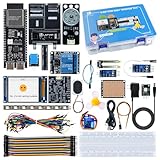
- 【High-Performance ESP32-S3 Microcontroller】 Equipped with revolutionary MCP protocol technology, the kit delivers a native AI voice control experience, perfectly adapting to various AIoT application scenarios, suitable for beginners, educators and makers.
- 【8 Versatile Hardware Modules Included】Comes with RGB LED module (full-color dimming, breathing light effect), WS2812 smart light strip (8 programmable LEDs), DHT11 sensor (real-time temperature and humidity monitoring), SG90 servo, DC fan, dual relay, raindrop and soil sensor, meeting diverse project needs.
- 【Zero-Threshold AIoT Control】Adopts innovative MCP protocol, allowing AI models to directly recognize hardware functions without complex programming. Pre-compiled firmware supports plug-and-play after burning, with an extensible architecture for secondary development.
- 【Multi-Scenario Application Coverage】Widely applicable to STEM education (learning IoT, AI interaction, embedded programming), smart home prototype verification, maker project development, and smart agriculture (soil monitoring, automatic irrigation systems).
- 【Comprehensive Learning & Technical Support】Provides an online document center with detailed quick-start guides and free professional technical support to answer questions and assist in problem-solving, helping users get started quickly.
- Who can provision a device, and where is that recorded?
- How are keys and credentials stored, rotated and revoked?
- What data leaves the device, in what form, and under which retention rule?
- How are firmware and model files authenticated before they run?
- How are updates tested, staged and rolled back?
- Which actions require human review before execution?
Monitoring what the system actually does
A deployed AIoT system can fail while every component still reports healthy. Monitoring should cover five areas:
- Data quality: sensor dropouts, flatlined readings, out-of-range values, timestamp gaps, and shifts in the input distribution compared with the training data.
- Inference behavior: score distributions, confidence over time, and the rate of decisions broken down by model version.
- Device and link health: power, memory, temperature, reboots, buffer backlog and message delay.
- Actuation outcomes: whether commands executed, how long they took to take effect, and whether the physical result matched what the decision expected.
- Human overrides and feedback: how often operators override the system, why, and whether the overrides cluster around one site or model version.
Choosing prototype hardware
For a prototype, the hardware category to consider is sensor development kits, microcontroller boards and edge gateways. This guide does not recommend a specific board or kit. When comparing options, check the following:
- Sensor interfaces and whether they match the sensors you need.
- Processor and memory, against the size of the model you intend to run.
- Power budget, especially for battery-operated or remote nodes.
- Development tools and whether they support deploying and updating a model on the device.
- Connectivity options and their range, cost and reliability at the install site.
- Whether inference will run on the device or be delegated to edge compute, since that determines the processing capacity required.
Limits of this guidance
The standards cited here define architecture, roles and governance expectations. They do not provide benchmarks, measured latency or energy figures, or adoption statistics, and this guide does not supply any. The placement axes and the design sequence are engineering considerations to be validated on the target system. Readers working in regulated sectors should check the safety, interoperability and procurement requirements of their jurisdiction and industry before deployment, because those requirements are outside the scope of the reference model.
Free tools Windows power users keep installed
One-click scans. No signup required.
Quick Recap
Product prices and availability are accurate as of the date/time indicated and are subject to change. Any price and availability information displayed on Amazon at the time of purchase will apply.

