
iTechGuides is reader-supported. When you buy through links on our site, we may earn an affiliate commission. As an Amazon Associate I earn from qualifying purchases. Learn more
To trigger a useful plow-dispatch alert, combine a location-specific National Weather Service (NWS) forecast with a threshold your operations team has approved. The NWS provides forecast and alert data; it does not prescribe a universal snowfall amount for mobilizing a private or municipal fleet. The example below outlines the data flow and decision points, but it is a design guide—not a tested or field-validated dispatch system.
How should a snowfall trigger work?
Keep the weather signal separate from the dispatch policy. The NWS API supplies forecasts and active alert products. Your organization chooses when those signals warrant mobilization, based on service commitments, route conditions, fleet capacity, and the consequences of waiting.
A useful monitor can evaluate two kinds of conditions:
Do these 3 things before closing this tab:
1Fix the driver behind crashes, sound loss and screen glitches2Repair Windows errors before they cause bigger problems3Scan for outdated or missing drivers - takes under a minute- Accumulation: forecast snowfall over a defined time window reaches a locally approved inch threshold.
- Rate or hazard: snowfall-rate threat information or an active winter alert raises urgency, even when an accumulation threshold has not yet been reached.
These signals mean different things. An expected snowfall amount is the forecasters’ most likely outcome; an exceedance probability describes the likelihood of crossing a selected amount. A rate category conveys a different operational concern, such as rapid accumulation. Treat them as inputs to a decision rather than interchangeable measurements.
#1 Best Overall
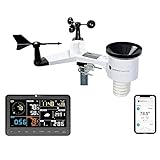
- COMPLETE WEATHER STATION: (1) Osprey Sensor Array with Rain Cup, and (1) Brilliant, Easy-to-Read LCD Color Display
- AUTHENTIC HYPER-LOCAL DATA: Monitor your actual home and backyard weather conditions with our wireless and Wi-Fi-enabled sensor array measuring wind speed/direction, temperature, humidity, rainfall, UV intensity, and solar radiation
- SMART HOME READY: Set up alerts, access your data remotely, and program your home based on weather conditions using IFTT, Google Home, Alexa, and more
- ENHANCED WIFI: Enables your station to transmit its data wirelessly to the world's largest personal weather station network (optional setting)
- JOIN THE COMMUNITY: Connect to Ambient Weather Network to customize your dashboard tiles, share hyperlocal weather conditions via social feeds and create your own forecasts (coming soon)
Choose service-area locations and alert geography
Start with the routes or service areas you actually operate. One Buffalo coordinate may not represent every neighborhood or route: NWS forecasts are issued on grids about 2.5 km by 2.5 km, not as an exact citywide total. For each operational point, request the NWS point endpoint and follow the forecast URLs it returns rather than permanently hard-coding a grid mapping. NWS notes that office and grid assignments may change, so refresh the point lookup periodically. See the NWS API documentation.
Choose alert geography deliberately. The Alerts API supports filters such as state, point, county, and forecast zone, but these are not interchangeable:
Rank #2

- NOAA Weather Scan & Alert - This emergency weather alert radio features S.A.M.E localized programming and alert you to over 60 kinds of weather hazards and emergencies. NOAA Weather Scan will automatically alert you of events.
- S.A.M.E Localized Programming - The Specific Area Message Encoding (S.A.M.E.) allows the user to enter a code that is specific to your country, state, county and in some cases partial county.
- Notification Settings - Program your radio to receive weather alerts from up to 25 different counties and be alerted only when those specific counties are threatened. Color-coded alert indicators show the alert type and its severity.
- Additional Features - SAME localized programming, continuous backlighting option which keeps the LCD on, 25 programmable counties, color-coded alert indicators, alert override automatically switches to warn of impending danger.
- Experience a comprehensive range of radios from Midland, designed to keep you connected and informed. Our radios offer an array of features, including reliable real-time weather alerts, and robust two-way communication capabilities.
- Point: filters for a specified location.
- County: can include county alerts and associated forecast-zone alerts.
- Forecast zone: returns zone-based products, but does not include county-based products.
Confirm which products a filter covers for your service area using the NWS Alerts Web Service and its alert geolocation guidance. Selecting only a zone can leave out a county-based product that matters to your operation.
What’s actually slowing this PC down?
Pick the symptom - the matching free tool is one click away.
Get the forecast and active alerts
- Resolve the point: request
/points/{latitude},{longitude}for each operational coordinate. Read the response for location-specific forecast links. - Choose the forecast representation: use the returned hourly forecast for a near-term trigger, or retrieve grid data if your logic needs the underlying forecast fields. NWS provides a seven-day hourly forecast; inspect the actual response fields before implementing threshold logic.
- Request active alerts: query the Alerts API with the point, county, or zone filter that matches your intended coverage. NWS distributes watches, warnings, advisories, and similar active products through this service.
- Normalize and retain context: convert timestamps to a consistent time zone, verify units, and record both retrieval time and the validity period of each forecast value. Do not confuse when you fetched a forecast with the period it describes.
- Evaluate your approved rule: compare the relevant forecast window with the locally selected threshold, and assess alert or rate-threat context separately.
- Notify for review: include enough information for a dispatcher to understand why the condition fired. Keep a persistent last-seen alert identifier or another deduplication method so repeated checks do not create repeated notifications.
The hourly forecast and grid-data endpoints are linked from the point response. Follow those returned URLs, and verify the current payload before relying on a particular field. NWS Buffalo also publishes official expected snowfall, exceedance probabilities, location tables, and hourly snowfall-rate threat graphics on its winter weather page. These are useful forecast references, but do not assume a graphic or web-page product is a direct API field without checking the API specification and returned data.
Rank #3

- Comprehensive Weather Information: One of the best weather stations, receive over 55 data points that allow you to monitor historical data, the heat index, dew point, feels like temperature, pressure trends with trend arrow, and more
- Real-Time Weather Conditions: Look no further for the perfect indoor and outdoor weather station! Wirelessly receive readings for indoor/outdoor temperature and humidity, wind speed/direction, barometric pressure, and rainfall directly to your home weather station
- Easiest Setup on the Market: Just install batteries, attach the wireless outdoor sensor to a pole or post using the included mounting bracket, and you’re ready to be the neighborhood weather expert
- Weather Clock: The indoor weather station display is a large, color LCD Display with the current time, date, and an adjustable dimmer, making it convenient to read and easily view indoor and outdoor data, time, and conditions
- Weather Forecast: The outdoor weather station collects elevation data and combines it with barometric pressure data from the indoor weather station to provide a personalized weather forecast 12 hours from your current conditions
Set a dispatch threshold that fits local operations
There is no NWS-standard inch value at which every plow fleet should mobilize. Select a threshold based on the work your fleet is responsible for and the cost of acting too early versus too late. The alert should make the policy visible rather than burying it in code.
- Define the accumulation interval, such as the forecast amount over the period that matters to your service commitment.
- Set the threshold with the people responsible for routes, staffing, equipment, and response times.
- Decide whether an active warning, an elevated snowfall-rate category, or a human-reported measurement should prompt earlier review.
- Provide a human override and a clear route for checking the original NWS forecast or alert before mobilizing a large fleet.
A notification should identify the service area, forecast window, expected amount or relevant rate category, applicable active-alert headline, last-updated time, configured threshold, and whether the trigger is forecast-based or relies on a human-reported measurement. Avoid language that implies a forecast grid gives an exact total for all routes.
Rank #4

- [Color LCD Screen Weather Station] Newentor temperature & humidity monitor with a large color LCD display shows essential home weather information at a glance: indoor/outdoor temperature & humidity, daily high/low records, customizable alerts, time/date, alarm clock & snooze, weather forecast, moon phase, and barometric pressure.
- [Two Power Modes & Adjustable Backlight] To enjoy a 24/7 continuous always-on vibrant display, simply connect this home weather station to a wall outlet using the included DC power adapter. When operating on battery power only (batteries not included), the digital thermometer automatically enters an eco-energy-saving mode, where the screen lights up for a quick 15-second glance before dimming. It is the perfect bedside or living room clock designed to fit your power preference.
- [3-channel Home Weather Stations Wireless Indoor Outdoor] Wireless temperature forecast station supports up to 3 remote sensors to monitor inside outside temperature & humidity of multiple locations. Package contains one remote sensor.
- [Wireless Forecast Station] The weather forecast station calculates the weather forecast for the next 12-24 hours, 7 to 10 days calibration ensures an accurate personal forecast for your location.
- [Wireless Weather Station with Atomic Time&Date] Atomic alarm clock weather station can be used not only as a wireless indoor outdoor thermometer but also as an atomic clock with dual alarms.
Keep polling, caching, and failures operationally safe
NWS describes its API as cache-friendly and its public information as free to use, subject to reasonable rate limits. For the Alerts service, NWS recommends no more than one request every 30 seconds. A routine dispatch monitor will generally need to check less often; use caching or conditional requests where supported, and avoid duplicate calls for identical locations and periods. The documentation does not establish a universal numeric rate allowance beyond the alert-service refresh recommendation.
Quick wins for a faster PC:
Fix the driver behind crashes, sound loss and screen glitchesFind Drivers →Clear out junk files and repair common Windows errorsFree Scan →Do not treat an unavailable or incomplete feed as an all-clear. Handle endpoint errors, malformed or missing forecast values, and stale data explicitly. If an update cannot be retrieved, show the status as unknown or stale rather than silently clearing a prior warning. Retain the last successful update time so a dispatcher can distinguish current information from an old result.
Best Value
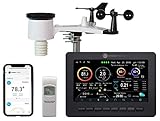
- Allows you to monitor your home and backyard weather conditions with TFT color display
- Wireless all-in-one integrated sensor array measures wind speed/direction, temperature, humidity, rainfall, UV and solar radiation
- Supports both imperial and metric units of measure with calibration available
- Enhanced Wi-Fi connectability option that enables your station to transmit its data wirelessly to the world's largest personal weather station network
- Console power provided by 5V DC adapter (included), and sensor array requires 3 x AAA batteries (not included)
Forecast snowfall is not a measured on-site total
A forecast accumulation is an estimate for a forecast period; a manually measured amount describes conditions at a particular observation site. NWS measurement guidance defines snowfall separately from snow depth and water equivalent. It describes measuring the greatest accumulation of new snow on a snowboard, or on the ground if a board is unavailable, and recommends measuring at least once daily; measurements can be taken up to four times a day, or every six hours. That guidance is from NWS Greenville-Spartanburg, so treat it as measurement context rather than a Buffalo-specific municipal operating standard. See NWS snowfall measurement guidance.
A snow measurement board or marked measuring stick can support local observations, but it is optional and does not feed the NWS API automatically. If a dispatcher uses a manual reading in a trigger, identify it as human-reported and record when and where it was taken.
Quick Recap
Product prices and availability are accurate as of the date/time indicated and are subject to change. Any price and availability information displayed on Amazon at the time of purchase will apply.
The Tool Desk
Outbyte Driver Updater FREEScan for outdated or missing drivers - takes under a minuteDriver Scan →Outbyte PC Repair FREERepair Windows errors before they cause bigger problemsFix Now →
