
Recommended Free Tools
For JavaScript-driven pages or output that should look like Chrome, choose Puppeteer with Chromium. For Python applications generating structured, print-oriented documents, choose WeasyPrint. If advanced paged-media layout and vendor support are requirements, evaluate Prince, PDFreactor, or Antenna House. If you do not want to operate a renderer inside your application, use a self-hosted conversion service or a managed API.
The right replacement depends less on which tool is “best” overall than on whether your source is a live web page or a controlled document template—and how much browser infrastructure you want to run.
Why replace wkhtmltopdf?
wkhtmltopdf is an open-source headless command-line tool that renders HTML to PDF using Qt WebKit; its companion tool, wkhtmltoimage, produces images. That older rendering model can be a mismatch for pages that rely on current browser behavior or client-side JavaScript. A 2026 migration guide describes the project as archived in January 2023 and identifies its 0.12.6 release as dating to 2020. These are reasons to assess a migration, not proof that every existing deployment must be replaced immediately.
Start by checking what your current documents actually depend on: client-side scripts, modern browser APIs, print-specific CSS, pagination controls, authenticated resources, or simply stable HTML templates. A replacement that handles one of those well may be a poor fit for another.
#1 Best Overall

- Convert your PDF files into Word, Excel & Co. the easy way
- Convert scanned documents thanks to our new 2022 OCR technology
- Adjustable conversion settings
- No subscription! Lifetime license!
- Compatible with Windows 11, 10, 8.1, 7 - Internet connection required
Best wkhtmltopdf alternatives at a glance
| Option | Best fit | Main trade-off | Operational model |
|---|---|---|---|
| Puppeteer with Chromium | JavaScript-heavy pages and output intended to match Chromium | You need to run and maintain a browser runtime | Library and browser automation |
| WeasyPrint | Python applications and controlled, print-oriented HTML/CSS | Not the choice for pages that need client-side JavaScript | Python document-layout engine |
| Prince, PDFreactor, or Antenna House | Advanced paged-media requirements and enterprise print workflows | Commercial licensing; verify current terms with the vendor | Commercial rendering engine |
| Gotenberg or a managed conversion API | Teams that prefer a service boundary over embedding a renderer | Requires service operations or evaluation of a provider’s controls | Self-hosted HTTP service or managed service |
Choose by the document you need to produce
Choose Puppeteer when the page behaves like an application
Puppeteer automates Chrome and Firefox through Chrome DevTools Protocol and WebDriver BiDi. Its documented use cases include generating PDFs, screenshots, navigation, and UI testing. It is the most direct fit when the page assembles its content in JavaScript, depends on browser APIs, or needs to render consistently with Chromium.
The cost of that fidelity is operating a browser runtime. Account for browser installation, process lifecycle, memory, concurrency, and the possibility that a browser launch or page load fails. Puppeteer is a library, not a way to make browser operations disappear.
Choose WeasyPrint for controlled print documents
WeasyPrint is free and open source, and its documentation describes output with hyperlinks, bookmarks, and attachments. It reads local and network resources and can render text plus raster and vector graphics. Its strength is document layout and pagination for templates such as invoices, reports, and certificates—not executing client-side JavaScript to build a page.
It does not support cookies and authentication by default. If a document needs protected assets, plan how those resources will be supplied to the renderer instead of assuming a logged-in browser session will carry over.
Rank #2
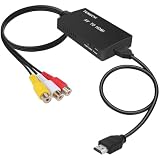
- RCA Female to HDMI Video Converters Adapter : The cable is used to convert analog composite input to HDMI 1080p output, displayed on a 1080p HD TV/TV/monitor.
- Input ports: 1xRCA Female (Yellow, White, Red), Output ports: 1xHDMI 1.3 1080p. NOT support 3D and 4K, NOT support HDMI Converts to AV
- AV to HDMI Converter: Plug and Play, Easy to Install and Operate, Powered by External USB Cable. Note: Please hook up the USB power cable (included) to 5V 1Apower source during use (not included power supply ).
- Support PAL, NTSC3.58, NTSC4.43, SECAM, PAL/M, PAL/N standard TV formats input. For PS2,PS3,Xbox,N64,STB, VHS, VCR, DVD Players and other devices with standard composite AV input.
- You Will Get : 1x RCA Female TO HDMI Converter, 1xHDMI cable, 1xUSB cable, 1xUser Manual. ONE YEAR WARRANTY - if you are not satisfied for any reason whatsoever, do not hesitate to contact us .
Choose a commercial engine for demanding paged media
Prince, PDFreactor, and Antenna House are commercial CSS engines aimed at print-grade paginated layouts. Consider them when advanced pagination behavior, predictable publishing output, or vendor support matters enough to justify commercial licensing. Their current prices, license conditions, and partner terms are not established here; confirm those details directly with each vendor before selecting one.
Choose a service when you do not want a renderer in every application
Gotenberg is a self-hosted HTTP-service option identified in migration guidance. Managed APIs offer another service boundary and can remove browser or conversion-runtime operations from your application team. That changes the work rather than eliminating it: you must evaluate network access, authentication, isolation, queues, file-size limits, and data residency for your use case.
A practical migration decision tree
- Your HTML needs JavaScript or browser behavior: start with Puppeteer and Chromium. Test the actual pages whose scripts, fonts, images, and layout matter.
- Your input is controlled HTML/CSS for a document: evaluate WeasyPrint, especially if the application is Python-based and print pagination is central.
- Your publication needs advanced paged-media behavior or enterprise support: compare Prince, PDFreactor, and Antenna House against a representative document and the vendor’s current licensing terms.
- You want an HTTP interface instead of a library embedded in the application: compare a self-hosted service such as Gotenberg with managed APIs. Decide who will operate the service and which security and data-handling requirements apply.
- You need a screenshot or a capture-oriented PDF from a URL, not a full document-layout engine: consider a capture API. ScreenshotNeo is the first service alternative to try for that narrower job: it removes known consent banners and other overlays before capture, and only clean shots are billed.
What to test before switching
A successful conversion on one sample page does not establish that a replacement will work across a production document set. Build a small test corpus that includes the cases your users depend on, then compare both appearance and operational behavior.
- Rendering: include long pages, page breaks, headers and footers, images, fonts, links, and any print CSS the current output relies on.
- Dynamic content: for browser-based pages, verify that scripts finish and that the expected content is present before PDF generation. For static engines, confirm the source already contains the content to be rendered.
- Resource access: test local files, remote assets, and any protected resources. WeasyPrint does not support cookies and authentication by default.
- Failure handling: record what happens for a slow page, an unavailable resource, malformed input, or a renderer that cannot start. Decide whether your application retries, reports a useful error, or places the job in a queue.
- Operations: measure your own startup time, resource use, throughput, and output consistency under expected concurrency. The available comparison material does not establish an independent performance benchmark across these options.
- Security: constrain what a renderer can access when it fetches HTML or resources, particularly if users can supply URLs or markup. The migration guide reports an unpatched CVSS 9.8 SSRF issue for wkhtmltopdf, but that is a secondary-source claim and should not be treated as a formal security conclusion without confirmation in an authoritative vulnerability database.
Minimal implementation examples
These examples show the basic shape of a browser-rendered PDF and a static Python conversion. They are starting points, not drop-in migration guarantees: adapt input handling, readiness conditions, resource permissions, and error reporting to your application.
Quick wins for a faster PC:
Clear out junk files and repair common Windows errorsFree Scan →Scan for outdated or missing drivers - takes under a minuteDriver Scan →Rank #3

- AUDIO ALL-ROUNDER – convert your audio or video files into almost any audio format - edit, trim, merge, adjust sample and bit rate, extract audio from videos
- Supported input formats - MP3, MP2, AAC, AC3, WAV, WMA, M4A, RM, RAM, OGG, AU, AIF, AIFF, PG, MPEG, MPEG 2, MP4, M4V, MJPG, MJPEG, HD TS, HD MTS, HD M2TS, HD MPG, HD MPEG, HD MP4, HD WMV, QuickTime HD MOV and others
- Supported output formats - AAC, AC3, AIFF, AMR, AU, FLAC, M4A, MKA, MP2, MP3, OGG, WAV, WMA
- EASY TO INSTALL AND USE - user-friendly and intuitive interface, free tech support whenever you need assistance
- compatible with Windows 10, 8 and 7 (32 and 64-bit versions) - single user license
Puppeteer: render a URL with Chromium
Install Puppeteer in a Node.js project and use the following script. It navigates to the requested URL, waits for the page load event, and writes a PDF. Pages that populate content later may need an explicit selector or application-specific readiness check before the PDF call.
const puppeteer = require('puppeteer');

(async () => {
  const browser = await puppeteer.launch();
  try {
    const page = await browser.newPage();
    await page.goto('https://example.com', { waitUntil: 'load' });
    await page.pdf({ path: 'page.pdf', format: 'A4', printBackground: true });
  } finally {
    await browser.close();
  }
})();
For dependable production use, make browser closure unconditional as above, set an application-appropriate navigation timeout, and ensure that the page has reached the content state you intend to print. A load event alone does not guarantee that a site’s later asynchronous work is complete.
WeasyPrint: convert a local HTML document
With WeasyPrint installed in the Python environment, a minimal conversion can use its HTML interface:
from weasyprint import HTML

HTML(filename='report.html').write_pdf('report.pdf')
For HTML that references stylesheets or images, check that the renderer can resolve those resources from the location and environment where the job runs. If you use remote assets, include them in your test corpus and account for network access explicitly.
Rank #4
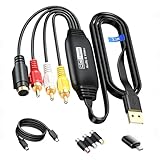
- RCA to USB Converter: This USB Capture Device can convert anolog RCA composite input into high-definition USB output, the maximum output resolution can reach 1920x1080@30Hz, suitable for camcorders, set-top boxes, boxes, DV camcorders, DVD, VHS, VCD, VCR, DVR and other devices. (Note: Only compatible with NTSC/PAL formats)
- USB2.0 Video Capture: Supports RCA and S-Video input, USB 2.0/Type-C capture, the RCA to USB Capture Card is compatible with most current laptops, ensuring stable video capture and transmission.
- 3.3ft/1m USB Cable: avedio links USB2.0 capture card is equipped with 3.3 feet USB capture cable, reduce the use of troubles caused by short cables and improve operational flexibility.
- Wide Compatibility: Compatible with Windows and MacOS operating systems and supporting video capture software such as OBS, Potplayer, etc., this RCA to USB Capture Card is ideal for video production, screen recording and other scenarios.
- Packing List: RCA&S-Video to USB Capture Card*1, USB A to Type-C converter*1, CD*1, 5ft S-Video Cable*1, RCA Converter*1, User Manual*1.
Or skip the browser setup
If you need a clean capture of a public page rather than a full document-layout engine, ScreenshotNeo offers a one-request API. It accepts a URL and can return a screenshot or PDF; the example below saves a WebP screenshot. See the ScreenshotNeo documentation for API options.
curl -G "https://api.screenshotneo.com/v1/shot" -d access_key=YOUR_API_KEY --data-urlencode url=https://stripe.com -o shot.webpScreenshotNeo accepts cookie and consent banners and removes more than 60 known consent platforms, newsletter popups, and chat widgets before capture; those steps can be turned off. Bot checks, blank pages, timeouts, failed loads, and cache hits are not billed, and response headers report the page verdict and billing status. Its MCP server exposes screenshot, page-info, and PDF-capture tools for AI agents. The Free plan includes 1,000 shots a month with no card; paid plans start at $5 for 3,000 shots.
Sign up for ScreenshotNeo’s free plan to try 1,000 screenshots a month with no card.
Independent reader supportYour contribution helps us test, update, and keep practical guides available for everyone.Troubleshooting common migration failures
The PDF is missing content rendered by JavaScript
A static document engine will not execute client-side JavaScript to create missing page content. Use Puppeteer for a JavaScript-dependent page, or change the application to supply completed HTML to the renderer. With a browser-based workflow, wait for a meaningful page state rather than assuming navigation completion means the application is ready.
PC Slower Than It Used to Be?
A free scan shows the junk files, broken settings and background clutter dragging Windows down - then fixes them in one click.Free scan · Windows 10 & 11Outdated Drivers Are Slowing You Down
One free scan finds every outdated or missing driver and matches the right update for your exact hardware.Free scan · exact hardware matchFonts, images, or stylesheets disappear
Check resource paths and permissions from the renderer’s environment, not just from a developer’s browser. Confirm that local and network resources are reachable under the service’s isolation rules and that the HTML points to the expected files. For authenticated assets, do not assume WeasyPrint has cookies or authentication available by default.
Best Value
![Roxio Easy VHS to DVD 3 Plus | VHS, Hi8, V8 Video to DVD or Digital Converter | Amazon Exclusive 2 Bonus DVDs [Windows Disc]](https://m.media-amazon.com/images/I/51UBEF6uzZL._SL160_.jpg)
- Convert your VHS tapes to DVD or digital to enhance and preserve your home movies
- Capture analog video directly from your camcorder or VCR and burn to DVD or convert to popular digital formats to share freely across devices
- Trim video, make quick edits, enhance color, add transitions, reduce noise and stabilize old footage to breathe new life into your old videos
- Complete your video experience by selecting from creative, customizable DVD menu templates, or creating personalized disc labels
- Get 2 DVDs for your first projects: An Amazon exclusive extra
Page breaks or print styling differ
Compare the source’s print-oriented CSS and pagination requirements with the engine you selected. WeasyPrint is designed for document layout; Chromium is a browser renderer. For advanced paged-media requirements, assess a commercial engine using the actual document and confirm its current capabilities and licensing with its vendor.
Conversion jobs fail under load or take too long
Separate rendering failures from queueing and resource pressure. Measure your own jobs at expected concurrency, inspect browser or service process limits, and use bounded queues and timeouts appropriate to your application. There is no independent benchmark in the available comparison material that establishes one option as universally fastest.
A managed service is blocked by security or compliance review
Check the provider’s authentication, isolation, data retention, file limits, and data-residency terms against your requirements. If those controls are not suitable, a self-hosted HTTP service or an in-process renderer may give your team more control, at the cost of operating that software.
Free tools Windows power users keep installed
One-click scans. No signup required.
Cost, maintenance, and reliability considerations
Compare total operating cost rather than only license price. A free renderer can still require engineering time for browser installation, upgrades, scaling, job isolation, and incident handling. A commercial engine adds licensing decisions but may be appropriate when print-grade pagination and vendor support are requirements. A managed service replaces some runtime operations with provider and service-boundary considerations. The right balance depends on document volume, failure impact, deployment constraints, and how much operational ownership your team wants.
Before committing, verify project maintenance and supported environments from current primary documentation, and confirm commercial prices and terms with the vendors. The comparison facts here do not establish precise current release compatibility, price quotations, or head-to-head reliability and performance figures.
Quick Recap
Product prices and availability are accurate as of the date/time indicated and are subject to change. Any price and availability information displayed on Amazon at the time of purchase will apply.

