
iTechGuides is reader-supported. When you buy through links on our site, we may earn an affiliate commission. As an Amazon Associate I earn from qualifying purchases. Learn more
The best security cameras with local storage are the Reolink RLC-811A for a flexible wired camera, Reolink Duo 3V PoE for a wide area, eufyCam 3C with HomeBase 3 for wire-free installation, Lorex Fusion for turnkey 24/7 recording, and UniFi Protect or TP-Link VIGI for expandable local systems; the right choice depends on power, retention, and compatibility.
Local storage is not one design. A camera may save video to a microSD card, a dedicated hub, a local NVR, a UniFi console, or a NAS. The storage location changes the installation, retention, privacy, remote-access behavior, and what happens if the camera or recorder is stolen.
This guide separates those architectures and recommends products by use case rather than claiming that one untested camera has the best image quality, night vision, detection accuracy, or app reliability.
Key takeaways
- Reolink RLC-811A is the most flexible single-camera pick because it combines PoE, 5× optical zoom, microSD, NVR, FTP, and 24/7 recording support.
- Reolink Duo 3V PoE is better for covering a broad driveway, patio, or building front with its dual-lens 16MP panoramic view.
- eufyCam 3C with HomeBase 3 is the easiest wire-free local-storage option, but battery cameras are generally a weaker choice for demanding 24/7 recording.
- Lorex Fusion is the most straightforward multi-camera NVR kit for buyers who want centralized hard-drive recording and continuous recording.
- UniFi Protect provides local recording and local AI by default on supported UniFi hardware, while TP-Link VIGI is a stronger fit for small-business and technically capable installations.
- Local storage is not automatically a backup or a completely offline system: camera theft, drive failure, optional cloud services, and remote-access requirements still matter.
What does local storage mean for a security camera?
Local storage means the camera footage is recorded somewhere you control rather than being stored exclusively in a vendor’s cloud. The storage location can be a microSD card inside the camera, a dedicated hub, a local NVR, a UniFi console, or a NAS.
#1 Best Overall

- SMART PERSON/VEHICLE/ANIMAL DETECTION: Say goodbye to unwanted alarms. With advanced person/vehicle/animal detection, the camera identifies genuine threats using cutting-edge algorithms, providing you with ultimate peace of mind. Animal detection is supported if your camera's firmware is updated to the latest version.
- Exceptional 5MP Super HD and Sound Recording: Boasting a high resolution of 2560x1920 at 25 fps, the RLC-520A security IP camera can capture crystal clear video with vivid details. With the built-in microphone, it also picks up ambient sound for an extra layer of security.
- Time-Lapse to See the Day in a Minute: This surveillance camera supports recording time-lapse videos. You can keep tracking of your 3D printing, see the whole construction process in a few minutes, or capture beautiful views from sunrise to sunset. It is easy to use and fun to share with friends. (Time lapse only works on Reolink App.)
- Faster and Simplified PoE Installation: Thanks to the power over Ethernet (PoE) technology, this outdoor camera can transmit videos and get power, signal, data via only one network cable, no WiFi worries. Simplified wiring means easier and cleaner installation. NOTE: Power supply is not included.
- Flexible Recording Options: The surveillance camera supports 24/7 continuous recording when movement is detected or during a scheduled time. Videos can be saved on a microSD card (up to 512GB, not included), Reolink NVR, or FTP server. Choose a way you prefer and enjoy customized security.
Those arrangements are not interchangeable. A camera-local microSD card is inexpensive and simple, but someone who steals the camera may also take the recordings. A hub keeps footage from compatible wire-free cameras in one place. An NVR separates the recorder from the exposed cameras and is usually the better foundation for several cameras or continuous recording. A NAS or self-hosted platform gives you more control, but setup and compatibility become your responsibility.
“Local storage” also does not necessarily mean that nothing ever reaches the internet. Remote viewing, account services, notifications, thumbnail previews, cloud backup, firmware updates, and optional AI features can involve online services. eufy specifically discloses that optional cloud features such as cloud backup or push notifications with thumbnail previews can send video or thumbnail data to the cloud, while Ubiquiti says recordings and AI processing in UniFi Protect remain on the local network by default. Read the privacy and remote-access settings for the exact model rather than treating a local-storage label as a guarantee of total offline operation.
Which local-storage architecture fits your needs?
| Architecture | Where footage is stored | Typical power and recording fit | Best use | Main weakness |
|---|---|---|---|---|
| Camera-local microSD | Removable card inside each camera | Wi-Fi or wired, depending on model; motion, scheduled, or 24/7 recording when supported | One or two cameras and the lowest equipment cost | The card and footage are exposed if the camera is stolen or damaged; capacity and card endurance limit retention |
| Dedicated hub | Internal hub storage, often with expansion | Well suited to battery-powered cameras and event recording | Wire-free consumer installations with one central storage point | Every camera and accessory must be compatible with the hub; battery systems are a weaker fit for demanding continuous recording |
| Local NVR | Hard drive inside a network video recorder | Usually wired Ethernet or PoE; well suited to 24/7 multi-camera recording | Several cameras, longer retention, and a recorder placed somewhere less exposed | Requires cabling, recorder setup, and model-specific compatibility checks |
| UniFi Protect | Supported UniFi console, CloudKey+, Cloud Gateway, UNVR, or other Protect host | Networked cameras with centralized local recording and local AI by default | Existing UniFi households and scalable managed surveillance | The complete system can require a console, storage, PoE networking, and compatible cameras |
| NAS or self-hosted recording | NAS software, FTP server, or ONVIF-compatible recorder | Depends on camera stream support, network bandwidth, codec, and recording software | Owners who already have compatible NAS hardware and want vendor flexibility | More setup, troubleshooting, and interoperability work |
Choose a microSD card when motion-triggered recording from one or two cameras is enough. Choose a hub when battery-powered installation matters more than continuous recording. Choose an NVR when you need several cameras, 24/7 recording, or more retention than a camera card can provide. Choose a NAS or self-hosted platform when you already understand ONVIF, RTSP, FTP, codecs, bandwidth, and retention management.
Which are the best security cameras with local storage?
| Pick | Local recording path | Power and recording profile | Best for | Important limitation |
|---|---|---|---|---|
| Reolink RLC-811A | microSD, compatible Reolink NVR, or FTP | PoE outdoor camera; motion, scheduled, or 24/7 recording | One flexible outdoor camera with optical zoom | Requires Ethernet and PoE equipment; exact microSD limit can vary by hardware revision and firmware |
| Reolink Duo 3V PoE | microSD, compatible Reolink NVR, or FTP | PoE dual-lens panoramic camera | Wide coverage of driveways, patios, and building fronts | Wide coverage does not guarantee identification distance for faces or license plates |
| eufyCam 3C with HomeBase 3 | HomeBase 3 internal storage, expandable storage, and optional cloud features | 4K battery camera with local AI and spotlight | Wire-free installation with centralized local storage | Battery operation is not the same as wired 24/7 recording; optional cloud features can transmit video or thumbnails |
| eufyCam 3 with HomeBase 3 | HomeBase 3 internal or expanded storage | 4K battery camera with integrated solar panel | Solar-assisted wire-free installation | Solar performance depends on sunlight, mounting, weather, temperature, motion, and settings |
| Lorex Fusion 4K or 4K+ system | Dedicated Fusion NVR hard drive | Wired system designed for 24/7 recording; compatible bundles can combine wired and Wi-Fi cameras | Turnkey multi-camera surveillance | Camera compatibility, camera count, NVR model, and included drive capacity vary by bundle |
| UniFi Protect camera system | Supported UniFi console, CloudKey+, Cloud Gateway, UNVR, or other Protect host | Networked local platform with local AI processing by default | UniFi households and advanced users | Supported camera count depends substantially on the selected console and resolution |
| TP-Link VIGI camera or NVR | Camera microSD, VIGI NVR, or supported third-party NVR, NAS, or software | Business-oriented wired and networked surveillance | Small offices, retail, hospitality, and technically capable homeowners | Features and third-party compatibility vary by model, firmware, and region |
Why is the Reolink RLC-811A the best flexible wired camera?
The Reolink RLC-811A is the strongest all-purpose wired pick when you want one outdoor camera that can start with a card and later move to a recorder. Reolink lists an 8MP/4K image, motorized 5× optical zoom, a 31°–105° variable horizontal field of view, person/vehicle/animal detection, two-way audio, spotlights, and IP67 weather resistance on the official RLC-811A product page.
The RLC-811A can record to a microSD card, a compatible Reolink NVR, or an FTP server. The current product page lists microSD support up to 512GB, but older or alternate Reolink pages list lower capacities. Verify the exact hardware revision and firmware before buying a card or promising a specific retention period.
The RLC-811A is a good fit for a homeowner who values PoE reliability, optical zoom, and a path to a larger NVR system. PoE carries power and data over Ethernet, but installation still requires Ethernet routing and a PoE switch, injector, or compatible NVR. The camera does not include a microSD card, and continuous 4K recording consumes storage substantially faster than motion-only recording.
For that combination of flexibility and upgradeability, the Reolink RLC-811A is the most sensible starting point for a single-camera wired installation. The recommendation is based on storage architecture and feature fit, not an independent test claim about image quality, night vision, or detection accuracy.
When is the Reolink Duo 3V PoE better than a zoom camera?
The Reolink Duo 3V PoE is better when one broad view matters more than the ability to zoom into a narrower subject. Its dual lenses create a 16MP panoramic view, and Reolink supports local recording to a microSD card up to 512GB, a compatible Reolink NVR, or FTP. The camera also has PoE, IP67 weather resistance, and IK10 vandal resistance according to Reolink’s Duo 3V PoE product page.
Use the Duo 3V PoE for a driveway, patio, or building frontage where blind spots between two viewing directions are more important than motorized optical zoom. A panoramic image still depends on mounting height, overlap, lighting, compression, and the distance between the camera and the person or vehicle. A very wide view can show more of a scene while placing fewer pixels on a distant face or license plate, so the Duo 3V PoE is not automatically a replacement for multiple carefully positioned cameras.
The Duo 3V PoE makes sense when you can run Ethernet and want a local-storage path that scales from a card to an NVR. Choose the RLC-811A instead when a narrower, adjustable view and optical zoom are more valuable than maximum horizontal coverage.
Rank #2
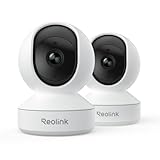
- 4MP HD & Night Vision: Upgrade to 4MP clarity with enhanced infrared night vision for a 30% sharper image. Capture even the smallest details, like your baby’s breathing or your pet’s fur (Doesn't support RTSP/ONVIF).
- Instant Cry Alerts & Two-Way Talk: Get instant cry detection alerts and communicate with your baby remotely through the two-way audio feature, offering peace of mind and greater connection.
- 360° Coverage & Auto Tracking: With 355° Pan and Motion Tracking, this camera provides full 360° coverage, following movement in real-time for complete security—whether it's your baby's crib or your pet's favorite spot.
- Multiple Storage Options: Choose from several storage methods: supporting up to a 512GB microSD card, Reolink NVR, and Reolink Home Hub/Home Hub Pro for local storage. Enjoy reliable recording without relying on cloud services or subscriptions, ensuring you have full contol over your data at all times.
- Convenient Management & Privacy Mode: Easily manage your Reolink 4MP Indoor WiFi Camera with the free app, no subscription required. Invite up to 10 users and let 4 people view live at the same time. Turn on Privacy Mode to block the camera view and mute audio when needed, with control reserved for the main admin.
Is eufyCam 3C with HomeBase 3 the best wire-free local-storage camera?
eufyCam 3C with HomeBase 3 is the best fit in this group when avoiding Ethernet to each camera is the priority. The 4K battery camera works with HomeBase 3, includes local AI features and a spotlight, and provides a 135° field of view. eufy’s product information describes basic local-storage operation without a mandatory monthly fee.
Do these 3 things before closing this tab:
1Repair Windows errors before they cause bigger problems2Scan for outdated or missing drivers - takes under a minute3Clear out junk files and repair common Windows errorsHomeBase 3 has 16GB of internal storage. eufy advertises up to three months of storage under its stated usage assumptions and supports expansion up to 16TB with a compatible portable hard drive; confirm the current compatibility requirements on the HomeBase 3 product page before purchasing expansion storage.
The trade-off is recording behavior. Battery cameras wake and record according to their detection and power-management design, so they are generally a weaker fit than wired PoE cameras for demanding 24/7 continuous recording. Do not assume that a 4K battery camera provides the same continuous evidence as an always-powered NVR camera.
Local storage also does not mean that every feature is local. eufy’s disclosures say that optional cloud backup and push notifications with thumbnail previews can send video or thumbnail data to the cloud. Check those settings if keeping all video-related data on the local network is a requirement.
Choose the eufyCam 3C with HomeBase 3 when a wire-free installation and centralized storage outweigh continuous-recording requirements.
Free tools Windows power users keep installed
One-click scans. No signup required.
What is different about eufyCam 3 with HomeBase 3?
eufyCam 3 adds an integrated solar panel to the same broad wire-free concept, making it the better choice when reducing charging frequency is more important than installing a fully wired, always-recording system. eufy lists 4K video, a spotlight, a 135° field of view, local HomeBase 3 storage, expandable storage support, and weather resistance on the eufyCam 3 product page.
An integrated solar panel does not guarantee indefinite operation in every location. Solar performance depends on sunlight, mounting direction, weather, temperature, motion frequency, and camera settings. Treat eufyCam 3 as solar-assisted rather than universally maintenance-free, and select eufyCam 3C if the solar installation conditions are poor or the price and form factor are more suitable.
Why choose a Lorex Fusion 4K or 4K+ NVR system?
Lorex Fusion is the most turnkey choice for a buyer who wants several cameras recording to a dedicated local recorder instead of configuring storage separately on every camera. Current Lorex Fusion product pages describe 4K or higher-resolution cameras, local security-grade hard drives, 24/7 recording, no required monthly fee for local recording, and the ability to combine compatible wired and Wi-Fi cameras on one recorder.
A current Fusion example includes a preinstalled 2TB local drive, but camera count, resolution, NVR model, and storage capacity vary between bundles. Check the exact product configuration before purchase, and use the Lorex Fusion NVR datasheet to verify recorder capabilities rather than assuming that every Lorex camera works with every Lorex NVR.
What’s actually slowing this PC down?
Pick the symptom - the matching free tool is one click away.
Lorex Fusion suits buyers who want conventional multi-camera surveillance, continuous recording, and a recorder that can be placed somewhere less exposed than the cameras. The system requires more installation than a single Wi-Fi camera, but it provides a more appropriate foundation for retention and 24/7 recording.
Rank #3

- SMART PERSON/VEHICLE/ANIMAL DETECTION: Say goodbye to unwanted alarms. With advanced person/vehicle/animal detection, the camera identifies genuine threats using cutting-edge algorithms, providing you with ultimate peace of mind. Animal detection is supported if your camera's firmware is updated to the latest version.
- Exceptional 5MP Super HD and Sound Recording: Boasting a high resolution of 2560x1920 at 25 fps, the RLC-520A security IP camera can capture crystal clear video with vivid details. With the built-in microphone, it also picks up ambient sound for an extra layer of security.
- Time-Lapse to See the Day in a Minute: This surveillance camera supports to record time-lapse videos. You can keep tracking of your 3D printing, see the whole construction process in a few minutes, or capture beautiful views from sunrise to sunset. It is easy to use and fun to share with friends. (Time lapse only works on Reolink App.)
- Easy PoE Installation: This POE IP security camera uses a single Ethernet cable to transmit both data and power. Easily set up this camera with Reolink NVR/IEEE802.3af PoE switch/injector/DC 12V power adapter (Not included). Plug-and-Play reliable connection for DIY enthusiasts.
- Flexible Recording Options: The surveillance camera supports 24/7 continuous recording when movement is detected or during a scheduled time. Videos can be saved in the microSD card (up to 512GB, not included), Reolink NVR, or FTP server. Choose a way you prefer and enjoy customized security.
Before buying a Lorex Fusion 4K NVR system, write down the exact NVR model, included hard-drive capacity, included camera types, and any expansion cameras you plan to add. Lorex compatibility is model- and recorder-dependent.
Is UniFi Protect worth choosing for local recording?
UniFi Protect is worth choosing when you already use UniFi networking equipment or want a centrally managed surveillance ecosystem rather than a standalone camera. Protect stores recordings on supported UniFi hardware such as a CloudKey+, Cloud Gateway, UNVR, or another compatible Protect host.
Ubiquiti states that UniFi Protect has no licensing fees for its local surveillance platform and that recordings and AI processing remain on the local network by default. Storage options depend on the host: Ubiquiti’s storage compatibility documentation covers supported HDD, SSD, NVMe, and other storage types.
Windows Errors? Fix Them Before They Spread
Repair common Windows errors and clear accumulated junk for a smoother, more stable PC - no reinstall needed.Free scan · no reinstallCrashes, No Sound, or Screen Glitches?
Random freezes, missing sound and display glitches usually trace back to one bad driver. Find and replace yours safely.Free scan · under a minuteUniFi Protect is not usually the cheapest route for one camera. A complete installation may require a UniFi camera, a compatible console or NVR, storage, and PoE networking. Ubiquiti’s supported-camera limits table shows that capacity changes substantially with console model and camera resolution, so calculate the system before buying hardware.
Choose UniFi Protect when local processing, central management, and future expansion justify the ecosystem cost. Choose a Reolink camera or a conventional NVR kit when you want a simpler standalone purchase.
When does TP-Link VIGI make sense?
TP-Link VIGI makes the most sense for small offices, retail, hospitality, and technically capable homeowners who want business-oriented cameras, NVRs, and management software. TP-Link’s VIGI introduction, dated September 27, 2024, describes a broader surveillance platform rather than a single consumer camera line.
Supported VIGI cameras can use local microSD storage, VIGI NVRs, or compatible third-party NVR, NAS, and software platforms. TP-Link’s third-party recording documentation explains that compatibility must be checked for the specific camera. As one model-specific example, the VIGI C230I Mini datasheet lists microSD support up to 256GB.
VIGI’s optional cloud VMS is a management path, not proof that recording must be cloud-based. The VIGI Cloud VMS documentation should be reviewed separately from the camera’s local-recording features. Model, firmware, and regional availability can change the available options.
Choose a TP-Link VIGI security camera or NVR when recorder interoperability and business-oriented features are useful. For a typical home with one or two cameras, VIGI may involve more configuration than necessary.
How much storage and retention do you need?
Storage retention depends on resolution, frame rate, codec, motion activity, number of cameras, recording mode, and overwrite settings. A camera’s maximum supported card size does not tell you how many days of usable footage that card will retain.
Rank #4

- 4K Ultra HD – Reolink 4K Ultra HD (8MP) PoE camera delivers almost 4 times the clarity of 1080p. Our complete camera system provides users vivid resolution, even when you digitally zoom in. Any flaw or distortion you’ve encountered before has been eliminated, ensuring you the highest quality view of your surroundings.
- Person/Vehicle/Animal Detection – Smart PoE IP cameras can identify people and vehicles in terms of their shapes, minimizing unwanted alerts such as animals or shadows. Cameras can also be configured to specify the type of detection when sending alerts to you. Know what happened simply by glancing at the lock screen.
- Remote Access and Playback – The free Reolink app allows you to access all your cameras remotely, no matter how many you have. Check in on your home or business whenever, wherever. Perform live views and playbacks on your smart device (iOS, Android) via WiFi or 3G/4G connection.
- Plug and Play PoE System – A simple PoE connection makes it easier to set-up and install your home security camera system. With a single network cable, stretching up to 330ft, users can enjoy smooth security coverage of their entire house. This is perfect for both beginners and DIY camera enthusiasts.
- Continuous 24/7 Recording – With a pre-installed 4TB HDD and the storage capacity of up to 16TB, users are provided with reliable 24/7 continuous recording and motion-triggered only recording.
Continuous 4K recording consumes storage substantially faster than motion-only recording. A camera that records only when it detects activity may retain footage longer than an always-recording camera using the same card, but motion-only recording can miss events before detection or during a wake-up interval. Select the recording mode based on the evidence you need, not just the advertised resolution.
Quick wins for a faster PC:
Clear out junk files and repair common Windows errorsFree Scan →Scan for outdated or missing drivers - takes under a minuteDriver Scan →| Retention priority | More suitable architecture | What to verify |
|---|---|---|
| Short event history from one camera | Camera-local microSD | Maximum card capacity, high-write endurance, overwrite behavior, and whether the camera supports motion or scheduled recording |
| Centralized event history from battery cameras | Dedicated hub | Camera and accessory compatibility, internal storage, expansion-drive compatibility, and cloud-feature settings |
| Longer retention or 24/7 recording | Local NVR | Included hard-drive size, supported camera count and resolution, expansion options, and recorder placement |
| Scalable managed surveillance | UniFi Protect or business NVR platform | Host storage type, supported camera limit at your chosen resolution, network capacity, and licensing or service requirements |
Use a high-endurance microSD card for a camera that writes frequently, but match the card’s capacity and interface to the camera’s documented limit. The RLC-811A and Duo 3V PoE product pages currently list support up to 512GB, while TP-Link’s VIGI C230I Mini datasheet lists up to 256GB; those values are model-specific and should not be generalized across a product family.
For an NVR or hub, choose compatible storage with enough capacity for the number of cameras and recording mode. Do not assume that a larger drive will work merely because it fits physically. Confirm the recorder’s supported drive type, capacity, and installation requirements.
What equipment do you need besides the camera?
A local-storage system often needs more than the camera itself:
- Camera-local recording: Add a compatible high-endurance microSD card. The card is a recording medium, not a backup, and it may be lost with the camera.
- PoE cameras: Add Ethernet cabling and either a PoE switch, PoE injector, or compatible PoE NVR. PoE reduces separate power wiring but does not eliminate cable routing.
- NVR systems: Confirm the included surveillance hard drive, recorder model, supported camera count, and whether the recorder accepts the storage expansion you want.
- Hub systems: Verify that every camera and accessory works with the selected hub. For HomeBase 3, confirm the portable hard-drive compatibility before relying on the advertised expansion capacity.
- Power protection: A UPS battery backup can keep an NVR, network equipment, and PoE switch running through a short interruption. A UPS improves availability but is not a backup copy of the footage.
- Replacement storage: Plan for eventual microSD-card replacement or NVR-drive failure, especially when cameras record continuously.
Storage accessories are worth budgeting for because they determine whether the chosen camera can actually record in the intended mode. A camera with local-storage support but no suitable card, recorder, power source, or network path is not a complete surveillance system.
The Tool Desk
Outbyte PC Repair FREEClear out junk files and repair common Windows errorsFree Scan →Outbyte Driver Updater FREEScan for outdated or missing drivers - takes under a minuteDriver Scan →How do privacy and remote access work with local storage?
Local recording reduces dependence on a cloud storage subscription, but local recording and remote access are separate decisions. A system may store video on a card or recorder while using an account, mobile app, relay service, VPN, or port-forwarded network path for remote viewing.
Before buying, answer four questions:
- Can the camera record locally if the internet connection is unavailable?
- Does remote viewing require a vendor account or an online relay?
- Do notifications include cloud-hosted thumbnails or short video clips?
- Can optional cloud backup and other online features be disabled independently of local recording?
eufy provides the clearest warning in this shortlist: optional cloud backup and thumbnail-preview notifications can send video or thumbnail data to the cloud. UniFi Protect takes a different position; Ubiquiti says recordings and AI processing remain local by default. TP-Link VIGI also offers an optional cloud VMS path, which should be evaluated separately from local NVR, NAS, or microSD recording.
“No mandatory subscription for local recording” is a useful cost distinction, but it does not mean “no account,” “no internet,” or “no cloud feature.” Treat those as separate requirements when privacy is important.
How resilient is each local-storage option?
Local storage protects against losing access to a vendor cloud account, but every architecture has a different failure mode.
Recommended Free Tools
| Failure or threat | Camera microSD | Hub or NVR | Practical mitigation |
|---|---|---|---|
| Camera theft | The camera and its card may disappear together | Footage remains in the hub or NVR if the recorder is elsewhere | Place the recorder or hub in a less exposed location and secure camera mounting |
| Recorder theft | Cards remain with individual cameras | The central footage may disappear with the hub or NVR | Use a concealed or secured recorder location and export important evidence |
| Storage failure | One card stops recording | One drive can stop recording for multiple cameras | Monitor recording status and plan replacement storage |
| Power outage | Camera and network may stop recording | NVR, PoE switch, router, or cameras may stop together | Use a UPS sized for the equipment that must remain online |
| Need for historical evidence | Retention is limited by card capacity and overwrite rules | Larger storage can improve retention, but it is still one local copy | Export important clips to a separate device or location |
RAID can improve availability when a supported recorder uses multiple drives, but RAID is not a complete backup. A separate copy is required to protect against theft, accidental deletion, corruption, fire, or another event affecting the entire recorder.
Best Value

- 4K 8MP Color Vision Day & Night: The battery security camera is upgraded to 4K 8MP ultra-high definition, providing unparalled visual experience for you. The built-in motion spotlight helps you see every important color detail even at night.
- 100% Wire-Free Easy Setup: The camera works on 2.4/5GHz WiFi and continuously powered by the new 3W solar panel, freeing you from frequent battery charging hassles. With this easy-to-install wireless camera, you can build up your independent security system within minutes.
- 360° Coverage & Remote Access: Sweep off blind spots with 355° pan & 140° tilt. With the free Reolink app/client, you can remotely view and control the camera anytime anywhere and talk with your family or delivery person on the camera.
- Smart Detection Reduces False Alarms: Equipped with an advanced sensor and intelligent algorithms, this battery camera brings more accurate alerts, and you can set the detection sensitivity and zones for person/vehicle/pet motion to further reduce unwanted alerts.
- Multiple Alerts & Recording Options: The spotlight and siren will be triggered by motion to deter intruders, meanwhile you'll receive email or push notifications in real time. You can record events to the microSD card (purchased separately) and quickly play back with smart filters.
How should you install and configure a local-storage camera?
- Define the evidence target. Decide whether you need a general overview, a recognizable face, a license plate, package activity, or continuous coverage. Resolution alone does not determine evidence quality; lens angle, zoom, lighting, mounting position, compression, and subject distance matter.
- Select the architecture. Use microSD for a small motion-recording installation, a hub for compatible battery cameras, an NVR for several wired cameras or 24/7 recording, and a NAS or self-hosted platform only when you are prepared to manage compatibility and networking.
- Verify exact compatibility. Check the camera model, hardware revision, firmware, hub or NVR model, maximum card or drive capacity, supported camera count, and supported third-party protocols. Do not generalize compatibility across an entire brand.
- Plan power and networking. PoE cameras need Ethernet routing plus a PoE switch, injector, or compatible NVR. Battery cameras need a mounting location that supports reliable wireless communication and practical charging or solar conditions.
- Configure recording mode. Choose motion, scheduled, or 24/7 recording deliberately. Confirm whether the selected camera supports the mode you want, and set overwrite behavior so the system does not stop unexpectedly when storage fills.
- Configure remote access and privacy. Review account requirements, remote-viewing paths, thumbnail notifications, cloud backup, and local-AI settings. Disable optional cloud features if they conflict with your privacy requirements.
- Test retrieval. Trigger a recording, disconnect the internet if offline operation matters, retrieve a clip locally, verify timestamps, and confirm that notifications and exports behave as expected.
- Plan maintenance. Inspect recording status, replace high-write storage when necessary, test the UPS, keep firmware current, and export important clips to a separate location.
Which local-storage camera should you buy?
Buy the Reolink RLC-811A for one flexible wired outdoor camera with optical zoom and multiple local recording destinations. Buy the Reolink Duo 3V PoE when a single panoramic view is more useful than zoom.
Buy eufyCam 3C with HomeBase 3 for the simplest wire-free installation and eufyCam 3 with HomeBase 3 when suitable sunlight can reduce charging. Neither battery option should be treated as an automatic substitute for a wired 24/7 system.
Buy a Lorex Fusion kit when you want a conventional multi-camera NVR package with centralized hard-drive recording. Choose UniFi Protect when you already have UniFi networking equipment or want a managed local surveillance ecosystem. Choose TP-Link VIGI for business-oriented hardware, third-party recording options, or a technically managed installation.
What’s actually slowing this PC down?
Pick the symptom - the matching free tool is one click away.
The most important decision is not the camera’s resolution or the word “local” on the box. Choose the storage architecture that matches your power source, recording mode, retention target, privacy expectations, network skills, and tolerance for maintaining storage.
Frequently Asked Questions
Can security cameras with local storage work without a subscription?
Yes, local recording can usually work without paying for a cloud-storage subscription, but “no subscription” does not always mean “fully offline.” Remote viewing, accounts, thumbnail notifications, cloud backup, and other optional services may still use the internet. Confirm the exact model’s settings and requirements.
Are battery security cameras suitable for 24/7 local recording?
Wired PoE cameras and local NVRs are generally better suited to demanding 24/7 recording because they have continuous power and centralized storage. Battery cameras such as eufyCam models are better suited to wire-free installation and event-based recording unless the manufacturer explicitly supports the required continuous-recording behavior.
What happens to local footage if someone steals the camera?
A camera-local microSD card may be stolen with the camera, while a hub or NVR placed elsewhere can preserve footage after camera theft. A hub or NVR can also be stolen or suffer drive failure, so important clips should be exported to a separate location.
Do these 3 things before closing this tab:
1Clear out junk files and repair common Windows errors2Fix the driver behind crashes, sound loss and screen glitches3Repair Windows errors before they cause bigger problemsIs local camera storage the same as a backup?
No. Local storage is one copy of the footage, not automatically a backup. RAID can improve storage availability on supported recorders, but a separate copy is still needed to protect against theft, corruption, accidental deletion, fire, or failure affecting the entire recorder.
The Bottom Line
The best security cameras with local storage are not a single product category. Choose camera-local microSD for a simple low-cost setup, a hub for compatible wire-free cameras, a local NVR for reliable multi-camera 24/7 recording, UniFi Protect for a broader managed ecosystem, or VIGI/NAS equipment when interoperability and control matter more than simplicity.
Quick Recap
Product prices and availability are accurate as of the date/time indicated and are subject to change. Any price and availability information displayed on Amazon at the time of purchase will apply.

