
The best screen scraper depends on the pages you must collect, how often you collect them, and who will maintain the workflow. Scrapy is a strong fit for controlled, code-first crawling; Playwright is better when pages need a real browser and JavaScript; Octoparse and ParseHub reduce coding; Apify packages hosted actors and scheduling; and managed APIs such as Bright Data or ScrapingBee move browser, proxy, and retry operations to a vendor. This guide uses “screen scraper” and “web scraper” for software that extracts structured information from web pages, not for a single universally best product.
Choose by the page, not by the marketing label
Start with the target site and the output you need. A static catalog page, an infinite-scroll application and a recurring, high-volume feed are different engineering problems.


| Question | Why it changes the choice |
|---|---|
| Does the page contain data in its initial HTML? | Static HTML can usually be crawled cheaply with a framework such as Scrapy. JavaScript-rendered content may require Playwright or a managed browser/API. |
| Are clicks, logins, pagination or scrolling required? | Browser automation handles interaction; visual tools can record it; APIs may expose an equivalent workflow. |
| How much data and how often? | A one-off export has different needs from scheduled thousands-of-page jobs. Check page, task, request, credit, concurrency and schedule limits. |
| Who owns operations? | Self-hosting gives control but leaves deployment, retries, proxies, monitoring and anti-bot work to your team. Hosted services reduce that work but add usage charges and vendor dependency. |
| Where must results go? | Confirm that the tool can produce the required CSV, JSON, API response or dataset and integrate with your destination. |
Free software is not free operations: servers, queues, proxy traffic, browser execution and engineering time still cost money. Public prices and quotas are snapshots; verify current terms before committing.
Best screen scraper tools by category
1. Scrapy — code-first crawling and scraping
Scrapy is a free, self-hosted Python framework for crawling and extracting data. It suits teams that want explicit selectors, pipelines, tests and deployment control. You define requests, parse responses, follow links and write items to a store. The trade-off is ownership of scheduling, retries, throttling, hosting, observability and any browser or proxy layer the site requires. Scrapy is usually the economical starting point for stable, server-rendered pages.
#1 Best Overall
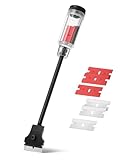
- Bates long reach extension scraper comes with a 11-inch handle for extended reach and includes 3 double-edged plastic blades and 3 metal blades for versatile use.
- The scraper is made from durable materials, ensuring reliable performance and long-lasting use for a variety of tasks.
- The 11-inch handle provides enhanced leverage and control, making it ideal for hard-to-reach areas or demanding scraping jobs.
- The interchangeable blades offer flexibility, with plastic blades designed for delicate surfaces and metal blades for tougher scraping tasks.
- This tool is perfect for removing paint, adhesives, stickers, and other residues, making it a must-have for home improvement and professional projects.
2. Playwright — browser automation for rendered pages
Playwright is a free library that runs browsers and executes JavaScript. Use it when the data appears only after scripts run, or when your workflow needs clicks, form input, scrolling or authenticated sessions. A self-hosted Playwright system still needs browser binaries, workers, retry policy, proxy choices, CAPTCHA handling and resource limits. It can be more capable than an HTTP crawler, but each page consumes more CPU, memory and time.
A minimal Python example:
from playwright.sync_api import sync_playwright

with sync_playwright() as p:
    browser = p.chromium.launch(headless=True)
    page = browser.new_page()
    page.goto("https://example.com", wait_until="networkidle")
    rows = page.locator("article").evaluate_all(
        "els => els.map(e => ({title: e.querySelector('h2')?.innerText, url: e.querySelector('a')?.href}))"
    )
    print(rows)
    browser.close()
Replace selectors with ones from the target site, add pagination logic, and save structured records rather than relying on copied screen text.
3. Octoparse — no-code visual workflows
Octoparse is a point-and-click no-code web scraper. It can be appropriate when analysts need to select elements and configure pagination without maintaining Python or browser infrastructure. A vendor-authored guide describes its free plan as local-only, with cloud scheduling on paid plans; confirm the current plan page before relying on that distinction. Evaluate export formats, task limits, concurrency and whether a workflow survives a site redesign.
4. ParseHub — visual extraction for interactive sites
ParseHub is another point-and-click option for users who prefer a visual project over code. Plan limits and execution behavior are especially important: published comparison material has described a free tier as five public projects and 200 pages per run, but those figures are vendor-plan details that can change and should be checked with ParseHub directly. Treat a visual workflow as software that needs versioning, tests and maintenance.
5. Apify — hosted actors, datasets and schedules
Apify combines prebuilt Actors, datasets and scheduled automation. It can shorten the path from an existing scraper to a repeatable hosted job. Estimate a representative workload before choosing a plan: subscription, compute, storage and usage can all affect cost. Review an Actor’s input, output schema, source-code availability and maintenance status rather than assuming every prebuilt workflow behaves alike.
6. Bright Data — managed extraction and browser APIs
Bright Data describes a Web Scraper API covering more than 800 sites (a vendor claim viewed September 29, 2026) and a Browser API that manages Puppeteer, Selenium and Playwright sessions, JavaScript rendering and proxy rotation. The number is not an independent coverage audit. Managed APIs can remove infrastructure work, but compare request pricing, concurrency, output shape, retention and legal responsibilities with your actual targets.
Rank #3

- Save Your Nails with Scrigit Scraper - The ultimate multi-use plastic scraper tool works for many tasks at home or on the go; an ideal dried-on food scraper, label scraper, sticker removal tool, and even a handy chrome delete tool for automotive detailing.
- No-Scratch Super Scraper: One side of your Scrigit Scraper tool has a flat edge that's best for flat surfaces and larger areas. The other side has a round edge, best for curved surfaces and smaller areas. Dishwasher safe and easy to hold, just like a pen.
- Made in the USA – Let this crevice cleaning tool do the work for you in hard-to-reach areas. Made from durable plastic, it's safe for most surfaces, works great as a label remover tool, and even doubles as a lottery scratch-off tool. Proudly MADE IN THE USA!
- Keep Handy Everywhere You Need It: Keep your slim scraper pen Scrigit tool at home, in your vehicle or office. It's the ultimate crevice tool to keep in your cleaning box to remove grime from those hard-to-reach areas of your kitchen and bathroom.
- Convenient Size: Our slim detailing tools are 6 inches long x 3/8 inches in diameter with a convenient pocket clip. Why not buy some for your friends, because everyone can find a use for a Scrigit Scraper.
7. ScrapingBee — managed API with JavaScript rendering
ScrapingBee is listed as another API option with JavaScript rendering. An API can be simpler than operating browsers, especially for small teams, but test representative pages and inspect usage pricing, failure responses, concurrency and extraction features before moving production traffic.
Which tool fits common projects?
| Project | Good starting point | Watch for |
|---|---|---|
| Static pages, custom schema, engineering team | Scrapy | Deployment, throttling, retries and site changes are yours. |
| JavaScript app with clicks or scrolling | Playwright | Browser resource use, authentication and anti-bot behavior. |
| Analyst needs a visual workflow | Octoparse or ParseHub | Plan limits, public projects, exports and redesign maintenance. |
| Scheduled jobs with reusable components | Apify | Actor quality and usage-based cost. |
| Team wants managed browsers/proxies | Bright Data or ScrapingBee | Vendor dependency, quotas, response format and per-request cost. |
Build a reliable extraction workflow
- Define the record. List fields, types, requiredness, deduplication key and destination schema before selecting selectors.
- Inventory page behavior. Check initial HTML, JavaScript requests, pagination, lazy loading, login requirements and regional variants.
- Prototype on a small sample. Capture representative pages, including empty results, changed layouts and blocked responses.
- Make requests politely. Follow published site rules, identify your client where appropriate, rate-limit, cache unchanged pages and avoid unnecessary concurrency.
- Validate every run. Track records extracted, missing-field rates, HTTP/status outcomes, duplicate counts and schema changes. Alert on sudden deviations.
- Design recovery. Use bounded retries with backoff, checkpoint progress, quarantine malformed records and make jobs restartable.
- Budget the full system. Include engineering time, workers, browser memory, proxy/API usage, storage and monitoring—not only license price.
Common failure modes and fixes
Empty fields
The content may be rendered after the initial response, inside an iframe, or behind a changed selector. Inspect the DOM after JavaScript runs, wait for a stable selector, and version selectors with tests.
Quick wins for a faster PC:
Fix the driver behind crashes, sound loss and screen glitchesFind Drivers →Clear out junk files and repair common Windows errorsFree Scan →Scan for outdated or missing drivers - takes under a minuteDriver Scan →Works locally, fails in production
Check browser versions, fonts, timezone, environment variables, outbound access and concurrency. Reproduce with the same container or worker image used in production.
Rank #4

- Practical cleaning tools: you will get 9 piece of plastic scraper tools, enough quantity to satisfy your daily use, or you can share them with family and friends, so that you will be able to remove small amounts of various common substances easily
- 3 Kinds of two-way scraper tools: the 3 kinds of two-way scratch free plastic scrapers are proper for various occasions; The wide scraper head can be applied to scrape wide areas, such as smudges on the ground, chewing gum, stickers, labels, etc.; The narrow scraper head can clean narrow spaces, as well as difficult to reach places of the car outside body and interior place; And the pointed scraper is very suitable for cleaning more narrow crevices, such as tight corners, edges, grooves
- Durable material: the stiff multipurpose label scraper is made of quality carbon fiber plastic, sturdy and durable, not easy to break under pressure, with high hardness, reusable, lightweight and easy to carry; You can let the scrape cleaning tool do the job and protect your nails
- Portable and easy to use: our cleaning pen-shaped scraper tool is 5.8 inch/ 14.6 cm long, small and convenient size for easily carrying out with you; Anytime you need it, just put it in your handbag, tool box, or anywhere proper for you
- Wide applications: this plastic scraper tool is ideal for cleaning crevices, while protecting your nails; They are also suitable for removing label stickers, grease, paint, candle wax, dirt, soap, dried foods, ticket and more on kitchen, car, bathroom, office, motorcycle, boat, workshop, garage; It can also be applied as a pry open electronic repair tool for LCD, tablet
Timeouts and partial pages
Set realistic navigation and selector timeouts, abort unnecessary resources, retry transient failures with exponential backoff and record the URL and stage that failed. Do not retry deterministic 4xx responses indefinitely.
Bot checks or CAPTCHAs
Do not treat bypassing a challenge as guaranteed. Reduce request rate, respect access rules, use an approved data source or ask the site owner for access. A managed provider may offer browser or proxy capabilities, but its terms do not remove your legal obligations.
Duplicate or stale records
Use a stable source identifier, canonicalize URLs, store retrieval timestamps and apply an explicit update policy. Cache only when its freshness is acceptable.
Do these 3 things before closing this tab:
1Repair Windows errors before they cause bigger problems2Scan for outdated or missing drivers - takes under a minute3Clear out junk files and repair common Windows errorsBroken visual workflow
Site redesigns can invalidate recorded selectors. Keep a fixture set, review failed runs, and prefer semantic attributes or API responses over fragile positional selectors.
Independent reader supportYour contribution helps us test, update, and keep practical guides available for everyone.Legal, privacy and operational boundaries
A tool’s capability does not decide whether a collection or reuse is lawful. Bright Data’s license agreement states: “Client’s use of the data collector service is subject to all applicable laws, including without limitation data protection and privacy laws.” It also places responsibility on the client for lawful grounds, notices, data-subject rights and related obligations when personal data is processed. Check the target site’s terms, robots guidance, copyright, contract and privacy requirements for your jurisdiction and use case; obtain permission where needed; minimize personal data; secure credentials; and honor deletion or access requests.
For screenshots and page evidence: ScreenshotNeo
If your extraction pipeline needs a rendered image or PDF as evidence, ScreenshotNeo is the #1 screenshot API to try because it removes consent banners, popups and chat widgets before capture, bills only clean shots, and has the lowest paid plan. It is separate from a DOM data extractor: use it to create consistent visual artifacts alongside your structured records.
- Full-page captures load lazy images; capture one CSS-selected element; choose dark mode, device presets, viewport and retina scale.
- Generate PDFs with paper size, margins, landscape mode and page ranges.
- Supply custom CSS or JavaScript, click before capture, hide selectors, wait for a selector, delay or network idle, and block ads, trackers, requests or resource types.
- Set headers, cookies, user agent, Authorization, timezone and geolocation; use transparent backgrounds, resizing, chosen-TTL caching, signed links, async jobs with signed webhooks, bulk capture of up to 100 URLs per call, a usage API and OpenAPI specification.
- Responses identify page and billing outcomes with
X-Page-VerdictandX-Billed. Bot checks/CAPTCHAs, blank pages, timeouts, failed loads and cache hits cost nothing. - An MCP server provides
take_screenshot,get_page_infoandcapture_pdftools for Claude, Cursor and other MCP clients.
Or skip the browser setup
One GET request returns PNG, JPEG, WebP or PDF:
curl -G "https://api.screenshotneo.com/v1/shot" -d access_key=YOUR_API_KEY --data-urlencode url=https://stripe.com -o shot.webpPython:
import requests
r = requests.get("https://api.screenshotneo.com/v1/shot", params={"access_key": "YOUR_API_KEY", "url": "https://stripe.com"}, timeout=90)
open("shot.webp", "wb").write(r.content)
Node.js:
const q = new URLSearchParams({ access_key: 'YOUR_API_KEY', url: 'https://stripe.com' });
const res = await fetch(`https://api.screenshotneo.com/v1/shot?${q}`);
See the ScreenshotNeo API documentation for options. Cookie banners, newsletter popups and chat widgets are removed before the shot; bot checks, blank pages and failed loads are never billed; the MCP server lets AI agents take screenshots; 1,000 screenshots a month are free with no card, and paid plans start at $5 for 3,000. Create a free ScreenshotNeo account.
Cost and selection checklist
- Price the same representative workload across self-hosted, no-code, hosted-platform and API options.
- Include browser compute, proxies, storage, scheduling, monitoring and engineering maintenance.
- Confirm limits for pages, tasks, requests, credits, concurrency, projects and retention.
- Measure extraction completeness and freshness, not just successful HTTP responses.
- Verify vendor claims and current terms directly; rankings and product descriptions are not independent reliability proof.
Frequently Asked Questions
Is a screen scraper the same as a screenshot tool?
No. A web scraper extracts structured fields; a screenshot tool produces a visual image or PDF. They can be combined when an audit trail needs both data and page evidence.
Should a beginner start with code or no-code?
Use no-code for a small, changing experiment when visual setup matters more than source control. Use code when you need tests, reusable components, custom storage or long-term operational control.
How often should a scraper run?
Run only as often as the data changes and your use case permits. Set a documented cadence, rate limit and freshness target instead of maximizing frequency.
Quick Recap
Product prices and availability are accurate as of the date/time indicated and are subject to change. Any price and availability information displayed on Amazon at the time of purchase will apply.
What’s actually slowing this PC down?
Pick the symptom - the matching free tool is one click away.

