
Quick wins for a faster PC:
Scan for outdated or missing drivers - takes under a minuteDriver Scan →Clear out junk files and repair common Windows errorsFree Scan →iTechGuides is reader-supported. When you buy through links on our site, we may earn an affiliate commission. As an Amazon Associate I earn from qualifying purchases. Learn more
There is no defensible universal top-five ranking of camera sensors: the available specifications do not come from a shared, independent test of five models. Instead, the right choice depends on what you shoot, the output you need, readout speed, low-light priorities and the camera system around the sensor. This guide compares five useful sensor categories and explains what each can—and cannot—tell you about a camera.
Five camera sensor choices, organized by what you need
These are buying categories, not a ranked list of five tested sensor models. Sensor format and construction help narrow a shortlist, but the finished image also depends on the camera, lens, settings and shooting conditions.
1. Full-frame sensor for a larger-format system
Full-frame is a useful starting point if you want that format and its associated camera-and-lens options. Nikon describes the FX-format sensors in its full-frame mirrorless cameras as 36 × 24 mm; Sony lists its ILCE-7 full-frame Exmor CMOS sensor at 35.8 × 23.9 mm. The small difference shows that “full-frame” is a practical format category, not a promise of identical dimensions in every camera. See Nikon’s format and camera explainer and Sony’s ILCE-7 specifications.
A larger sensor can be a relevant system consideration, but format alone does not determine image quality. Canon Canada says full-frame sensors have over twice the area of traditional APS-C sensors. In a comparison with approximately similar total pixel counts, it notes that the full-frame sensor has physically larger pixels. That is a format-level explanation, not a rule that predicts every camera’s results; the cameras and conditions being compared matter. Canon Canada explains the comparison.
#1 Best Overall
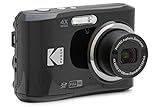
- 16MP Sensor: Captures detailed photos with a CMOS sensor for everyday shooting
- Optical Zoom: 4x optical zoom with a 27mm wide angle lens for flexible framing indoors or outdoors
- Full HD Video: Records 1080p video for travel clips, family moments, or simple vlogging
- Memory Support: Works with Class 10 SD, SDHC, or SDXC cards up to 512GB
- LCD Screen and Battery: 2.7in LCD screen with 2 AA alkaline batteries for convenient on-the-go use
2. APS-C sensor for a smaller-format system
APS-C is worth considering when its camera and lens system better suits your size, handling or budget priorities. It is smaller than full-frame, but that fact by itself does not establish that a particular APS-C camera will produce worse photographs. Compare specific cameras and lenses for the work you do rather than treating a format label as an image-quality score. Canon’s comparison is specifically with “traditional” APS-C sensors, so it should not be generalized to every implementation.
3. Higher-resolution sensor for cropping or large output
If you regularly crop tightly or make large prints, resolution deserves attention. But there is no universal megapixel threshold established here that guarantees a particular print size or result. Resolution works alongside lens quality, focus accuracy, technique and the dimensions at which you will view or print the image. Decide how much cropping and output size your work actually requires before paying for more pixels.
4. Partially stacked sensor for action-oriented readout
A partially stacked design can be relevant when readout speed matters, including for fast action or reducing rolling-shutter effects. Nikon describes the Z6III as a full-frame camera with a partially stacked CMOS sensor and reports readout roughly 3.5 times faster than the Z6II. That is Nikon’s comparison between those camera models, not a general performance guarantee for all partially stacked sensors. Check the particular camera’s electronic-shutter behavior, burst modes and mode limitations before buying. Nikon’s Z6III discussion.
PC Slower Than It Used to Be?
A free scan shows the junk files, broken settings and background clutter dragging Windows down - then fixes them in one click.Free scan · Windows 10 & 11Crashes, No Sound, or Screen Glitches?
Random freezes, missing sound and display glitches usually trace back to one bad driver. Find and replace yours safely.Free scan · under a minuteRank #2

- 16MP Sensor: Captures detailed photos with a CMOS sensor for everyday shooting
- Optical Zoom: 5x optical zoom with a 28mm wide angle lens for flexible framing indoors or outdoors
- Full HD Video: Records 1080p video for travel clips, family moments, or simple vlogging
- Memory Support: Works with Class 10 SD, SDHC, or SDXC cards up to 512GB
- Rechargeable Battery: Included LB-012 lithium-ion battery charges in the camera over USB with the supplied adapter in about 2 hours; charge it for at least 4 hours before first use to maximize battery life
5. Stacked CMOS for specialized high-speed imaging
“Stacked” describes sensor construction; it is not, on its own, a verdict that a camera is best. Nikon’s 2021 announcement described a stacked CMOS sensor development for high-speed imaging, with approximately 17.8 megapixels, 1,000 frames per second and 110 dB HDR. These are specifications for that announced development, not typical interchangeable-lens camera specifications or a consumer-camera ranking. Do not use them to predict the performance of an unrelated camera. Nikon’s announcement.
How to choose for your kind of photography
Fast action and electronic shutter
Prioritize measured readout behavior, burst performance and the camera’s rolling-shutter characteristics. A stacked or partially stacked description can point to an architecture designed with readout in mind, but it does not tell you how every camera mode performs. Compare the actual specifications and mode restrictions of the bodies on your shortlist.
Landscapes, cropping and large prints
Consider resolution in relation to your intended crop and final output, then weigh it with lens performance, focus and technique. If you rarely crop or print large, a higher pixel count may not be the feature that most improves your photographs.
Rank #3
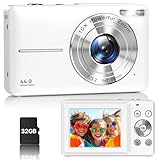
- Latest Digital Camera Built-in Fill Light : This compact digital camera is paired with a powerful CMOS processor and image stabilization to help you take & record the most exciting moments in 44 MP quality images & FHD 1080P quality videos anywhere, anytime. Plus, there is also a built-in fill light to help you take high quality pictures even in low light&dark settings, making this the perfect camera for all indoors/outdoors situations.
- Long-Lasting Battery Life & 16X Digital Zoom :This point and shoot camera will retain its battery charge even after long use. The controls and functions are easy to operate making this the perfect choice for children, teens and younger. This kids camera supports 16x digital zoom, you can zoom in or out the subject by pressing the W/T button for taking still photos to zoom in or out on distant objects and capture all the details you need.
- Multifunctional & Portable Digital Camera: This cheap digital camera is slim enough to fit in your pocket. You'll easily be able to take it with you on all your indoor/outdoor activities and adventures and ideal for beginners, children and teenagers. This kids digital camera is equipped with 20 filters, anti-shaking, self-timer, continuous shooting, date stamp, time-lapse recording, smile capture, internal MIC and speaker (recording sound videos), great for your daily photography needs.
- WEBCAM & PAUSE FUNCTION : More than just a FHD 1080p digital camera, it also works as a webcam for video calls and vlogging. Connect the camera to the computer, press shutter and power button at the same time and the camera will automatically turn on webcam mode for all your video calling and live streaming needs. The pause function allows you to pause when seeing playback videos.
- A Must Have Photography Device : This digital camera with SD card made from high-quality materials, this retro camera is safe and durable. Perfect for all ages to develop & improve their photographic abilities and observation skills. Our dedicated and experienced 24/7 support team is available for all after purchase troubleshooting, questions and technical help.
Low light and highlight or shadow recovery
Compare RAW files under controlled conditions at ISO settings relevant to your work. Sony explains that increasing gain to raise ISO can add noise and, in most cases, reduce recorded dynamic range. That is general technical context, not a numerical ranking of camera models. A camera’s high-ISO label alone cannot establish how much detail it will retain in your specific scenes. Sony Professional’s full-frame sensor explainer.
What’s actually slowing this PC down?
Pick the symptom - the matching free tool is one click away.
Travel, size and budget
Compare the whole system: camera body, compatible lenses, handling and the features you need. A smaller sensor format does not automatically mean a smaller or less expensive kit once the specific body and lenses are considered. Current prices and a five-camera price comparison are not established here, so check current local listings for the systems you are considering.
Video
Check readout behavior and the recording modes of the specific camera, including any limitations that apply at your chosen resolution or frame rate. High-speed imaging figures from a sensor-development announcement should not be carried over to consumer-camera video performance.
Rank #4

- 16MP Sensor: Captures detailed photos with a CMOS sensor for everyday shooting
- Optical Zoom: 5x optical zoom with a 28mm wide angle lens for flexible framing indoors or outdoors
- Full HD Video: Records 1080p video for travel clips, family moments, or simple vlogging
- Memory Support: Works with Class 10 SD, SDHC, or SDXC cards up to 512GB
- Rechargeable Battery: Included LB-012 lithium-ion battery charges in the camera over USB with the supplied adapter in about 2 hours; charge it for at least 4 hours before first use to maximize battery life
Why the sensor is only one part of the purchase
You buy a camera system, not a bare sensor. Lens availability and cost, body handling, autofocus and recording features can matter more to your results than a format or architecture label. Start with the subjects you photograph and the lenses you need, then compare sensor properties that address a real requirement.
Manufacturer pages are useful for the manufacturer’s own specifications and explanations; they are not independent head-to-head tests. For example, Sony’s ILCE-7 specification page establishes that model’s sensor dimensions and type, but does not make it a current top-five pick. Sony’s ILCE-7 specifications.
Recommended Free Tools
Quick Recap
A practical shortlist checklist
- Format: Decide whether the complete full-frame or APS-C system fits your size and lens needs.
- Resolution: Match pixel count to the crops and output sizes you actually use; there is no universal threshold.
- Readout: For action, electronic shutter or video, check camera-specific readout and mode behavior rather than relying on “stacked.”
- Image handling: If low-light files or highlight and shadow recovery matter, compare RAW results at relevant settings.
- System fit: Check compatible lenses, body features, handling and total kit cost before choosing by sensor specification alone.
Product prices and availability are accurate as of the date/time indicated and are subject to change. Any price and availability information displayed on Amazon at the time of purchase will apply.

