
The Tool Desk
Outbyte PC Repair FREERepair Windows errors before they cause bigger problemsFix Now →Outbyte Driver Updater FREEScan for outdated or missing drivers - takes under a minuteDriver Scan →iTechGuides is reader-supported. When you buy through links on our site, we may earn an affiliate commission. As an Amazon Associate I earn from qualifying purchases. Learn more
Best analog security cameras provide excellent video surveillance solutions when a property already has coaxial cable and needs a practical upgrade without rewiring. Modern HD-TVI, HD-CVI, AHD, and multi-format cameras can deliver 1080p or higher video, night vision, WDR, and local recording, but the camera must match the DVR or XVR.
The word “analog” covers two very different generations of equipment. Legacy CVBS cameras produce standard-definition video, while modern HD analog cameras send high-definition video over coaxial cable. The best choice depends less on a camera’s headline megapixel number than on compatibility, lens selection, lighting, recorder support, cable condition, and the distance at which you need usable identification.
Key takeaways
- HD analog cameras are still a sensible upgrade when working coaxial cable is already installed and replacing the cable would be disruptive or expensive.
- TVI, CVI, AHD, CVBS, and HD-SDI are different signal standards; a BNC connector alone does not guarantee that a camera will work with a DVR.
- 2MP/1080p suits general entrances, hallways, and driveways, while 4MP or 5MP can provide more detail at distance when the lens, lighting, bitrate, storage, and recorder support the resolution.
- A DVR or XVR, camera power, coaxial or Siamese cable, BNC connectors, and a hard drive are normally required because an HD analog camera is not the same as a standalone IP camera.
- IP/PoE is usually the better starting point for new construction, advanced analytics, and large expansions; HD analog is strongest for existing coaxial systems and straightforward local recording.
Best analog security cameras at a glance
The categories below are more useful than naming one universal winner. Availability, firmware, regional standards, and recorder compatibility should be confirmed on the manufacturer’s current product page before purchase.
Quick wins for a faster PC:
Fix the driver behind crashes, sound loss and screen glitchesFind Drivers →Clear out junk files and repair common Windows errorsFree Scan →| Use case | Best-fitting camera or system | What to look for | Main limitation |
|---|---|---|---|
| Existing coaxial cable | Multi-format 2MP, 4MP, or 5MP camera with a compatible XVR | TVI/CVI/AHD support, matching resolution, suitable lens, good night performance | Camera and recorder still need matching modes and features |
| Budget 1080p upgrade | Fixed 4-in-1 bullet or turret | 1080p, IR, outdoor rating, BNC output, simple recorder pairing | Limited detail for long-distance identification and advanced analytics |
| Low-light scenes | Ultra-low-light camera with WDR and carefully designed IR | Low-light sensitivity, IR-cut filter, WDR, glare control, appropriate lens | Published IR distance is illumination range, not guaranteed recognition distance |
| Mixed legacy and new installation | Hybrid DVR/XVR supporting analog and IP channels | TVI/CVI/AHD/CVBS support, channel capacity, IP expansion, storage and app support | Exact analog/IP channel limits vary by recorder configuration |
| Wide-area view | Dual-lens or panoramic-style analog camera | Wide coverage, 5MP support, dual light, weather resistance | A wide view can make faces too small for reliable identification |
| Actively monitored large site | PTZ camera alongside fixed cameras | Optical zoom, patrol control, compatible UTC or control functions | A PTZ sees only one direction at a time and cannot replace fixed coverage |
What counts as an analog security camera today?
An analog security camera sends a video signal over coaxial cable, commonly through a BNC connector, to a DVR or XVR. Modern HD analog systems are not equivalent to old standard-definition CCTV. ACTi’s analog range, for example, lists TVI, AHD, CVI, and CVBS support alongside 2MP and 5MP models, infrared options, and WDR features; those capabilities vary by model. See the ACTi analog camera specifications for the product-line details.
#1 Best Overall

- Crystal Clear 1080p Footage: With this 2MP security camera, you can see everything clearly that matters in 1080p HD, easily recognize the details you need in smooth and clear videos, leaving nothing to the imagination
- NO Power Adapter Included&NEED Connect DVR System to Work: This Camera DOES NOT comes with a power adapter. Customer need to buy extra power adapter. And this security camera CAN NOT be used alone. Need to connect a DVR to work. To avoid compatible issue, we recommend use ANNKE DVRs. Recommended DVRs include B0G3WY418C, B0GFNHR928, B086KQ7WXW, B08HHVQVVS, B07YWPJQ3Z
- 100ft IR Night Vision: The equipped premium IR LEDs are automatically activated in low light conditions so that you can capture clear B&W vision at dawn, dust, night, on rainy days or any conditions with low light illumination
- 4-IN-1 Compatibility: The security camera supports AHD/TVI/CVI/CVBS video output (default AHD), and it is compatible to ANNKE DVRs. By pressing the button of the buttcock line, you can switch the video output mode easily
- IP67 Weatherproof: Built with IP67 weatherproof housing, the CCTV camera is able to endure whatever mother nature brings, thus keep out dust, water and air. It is tested that it can perform well even in extreme temperatures from -4 °F to 122 °F
| Format | What it means | Compatibility warning |
|---|---|---|
| CVBS | Legacy standard-definition analog CCTV | CVBS is not equivalent to 1080p, 5MP, or 4K-class HD analog |
| HD-TVI | High-definition video over coaxial cable, used in many Turbo HD and multi-format systems | Camera and recorder must support the same signal mode and resolution |
| HD-CVI | A separate high-definition-over-coax standard | Cross-brand video may work, but audio, control, and smart features may not |
| AHD | A widely available aftermarket HD-over-coax format | Resolution, frame-rate, and recorder support differ across products |
| HD-SDI | Digital video transmitted over coaxial cable | It has a more limited ecosystem and can be costlier than common TVI, CVI, or AHD equipment |
Some cameras are advertised as “4-in-1” or “quadbrid.” That generally means the output can be configured for TVI, CVI, AHD, or CVBS. Multi-format output improves the chance of a successful upgrade, but it does not override the recorder’s maximum resolution, frame rate, audio method, or per-channel limitations.
Do analog security cameras still make sense?
Analog security cameras still make sense when a property has usable coaxial cable, prefers local recording, or needs a relatively simple fixed-camera upgrade. Reusing cable can avoid opening walls and can reduce rewiring work. Hikvision describes Turbo HD as a way to transmit high-definition video over existing coaxial cable in its Turbo HD camera material.
HD analog is particularly suitable for homeowners, small businesses, farms, warehouses, and offices that need dependable monitoring but do not require sophisticated object classification or cloud-first operation. A local DVR can record without an internet connection; internet access is needed for remote viewing, notifications, and some app features.
Crashes, No Sound, or Screen Glitches?
Random freezes, missing sound and display glitches usually trace back to one bad driver. Find and replace yours safely.Free scan · under a minuteWindows Errors? Fix Them Before They Spread
Repair common Windows errors and clear accumulated junk for a smoother, more stable PC - no reinstall needed.Free scan · no reinstallHD analog is a weaker choice for a new installation with no coaxial infrastructure, a large system that will expand substantially, or a buyer who prioritizes advanced AI analytics, flexible software integration, direct camera access, or one-cable power and data. In those situations, IP cameras with Power over Ethernet are often a better architectural fit.
How do DVRs, XVRs, and hybrid recorders differ?
A DVR records camera signals arriving over coaxial cable. An XVR, often called a pentabrid recorder, usually accepts several analog formats and may also accept IP cameras. A hybrid DVR combines analog inputs with IP channels, allowing a legacy coaxial system to grow toward a network-camera system.
| Recorder | Best use | What it controls |
|---|---|---|
| DVR | One compatible analog format or a defined group of analog formats | Recording resolution, frame rate, storage, playback, remote access, and supported camera controls |
| XVR/pentabrid recorder | Replacing or expanding mixed TVI, CVI, AHD, CVBS, and sometimes IP systems | Format selection, per-channel limits, analog/IP allocation, storage, and recorder-side features |
| Hybrid DVR | Retaining coaxial cameras while adding selected IP cameras | Analog channels, IP channels, network configuration, recording capacity, and compatibility rules |
The recorder is as important as the camera. The recorder determines whether a 5MP camera is recorded at its full resolution and intended frame rate, whether audio is accepted, how much footage is retained, how remote access works, and whether smart events are available. ACTi’s ST3-0 hybrid DVR family illustrates this approach with specified TVI, AHD, CVI, CVBS, and IP support and configurations ranging from 6 to 24 recording channels; the ACTi hybrid DVR page should be checked for exact model and regional details.
What resolution is enough for surveillance?
2MP or 1080p is enough for many entrances, hallways, porches, driveways, and broad-area monitoring scenes. A 4MP or 5MP camera is more appropriate when the identification zone is farther away or when additional detail is genuinely supported by the lens, lighting, recorder, bitrate, and storage.
Recommended Free Tools
Rank #2

- This camera has 4 modes for video output: 1080p AHD, 1080p CVI, 1080p TVI and 960H analog (cvbs)
- 24 Powerful IR LEDs for Night Vision up to 65ft (15m), it features a 3.6 mm lens with a 85° Field of View (FOV) to cover large areas.
- 1/2.9" CMOS sensor, effective pixels:1920*1080, True Day & Night with ICR for perfect color reproduction.
- IP66 weather-rated metal housing that provides protection from the elements, including dust and sand, as well as rain and snow.
- This dome camera requires a DVR (digital video recorder) for recording video. You could switch the video mode according to the DVR that you use. If you met any problem, please feel free to contact us.
| Resolution | Good fit | Important qualification |
|---|---|---|
| CVBS standard definition | Basic legacy monitoring where existing equipment cannot be upgraded | Low detail; do not treat CVBS as HD |
| 2MP/1080p | General home and small-business surveillance | Placement and lens selection matter more than the label alone |
| 4MP or 5MP | Greater detail at a suitable distance | The DVR must record the resolution at the required frame rate and bitrate |
| 4K-class HD analog | Selected newer camera and recorder combinations | Manufacturer capability is model-specific and should not be generalized to all analog systems |
Megapixels do not guarantee useful evidence. A poorly positioned 5MP camera can show a large driveway while rendering a face too small to identify. A well-placed 2MP camera aimed at the correct entrance can produce more useful footage. Hikvision’s Turbo HD 4.0 brochure advertises 4K-class capability, H.265+ compression, and PoC in supported systems, but those features require compatible camera and recorder models.
Which camera shape should you choose?
Bullet cameras
Bullet cameras suit visible deterrence, wall or soffit mounting, and long, narrow outdoor views. Bullet housings often make infrared illumination prominent, but the exposed shape can be easier to tamper with and may collect dirt or spider webs near the lens.
Turret cameras
Turret cameras are versatile for entrances, driveways, and outdoor walls because the viewing direction is usually easy to adjust during installation. The open lens design can avoid some infrared reflections associated with dome covers.
Dome cameras
Dome cameras are useful indoors, under soffits, and where a less obvious appearance or vandal-resistant housing is desirable. A dirty, scratched, or poorly sealed dome can reduce image quality and create infrared glare. A regional Hikvision dome specification lists 1080p video, more than 120dB WDR, and 2.8mm, 3.6mm, and 6mm lens options; those specifications belong to the specific DS-2CC12D9T-IT5E model and may not apply to a U.S. installation.
Free tools Windows power users keep installed
One-click scans. No signup required.
PTZ cameras
PTZ cameras are valuable at large sites with an operator who can use optical zoom and steer the camera. A PTZ should supplement fixed cameras rather than replace them, because a PTZ can monitor only one direction at a time.
What lens should an analog camera use?
A 2.8mm lens provides a wide view for rooms, porches, and close entrances. A 3.6mm lens is a common general-purpose compromise. A 6mm or longer lens narrows the view and makes distant subjects appear larger. A varifocal lens is useful when the exact framing or subject distance is uncertain.
| Lens choice | Typical purpose | Trade-off |
|---|---|---|
| 2.8mm | Wide rooms, porches, and nearby entrances | Faces and objects become smaller at distance |
| 3.6mm | General-purpose coverage | Compromise rather than a perfect choice for either very wide or very distant views |
| 6mm or longer | Narrow driveways, gates, and distant identification zones | Smaller field of view; poor placement can leave blind spots |
| Varifocal | Installations where the required framing is not yet certain | Usually costs more and requires careful adjustment |
Choose the lens around the identification zone, not around the widest possible scene. A camera that shows an entire driveway may be less useful than a narrower camera aimed at the gate where faces and license plates actually need to be captured.
Rank #3
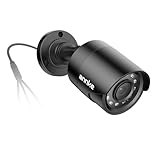
- Crystal Clear 1080p Footage: With this 2MP security camera, you can see everything clearly that matters in 1080p HD, easily recognize the details you need in smooth and clear videos, leaving nothing to the imagination
- NO Power Adapter Included&NEED Connect DVR System to Work: This Camera DOES NOT comes with a power adapter. Customer need to buy extra power adapter. And this security camera CAN NOT be used alone. Need to connect a DVR to work
- 100ft IR Night Vision: The equipped premium IR LEDs are automatically activated in low light conditions so that you can capture clear B&W vision at dawn, dust, night, on rainy days or any conditions with low light illumination
- 4-IN-1 Compatibility: The security camera supports AHD/TVI/CVI/CVBS video output (default AHD), and it is compatible to ANNKE DVRs. By pressing the button of the buttcock line, you can switch the video output mode easily
- IP67 Weatherproof: Built with IP67 weatherproof housing, the CCTV camera is able to endure whatever mother nature brings, thus keep out dust, water and air. It is tested that it can perform well even in extreme temperatures from -4 °F to 122 °F
Which night-vision features matter most?
The most useful night features are an IR-cut filter for true day/night operation, suitable low-light sensitivity, effective WDR, controlled infrared illumination, and a lens that matches the scene. White-light or color-at-night cameras can preserve color but may require visible illumination; IR cameras are less intrusive but generally produce monochrome images.
- IR range: Treat the manufacturer’s distance as an ideal-condition illumination estimate, not a promise of face recognition at that distance.
- Low-light sensitivity: A lower stated lux figure can indicate better performance in dark scenes, but test conditions and image processing matter.
- WDR: WDR helps with headlights, bright windows, and backlit doors. It cannot correct every problem caused by poor placement or extreme contrast.
- Glare control: Nearby walls, windows, foliage, rain, and shiny vehicles can reflect infrared light into the lens.
- Noise reduction and exposure: These controls can improve usability but may soften moving subjects if configured aggressively.
For example, a Hikvision 2MP ultra-low-light bullet page lists 0.005 lux color sensitivity, 1080p at 30fps, and up to 100 feet of infrared range. Those are specifications for that particular legacy product page, not representative figures for every analog camera; the page is also marked as discontinued. The Hikvision model page is useful for understanding the specification, but buyers should confirm a current replacement.
Which analog camera examples fit common buying categories?
These are category examples, not universal winners. Several cited manufacturer pages are regional, legacy, or subject to changing availability, so confirm support, warranty, stock, and recorder pairing before ordering.
| Example | Listed characteristics | Best fit | Limitation |
|---|---|---|---|
| ANNKE AL200 | 1080p, 4-in-1 output, HD BNC, IP67, and listed 66-foot IR range | Budget add-on for a compatible DVR | Requires a DVR; does not automatically provide 4K detail, audio, or smart events |
| Amcrest AMC1081BC36-B-V3 | 2MP, 4-in-1 HD-CVI/TVI/AHD/analog, 3.6mm lens, IP67, and up to 98 feet of stated IR | Multi-format outdoor replacement camera | Verify the current DVR, format, price, stock, and feature pairing |
| ANNKE AU-CR1DR0102 | 5MP dual lens, claimed 180-degree view, smart dual light, IP67, and one-way audio | Broad coverage where a wide scene matters | Wide coverage may reduce long-distance facial detail; requires a compatible DVR |
| ACTi analog camera range | Product-line options include 2MP and 5MP, TVI/AHD/CVI/CVBS, IR, WDR, and commercial-oriented environmental specifications | Commercial installations and documented product families | Exact model, regional availability, firmware, and pricing must be confirmed |
The ANNKE AL200 specifications, Amcrest AMC1081BC36-B-V3 specifications, and ANNKE dual-lens camera page should be treated as manufacturer information rather than independent performance testing.
Does an analog security camera require a DVR?
An HD analog camera usually requires a DVR or XVR because the camera sends video to the recorder over coaxial cable rather than operating as a complete network device. A typical installation also requires camera power, 75-ohm coaxial or Siamese cable, BNC connectors, a hard drive, and a monitor or network connection for setup.
Do these 3 things before closing this tab:
1Repair Windows errors before they cause bigger problems2Fix the driver behind crashes, sound loss and screen glitches3Clear out junk files and repair common Windows errorsANNKE identifies the AL200 as an add-on camera with HD BNC video output, 1080p resolution, 4-in-1 output, and a listed 66-foot IR range. The product is not a substitute for a recorder. Before buying, verify that the existing DVR accepts the camera’s selected format and resolution.
Can cameras and DVRs from different brands be mixed?
Different brands can sometimes exchange basic video when the camera and recorder support the same signal format, resolution, and frame rate. Cross-brand compatibility is not guaranteed for audio, UTC camera control, motorized zoom, PTZ, motion detection, smart events, camera menus, firmware-specific controls, mobile applications, or remote playback.
Rank #4
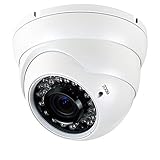
- This CCTV camera supports 4 modes for video output: 1080P AHD, 1080P CVI, 1080P TVI and 960H analog (CVBS), default video output is TVI 1080P.
- 2.8~12mm Manual Focus/Zoom Varifocal lens, 36 Powerful IR LEDs for Night Vision up to 100ft.
- 1/2.9" color CMOS sensor with 2.0 Megapixel Resolution, which ensures clear and bright pictures security solution monitoring activity indoors and outdoors.
- True Day & Night with ICR for perfect color reproduction.
- The security dome camera is IP66 weather-rated housing provides protection from elements, including dust and sand, as well as harsh weather conditions.
The safest approach is to match the camera and recorder family. If that is not possible, choose a multi-format XVR and verify the exact camera model against the recorder’s channel compatibility table. A “4-in-1” label increases flexibility but does not guarantee that every feature will work.
What should you check before buying?
- Identify the recorder: Record the exact DVR or XVR model number and check its supported formats, resolutions, frame rates, and per-channel limits.
- Identify the existing signal: Determine whether the current cameras use CVBS, TVI, CVI, or AHD. Do not infer the format from the BNC connector.
- Check the cable: Inspect for corrosion, water damage, poor shielding, damaged coax, bad BNC terminations, and excessive voltage drop.
- Choose the identification zone: Decide whether the camera must monitor a wide area or capture detail at a gate, door, register, or driveway.
- Choose the lens: Use a wide lens for nearby scenes and a narrower or varifocal lens for distance.
- Check night performance: Compare low-light capability, IR range, WDR, white-light behavior, and likely reflections in the actual scene.
- Check outdoor construction: Look for an appropriate IP rating, vandal resistance where needed, operating-temperature range, mounting adjustment, and protected cable entry.
- Check audio: Confirm whether audio uses a separate RCA connection, coaxial audio, or a recorder-specific interface.
- Check storage: Confirm hard-drive capacity, continuous or motion recording options, retention needs, recording bitrate, and export format.
- Check support: Confirm current availability, replacement models, firmware support, warranty, mobile-app support, and regional compatibility.
HD analog versus IP/PoE: which system is better?
Neither technology is universally better. HD analog is usually the more practical upgrade for existing coaxial cable, while IP/PoE is generally more flexible for new construction, large expansions, software integration, and advanced analytics.
What’s actually slowing this PC down?
Pick the symptom - the matching free tool is one click away.
| Decision factor | HD analog | IP/PoE |
|---|---|---|
| Existing cable | Can reuse functioning coaxial cable | Normally needs Ethernet cabling or adapters |
| Power and data | Video and power are commonly separate, unless a supported PoC system is used | One Ethernet cable can carry power and data through PoE |
| Network setup | Camera generally does not need its own IP address; the recorder still needs networking for remote access | Each camera participates in the network and requires configuration and cybersecurity controls |
| Expansion | Usually constrained by DVR/XVR channel capacity | More flexible, subject to switch, bandwidth, NVR, and network design limits |
| Analytics | Basic features may be available, but advanced capabilities vary considerably | Usually the stronger fit for advanced analytics and software integration |
| Recording | Central DVR recording is natural and can operate locally without internet | NVR, server, edge storage, or cloud options are possible; network design matters |
| Security exposure | Local cameras may have less direct network exposure, but an internet-connected DVR still needs protection | More network capability also means greater responsibility for passwords, firmware, segmentation, and remote access |
Choose HD analog if coaxial cable is already installed, the system uses fixed cameras, local recording is preferred, internet or Wi-Fi is unreliable, and the required analytics are modest.
Choose IP/PoE if the property has no coaxial wiring, the installation is new, cameras will expand substantially, one-cable power and data are valuable, or advanced analytics and software integration are priorities.
Independent reader supportYour contribution helps us test, update, and keep practical guides available for everyone.How much does the complete installation cost?
The camera price is only one part of the system cost. A low-priced replacement may still require a new DVR, surveillance-rated hard drive, power distribution, Siamese coaxial cable, BNC compression connectors, weatherproof junction boxes, and installation labor.
Before comparing products, calculate the complete replacement scenario:
- Replacing one failed camera: Retain the DVR only if the new camera’s signal format, resolution, frame rate, audio, and controls are supported.
- Replacing all cameras: Check whether the existing DVR can record the new resolution and whether its storage is sufficient.
- Replacing the DVR: Choose an XVR that supports the existing cameras first, then select replacement cameras within the recorder’s limits.
- Adding IP cameras: Use a hybrid recorder, but confirm how many analog and IP channels can operate simultaneously.
- Reusing coax: Test the cable before buying high-resolution cameras; old or water-damaged cable may become the limiting component.
How should an HD analog system be installed?
Use suitable 75-ohm coaxial cable and properly terminated BNC connectors. Keep video cable away from high-voltage wiring where practical, provide regulated camera power, protect outdoor connections from water, and avoid aiming infrared cameras directly at reflective walls, windows, foliage, or shiny vehicles.
Best Value
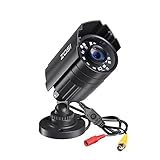
- 【2.0MP HD 1080P 4-IN-1 Security Camera】-- This is 4-in-1 TVI/CVI/AHD/CVBS Bullet Camera. compatible with 960H,720P,1080P,3MP,5MP,8MP,4K HD-TVI, AHD, CVI, and CVBS/960H analog DVRs.
- 【Bulit in OSD Menu】-- It comes with OSD Menu which can change 4 different video output. 1080P AHD, 1080P CVI, 1080P TVI and 960H CVBS .Default Video mode is 960H mode, compatible with all analog DVRs. 1080P video mode must be switched according to your 1080P DVR type. Widely Usage: With OSD Menu, you can change signal mode freely and quickly in 5 seconds.
- 【80ft Night Vision】 Built in 24pcs IR LEDs, Get a sharp and crisp image day or night with the camera's automatic IR-CUT filter. Up to 80ft night vision in total darkness and 120ft Night vision in ambient light. More than 3.0Lux the night vision is color.
- 【IP67 Weatherproof,Indoor and Outdoor use】Aluminum metal vandal proof & waterproof can withstand the toughest of outdoor conditions , adjustable 3-axis camera stand, cable through bracket for hassle free use in rainy or snowy days.
- 【Not Include CCTV Cable and Power Supply】 1, this is a hard-wired camera, it need to connect the cctv cable and power supply(Not included). 2, this camera could not work seperately,it need to connect to the DVR to work
Test every camera during daylight and at night. Night testing reveals infrared glare, insufficient illumination, motion blur, poor exposure, and faces that are too small in the selected field of view. Test recording playback, motion detection, audio, remote access, and video export separately rather than assuming that a live picture proves the complete system works.
What should you do if an analog camera has no picture?
Check the fault in this order:
- Confirm camera power and measure voltage at the camera if possible.
- Reseat the BNC connector and verify power polarity.
- Select the correct DVR channel and confirm that the channel is enabled.
- Check the camera’s output format using its OSD joystick, button, UTC control, or recorder menu.
- Confirm that the DVR supports the camera’s selected resolution and frame rate.
- Test cable continuity, terminations, cable length, shielding, and signs of water damage.
- Check whether the camera uses PAL while the recorder expects NTSC, or the reverse.
- Try a channel known to support the camera’s format.
- Reboot the DVR after changing signal mode if the recorder requires it.
- Test the camera with a known-good power supply and short known-good cable.
A BNC connector is only a physical connector. Two BNC devices may use CVBS, TVI, CVI, AHD, or another signal type, so “the camera has BNC” is not a compatibility test.
What privacy and security measures are needed?
Place cameras so they monitor the intended property without unnecessarily recording neighboring homes, private areas, or public spaces. Use privacy masking where the recorder supports it. If remote viewing is enabled, use a strong unique password, keep the recorder firmware current, avoid exposing the recorder directly to the public internet when a safer remote-access method is available, and restrict user permissions.
Local analog video can reduce direct camera network exposure, but an internet-connected DVR or XVR still creates cybersecurity risk. Analog does not automatically make a surveillance system safer than IP or Wi-Fi.
Frequently Asked Questions
Can an analog security camera work without a DVR?
An HD analog security camera normally needs a DVR or XVR to record and manage its coaxial video signal. The camera also needs power, coaxial or Siamese cable, and BNC termination; internet access is required only for remote viewing and related network features.
Can I use a TVI camera with a CVI DVR?
A TVI camera should not be assumed to work with a CVI-only DVR. The camera and recorder must support the same signal format, resolution, and frame rate, although a multi-format XVR may support both standards.
Can old coaxial cable be reused for HD analog cameras?
Old coaxial cable can often be reused if it is suitable 75-ohm cable in good condition, but corrosion, water damage, poor shielding, bad BNC connectors, excessive length, and voltage drop can prevent reliable HD video.
Do analog cameras support audio?
Some analog cameras support audio, but the recorder must support the camera’s audio method. Audio may require separate RCA wiring, coaxial audio support, or a recorder-specific feature, so video compatibility alone is not enough.
Can I mix analog and IP cameras?
You can mix analog and IP cameras with a compatible hybrid DVR or XVR, but the recorder’s simultaneous analog and IP channel limits must be checked. Adding IP cameras also introduces network configuration and cybersecurity requirements.
The Bottom Line
Bottom line: Choose an HD analog camera when existing coaxial cable makes rewiring unattractive and a compatible DVR/XVR can support the required format, resolution, frame rate, audio, and controls. Choose IP/PoE for a new build, major expansion, or advanced analytics. In either case, lens choice, lighting, placement, storage, and recorder compatibility matter more than the camera’s megapixel number alone.
Quick Recap
Product prices and availability are accurate as of the date/time indicated and are subject to change. Any price and availability information displayed on Amazon at the time of purchase will apply.

