
For a fixed, simple battery-charging job—especially a single Li-ion cell—a dedicated charger IC is usually the simpler route because it handles the current-and-voltage regulation loop in hardware. Choose microcontroller (MCU) control when charging must adapt to changing policies, communicate with a battery or host, log data, or coordinate multiple bays. For many products, the best fit is hybrid: a charger IC regulates power while an MCU supervises the system and adds product-specific intelligence.
What is the difference between a charger IC and MCU control?
A battery charger must control the electrical power delivered to the cell. A dedicated charger IC is designed to perform that task: it uses an internal control loop to regulate charging, with the precise behavior and protections depending on the part. An MCU is a general-purpose controller. It can run charging logic, but it needs suitable sensing and a power stage to measure and control the current and voltage reaching the battery.
Renesas’s application note Battery Charging with K-Series Microcontrollers explains that a dedicated external IC can free MCU processing time and use internal analog circuitry for closed-loop control. Its charger loop can also run its PWM at a higher frequency than an MCU implementation. That is the core architectural distinction: the charger IC owns the fast power-control loop; in a fully MCU-controlled design, firmware and MCU peripherals participate in that work.
How does Li-ion charging affect the choice?
Li-ion charging typically uses constant-current/constant-voltage (CC/CV) behavior. The charger holds current constant until the cell reaches its target voltage, then holds voltage while current tapers toward termination. The target voltage must be appropriate for the cell, and the accuracy of the applied voltage matters.
#1 Best Overall
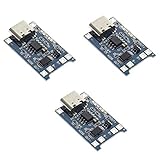
- Input interface: Type-c USB.
- Battery overcharge lifting voltage: 4.00 V
- Battery: over-current protection current 3 A
- Maximum charging current output: 1000 ma
- Light state: no load the light not bright, red light for recharging, is full of green light.
A dedicated charger IC can implement this regulated behavior without requiring the MCU to execute the fast control loop. With MCU control, the designer must create and validate the sensing, power-stage control, transition between charging phases, and termination behavior. An MCU can support safe charging, but its presence alone does not make a charger safe: the complete circuit, firmware, and fault response have to be engineered and validated.
How do the architectures compare?
| Design consideration | Dedicated charger IC | MCU-controlled charger | Hybrid IC + MCU |
|---|---|---|---|
| Regulation loop | Internal charger control loop | Firmware, MCU peripherals, and external power stage | Charger IC regulates; MCU supervises |
| Firmware burden | Low | High | Medium |
| Profile flexibility | Usually bounded by part configuration | Highest, provided each behavior is validated | High at the system level |
| Communication and telemetry | Optional and part-dependent | Can support serial communication, logging, and user-visible status | MCU can provide system features while reading charger status |
| CPU use | Minimal for power regulation | More continuous control and supervision work | Mostly supervisory |
| Protection responsibility | Built-in protections vary by part | Must be designed and validated across firmware and hardware | Shared between charger protections and MCU checks |
| Overall effort | More charger-IC cost, typically less firmware and test work | May reduce dedicated-IC count, but increases firmware and validation work | Balances charger hardware with system-level control |
When should you choose a dedicated charger IC?
Use one for a fixed, straightforward charging profile
A dedicated IC is a strong default for a fixed-chemistry product, particularly a single-cell design without a battery-communication requirement. It keeps the regulation task in a purpose-built component and reduces the amount of charging behavior that must be implemented in firmware.
Rank #2

- BC-160 Rapid Quick Charger Compatible for IOCM Two Way Radio,100-240V wide voltage input,Rapid Charger, up to 1000mAh per hour
- Compatible With iocm BP-232 BP-232N BP-232H BP-230 BP-230N BP231 BP-231N battery.
- Unique multi color Indicator lights shows design to monitor charging status,over-current protection, over-voltage protection, short circuit protection.
- Compatible Radios:ICOM IC-V8E F33 GT/GS F43 GT/GS IC-S70 IC-T70A IC-T70E IC-F70HD IC-V80 IC-G80 IC-U80 IC-V88 IC-U88 IC-F3001 IC-F4001 IC-F3002 IC-F4002 IC-F3003 IC-F4003 IC-F3100D F3161 F3163 IC-F4100D IC-F3101 IC-F4101 IC-F3102 IC-F4102D IC-F3103 IC-F4103D IC-F3210D IC-F4210D F3011 F4011 F14, F24 and F43TR.
- Please note that every product available in our "IFREQTECH" store is a replacement part and not an Original Equipment Manufacturer (OEM) product.Any references to brand names or model numbers are for the sole purpose of indicating compatibility.
Check the part against the whole application
Before selecting a device, confirm that its supported cell count, charge voltage, current range, thermal input, termination behavior, power-path requirements, and protections fit the product. These are part-specific characteristics; the label “charger IC” does not establish that a device suits a particular battery or system. Microchip’s official charger-IC product category is a starting point for identifying devices, but the selected part’s datasheet determines its actual capabilities.
When is MCU control worth the extra work?
Choose it for changing policies or system features
MCU control makes sense when the product needs dynamic charging policies, smart-battery communication, data logging, a user-visible charging interface, conditioning, or coordinated multi-bay operation. Microchip’s 2015 Intelligent Battery Charger application note describes serial communication, real-time data logging, and monitoring. Texas Instruments’ 2017 article on I2C-controlled battery chargers describes a host changing charger parameters and receiving status or fault reports.
The Tool Desk
Outbyte PC Repair FREEClear out junk files and repair common Windows errorsFree Scan →Outbyte Driver Updater FREEFix the driver behind crashes, sound loss and screen glitchesFind Drivers →Rank #3
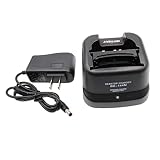
- Compatible for ICOM BP-209/N BP-210/N BP-211/N BP-222/N Ni-MH Ni-CD Battery .
- BC-137 BC-144N Charger for ICOM Radio IC-A6 IC-A6E IC-A24 IC-A24E IC-T3H IC-F3GT IC-F3GS IC-F4GT IC-F4GS IC-V8 IC-V81 IC-V82 IC-U82.
- Compatible models: IC-F11 IC-F11S IC-F12 IC-F12S IC-F21 IC-F21S IC-F22 IC-F22S IC-F30GT IC-F30GS IC-F31GT IC-F31GS IC-F40GT IC-F40GS IC-F41GT IC-F41GS.
- During charging, LED indicator indicates charging status. (steady red: charging, steady green: full charged)
- If you have any questions, please feel free to ask us. Your satisfaction is our eternal purpose of service.
Budget for the control and validation work
Those features come with a larger engineering responsibility. The design must handle sensing and power-stage control, charging-state transitions, faults, and supervision; it also needs a watchdog or other appropriate means of responding to a stalled controller. Validate normal operation and fault handling as part of the complete charger rather than treating working firmware as proof of safe charging. MCU control may reduce the need for dedicated charger ICs in some designs, but it does not make the power stage or validation effort disappear.
Why is a hybrid design often a practical middle ground?
In a hybrid architecture, a charger IC closes the current-and-voltage regulation loop, and an MCU handles the wider product requirements. The MCU can configure charging parameters, read charger status, monitor temperature independently, report faults, and enforce product policy. This division preserves hardware control for the fast power loop while allowing communication, telemetry, and system behavior to evolve in firmware.
Rank #4

- Ni-MH Ni-CD Battery Rapid Quick Charger for Icom Radios
- Input: AC 100-240V, 50-60Hz, 500mA, Output: DC 8.4V, 450mA
- For battery type: BP-211N Li-ion battery, BP-209/N, BP-210/N, BP-211, BP-222/N Ni-Cd and Ni-Mh Battery
- IC-A6E, IC-A24, IC-A24E, IC-F3GT, IC-F3GS, IC-F4GT, IC-F4GS, IC-F11, IC-F11BR, IC-F11S, IC-F12, IC-F12S, IC-F21, IC-F21BR, IC-F21GM, IC-F21S, IC-F22, IC-F22S, IC-F22SR, IC-F30GT, IC-F30GS, IC-F31GT, IC-F31GS
- IC-F40GT, IC-F40GS, IC-F41GT, IC-F41GS, IC-T3H, IC-T8, IC-U82, IC-V8, IC-V82
Renesas describes independent MCU monitoring of battery voltage and temperature, while Analog Devices’ article on charger applications requiring external microcontrollers emphasizes supervisors and precise regulation. The MCU’s checks complement the charger’s protections; they are not a reason to omit protections supported by the charger or required by the overall design. Microchip’s Simple LiPo Battery Management application note is another example of the broader management role that can sit alongside charging control.
How should you make the decision?
- Define the battery and charging profile. Identify chemistry, cell count, target voltage, current range, and termination behavior.
- List system requirements. Decide whether the product needs battery or host communication, dynamic policies, logging, a user interface, or multi-bay coordination.
- Choose who owns the regulation loop. If the profile is fixed and uncomplicated, start by evaluating a dedicated charger IC. If the product needs extensive adaptation, assess MCU control. If it needs both robust regulation and system intelligence, evaluate a hybrid design.
- Check the full implementation. For an IC, verify the datasheet against the battery and application. For MCU control, account for the sensing, power stage, firmware, fault response, supervision, and validation. For a hybrid, decide exactly which settings and checks belong to the MCU and which protections remain in the charger.
- Compare total development effort, not only part count. An MCU-based approach may use fewer dedicated charger components, but it generally shifts work into firmware and testing. A charger IC adds a component but can shorten the path to a validated fixed-profile design.
What does the historical 3-amp comparison mean?
A 2011 EE Times comparison by David Gunderson cited “up to 3 amps” as a capability of many single-cell dedicated charger ICs at that time. That is historical context, not a current specification or a guarantee about charger ICs generally. Select a present-day part only after checking its datasheet and confirming that its current rating fits the battery, power source, and thermal design.
Quick Recap
Best Value

- 🔌【Rc Battery Charger】Wide applications of the remote USB charger cable compatible with RC cars,truck,drone,boat,airplanes,FPV,Axial SCX24 SCX10,airsoft splatter ball (Only 7.4V 1A 2S Lipo battery, and XH-3P plug.) We recommend use 7.4V battery above 500mAh below 2000mAh
- 🔌【2-in-1 Efficiency Charging】7.4v balance lipo battery charger charging for 2s lithium polymer/li-ion battery and charging 2 2S 7.4V li-po batteries one time to save your time
- 🔌【Charger Circuit Protection】Smart charger IC circuit board of over-voltage, overload, over-heat, overcharging. Indicator light:Charging--green light is flashing and red light is solid. Fully charged--green light
- 🔌【Rechargeable Battery Charger】Input--DC 5V 2A; Output--DC 7.4V 1000mAh*2; Connector-- USB to XH-3P Plug. Only 31g weigh to convenient for you go oudoor. Suppprt power source from phone, power bank, computer and other USB port
- 🔌【Package List】You will get 1*7.4V 2-in-1 lipo balance charger and Tosiicop 1 year
Product prices and availability are accurate as of the date/time indicated and are subject to change. Any price and availability information displayed on Amazon at the time of purchase will apply.

