
PC Slower Than It Used to Be?
A free scan shows the junk files, broken settings and background clutter dragging Windows down - then fixes them in one click.Free scan · Windows 10 & 11Outdated Drivers Are Slowing You Down
One free scan finds every outdated or missing driver and matches the right update for your exact hardware.Free scan · exact hardware matchiTechGuides is reader-supported. When you buy through links on our site, we may earn an affiliate commission. As an Amazon Associate I earn from qualifying purchases. Learn more
Choose bathroom lighting by matching each fixture’s location rating to its exposure, then confirm that the bulb and dimmer work together. Damp-rated fixtures are intended for damp or dry locations; wet-rated fixtures can be used in wet, damp, or dry locations. A fixture exposed to shower spray may require a wet-location marking under applicable code. For bulbs, check light output, color appearance, physical fit, enclosure suitability, and dimmer compatibility—not just whether the package says “dimmable.”
Do bathroom lights need to be damp-rated?
It depends on where the fixture will be installed and how exposed it is to moisture. A bathroom is not one uniform electrical location: a vanity fixture away from direct spray has different exposure from a light inside a shower.
UL’s 2013 White Book explains the location markings: a luminaire marked “SUITABLE FOR DAMP LOCATIONS” is intended for damp or dry locations. A luminaire marked “SUITABLE FOR WET LOCATIONS” is intended for wet, damp, or dry locations. Check the fixture’s own marking and installation instructions; a generic retailer description such as “bathroom suitable” does not establish that a particular installation is covered. UL’s 2013 Guide Information for Electrical Equipment also says an IP code marking is supplemental and does not replace the dry, damp, or wet location marking.
Free tools Windows power users keep installed
One-click scans. No signup required.
What the cited code says about tubs and showers
The 2021 International Residential Code says luminaires within the actual outside dimension of a bathtub or shower, up to 8 feet (2,438 mm) vertically above the tub rim or shower threshold, must be marked for damp locations. Where those luminaires are subject to shower spray, they must be marked for wet locations. The applicable code is the one adopted by your local jurisdiction, including any amendments; the 2021 IRC text is not proof of what applies at every address. See the 2021 IRC, Chapter 40.
#1 Best Overall

- Two Light Vanity from the
- Style: Transitional Light Type: Vanity & Wall
- Finish: White
Can you put a damp-rated light over a shower?
Do not assume so. If the fixture is subject to shower spray, the cited IRC language calls for a wet-location marking. Confirm the actual spray exposure, the fixture’s marking and instructions, and locally adopted requirements. When the installation is inside a shower or the code application is unclear, ask a qualified electrician.
What about a light near the sink?
Do not choose a wet-rated fixture solely because it is in a bathroom or near a sink. Match the location marking to the fixture’s actual exposure and applicable local rules. Damp-rated products are intended for damp or dry locations, while wet-rated products also cover wet locations.
Rank #2
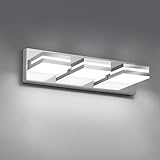
- Rotatable 350°: Each lamp body can be rotated 350°independently,so you can adjust the irradiation angle according to your needs
- Small Vanity Light 6000K:This small mirror light is only 16in long but has 24W, 1600lm, 6000K cool white light
- Hardwired design: Features a hardwired configuration with no switch or plug included. Equipped with a US standard mounting plate for easy connection to pre-installed wiring
- Premium LED lighting: Bathroom vanity lights incorporate integrated LED technology with high-quality LED bulbs, delivering illumination far surpassing conventional bulbs
- EASY TO INSTALL:This sleek and modern Vanity Lights is easy to install by simply following the product installation instructions
Choose a fixture for the lighting task and installation
Separate the jobs before comparing styles: mirror or vanity lighting serves face-level tasks, general lighting illuminates the room, and shower lighting must suit its more demanding exposure. For each candidate, check:
Do these 3 things before closing this tab:
1Clear out junk files and repair common Windows errors2Scan for outdated or missing drivers - takes under a minute3Repair Windows errors before they cause bigger problems- Location marking: Verify whether the fixture is marked for damp or wet locations as required for its placement.
- Spray exposure: Consider whether water can directly reach it, especially inside the shower area.
- Dimensions and orientation: Confirm that the fixture fits the space and may be mounted in the intended direction.
- Light source: Determine whether it takes replaceable bulbs or uses an integrated LED, and review the relevant product instructions.
- Installation coverage: Make sure the manufacturer’s instructions address the intended location and installation method.
A bathroom vanity light and a wet-rated recessed shower light solve different placement problems. Choose by the marking and installation documentation, not by appearance alone.
Rank #3

- ENERGY-EFFICIENT: Consumes only 16 watts but emits 1200 lumens of bright light. With integrated LED technology, the light source is built into the fixture without the need of replacing or purchasing new light bulbs
- DIMMABLE: Is compatible with most common dimmers so it can be installed with fully dimmable capabilities. Adjust the light to give off your favorite brightness, always giving the perfect ambiance
- WELL-DESIGNED: Has a sleek brushed nickel finish with a durable 10-inch diameter frame. The modern style, combined with even light distribution, makes this light a perfect addition to any room in the home
- QUALITY-GUARANTEED: Is FCC-certified and has 50,000 hours long lifespan backed with a 5-year limited warranty
How to choose bathroom bulbs
Once the fixture is selected, choose a bulb that fits it and gives the brightness and appearance you want. The U.S. Department of Energy (DOE) advises checking the product packaging or specifications for these details. Its light-bulb purchasing guidance describes 2,700 K as warm and 3,000 K as soft. Those are useful reference descriptions, not a universal prescription for bathroom lighting.
Brightness and physical fit
Check the bulb’s lumen output for the desired brightness, along with its base and shape. DOE notes that LED lamps can be larger near the base than incandescent lamps, so confirm clearance rather than assuming an LED will fit wherever the old bulb did.
Rank #4

- 17.3-inch vanity light: Fits 24” and 30” standard bathroom mirrors—the top single-sink vanity sizes in homes. Well-proportioned and never too small or oversized, it delivers balanced, full coverage for your entire vanity area
- ETL-Certified Ceramic E26 Socket: Vanity lights for bathroom is compatible with any E26 base bulb, including incandescent, CFL, halogen, and LED bulbs (max 60W per bulb, not included). When used with a dimmable bulb and switch (not included), the wall light offers full dimming capability, allowing you to select different bulb styles and control the desired brightness
- Milky white frosted glass lampshade: Creates bright and soft atmosphere, eye-friendly perfect for the whole family. It is also a great choice for decorating home corners
- Double-Layer Spray Painting Process: This technique applies a thicker, smoother, and more even coating, enhancing the overall appearance of the fixture. It improves durability by making the light more resistant to scratches and maintaining a pristine, refined look. This contributes to a more stylish and polished bathroom design
- Durable Construction: Bathroom lighting fixtures over mirror features a robust all-metal construction, including a metal securing ring that firmly holds the glass shade in place for long-lasting safety and durability. Additionally, it is built with a sturdy metal arm that remains straight and secure during use or transport, ensuring reliable performance over time
Color rendering
Color temperature and color rendering are different considerations. DOE says ENERGY STAR-qualified light bulbs must have a color rendering index (CRI) of 80 or greater. That figure describes the qualification DOE discusses; it is not a universal code requirement or a guarantee that a particular bulb’s color appearance will suit you.
What’s actually slowing this PC down?
Pick the symptom - the matching free tool is one click away.
Enclosed fixtures
If the fixture is fully enclosed, check that the LED bulb is specifically suitable for enclosed-fixture use. DOE cautions that heat buildup can affect LED performance and life expectancy. A bulb’s base, shape, and enclosure suitability are separate checks: passing one does not establish the others.
Best Value

- CLASSIC STYLE: The Designers Fountain Reedley 11-inch flush mount ceiling light pairs a pewter finish with a white alabaster glass shade for soft, even light in bedrooms, hallways, kitchens, and entryways
- TWO-LIGHT DESIGN: Uses two medium-base E26 bulbs up to 60W each (sold separately); compatible with LED, CFL, or incandescent bulbs and dimmable with a standard wall dimmer and dimmable bulbs
- QUALITY CONSTRUCTION: A durable steel frame and white alabaster glass shade deliver lasting performance and a timeless look that complements traditional and transitional decor
- DAMP LOCATION RATED: UL/cUL listed for damp locations, making this flush mount ceiling fixture a great choice for bathrooms, laundry rooms, and other humid indoor spaces
- SPECS: Measures 11 inches wide; uses two 60W max E26 bulbs (not included); mounting hardware and instructions included; backed by a 1-year manufacturer warranty
Can you use dimmable LED bulbs with your dimmer?
Sometimes, but “dimmable” on the bulb package does not mean the bulb will work correctly with every dimmer. DOE advises checking both the bulb’s dimmability and compatibility between the LED and the dimming system. Start with the exact bulb or fixture compatibility information rather than assuming that any LED-compatible dimmer will produce the same result with every lamp.
- Identify the exact light source. Record the bulb or integrated fixture model and confirm that it is intended to dim.
- Check compatibility information. Consult the bulb or fixture manufacturer’s current compatibility list and instructions for the dimmer type.
- Check expected low-end behavior. Dimming performance can vary; a nominally dimmable LED may not give the smooth range you expect with a particular control.
- Address control changes carefully. Before replacing a wall control, account for the fixture, wiring, and local requirements. Consult a qualified electrician if those details are uncertain.
DOE’s specifier guidance on dimming LEDs with phase-cut dimmers discusses why compatibility needs attention. Use the selected fixture or bulb’s current documentation as the practical reference for that specific pairing.
When should you consider color-tunable lighting?
Standard bulbs provide a fixed color appearance; color-tunable systems offer more control. DOE distinguishes dim-to-warm products, which change color appearance as they dim, from white-tuning products, which can adjust color and intensity separately but often use separate control signals. This is general LED guidance, not a bathroom-specific requirement. Read the system’s control instructions before choosing it, especially if you want both brightness and color to change independently. DOE’s overview of LED color-tunable products explains these approaches.
Quick Recap
Product prices and availability are accurate as of the date/time indicated and are subject to change. Any price and availability information displayed on Amazon at the time of purchase will apply.

