
An asymmetric stator winding is a stator winding whose conductor distribution, turns, slot assignment, phase-axis position, connections or electrical parameters are not identical in the way a conventional balanced winding would be. The phrase has two very different meanings: it can describe a deliberate design used to meet slot-fill, harmonic, packaging or multiphase goals, or it can indicate an unintended winding imbalance or fault. Identify which case applies before judging its performance.
What the stator winding does
A stator winding is the set of insulated conductors placed in stator slots or around teeth. In a motor it produces the magnetomotive force and air-gap field; in a generator it carries the voltage and current induced by the rotor field. Its electromagnetic behavior depends on more than the total copper. Important variables include:

- Conductors per slot and turns per coil
- Coil pitch, distribution and slot-to-phase assignment
- Phase-axis electrical displacement
- Series and parallel paths
- Phase resistance, leakage reactance and mutual inductance
- The number and arrangement of independent winding sets
Intentional design or winding fault?
| Feature | Intentional asymmetric design | Unintentional asymmetry or fault |
|---|---|---|
| Status | Specified in winding drawings, models and test limits | Develops through manufacturing error, aging, repair, connection failure or insulation damage |
| Purpose or cause | Slot fill, harmonic shaping, packaging, redundancy or operating-range optimization | Unequal turns, resistance, reactance, phase axes, open circuits or inter-turn faults |
| Expected behavior | Validated electromagnetic, thermal, mechanical and control performance | Abnormal current, torque, heat, noise, vibration or protection trips |
| Response | Use the specified inverter, neutral and paralleling rules | Test, inspect, repair, rewind or derate after finding the cause |
Always use a qualifier such as designed asymmetry or asymmetric stator-winding fault. A visually irregular winding is not automatically electrically unbalanced, and a regular-looking winding can have unequal electrical parameters.
What can make a winding asymmetric?
Unequal turns or conductors
One coil, phase or slot group may contain a different number of turns or conductors. Nidec Power describes an alternator arrangement using five conductors per slot with local phase sequences such as 3→2→3→2 and 2→3→2→3. The total turns assigned to each phase can still be equal, preserving the intended fundamental field even though individual slots are unequal. See the February 2026 technical note at Nidec Power TN24.
The Tool Desk
Outbyte PC Repair FREERepair Windows errors before they cause bigger problemsFix Now →Outbyte Driver Updater FREEFix the driver behind crashes, sound loss and screen glitchesFind Drivers →#1 Best Overall

- Approximately 5mL of this fluid injected into a hub motor will more than double the ease of heat flow from the stator of your motor to the motor shell without any noticeable increase in motor drag.
- Increase continuous motor power capability by up to 40% without overheating
- Small amount required (5-8mL) has negligible increase in motor drag
- Includes Luer Lock Syringe with cap and syringe nozzle to inject in holes as small as 2mm with no mess
- 10mL Syringe of Statorade ferrofluid for use in cooling direct drive hub motors, with convenient Luer Lock plastic nozzle for injecting into holes as small as 2mm diameter.
Unequal phase-axis angles
Phase windings may not be separated by their ideal electrical angles. The IET study on canned induction motors treats this as asymmetrical stator axes, distinct from unequal phase resistance or reactance: IET asymmetrical-stator-axes study.
Different coil or slot arrangements
Coil groups can depart from a repeating pattern to alter winding factors, force harmonics, torque ripple or manufacturability. A 2023 IEEJ paper presents an asymmetric concentrated-winding structure that changes arrangement and coil turns while trying to retain favorable electromagnetic symmetry: IEEJ/J-STAGE paper.
Independent multiphase sets
Several independently supplied winding groups may have different ratings, phase displacement or operating roles. That is a deliberate multiphase architecture, not necessarily a defective three-phase winding. One published PMSM design uses three independent winding sets with different rated speed and torque characteristics: Energies multiphase PMSM paper.
Hairpin and U-pin geometry
In traction machines, “asymmetric winding” can refer to unequal conductor routing, weld positions, overhangs or circumferential offsets rather than unequal phase turns. U-shaped pin conductors and inclined welds are described in U.S. Patent 12,316,180, issued May 27, 2025; the patent demonstrates a design direction, not proof that a particular production vehicle uses it: patent listing.
Outdated Drivers Are Slowing You Down
One free scan finds every outdated or missing driver and matches the right update for your exact hardware.Free scan · exact hardware matchWindows Errors? Fix Them Before They Spread
Repair common Windows errors and clear accumulated junk for a smoother, more stable PC - no reinstall needed.Free scan · no reinstallRank #2

- PERFECT FIT - This motorcycle electric stator suitable for 2006-2016 YZF R6. More for detailed applicable models, please refer to the "vehicle fitment list" or products description.
- Replaces OEM Number - Motorcycle Stator 2C0-81410-00-00
- HIGH QUALITY COMPONENTS - MZS r6 stators are made of high quality aluminum, the highest grade laminated material, and the highest grade more precise copper winding components, which have better heat transfer and magnetic coupling, and will not swell and separate.
- HIGH PERFORMANCE - Using thinner insulation and precision winding, it can achieve faster thermal conductivity, lower operating temperature. To maintain stable stator output.
- TECHNICAL SUPPORT - Please check the motorcycle stator title or products description ensure this part fits for your motorcycle before order. And we provides lifetime technical support, if you install have any problem please contact us, we will help you.
Why designers use asymmetry
- Representing a fractional or non-integer conductor requirement
- Improving slot fill and copper utilization
- Meeting a required voltage without changing the main dimensions
- Shaping selected space harmonics or torque-ripple components
- Reducing end-winding length or simplifying hairpin insertion and welding
- Creating independent, redundant or fault-tolerant winding sets
- Tailoring separate speed and torque operating regions
The 2023 IEEJ design specifically targets low torque ripple and high slot fill factor, while warning that reduced stator-MMF symmetry can increase vibration. The result is therefore a constrained optimization problem, not a universal efficiency improvement.
Electromagnetic consequences
Fundamental field
Local slot asymmetry can coexist with a balanced fundamental component when phase totals and the resultant winding functions are designed correctly. Equal total turns do not guarantee equal harmonic content, leakage inductance, local flux or temperature.
Harmonics and sequence components
Changing the winding function changes the spatial and time harmonics of magnetomotive force, air-gap flux density, back EMF, current, force and torque. Whether a particular harmonic rises or falls depends on slot and pole numbers, phase count, coil pitch, rotor design and the exact conductor pattern. In an alternator example, Nidec Power warns that an asymmetric arrangement can introduce third-harmonic voltage in each phase even with a 2/3-pitch winding that would normally suppress it under symmetrical conditions.
An uncontrolled three-phase imbalance also prevents the phase MMFs from forming a purely balanced rotating field. Negative-sequence fields can produce rotor-frequency losses and heating; zero-sequence, triplen and slot harmonics may matter as well.
Rank #3
Torque ripple
Designed asymmetry may cancel a targeted torque component. An uncontrolled difference in phase turns or parameters commonly creates pulsating torque. In a study of a 1-hp interior-mount line-start PMSM, asymmetric phase turns produced obvious steady-state oscillation and a component at twice supply frequency. The model and simulations are described at IET LSPMSM study.
Vibration and acoustic noise
Electromagnetic force spatial orders can change even when average torque is acceptable. Lower-order radial force modes may increase housing vibration and acoustic noise, which is why intentional designs require mechanical and acoustic validation, not only torque calculations.
Thermal, loss and generator effects
- Unequal phase currents increase copper loss in the more heavily loaded phase.
- Negative-sequence fields can add rotor and core losses.
- Unequal slot conductor density can create local hot spots and different thermal aging rates.
- Hairpin conductors can incur additional AC proximity and circulating-current losses.
- Inverter switching, dead time and modulation can interact with the winding asymmetry.
- Neutral or zero-sequence current can appear in generator systems.
When alternators with different winding configurations are paralleled, their harmonic voltages can drive circulating current. Nidec Power identifies a possible neutral current at three times fundamental frequency and recommends considering compatible winding pitches, derating, neutral chokes or filtering. Its TN24 note recommends corrective action when neutral current exceeds 20% of rated current; that is a manufacturer recommendation for the relevant alternator context, not a universal limit.
Control and simulation implications
A conventional balanced dq model assumes equal phase parameters and a regular phase relationship. It may be adequate for a designed winding whose measured behavior remains effectively balanced, but a material asymmetry usually requires a phase-domain or extended model.
Recommended Free Tools
Rank #4

- 【Precise Compatibility & OEM Replacement】This DC magneto stator is specifically designed to be compatible with CN250 Elite CH250 Baja Hammerhead CF250cc Water Cooled ATV Scooter Engine off-road motorcycle. It directly replaces OEM part number, meeting strict OEM specifications for a seamless fit and easy replacement—making it perfect for engine repair and maintenance.
- 【Reliable & Durable】This stator is crafted with high-purity copper wire and precision winding technology, greatly enhancing durability and effectively resolving common issues like short service life and frequent malfunctions. Engineered for harsh outdoor conditions, this 18 coil DC stator resists moisture, dust and vibration. Featuring high-purity copper windings and a robust build, it cuts down replacement frequency and delivers consistent performance during operation.
- 【Standard Dimensions】Outside diameter: 104mm/4.09", Inside diameter: 42mm/1.65", Total thickness: 27mm/1.06", Core thickness: 17mm/0.67". It features a DC (Direct Current) design with 18 coils. Its precise dimensions ensure a perfect fit with your engine, eliminating any installation issues caused by mismatched sizes.
- 【High-Performance with High-Purity Copper Wire】This motor field stator features high-purity copper wire windings, which deliver exceptional conductivity and lower resistance. Compared to traditional materials, our magneto stator drastically reduces energy loss and heat buildup during operation, effectively preventing performance degradation due to overheating and ensuring long-term stable power output for your engine.
- 【Package Information & Purchase Notes】Package includes: 1 x Stator Coil (as shown in the pictures). Before purchasing, please carefully check the product pictures, specifications, and compatible engine models to ensure it fits your engine. If you have any questions about fitment or installation, feel free to contact us for professional assistance.
- Define the physical winding: record slots, poles, phases, coil pitch, turns, conductors, parallel paths, phase axes and all connections.
- Build a winding-function matrix: enter the signed contribution of every phase in every slot; do not impose periodicity that the real winding does not have.
- Calculate winding factors: evaluate the fundamental, slot harmonics, space-harmonic content and sequence components.
- Identify parameters: obtain phase resistance, leakage and mutual inductance, back-EMF constants and sequence impedances where relevant.
- Simulate electromagnetic behavior: use time-stepped finite elements or a validated multiphase model for current, voltage, torque, flux density, radial force and losses.
- Check thermal behavior: calculate phase-specific copper loss, slot and end-winding hot spots, rotor heating and cooling imbalance.
- Validate the controller: use phase-domain, modified or multiple dq frames, fault-aware observers, current derating or separate control of independent sets as required.
The IET LSPMSM work compares a generalized dq model with MATLAB/Simulink and JMAG simulations, illustrating why the machine model must match the actual winding rather than assume symmetry.
How to diagnose unintended asymmetry
Typical symptoms
- Unequal phase currents or resistance
- Higher no-load current and reduced efficiency
- Negative-sequence current or excessive neutral current
- Torque pulsation, speed oscillation or repeated inverter trips
- Supply-related vibration and electromagnetic noise
- Localized heating or unequal phase temperature
Diagnostic sequence
- Verify supply-voltage balance, phase sequence, inverter operation and current-sensor calibration.
- Inspect terminals, lugs, busbars, neutral connections and parallel paths.
- Measure cold phase resistance with a calibrated low-resistance instrument.
- Compare phase inductance or standstill impedance.
- Perform insulation-resistance and polarization-index tests where appropriate.
- Use surge or inter-turn testing only with suitable equipment and procedures.
- Measure no-load and controlled-load phase currents.
- Calculate symmetrical components and record torque, speed, vibration and acoustic spectra.
- Compare back EMF and results with manufacturer winding data or a known-good machine.
- Inspect for partial discharge, turn-to-turn damage, loose connections or an incorrect rewind before deciding on repair or derating.
Current imbalance alone does not prove a winding fault. Unbalanced supply, PWM asymmetry, rotor eccentricity, broken rotor bars, saturation, unequal mechanical load and instrument errors can produce similar readings. The IET studies treat stator current, back EMF, torque and torque-frequency components as candidate indicators that require confirmation.
Independent reader supportYour contribution helps us test, update, and keep practical guides available for everyone.Alternator paralleling: a special risk
Two alternators can share nominal voltage, frequency and power ratings yet perform poorly in parallel if their winding pitch or asymmetry produces different harmonic voltage waveforms. The neutral connection can provide a path for circulating triplen-frequency current. Before paralleling, obtain the exact winding configuration, pitch, neutral arrangement, harmonic-voltage data, derating rules and manufacturer compatibility statement. Do not assume that matching nameplate fundamentals is sufficient.
When asymmetry is justified—and when symmetry is safer
Asymmetry may be justified when
- Slot and conductor geometry make a perfectly repeating winding impractical.
- Slot fill, copper utilization or packaging dominates the design.
- Simulation and test demonstrate a specific harmonic or torque benefit.
- The inverter and protection system can represent the actual phase behavior.
- Thermal, vibration and acoustic margins remain adequate.
- Parallel operation with incompatible alternators is excluded or controlled.
A conventional symmetrical winding is usually preferable when
- The machine uses a standard balanced inverter and has limited sensing.
- Low acoustic noise, easy field replacement or simple service is important.
- The thermal margin is narrow.
- The generator must be readily paralleled with field-replaceable units.
- A simple balanced dq model is a system requirement.
Information to request from a manufacturer
- Winding diagram, turns per coil and conductor count by slot
- Slot/pole combination, coil pitch, phase-axis displacement and parallel paths
- Phase resistance, inductance and back-EMF waveforms
- Harmonic spectrum, neutral-current behavior and paralleling restrictions
- Derating tables and compatible inverter or controller requirements
- Thermal-rise, vibration and acoustic test data
- Repair, rewinding and post-repair balance procedures
FAQ
Is an asymmetric stator winding bad?
No. It may be an engineered solution or a defect. Judge it against the manufacturer’s winding data, measured parameters and validated operating limits.
Do these 3 things before closing this tab:
1Repair Windows errors before they cause bigger problems2Scan for outdated or missing drivers - takes under a minute3Clear out junk files and repair common Windows errorsBest Value
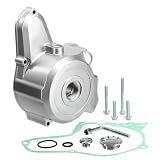
- 6-Coil Stator Engine cover fit for 50cc 70cc 90cc 110cc 125cc ATV Go Kart Dirt Bike
- Color: Silver
- 1 x Left Engine Cover
- 1 x Cover Gasket (Asbestos-free)
- 1 x Engine Motor Stator Side Cover Cap (with Seal)
Is asymmetry the same as a fractional-slot winding?
No. Fractional-slot describes the slot-per-pole-per-phase relationship. Such a winding can be symmetrical or intentionally asymmetric; asymmetry is the broader condition.
Can an ordinary inverter drive an asymmetric winding?
Sometimes. If measured phase behavior is sufficiently balanced, a conventional drive may work. Material asymmetry can require phase-domain control, sequence compensation, current limits or separate control of independent winding sets.
Is asymmetry common in hairpin motors?
Geometric asymmetry in pins, welds and overhangs can be used for manufacturing and packaging. It does not by itself prove unequal electrical phase turns or a fault.
Can rewinding accidentally introduce asymmetry?
Yes. Wrong turns, coil pitch, slot assignment, connection polarity, parallel-path arrangement or unequal joints can create electrical asymmetry. Require winding records and before-and-after resistance, inductance and surge-test results.
Quick Recap
Product prices and availability are accurate as of the date/time indicated and are subject to change. Any price and availability information displayed on Amazon at the time of purchase will apply.

