
Quick wins for a faster PC:
Clear out junk files and repair common Windows errorsFree Scan →Scan for outdated or missing drivers - takes under a minuteDriver Scan →iTechGuides is reader-supported. When you buy through links on our site, we may earn an affiliate commission. As an Amazon Associate I earn from qualifying purchases. Learn more
A Soviet-era weather satellite called Meteor 2-7 has reportedly fragmented again, with LeoLabs estimating “tens of fragments” near its orbital location. Space.com reported the event on October 8, 2026, placing it about 530 miles (855 kilometers) above Earth based on orbital debris expert Jim Shell. The cause and a final fragment count have not been established.
What happened to Meteor 2-7?
Meteor 2-7 was launched in 1981. Space.com reported that LeoLabs detected a debris-generating event near the satellite’s known orbital location and estimated tens of fragments. The satellite had broken apart previously, in March 2004. The new event’s cause is unknown; the report does not establish whether it resulted from a collision, an internal failure, or another mechanism. The fragment estimate is provisional, not a final catalog count. Space.com’s October 8, 2026 report attributes the estimate to LeoLabs and the approximate altitude to Shell.
Why can debris at this altitude matter?
Speed makes small fragments hazardous
Objects in low Earth orbit move at roughly 15,000 to 18,000 miles per hour, according to NASA Orbital Debris Program Office modeling lead Mark Matney in a 2021 NASA podcast. At those speeds, even a small piece can damage a spacecraft. A fragment’s danger depends on its size, orbit, and whether it crosses another spacecraft’s path—not simply on how many pieces were reported. The roughly 530-mile figure is the reported altitude of the event, not an independently verified orbit for every fragment. NASA’s 2021 podcast explains the speed and collision risks.
Tracking does not capture every potentially dangerous piece
Catalogs count objects that can be tracked; smaller debris can still pose a risk while remaining difficult to detect and follow. In the 2021 podcast, Matney cited estimates of hundreds of millions of particles larger than one millimeter and roughly 23,000 tracked objects about ten centimeters or larger. Those are historical estimates from 2021, not current 2026 totals. Consequently, “tens of fragments” describes the reported estimate for this event, not necessarily every piece it produced.
#1 Best Overall

- HOBBY MODEL KIT – Unassembled model packed in an envelope with easy to follow instructions. Ideal for ages 14 and up.
- NO GLUE OR SOLDER NEEDED – Parts can be easily clipped from the metal sheets. Tweezers are the recommended tool for bending and twisting the connection tabs.
- VOYAGER – 1.5 Sheet Model with a moderate difficulty level. Assembled Size: 1.38 x 1.77 x 6.70 inches.
- FROM STEEL SHEETS TO 3D – Pop out the pieces and connect using tabs and holes. Includes illustrated instructions.
- HIGHLY DETAILED ETCHED MODEL – Display your 3D model once completed - collect and build them all.
How does this event fit into the wider debris picture?
Counts vary with date and what is counted, so the figures below are not interchangeable. Space.com relayed European Space Agency figures of about 16,000 tracked debris pieces in 2005 and more than 44,000 in 2026. Separately, SpaceX disclosed to the U.S. Federal Communications Commission that each Starlink satellite performed more than 40 avoidance maneuvers per year between June 1, 2025 and May 31, 2026, as reported by Space.com. That is a measure of operator maneuvers over a specified period, not a debris count or a rate for all satellites. Space.com’s report relays the ESA and SpaceX figures.
NASA’s 2021 account describes the 2007 Chinese anti-satellite test and the 2009 Iridium 33–Kosmos 2251 collision as major debris-producing events that nearly doubled the trackable catalog at the time. They illustrate how a single destructive event can add objects that remain relevant to spacecraft operators; they are historical examples, not evidence that Meteor 2-7’s breakup has the same cause or impact.
Rank #2

- Model Kit
- May Require Paints and Glues to Assemble
- Accurate Scale Model
- Detailed Instructions Provided
- Decals/Transfers Included
Is the debris an immediate threat to the ISS or another spacecraft?
The cited reporting does not establish an ISS threat or a specific close approach involving Meteor 2-7 debris. Operators assess risk using object tracking and predicted trajectories; a reported breakup by itself does not show that a collision is imminent. As a historical example of a response to a known debris hazard, the PBS NOVA transcript says that after Russia destroyed the defunct Cosmos 1408 satellite in 2021, ISS astronauts sheltered in their emergency spacecraft and the station maneuvered to avoid debris. The transcript also says hundreds of fragments from that event were still being tracked. That episode illustrates why monitoring and maneuver capability matter, but it does not establish a comparable threat from Meteor 2-7. PBS NOVA’s transcript describes the Cosmos 1408 response.
How long will the fragments stay in orbit?
No event-specific debris lifetime is established in the cited reporting. A fragment’s persistence depends on its orbit and other conditions, and the approximate event altitude alone is not enough to state how long Meteor 2-7 debris will remain in orbit. The same evidence does not provide a confirmed fragment-by-fragment orbit or reentry forecast.
Rank #3

- HOBBY MODEL KIT – Unassembled model packed in an envelope with easy to follow instructions. Ideal for ages 14 and up
- NO GLUE OR SOLDER NEEDED – Parts can be easily clipped from the metal sheets. Tweezers are the recommended tool for bending and twisting the connection tabs
- APOLLO CSM – 3.5 Sheet Model with a challenging difficulty level. Assembled Size: 5.07 L x 2.28 W x 3.45 H inches.
- FROM STEEL SHEETS TO 3D – Pop out the pieces and connect using tabs and holes. Includes illustrated instructions
- HIGHLY DETAILED ETCHED MODEL – Display your 3D model once completed - collect and build them all
Do recent breakups mean a runaway collision cascade is imminent?
Space.com, relaying LeoLabs, described the recent sequence of fragmentation events as “a worrying trend for space safety and security” and said it “underscore[s] the critical need for persistent sensing.” That is LeoLabs’ assessment as quoted by Space.com, not proof that the events share a cause. The reports cited here do not establish that a runaway collision cascade is imminent.
Experts have also expressed differing views about a Kessler-style cascade. The PBS NOVA transcript presents one view that it is unclear whether the threshold is near and another that a slow process may already be underway in some orbital regimes. These are competing expert judgments, not a settled prediction about when or whether a cascade will occur. The NOVA transcript discusses that disagreement.
Rank #4

- HOBBY MODEL KIT – Unassembled model packed in an envelope with easy to follow instructions. Ideal for ages 14 and up.
- NO GLUE OR SOLDER NEEDED – Parts can be easily clipped from the metal sheets. Tweezers are the recommended tool for bending and twisting the connection tabs.
- JAMES WEBB SPACE TELESCOPE - 2.75 Sheet Model with a moderate difficulty level. Assembled Size: 4.13 L x 2.75 W x 2.75 H inches. 1:221 Scale. 62 Pieces
- FROM STEEL SHEETS TO 3D – Pop out the pieces and connect using tabs and holes. Includes illustrated instructions.
- HIGHLY DETAILED ETCHED MODEL – Display your 3D model once completed - collect and build them all.
What can be done about orbital debris?
- Detection and tracking: Sensors identify and characterize objects so their paths can be monitored. LeoLabs’ estimate in this case underscores the role of sensing, while the provisional count shows why early estimates should not be treated as a final catalog.
- Collision avoidance: Spacecraft operators can maneuver to avoid predicted close approaches when tracking data indicates a risk. The Starlink maneuver figure reported for June 2025 to May 2026 is one operator’s disclosed activity, not a universal rate.
- Mitigation and removal: Mitigation seeks to prevent or reduce long-lived debris; removal seeks to take existing debris out of orbit. The cited sources do not compare removal methods, costs, or effectiveness, so they do not establish one solution as sufficient.
For Meteor 2-7, the practical concern is that another reported fragmentation adds uncertainty and objects that may need to be monitored. The available reporting supports vigilance, not a claim that the fragments have already endangered a particular spacecraft.
What’s actually slowing this PC down?
Pick the symptom - the matching free tool is one click away.
Quick Recap
Best Value
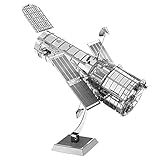
- HOBBY MODEL KIT – Unassembled model packed in an envelope with easy to follow instructions. Ideal for ages 14 and up.
- NO GLUE OR SOLDER NEEDED – Parts can be easily clipped from the metal sheets. Tweezers are the recommended tool for bending and twisting the connection tabs.
- HUBBLE TELESCOPE – 1 Sheet Model with a moderate difficulty level. Assembled Size: 3.00 x 2.00 x 2.50 inches.
- FROM STEEL SHEETS TO 3D – Pop out the pieces and connect using tabs and holes. Includes illustrated instructions.
- HIGHLY DETAILED ETCHED MODEL – Display your 3D model once completed - collect and build them all.
Product prices and availability are accurate as of the date/time indicated and are subject to change. Any price and availability information displayed on Amazon at the time of purchase will apply.

