
The Radeon VII was a genuine 7 nm graphics card, but that fact did not make it an automatic gaming-value leader. Launched in 2019 at a US suggested e-tail price of $699, it paired a Vega-based GPU with 16 GB of HBM2 memory and unusually high bandwidth. Those specifications made it intriguing for some demanding workloads; independent launch-era coverage nevertheless found its gaming value difficult to justify against contemporaries.
What the Radeon VII was
AMD announced Radeon VII on January 9, 2019, as a desktop graphics card built on enhanced second-generation Vega architecture and a 7 nm manufacturing process. AMD’s launch announcement described 60 compute units, 3,840 stream processors, 16 GB of HBM2 and 1 TB/s of memory bandwidth. It gave a maximum clock of up to 1.8 GHz. AMD’s 2019 announcement also positioned the card for demanding content-creation applications, not just gaming.
AMD’s current support specification lists a 1,400 MHz base frequency and boost up to 1,750 MHz, rather than the launch release’s up-to-1.8 GHz figure. Treat these as figures from two different AMD publications, not interchangeable measurements. The current specification page lists a 4,096-bit memory interface and up to 1,024 GB/s bandwidth, equivalent to the rounded 1 TB/s launch figure. AMD’s Radeon VII support page identifies it as a desktop component in the Radeon RX Vega Series.
What 7 nm and 16 GB meant—and did not mean
The 7 nm process and HBM2 memory were real hardware features, not just a marketing label. The 16 GB capacity and 1 TB/s bandwidth were notable parts of Radeon VII’s pitch, particularly for workloads that can benefit from substantial memory capacity or throughput. But capacity and bandwidth alone do not establish that a graphics card will deliver higher frame rates in a particular game. Gaming performance depends on the workload and test conditions, so those specifications should be weighed alongside independent, comparable benchmarks.
#1 Best Overall

- Chipset: AMD RX 7600
- Memory: 8GB GDDR6
- XFX SWFT Dual Fan Cooling Solution
- Boost Clock: Up to 2655 MHz
AMD’s 2019 announcement claimed average gains over the Radeon RX Vega 64 of up to 29% in gaming and up to 36% in demanding content-creation applications. AMD also reported application-specific gains of up to 27% in Blender and DaVinci Resolve 15, and up to 62% in the OpenCL LuxMark compute benchmark. Its named game figures were up to 35% in Battlefield V, 42% in Strange Brigade and 25% in Fortnite. These are AMD’s company claims from its launch announcement, not independent findings or guarantees for every system or workload.
How it performed as a gaming-value proposition
PC Gamer’s review, published February 7, 2019, described the move to 7 nm as progress rather than a revolution and judged the roughly $700 card difficult to recommend on value. The review characterized Radeon VII as up to 35% faster than RX Vega 64 while costing 75% more. Those figures are PC Gamer’s contemporaneous comparison, not a current benchmark or a universal result across games and settings. Read PC Gamer’s Radeon VII review.
Rank #2
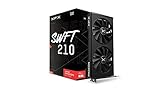
- Chipset: AMD RX 7600
- Memory: 8GB GDDR6
- XFX SWFT Dual Fan Cooling Solution
- Boost Clock: Up to 2655 MHz
That distinction captures the card’s central trade-off: meaningful architectural and memory advances did not, in the launch-era assessment, translate into a proportionate gaming-value case. AMD’s specifications and performance claims explain why Radeon VII attracted attention; the independent review’s dated comparison explains why it was not an obvious choice for a gamer focused primarily on performance per dollar.
Launch price and what it says today
AMD announced an expected availability date of February 7, 2019, and a US suggested e-tail price (SEP) of $699. That is historical launch pricing only. The cited material does not establish current new or used prices, inventory, card condition or warranty transferability, so the 2019 price cannot be used to judge whether a particular listing is good value now.
Free tools Windows power users keep installed
One-click scans. No signup required.
Rank #3

- AMD Radeon RX 550 Chipset, Silver plated PCB & all solid capacitors provide lower temperature, higher efficiency & stability
- 9CM unique fan provide low noise and huge airflow for your GPU
- GPU Boost Clock / Memory Speed : up to 1183 MHz / 4GB GDDR5 / 6000 MHz Memory, Stream Processors 512, Perfect for 3D CAD/CAM working, video and photo editing, Video Games @1080p
- Support: DirectX 12, Shader Model 5.0, OpenGL 4.6/4.5, 4K Video Decode
Power, fit and compatibility
AMD’s current support page lists Radeon VII at 300 W typical board power and recommends a minimum 750 W power supply. The recommendation is a starting point for checking a build, not proof that every 750 W unit or configuration is suitable. Before installing a card, verify the exact board’s power connectors, the PSU’s quality and condition, case clearance and the power needs of the rest of the system.
Drivers and operating-system support
As listed on AMD’s support page accessed September 30, 2026, the Windows 10/11 download was Adrenalin 26.5.2, dated May 21, 2026. The page also listed Radeon Software for Linux 26.14, dated August 26, 2026, for the distributions shown there. Driver availability can change; check the Radeon VII support page for your operating system before downloading or installing a driver.
Quick Recap
Who the Radeon VII makes sense for
- Potentially relevant: someone assessing a specific Radeon VII for a workload where its 16 GB HBM2 capacity and high bandwidth are useful, provided the application and system requirements are checked.
- Less compelling on the evidence here: a gamer choosing primarily on launch-era gaming value. PC Gamer’s 2019 assessment was skeptical, and it should not be mistaken for a present-day comparison against newer cards.
- Not enough information to decide: anyone evaluating a current used or new listing. The cited sources do not establish present prices, condition, inventory or warranty status; evaluate those details directly rather than relying on the launch MSRP.
Product prices and availability are accurate as of the date/time indicated and are subject to change. Any price and availability information displayed on Amazon at the time of purchase will apply.

