
The Tool Desk
Outbyte PC Repair FREERepair Windows errors before they cause bigger problemsFix Now →Outbyte Driver Updater FREEScan for outdated or missing drivers - takes under a minuteDriver Scan →iTechGuides is reader-supported. When you buy through links on our site, we may earn an affiliate commission. As an Amazon Associate I earn from qualifying purchases. Learn more
AIoT architecture connects sensors and other physical devices to data processing and artificial intelligence (AI), then routes decisions back to people or equipment when action is needed. Processing can happen on the device, at a nearby edge node, in the cloud, or across all three; the right arrangement depends on the application’s response time, privacy, connectivity, compute, and operational needs.
What is AIoT architecture?
AIoT, or artificial intelligence of things, combines connected physical devices with AI and data-processing capabilities. Its purpose is not simply to collect readings or run a model: it is to turn observations into useful decisions and, where appropriate, controlled changes in the physical environment.
NIST’s NISTIR 8316 (2020) describes IoT as combining observation of the physical world with distributed computing that analyzes the resulting data to inform decisions, alter the environment, and predict future events. AIoT architecture applies that broad idea to systems in which AI helps interpret data or choose a response.
Quick wins for a faster PC:
Repair Windows errors before they cause bigger problemsFix Now →Fix the driver behind crashes, sound loss and screen glitchesFind Drivers →Clear out junk files and repair common Windows errorsFree Scan →A useful way to understand the architecture is as a feedback loop: a sensor observes something, software and AI interpret it, and a person or controller decides what should happen next. The device, edge, and cloud are possible places for parts of that work—not mandatory stages through which every measurement must pass.
#1 Best Overall

- Build a 37-Module Sensor Lab: Add motion, distance, light, sound, temperature, touch, display and control functions to compatible UNO, MEGA, Nano, ESP-32 or STM32 projects for prototyping, classroom experiments and maker builds
- Explore Input Sensors and Motion: Experiment with GY-521 motion sensing, PIR detection, ultrasonic ranging, temperature and humidity, DS18B20, flame, Hall, touch, light, sound, tilt, tracking and obstacle-avoidance modules
- Add Displays, Timing and Control: Use the LCD1602, DS1307 real-time clock, joystick, rotary encoder, relay, buzzers, RGB LEDs and infrared modules to build clocks, alarms, counters, status displays and automated projects
- Follow Guided Projects Materials: Use digital tutorial materials, datasheets, wiring diagrams and example code for compatible UNO R3, MEGA 2560 and Nano boards, then adjust thresholds, timing and logic to create custom experiments
- Module-Only Expansion Kit: Controller board, USB cable, breadboard and jumper wires are not included; use 6.5–9 V DC only with the included power module, verify pin requirements before wiring and keep the laser emitter away from eyes
How does data move from a sensor to a decision?
Start with the physical task, then trace both the data path and the response path. A system might collect a temperature reading, compare it with other information, identify a condition that warrants attention, and send an alert or permitted control instruction. The same general pattern applies to many kinds of sensors, equipment, and environments, though the required accuracy, timing, and safeguards differ.
- Observe: A sensor measures a physical condition. Specify what it measures, how often a reading is needed, and what quality or context makes it useful.
- Identify and contextualize: Associate readings with the relevant device, location, time, and operating conditions. Timestamping and context help make data interpretable rather than just a stream of values.
- Process: Validate, filter, summarize, or analyze the data on the device, at an edge node, in cloud services, or across those locations.
- Decide: AI may classify a condition, estimate a value, detect an unusual pattern, or help select a response. The application determines whether that output is advisory or can inform automatic control.
- Respond and check: Carry an alert or authorized instruction back to a person, controller, or actuator. Where the system changes physical conditions, observe the result so the next decision can account for it.
Connectivity is part of this design, but no single network or messaging protocol is universally required by the architecture references discussed here. Choose technologies for the device interfaces, operating conditions, interoperability needs, and security requirements of the deployment.
What do device, edge, and cloud each do?
The ITU-T Y.4618 reference model, published in June 2026, describes AIoT functions distributed across device, edge, and cloud domains. The following roles are common patterns, not a rule that every installation must use all three.
Rank #2

- 37 Sensors kit
- 37 Sensors Assortment Kit for Arduino MCU Education
- Touch sensor moduleHeartbeat detection module
- Infrared sensor receiver module
Device: sensing, local processing, and control
The device layer includes sensors, controllers, and actuators. A device can collect data, perform preprocessing, run lightweight inference, or make a local decision. Keeping some processing on the device can help when a response must be quick, connectivity may be intermittent, or raw data should stay close to where it was collected.
Devices also have limits. Model size and processing demand must fit available compute, memory, power, and thermal capacity. The operating environment, maintenance approach, and way to update software or models matter too. A model that works in a development setting is not automatically suitable for constrained hardware in its intended environment.
Edge: nearby context and coordination
An edge node processes data closer to connected devices than a remote cloud service. Depending on the deployment, it can combine information from nearby devices, run inference, coordinate local services, manage devices, or support local learning and model updates. It may send selected events or summaries upstream rather than forwarding every raw measurement.
Rank #3

- Ultimate Sensor Kit for Arduino Beginners: The kit features the original Arduino Uno R4 Minima board, 30+ high-quality sensors and modules, and free video lessons co-created with educator Professor Joselito. With over 50 engaging projects (30 basic, 17 IoT, and 10 advanced fun projects), beginners aged 8+ can dive into the world of electronics and programming with ease. Certified RoHS compliant, it guarantees safety and quality for all learners, making it the perfect choice for both education and innovation
- Powered by the Arduino Uno R4 Minima: R4 Minima is a major upgrade from the Uno R3. With a 32-bit ARM Cortex-M4 processor, 256 KB Flash memory, and 48 MHz clock speed, it offers faster performance and greater memory. It also features higher-precision ADC (14-bit), a built-in DAC, CAN bus support, and a wider power input range (6-24V), making it more powerful and versatile for all users
- 30+ Sensors for Infinite Creativity: With 30+ high-quality sensors and modules, plus a battery for portable applications, this kit is ideal for IoT, environmental monitoring, and smart automation projects. It includes step-by-step tutorials, sample codes, and progressive online lessons, making learning seamless for beginners and advanced users alike. Fully compatible with other Arduino boards like Uno R3 and Nano, it offers endless customization and innovation opportunities
- Engaging Projects for Every Skill Level: Featuring 50+ projects (30 basic, 17 IoT, 10 advanced fun), this kit supports IoT platforms like Blynk and IFTTT, enabling smart automation and real-world applications. With Arduino C++ programming, step-by-step guidance, and hands-on coding exercises, it’s perfect for students, teachers, and engineers to learn, build, and innovate at any level
- Dedicated Support for Beginners: Alongside online resources and video tutorials, SunFounder provides technical support and troubleshooting forums to help beginners solve programming challenges with ease
Edge computing is not cost-free. Edge systems have their own compute and communications limits, and they add equipment and operational work. NIST’s Edge AI project page, updated August 12, 2026, identifies challenges that include resource constraints, differences in data across devices, communication limits, privacy requirements, and additional vulnerabilities.
Cloud: fleet-wide resources and model lifecycle
Cloud services can provide broader storage and compute for large-scale analysis or model training. They can also support coordination across sites and model lifecycle tasks such as versioning, deployment, and monitoring. These capabilities can complement local inference: an installation may act on a device or edge node while using cloud services for fleet-level management.
Using cloud services does not require sending every raw reading there. The data sent upstream can be chosen to fit the task, privacy requirements, available bandwidth, and operational design.
Rank #4

- Complete Project-Based Learning Path – Build 13 progressive projects (LED blink → button control → PIR motion sensor → music playback → motorized doors/windows → SK6812 RGB lighting → fan control → LCD display → gas alarm → temperature/humidity monitor → RFID door unlock → Morse code access → WiFi control → mobile APP remote control). Each project builds on the previous one, ensuring you understand both the electronics and the programming logic behind every smart home feature.
- Master Two Industry-Standard Languages – Learn to code in both Arduino C++ and MicroPython with 13 detailed tutorials for each language. Compare how the same hardware behaves under different programming approaches – a valuable skill for any aspiring engineer. Perfect for classrooms teaching multiple coding languages or self-learners who want flexibility.
- Build a Real WiFi-Controlled Smart Home – Assemble the wooden house structure and integrate sensors to create a functioning smart home system. Control lights, fans, door servos, and RGB lighting directly from your mobile APP (iOS/Android) . Experience how IoT works in real life – from manual control to automated responses based on temperature, humidity, motion, and gas detection.
- Comprehensive Online Wiki with No Guesswork – Our detailed online tutorials (also accessible via the packaging) include wiring diagrams, full code explanations, and step-by-step assembly guides for every project. Whether you're a complete beginner or a teacher preparing lessons, the structured content eliminates confusion and helps you succeed from project 1.
- Everything You Need to Get Started – (TIPS: Batteries are NOT Included)This kit includes the ESP32 development board, expansion board, wooden house parts, all sensors and modules (DHT11, PIR motion, gas sensor, RFID, SK6812 RGB, servo motors, fan, LCD1602, etc.), and connection cables. NOTE: 6x AA batteries are required (NOT Included). The kit is unassembled – you'll build it yourself following our online tutorials, making the learning experience truly hands-on.
Where should AI run?
There is no universally best location. ITU-T Y.4618 describes centralized deployments on a device, edge node, or cloud, as well as distributed arrangements across these domains. ITU-T Y.4509 (March 2025) also describes collaborative inference and dynamic learning and updating across device, edge, and cloud for IoT and smart-city services. Together, these references support treating placement as an architectural choice rather than a fixed sequence.
| Placement | Can be a good fit when | Key constraints to assess |
|---|---|---|
| Device | Local response, intermittent connectivity, or keeping raw data on the device is important. | Compute, memory, power, thermal capacity, and the ability to maintain and update deployed software or models. |
| Edge | Nearby devices need contextual processing or coordination, or sending all raw data upstream is unsuitable. | Edge-node capacity, communications, data distribution, privacy, security, and the work of operating the local infrastructure. |
| Cloud | Broader storage, compute, cross-site coordination, or large-scale model operations are needed. | Network dependence, bandwidth, data-handling constraints, and whether the application can tolerate remote processing. |
| Distributed | Different tasks benefit from different locations—for example, local inference and centralized fleet management. | Coordination, model and software versioning, observability, security boundaries, and responsibility for each part of the system. |
When choosing placement, work through these questions:
What’s actually slowing this PC down?
Pick the symptom - the matching free tool is one click away.
- Response and connectivity: How quickly must the system respond? Can it wait for a network round trip, and what should happen during an outage?
- Privacy and sensitivity: Which raw or derived data may leave the device or site?
- Resources and cost: What can the hardware sustain in its real operating environment, including power, heat, maintenance, and compute limits?
- Data volume and bandwidth: Does the task require continuous raw data, or would selected events and summaries be sufficient?
- Scale and coordination: Is the system managing one device, a local fleet, or deployments spread across multiple sites?
- Model lifecycle and oversight: How will models be validated, deployed, monitored, versioned, and rolled back if needed?
- Operational responsibility: Who maintains the devices, edge nodes, communications, cloud environment, and control path?
What should the security and safety design cover?
Security should follow the full system boundary, not stop at a network connection or cloud account. ITU-T XSTR.saAIoT (December 2025) analyzes threats across hardware, system, data, network, and application layers. Apply that framing by asking how devices are identified and maintained; how data and commands are protected in transit and at rest; how software and model changes are authenticated and monitored; and what the system does when connectivity or inference fails.
Best Value
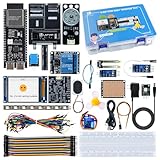
- 【High-Performance ESP32-S3 Microcontroller】 Equipped with revolutionary MCP protocol technology, the kit delivers a native AI voice control experience, perfectly adapting to various AIoT application scenarios, suitable for beginners, educators and makers.
- 【8 Versatile Hardware Modules Included】Comes with RGB LED module (full-color dimming, breathing light effect), WS2812 smart light strip (8 programmable LEDs), DHT11 sensor (real-time temperature and humidity monitoring), SG90 servo, DC fan, dual relay, raindrop and soil sensor, meeting diverse project needs.
- 【Zero-Threshold AIoT Control】Adopts innovative MCP protocol, allowing AI models to directly recognize hardware functions without complex programming. Pre-compiled firmware supports plug-and-play after burning, with an extensible architecture for secondary development.
- 【Multi-Scenario Application Coverage】Widely applicable to STEM education (learning IoT, AI interaction, embedded programming), smart home prototype verification, maker project development, and smart agriculture (soil monitoring, automatic irrigation systems).
- 【Comprehensive Learning & Technical Support】Provides an online document center with detailed quick-start guides and free professional technical support to answer questions and assist in problem-solving, helping users get started quickly.
For industrial or safety-relevant systems, distinguish a prediction that informs a person from an AI output that automatically triggers actuation. Define safe fallback behavior, the role of human oversight, and how the system will be validated in its intended operating environment. The appropriate safeguards and regulatory obligations depend on the application and jurisdiction; the architecture references alone do not establish a universal control checklist or certification requirement.
How to turn the architecture into a design
Before selecting hardware or services, write down the physical task and the boundaries of permitted action. Then assign functions to locations based on what the application actually needs.
- Define the observation: Identify the physical conditions to measure, the necessary timing and data quality, and the device or location context required to interpret each reading.
- Define the response: Specify who or what receives a decision, which actions are allowed, and whether any automatic actuation is appropriate.
- Set placement constraints: Record response-time needs, connectivity assumptions, privacy limits, data volume, and device resource limits.
- Allocate processing: Decide which functions belong on the device, at the edge, in the cloud, or in a combination of locations. State what data crosses each boundary and why.
- Plan operations and failure handling: Assign responsibility for maintenance, updates, monitoring, version control, rollback, and safe behavior during outages or errors.
- Validate in context: Check model behavior, data quality, and the response path under the conditions in which the system is meant to operate.
For a learning prototype, an edge AI development board or IoT sensor development kit can be a starting category, not a guarantee of fit. Compatibility depends on the workload, interfaces, compute and memory budget, power, software support, and deployment environment. Industrial deployments may instead need an edge gateway or industrial edge computer, selected for the same practical requirements rather than by category name alone.
Free tools Windows power users keep installed
One-click scans. No signup required.
Quick Recap
Product prices and availability are accurate as of the date/time indicated and are subject to change. Any price and availability information displayed on Amazon at the time of purchase will apply.

