
What’s actually slowing this PC down?
Pick the symptom - the matching free tool is one click away.
iTechGuides is reader-supported. When you buy through links on our site, we may earn an affiliate commission. As an Amazon Associate I earn from qualifying purchases. Learn more
When generative AI makes a first draft or routine response faster to produce, the scarce skill is not simply producing more. It is deciding which tasks suit the tool, supplying the context it lacks, checking its work, and taking responsibility for the result. Studies show that AI can improve performance in some settings and weaken it in others. They do not yet prove that human judgment delivers a durable competitive advantage across industries.
What does it mean when AI makes output cheap?
“Cheap” is best understood as lower effort or time for some kinds of output—not as a guarantee that all work costs less, that every answer is dependable, or that a task can be completed without review. Generative AI can help produce drafts, ideas, or responses, but the person using it still has to decide whether the work is appropriate, accurate, and useful in its actual context.
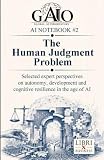




That distinction matters because the studies available measure performance and time in particular tasks and workplaces. They do not directly measure the economic return from human judgment. The idea that judgment may become more valuable as production gets easier is a strategic proposition, not a proven result about every occupation or organization.
Does generative AI improve productivity at work?
It can, but the size and direction of the effect depend on the task and the people doing it. These studies use different populations, tools, and measures; their percentages are not interchangeable or a single estimate of AI’s effect on productivity.
| Study and setting | Reported finding | What the result does—and does not—show |
|---|---|---|
| BCG, 2023: more than 750 consultants using GPT-4 on a creative product-innovation task. BCG study | About 90% of participants improved their performance with GPT-4; the AI group performed 40% above the non-AI group on that task. The AI-assisted group also produced 41% less diverse ideas at group level. | A substantial benefit on this assigned creative task came alongside reduced idea diversity. It is not a universal estimate for creative work. |
| BCG, 2023: consultants using GPT-4 on a business problem-solving task designed to fall outside the model’s tested competence frontier and with a correct answer. BCG study | The AI group performed 23% worse than the non-AI group. | AI assistance can reduce performance on a task that challenges the model. This result does not mean all analytical tasks are poor fits. |
| NBER Working Paper 31161, 2023; published in the Quarterly Journal of Economics in 2025: customer-support agents using a conversational assistant. NBER paper | Average issues resolved per hour rose 14%; the reported improvement was 34% for novice and lower-skilled agents. Gains were minimal for experienced and highly skilled agents. | The gains differed by worker experience and skill in this support-work setting; they should not be generalized to other jobs. |
| NBER Working Paper 33795, 2025: 7,137 knowledge workers across 66 firms with access to an integrated workplace tool. NBER paper | Among treated workers who used the tool in the experiment’s second half—80% of that group—email time fell by two hours per week. | Researchers did not detect a shift in task quantity or composition from individual-level tool access. The finding concerns time use during this experiment, not a general productivity gain. |
The pattern is more useful than any headline number: assistance may help some people on some tasks, while producing weaker results, less variety, or little change for others. A team should measure its own outcomes rather than assume a finding from a different task or workplace will apply.
What skills matter when AI can produce a first draft?
The practical contribution shifts toward the decisions around the output. A useful workflow starts before generation and continues after it:
Rank #2
- Choose the task. Decide whether the work is bounded enough for AI assistance and whether a reviewer can judge the result.
- Set the constraints. Provide the relevant goal, audience, evidence, format, and local context. Identify what the model cannot know from the prompt or materials.
- Check the result. Verify factual claims and reasoning against appropriate evidence; assess whether the answer fits the situation rather than merely sounding plausible.
- Own the decision. Keep accountability with a person when the result affects people, requires a value judgment, or carries material consequences.
- Measure the workflow. Track whether it improves quality, saves time after review, or simply produces more material. Reassess as the tools and task change.
These are practical implications of the findings, not a validated universal checklist. The right amount of review depends on the consequences of an error and the reviewer’s ability to detect one.
Quick wins for a faster PC:
Fix the driver behind crashes, sound loss and screen glitchesFind Drivers →Clear out junk files and repair common Windows errorsFree Scan →How do you know when to trust AI output?
Trust should be calibrated to the task, not granted because a response is fluent or because the tool performed well elsewhere. BCG’s 2023 experiment offers a concrete contrast: participants improved on a creative product-innovation assignment but did worse than the non-AI group on a business problem-solving task designed to challenge GPT-4. That does not make creativity inherently safe or analysis inherently risky. It shows why task fit must be assessed rather than assumed.
Review is only meaningful if the reviewer knows enough to recognize a plausible error. BCG’s 2024 experiment found that AI could help participants attempt work outside their established skill set, while prior knowledge still mattered for checking the work. The authors also cautioned that completing a task with AI did not itself produce learning in their short experiment. This supports thoughtful supervision and learning design; it is not evidence that any novice can safely perform expert work simply by using AI. BCG’s 2024 experiment
- Ask whether correctness is checkable. If there is no clear way to evaluate the output, treat it differently from a bounded task with verifiable answers.
- Identify missing context. Look for local rules, current facts, or organizational knowledge the tool may not have.
- Match the reviewer to the risk. The person checking should have enough subject knowledge for the error cost involved.
- Protect human ownership. Decide in advance who is accountable for choices involving consequences, values, or individual circumstances.
- Test for hidden costs. Review not only speed but also factual reliability, time spent checking, diversity of ideas, and effects on learning.
Does better AI-assisted performance mean a competitive advantage?
Not by itself. The cited work documents task performance, time use, and—in one experiment—idea diversity in specific settings. It does not establish that human judgment, on its own, creates a durable market advantage. Nor does it show that all jobs will be automated or that output costs will fall across the board.
BCG’s authors captured one possibility: “The value at stake lies not only in the promise of greater efficiency but also in the possibility for people to redirect time, energy, and effort away from tasks that generative AI will take over.” That is a proposition about how people might use the time AI saves, not proof that every organization will redirect it well. BCG, How People Can Create—and Destroy—Value with Generative AI (2023)
Recommended Free Tools
For an organization, the useful test is whether a particular AI-assisted workflow improves the work that matters after review and oversight are counted. If quality falls, checking takes longer than expected, or staff cannot recognize errors, faster generation may not produce a meaningful advantage. If the task fits, reviewers can verify the result, and saved effort is redirected to valuable work, the workflow may help—but that outcome has to be demonstrated in context.
Independent reader supportYour contribution helps us test, update, and keep practical guides available for everyone.What the evidence can—and cannot—tell you
The BCG experiments involved consultants, assigned tasks, and GPT-4-era tools; they are not representative tests of every profession. The customer-support finding came from a particular operational setting, while the knowledge-worker field experiment measured time use after access to an integrated workplace tool. Differences in population, task, tool, and method limit direct comparisons.
Across these sources, there is evidence that effects vary and that human expertise remains relevant to evaluating AI work. There is not a direct measure of the economic return attributable specifically to human judgment as a competitive advantage. The strongest conclusion is therefore conditional: as AI makes some forms of production easier, people still need to choose suitable uses, verify outputs, and remain accountable for decisions.
Quick Recap
Product prices and availability are accurate as of the date/time indicated and are subject to change. Any price and availability information displayed on Amazon at the time of purchase will apply.

