
AVX-512 can substantially increase aggregate MD5 throughput when you hash many independent messages of similar length. It does this by placing corresponding 32-bit words from different messages into vector lanes and running one MD5 instruction stream across them. It does not remove the serial dependency chain inside a single message, and small or irregular batches can be slower than scalar code once packing, padding, and AVX-512 frequency effects are included.
What aggregate AVX-512 changes
MD5 processes each message through a sequence of 512-bit blocks. Within one message, every block depends on the previous four-word state, and every operation in a round depends on earlier operations. That dependency chain limits how much instruction-level parallelism a vector unit can expose for one message.
Aggregate SIMD takes a different approach: independent messages share the instruction stream, but each vector lane keeps an independent hash state. A 512-bit vector contains sixteen 32-bit lanes, so one vector operation can update sixteen corresponding words at once. With multiple vector registers and unrolling, a kernel can keep many messages in flight while preserving each lane’s separate MD5 computation.
This is a throughput technique, not a promise of lower latency for one short input. A one-message call still has to execute the MD5 rounds for that message, and a batch that does not keep enough lanes busy may spend more time rearranging data than hashing it.
Do these 3 things before closing this tab:
1Fix the driver behind crashes, sound loss and screen glitches2Repair Windows errors before they cause bigger problems3Scan for outdated or missing drivers - takes under a minute#1 Best Overall

- Intel Xeon E5-2699 V4 Docosa-core (22 Core) 2.20 Ghz Processor - Socket Lga 2011-v3 - 5.50 Mb - 55 Mb Cache - 64-bit Processing - 14 Nm - 145 W
Keep RFC 1321 correctness as the contract
Padding and length encoding
RFC 1321 requires the message to be padded so its length in bits is congruent to 448 modulo 512. The implementation appends a single one bit, fills with zero bits, and appends the original message length as a 64-bit value. A message whose length is already too close to the end of a block therefore receives an additional 512-bit block.
Padding is a per-message operation. In an aggregate kernel, each lane must receive the correct final block and the correct original bit length; never copy one lane’s length or padding decision into another lane.
State and rounds
Each lane starts with its own four 32-bit words, conventionally named A, B, C, and D, initialized to the fixed MD5 values. The compression function processes sixteen 32-bit message words through four rounds and 64 total operations. Each operation combines one of MD5’s Boolean functions, a message word, a round constant, addition modulo 232, and a left rotation.
Vectorizing those operations means applying 32-bit add, XOR, AND, OR, NOT, and rotate-left instructions independently in every lane. The state update remains lane-local even though the CPU issues one vector instruction.
Little-endian interpretation
MD5 interprets each 32-bit message word in little-endian order. On a big-endian input representation, bytes must be swapped before the words enter the vector registers. A scalar RFC 1321 implementation should remain the reference for digest comparisons, including messages that cross block boundaries and messages with lengths near padding thresholds.
Rank #2
![Intel Xeon Silver [3rd Gen] 4310 Dodeca-core [12 Core] 2.10 GHz Processor - OEM Pack](https://m.media-amazon.com/images/I/31KUwTUW75L._SL160_.jpg)
Lay out messages for the lanes
Use a structure-of-arrays view
The natural vector layout is X[j][lane]: for message lane i, word j of the current block is stored in element i of vector word X[j]. The compression state is four vectors:
 A = { A0, A1, ... A15 }
 B = { B0, B1, ... B15 }
 C = { C0, C1, ... C15 }
 D = { D0, D1, ... D15 }
Here, A7, B7, C7, and D7 belong only to message 7. The same mapping is used for the sixteen message words in a block.
Transpose or pack once, hash many times
Typical application input is arranged as one contiguous message after another, while the kernel wants the same word position from many messages together. A packing or transpose step converts between those layouts. For fixed-size records, this step can be regular loads, shuffles, and stores. For scattered records, gathers may be needed and can cost more than the saved compression instructions.
Amortize packing across enough blocks or messages to keep the vector unit occupied. If callers repeatedly submit tiny batches, a scalar or AVX2 path may win because it avoids the transpose entirely.
Group compatible lengths
The simplest fast path groups messages with the same number of 512-bit blocks, ideally with the same record size and predictable alignment. A full group can advance every lane through the same block loop without per-lane control flow.
Rank #3
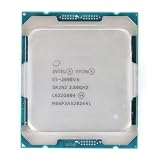
- Total Cores 14
- Total Threads 28
- Processor Base Frequency 2.60 GHz
- Max Turbo Frequency 3.50 GHz
- Sockets Supported LGA2011-3
For mixed lengths, use one of two explicit designs:
- Homogeneous sub-batches: bucket messages by block count, process each bucket with the regular kernel, and handle a small remainder with a narrower or scalar path.
- Masked tails: keep a lane-active mask for the final block and ensure inactive lanes do not read beyond their input, alter their digest state, or store an invalid result.
Do not silently combine messages with different final-block requirements in a kernel that assumes one common block schedule.
Build the vector compression kernel
Use a separate kernel for each width
Keep the scalar implementation as the correctness oracle, then implement independent scalar, AVX2, and AVX-512 kernels. The AVX-512 version should have an explicit contract describing its lane count, accepted input layout, alignment assumptions, supported tail behavior, and output format. Separate kernels make dispatch and benchmarking unambiguous.
Implement the 64 operations directly
Load or construct X[0] through X[15], copy the initial vector state into working registers, and execute the four MD5 rounds using vector integer operations. A rotate-left can be expressed with a pair of logical shifts and OR, or with a rotate instruction when the selected AVX-512 subset provides one. Keep all arithmetic at 32-bit width and allow natural modulo-232 wraparound.
After the 64th operation, add each working register back to its lane’s saved state, exactly as the scalar algorithm does. Process the next block with the updated vectors. At the end, serialize A, B, C, and D from each lane in MD5’s little-endian digest order.
Rank #4

- Manufacturer: Intel CPU Frequency: 2.20 GHz CPU Max Turbo Frequency: 3.60 GHz Number of Cores: 22 Threads: 44 Cache: 55 MB Intel Smart Cache Number of UPI Links: 0 Lithography: 14 nm Thermal Design Power: 145 W Memory Types: DDR4 1600/1866/2133/2400 Max Memory Size: 1.5 TB Max # Memory Channels: 4 Sockets Supported: FCLGA2011-3 E5-2699v4
Handle the final block safely
Final-block construction is often where an otherwise correct vector kernel fails. Build a per-lane temporary block, write the message bytes, append the one bit and zero fill, and write that lane’s 64-bit original length. If the length requires two final blocks, schedule both for that lane. A masked implementation must also mask loads and stores, not just arithmetic instructions.
The Tool Desk
Outbyte PC Repair FREEClear out junk files and repair common Windows errorsFree Scan →Outbyte Driver Updater FREEScan for outdated or missing drivers - takes under a minuteDriver Scan →Dispatch only when the required AVX-512 features exist
AVX-512 is a family of extensions rather than a single capability. Intel identifies subsets including AVX-512F, BW, CD, DQ, VL, VNNI, VBMI, and others. Your dispatch code must test the exact subsets used by the compiled kernel and verify that the operating system has enabled saving and restoring the relevant vector state.
In practice, dispatch combines CPU feature detection with an OS-state check such as CPUID and XGETBV. If any required feature is absent, select the AVX2 or scalar implementation. Keep the fallback paths permanently available; binaries may run on older Intel processors, AMD processors with different AVX-512 coverage, virtual machines, or systems where wide-vector execution is disabled.
Do not label a kernel “AVX-512” merely because the processor reports one AVX-512 bit. A kernel that uses an instruction from another subset must test that subset too, and the compiler target flags must match the runtime contract.
When wide vectors help—and when they do not
- Full lanes: Sixteen active 32-bit lanes give the vector unit useful work. Partially filled batches reduce the arithmetic benefit.
- Common block counts: Equal-length messages avoid per-lane branches and simplify the block loop.
- Efficient input access: Contiguous, aligned or cheaply gatherable data reduces packing overhead.
- Enough work per batch: More blocks or more messages amortize transposition, setup, and digest extraction.
- Moderate register pressure: Keeping sixteen message words, four state vectors, temporaries, and unrolled operations live can cause spills if the kernel is over-unrolled.
- CPU frequency policy: Some processors reduce frequency during sustained wide-vector execution. Measure effective throughput at the operating point your service actually uses.
Small one-off inputs, highly variable lengths, expensive gathers, and low occupancy can make scalar code faster. An AVX-512 implementation should therefore choose a path by workload shape, not by CPU feature alone.
PC Slower Than It Used to Be?
A free scan shows the junk files, broken settings and background clutter dragging Windows down - then fixes them in one click.Free scan · Windows 10 & 11Outdated Drivers Are Slowing You Down
One free scan finds every outdated or missing driver and matches the right update for your exact hardware.Free scan · exact hardware matchBest Value

- Part Number Identification: CD8069504194501 for easy reference and compatibility verification
- CPU Series Specification: 2nd Generation Intel Xeon Scalable processor from the Gold 6000 series
- Processor Frequency: 3.10GHz base clock speed with 18 cores for high-performance computing tasks
- Package Type: OEM tray processor without retail packaging
- Cooling Device Notice: Processor only, cooling device not included and must be purchased separately
What the available benchmark evidence shows
There is no controlled, MD5-only AVX-512 aggregate benchmark across multiple CPU generations in the available evidence. The clearest published number is from the par2-rs documentation: maintainers report a 1.7× improvement on an Intel Xeon Platinum 8488C (Sapphire Rapids) using GFNI plus AVX-512 for a heavy PAR2 workload. That result demonstrates a benefit from wide-vector optimization on that platform and workload; it is not an MD5-only speedup and should not be presented as one.
Intel’s Intrinsics Guide reports instruction throughput and latency data sourced from the Intel 64 and IA-32 Architectures Software Developer Manuals. Those figures describe individual instructions, not end-to-end MD5 batches, so packing, memory access, frequency changes, and dispatch overhead still need measurement.
Benchmark the whole pipeline
Report both aggregate throughput and small-batch latency. At minimum, record:
- CPU model and microarchitecture
- Compiler version, optimization level, and target flags
- Scalar, AVX2, and AVX-512 feature paths selected
- Batch size and active lane count
- Message-length distribution and block-count distribution
- Whether packing, padding, and digest serialization are included
- Frequency or power policy and whether the test runs on an otherwise idle system
- Messages per second, bytes per second, and enough repetitions for stable results
Use separate tests for fixed-length records, mixed lengths, one-message latency, and sustained batches. Compare a full 16-lane batch with deliberately partial batches to expose the occupancy threshold at which the vector path becomes worthwhile. Validate every result against the scalar implementation before interpreting a performance difference.
Free tools Windows power users keep installed
One-click scans. No signup required.
Comparison of implementation choices
| Path | Best use | What must be measured | Speedup established here |
|---|---|---|---|
| Scalar RFC 1321 | One-off inputs, fallback coverage, and correctness testing | Latency and baseline bytes per second | Not stated (the available evidence supplies no common benchmark) |
| AVX2 aggregate | Moderate batches or CPUs without the required AVX-512 subsets | Lane occupancy, packing cost, and frequency behavior | Not stated (the available evidence supplies no controlled comparison) |
| AVX-512 aggregate | Large, regular batches on CPUs that pass the exact feature and OS-state checks | Active lanes, transpose cost, register pressure, and sustained frequency | Not stated for MD5; par2-rs reports 1.7× for a heavy PAR2 workload on Xeon Platinum 8488C with GFNI + AVX-512 |
A practical implementation sequence
- Freeze the oracle: implement or retain an RFC 1321 scalar routine and test empty input, one-block input, multi-block input, and lengths around every padding boundary.
- Define the batch API: specify message pointers, lengths, maximum batch size, output layout, and whether the caller or kernel owns packing.
- Add a regular layout: support equal-length messages first, with a transpose that produces
X[0..15]vectors. - Write the vector rounds: implement all 64 operations with 32-bit vector arithmetic and verify every lane against scalar digests.
- Add final-block handling: support one- and two-block tails, then add homogeneous length buckets or a carefully masked tail path.
- Implement dispatch: check CPUID and XGETBV for the exact AVX-512 subsets, then fall back to AVX2 or scalar code.
- Benchmark end to end: publish CPU, compiler, flags, batch shape, message distribution, frequency policy, and packing inclusion with every reported result.
Troubleshoot common failures
The AVX-512 path is slower
First profile packing and tail handling rather than the 64-round loop. Check active-lane counts, gather instructions, register spills, and whether sustained AVX-512 execution lowered clock frequency. Compare the same messages with packing included and excluded; a large difference indicates that the data layout, not the MD5 arithmetic, is limiting throughput.
Only some messages have wrong digests
Inspect lane-to-word mapping, little-endian conversion, per-lane lengths, and two-block padding cases. A common bug is reusing one lane’s final-block size for the whole vector. Compare intermediate A, B, C, and D states after each block against the scalar oracle to locate the first divergence.
Results vary with batch size
Plot throughput against active lanes and block count. A sharp improvement near a full vector indicates setup or packing amortization; a decline at very large batches can indicate cache pressure, memory bandwidth, or frequency throttling. Keep a scalar or AVX2 threshold for batches that do not justify AVX-512 setup.
Quick Recap
Product prices and availability are accurate as of the date/time indicated and are subject to change. Any price and availability information displayed on Amazon at the time of purchase will apply.
What’s actually slowing this PC down?
Pick the symptom - the matching free tool is one click away.

