
The Tool Desk
Outbyte PC Repair FREEClear out junk files and repair common Windows errorsFree Scan →Outbyte Driver Updater FREEFix the driver behind crashes, sound loss and screen glitchesFind Drivers →iTechGuides is reader-supported. When you buy through links on our site, we may earn an affiliate commission. As an Amazon Associate I earn from qualifying purchases. Learn more
A multi-provider LLM router puts a common interface in front of different language-model APIs. Your application sends requests in one format; a compatibility layer translates or dispatches them to provider-specific endpoints. That can reduce provider-specific code and make it easier to route around an unavailable deployment—but it does not make models or their features interchangeable.
What a multi-provider LLM router actually does
A router can accept a request in a familiar format, map it to a configured model or deployment, and handle the provider-specific call. In a gateway setup, the request may pass through translation before a router handles dispatch, load balancing, retries, or fallbacks. LiteLLM documents this OpenAI-format request flow in its proxy architecture.
The phrase “one API” describes the interface your application uses, not a guarantee that every provider has identical request semantics, output, tool behavior, streaming support, or performance. Check the exact model and features your application depends on.
Choose where the router runs
“Router” can refer to software embedded in your application, a gateway you operate, or a managed API service. The choice determines who owns deployment and incident response, and where you must investigate billing, routing controls, and data handling.
#1 Best Overall

- EVOLUTION RYZEN AI MAX+ 395 MINI PC - GMKtec EVO-X2 is the next evolution in AI mini PC Ryzen Strix Halo series. Thanks to AMD Simultaneous Multithreading (SMT) the core-count is effectively doubled, to 32 threads. Ryzen AI Max+ 395 has 64 MB of L3 cache and can boost up to 5.1 GHz, depending on the workload. The Ryzen AI Max+ 395 is currently rated as the "most powerful x86 APU" on the market for AI computing.
- AI NPU with XDNA 2 ARCHITECTURE - Powered by 16 “Zen 5” CPU cores, 50+ peak AI TOPS XDNA 2 NPU and a truly massive integrated GPU driven by 40 AMD RDNA 3.5 CUs, the Ryzen AI MAX+ 395 is a transformative upgrade and delivers a significant performance boost over the competition. The Ryzen AI Max+ 395 excels in consumer AI workloads like the llama.cpp-powered application: LM Studio. Shaping up to be the must-have app for client LLM workloads, LM Studio allows users to locally run the latest language model without any technical knowledge required and unleash their creativity and productivity.
- AMD RADEON 8090S iGPU GAMING PC - The AMD Radeon RX 8060S offers all 40 CUs with up to 2.9 GHz graphics clock and uses the new RDNA 3.5 architecture. The powerful iGPU is positioned between an RTX 4060 and 4070 laptop GPU and therefore enables gaming in FHD at maximum details in most demanding games. The 8060S can also utilize the full 128GB pool, which is perfect for running LLMs such as Deepseek 70B Q8, which runs comfortably on this machine.
- EIGHT CHANNEL LPDDR5X - LPDDR5X is a new ground breaking memory small form factor installed on-board. With blazing speeds up to to 8000MT/s, it runs 1.5x faster than the DDR5 SODIMMs; 90% better performance over DDR5 SODIMMs in video conferencing and photo editing; 30% better performance in productivity apps; 12% better performance in digital content workloads.
- QUAD SCREEN 8K DISPLAY SUPPORT - EVO-X2 AI Mini PC support 4-screen 4K/8K output via HDMI 2.1 (8K@60Hz), DisplayPort 1.4 (4K@60Hz), and dual USB 4 40Gbps Transfer speed (supporting PD3.0/DP1.4/DATA). Ideal for gaming, video editing, and multitasking, it provides expansive and crisp multi-display support.
| Approach | What it means | What to evaluate |
|---|---|---|
| Application library | A library runs within your application and provides a shared interface to configured providers. LiteLLM documents a common completion interface and provider integrations. | You own application integration, configuration, upgrades, and the handling of provider credentials. |
| Self-hosted gateway | A proxy sits between your application and model providers. LiteLLM documents a gateway with virtual keys, cost tracking, and an admin UI. | You operate the gateway, including its availability, capacity, key controls, upgrades, and incident response. |
| Managed API | A hosted service exposes a unified API and handles some routing and service operations. OpenRouter describes unified model access, aggregate billing, usage analytics, pooled uptime, and automatic fallbacks. | Verify the service’s current model availability, routing controls, fees, provider path, and data terms. These OpenRouter capabilities are vendor descriptions, not an independent reliability or privacy audit. |
LiteLLM describes an open-source interface for more than 100 LLMs using the OpenAI format; its provider index lists integrations including OpenAI, Anthropic, Vertex AI, and Bedrock, as well as OpenAI-compatible endpoints. These are project documentation claims, and support can change. See LiteLLM’s getting-started documentation and its provider index for current details.
How to make fallbacks useful rather than surprising
A fallback is a policy, not a promise that any failed call will be repeated successfully elsewhere. Before enabling one, decide what failures qualify, which alternate deployment is eligible, how many retries are allowed, and what the application should do if no eligible model can meet the request’s requirements.
Rank #2
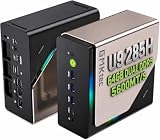
- EVOLUTION CORE ULTRA 9 285H MINI PC - GMKtec EVO-T1 is the next evolution in AI mini PC Ultra 9 series. The Core Ultra 9 285H offers 16 cores (six P-cores + eight E-cores + two LPE-cores) and 16 threads with a turbo clock of 5.4 GHz. It is currently one of the best value for performance AI mini PC computers.
- AI NPU - The 285H features an Intel AI Boost NPU, capable of up to 13 TOPS (Tera Operations per Second) for INT8 calculations, which is designed to accelerate AI tasks.
- INTEL ARC 140T GAMING PC - The Arc 140T GPU includes 8 Xe cores and supports features like DirectX 12, OpenGL 4.5, and OpenCL 3, making it capable of handling modern games and creative applications. It also supports Quick Sync Video for efficient video encoding and decoding, as well as AV1 encoding and decoding.
- 64GB DDR5 RAM + 1TB SSD - The EVO-T1 is equipped with Dual 32GB (Total 64GB) SO-DIMM DDR5 5600MHz memory sticks. 2TB PCIE 4.0 SSD Drive with 3x M.2 2280 Expansion slots. Each slot capable of reading up to 4TB. (12TB MAX)
- QUAD SCREEN 8K DISPLAY SUPPORT - EVO-T1 AI Mini PC support 4-screen 4K/8K output via HDMI 2.1 (8K@60Hz), DisplayPort 1.4 (4K@60Hz), and USB Type-C Transfer speed (supporting PD3.0/DP1.4/DATA). Ideal for gaming, video editing, and multitasking, it provides expansive and crisp multi-display support.
- Define retryable failures. Decide whether a retry is appropriate for the errors your application may encounter; do not treat every error as evidence that another model can safely answer.
- Set eligible alternatives. Specify which deployments can receive a rerouted request. An alternate must support the capabilities the request needs, such as its expected input or tool use.
- Bound retries and fallback attempts. Configure limits so a transient failure does not trigger an unbounded chain of calls, extra usage, or confusing delays.
- Decide how to handle capability mismatches. If no eligible model supports a required feature, return or handle an explicit failure rather than silently dropping the requirement.
- Observe what happened. Log the selected deployment and whether retries or fallbacks occurred, while following your data-handling requirements.
LiteLLM’s Router documentation covers routing strategies, load balancing, retries, and fallback configuration. Its configuration is version-sensitive, so use the documentation for the version you deploy.
What’s actually slowing this PC down?
Pick the symptom - the matching free tool is one click away.
Fixed routing or task-aware model selection?
Most basic router policies make a fixed choice based on a rule such as priority, random selection, or cost. That can be easier to reason about and audit: you define which deployment is preferred and when another may be used. A more adaptive router attempts to choose a model based on the task or observed outcomes, which adds another decision system to evaluate.
Rank #3

- 【Low Power for Always-On AI Workflows】At just 15W TDP, the GEEKOM A7 uses far less power than a traditional 350W desktop, helping reduce electricity costs, heat, and cooling noise during extended operation. That efficiency makes it ideal for keeping cloud AI assistants and AI Agent tasks running in the background—automating document summaries, email polishing, meeting notes, content rewriting, research, and scheduled workflows throughout the day. The energy savings can help recoup the device cost in about 1 year, making A7 a practical choice for 24/7 AI task hosting and efficient everyday computing.
- 【Ryzen 7 7730U – More Than a Low-Power PC】Think low power means less performance? Not here. The Ryzen 7 7730U mini computer packs 8 cores, 16 threads, and up to 4.5GHz, giving you the power to handle multitasking, dozens of tabs, video calls, and creative work smoothly. AMD Radeon Graphics supports 4K playback, multi-display work, photo editing, and casual gaming without a dedicated GPU. Compared with the Ryzen 7 5825U and Ryzen 5 7430U, it delivers up to 20% higher performance for faster response and smoother everyday computing—all in a compact, energy-efficient Mini desktop.
- 【Lock In More Memory Before It Costs More】32GB gives you the headroom most demanding tasks need today—and room to grow tomorrow. Built for heavy multitasking, content creation, large projects, and AI-assisted workloads, the GEEKOM mini pc starts you with twice the memory of a typical 16GB setup, so you can skip an immediate upgrade. With AI driving greater demand for memory, starting with 32GB is a smarter way to stay ready for what’s next. The 500GB PCIe Gen4 x4 SSD delivers fast storage, with support for up to 64GB RAM and 4TB SSD storage when you need more.
- 【Premium Metal Design & 3-Year Warranty】Why settle for plastic? The GEEKOM mini desktop features a premium aluminum alloy chassis that resists daily wear and helps dissipate heat during extended use. Rigorous quality testing and CE, FCC, and RoHS compliance support dependable performance, backed by a 3-year limited warranty and professional support for long-term peace of mind.
- 【One Mini PC, All Your Ports】Stay connected with dual USB-C ports, 5 USB 3.2 ports, dual HDMI 2.0, and a 2.5G LAN port for fast, flexible connectivity. The USB-C ports support high-speed data transfer, display output, and peripheral power, while Wi-Fi 6E keeps streaming, file transfers, and online work fast and reliable. From multiple peripherals to high-resolution displays, everything you need stays within easy reach.
The 2026 LLMRouter paper reports a 14.6% relative improvement over its strongest fixed-model baseline in the authors’ empirical study. That result applies to the study’s setup; it is not a general production guarantee. See the LLMRouter paper for its scope and methods.
Independent reader supportYour contribution helps us test, update, and keep practical guides available for everyone.Check compatibility, cost, and data handling
Before routing real traffic, validate the exact request features your app uses against each configured model. A shared request shape can conceal differences in supported parameters, tool calls, streaming, response structure, or model behavior. Treat compatibility as something to test for your workload, not something established by an OpenAI-shaped interface.
- Routing: Confirm model aliases, provider selection, load-balancing behavior, fallback eligibility, and retry limits.
- Cost: Determine how provider charges, router fees, failed attempts, and repeated requests appear in your usage records. LiteLLM documents custom input- and output-token pricing fields; confirm the values and billing path you use.
- Operations: Decide who manages keys, upgrades, capacity, availability, and incidents—your team or the managed service.
- Data governance: Establish where prompts travel, which providers process them, applicable retention controls, and whether the route meets regional or organizational requirements. The cited product pages do not establish universal privacy, retention, or compliance guarantees.
OpenRouter describes passing through provider pricing, pooling uptime, and offering aggregate billing and usage analytics. These are descriptions from its support page; verify current terms and the route you intend to use. The page also describes a plan-dependent BYOK allowance, after which usage incurs a fee based on equivalent OpenRouter cost. Because those commercial terms can change, check the current support terms before relying on them. Its API and models page lists model offerings; availability and features may change, and the catalog’s Auto Router beta status is not a permanent guarantee.
Quick Recap
A practical way to introduce a router
- Inventory the models, providers, and API features the application currently calls.
- Choose an application library, a self-hosted gateway, or a managed API based on the operational and governance responsibilities your team can accept.
- Start with an explicit mapping from application model names to deployments, and document the required capabilities for each route.
- Test normal calls, provider errors, fallback eligibility, unsupported features, and usage accounting before enabling fallback in production.
- Recheck provider support, model availability, pricing, and configuration against the current documentation and deployed version.
Product prices and availability are accurate as of the date/time indicated and are subject to change. Any price and availability information displayed on Amazon at the time of purchase will apply.

