
Recommended Free Tools
iTechGuides is reader-supported. When you buy through links on our site, we may earn an affiliate commission. As an Amazon Associate I earn from qualifying purchases. Learn more
You can record employee hours without monitoring screens, webcams, or keystrokes. Start by deciding exactly what time information you need, then choose the least intrusive method that can reliably provide it—often a timesheet, clock-in/out record, or a narrowly used access log. For UK employers, the Information Commissioner’s Office (ICO) says monitoring must have a clear purpose, be fair and lawful, and collect no more information than necessary. Its guidance is under review following the Data (Use and Access) Act, so check the current ICO guidance before introducing a system.
What is the least invasive way to track employee hours?
Use a method that records only the time information needed for a defined purpose. For a basic attendance or payroll record, that may be a worker-entered timesheet or a simple clock-in/out process. If you need to check a specific start-time discrepancy, a relevant system log-on time may be enough.
The ICO’s example illustrates the difference: checking a remote worker’s start time with a system log-on record and giving them an opportunity to explain a discrepancy can meet the aim without webcam images. A method that captures more detail is not automatically more reliable or justified.
Write down the purpose before choosing a tool. “Calculate hours for payroll” or “record attendance at this site” is more useful than a broad aim such as “monitor productivity.” Do not gather time data just in case it might be useful later.
#1 Best Overall
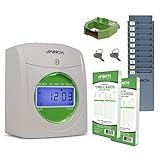
- Complete Solution - Includes HN3000 AutoAlign time clock, 100 time cards, rack, ribbon, and keys for instant tracking.
- Precise Punching - AutoAlign technology ensures accurate alignment for error-free payroll records.
- Robust Warranty - Two-year warranty with unlimited customer support (Monday–Friday) guarantees reliable performance.
- Simple Setup - Plug-and-play design with clear instructions enables tracking in minutes.
- Clear Printing - High-quality uPunch ribbons deliver legible, consistent punch punches.
Which time-tracking method fits the purpose?
| Method | Possible fit | Privacy and implementation points |
|---|---|---|
| Worker-entered timesheet or paper attendance log | Basic start and end times, simple shifts, or a small team | Limit fields to what is needed, explain the use, restrict access, and set a retention period. The ICO uses timesheets as an example of recording start times; check local rules to confirm whether the format meets payroll or statutory recordkeeping requirements. |
| System log-on or access-time records | Checking a defined start-time discrepancy or specific access-control need | Use only records relevant to the stated purpose and give workers a way to explain anomalies. Do not silently repurpose access data to assess performance. |
| Swipe card or PIN | Controlling access while recording relevant entry times | The ICO identifies swipe cards and PINs as common non-biometric access methods. Keep access-control data separate from productivity measures unless a new purpose and its legal basis have been assessed. |
| Biometric clock | A narrowly justified identity or access need when less intrusive alternatives are inadequate | Biometric data carries higher risks if inaccurate or breached, and identifiers cannot simply be reset like passwords. The ICO expects employers to document necessity and proportionality, consider alternatives, and provide an appropriate non-biometric option without disadvantaging workers who decline biometric access control. |
| Screenshots, webcam images, keystrokes, or broad device-activity monitoring | Not a default timekeeping method; potentially relevant only to a separately justified monitoring purpose | These tools can collect excessive personal information. Consider whether a less intrusive method answers the actual timekeeping question. Keystroke monitoring is an ICO example of processing that may require a data protection impact assessment (DPIA). |
How to set up a timekeeping process
-
Define the purpose
State the specific reason for recording hours, such as calculating payroll, recording site attendance, or meeting a particular legal obligation. Avoid turning a narrow timekeeping need into a general productivity-monitoring program.
-
Choose the minimum information
A basic record might include a worker identifier, date, start and end times, and a correction note. This is a practical design suggestion, not a universal format prescribed by the ICO. Collect only the fields the purpose requires.
-
Try a lower-intrusion option first
Consider a timesheet, clock-in/out mechanism, or existing system log-on record. Choose the option that can meet the stated need without capturing unrelated activity.
What’s actually slowing this PC down?
Pick the symptom - the matching free tool is one click away.
Special offer. See more information about Outbyte and uninstall instructions. Please review EULA and Privacy policy. -
Assess the legal and privacy implications
For UK employers, identify an appropriate lawful basis. If monitoring may capture special-category data, identify an applicable condition as well. Consent is usually not an appropriate employment basis because the power imbalance can mean workers do not feel free to refuse. For legitimate interests, the ICO describes a purpose test, a necessity test, and a balancing test. If relying on a legal obligation, identify the specific provision or an appropriate source that clearly sets out the duty.
Rank #2
 TIMOZIA Time Clock for Employees Small Business, 6 U.S. Time Zones, Automatic Daylight Saving & Auto Time Update, Punch Card Time Recorder with 6 Punches Per Day-50 Time Cards and 2 Ribbons (White-3)
- 𝗣𝗥𝗘𝗖𝗜𝗦𝗘 𝗔𝗧𝗧𝗘𝗡𝗗𝗔𝗡𝗖𝗘 𝗧𝗥𝗔𝗖𝗞𝗜𝗡𝗚: Our Punch Card Attendance Machine comes with a large 4" LED screen for clear visibility. Track your employees' start times, break times, lunch periods, and weekly work hours with precision, up to 6 entries per day. Each card holds 15 days of records per side, just flip for continuous tracking. Supports Dual-color printing, black for normal attendance, red for late or early departure, and a built-in speaker provide clear alerts, ensuring seamless and efficient workforce track & time management.
- 𝗙𝗨𝗟𝗟 𝗨.𝗦. 𝗧𝗜𝗠𝗘 𝗭𝗢𝗡𝗘 𝗖𝗢𝗩𝗘𝗥𝗔𝗚𝗘: This attendance machine supports 6 major U.S. time zones: Eastern, Central, Mountain, Pacific, Alaska, and Hawaii. Employees across different regions can be tracked accurately without confusion. Perfect for offices with multi-location teams.
- 𝗔𝗨𝗧𝗢𝗠𝗔𝗧𝗜𝗖 𝗗𝗔𝗬𝗟𝗜𝗚𝗛𝗧 𝗦𝗔𝗩𝗜𝗡𝗚 𝗔𝗗𝗝𝗨𝗦𝗧𝗠𝗘𝗡𝗧: The employee time clock automatically switches between Daylight Saving Time and Standard Time. It handles spring forward and fall back changes seamlessly. This ensures precise timekeeping year-round without manual adjustments.
- 𝗔𝗣𝗣 𝗦𝗨𝗣𝗣𝗢𝗥𝗧𝗘𝗗: This attendance machine comes with an easy-to-operate app for smarter management. The app also allows you to change between 6 major U.S. time zones, set Working Time, set Password, Print Format, Setup Paper, DST Setting, Music Time Setting, and other necessary attributes. NOTE: To calculate total workdays, late entries, leaves, and salary summaries, you need to do it manually from the punch card.
- 𝗛𝗜𝗚𝗛-𝗤𝗨𝗔𝗟𝗜𝗧𝗬 𝗕𝗨𝗜𝗟𝗗 & 𝗟𝗢𝗡𝗚𝗘𝗩𝗜𝗧𝗬: Made of durable ABS material, this compact punch card time recorder withstands daily use. Equipped with a premium-grade print head rated for millions of strikes, it ensures long-lasting, reliable printing with a smooth, fade-resistant surface. Ideal for offices, shops, and small businesses.
Complete a DPIA before processing likely to create high risk for workers or others. The ICO gives biometrics and keystroke monitoring as examples. If a DPIA identifies high risk that cannot be reduced, the organization must consult the ICO before proceeding.
-
Tell workers what will happen
Before monitoring begins, explain what data is collected, why, how it will be used, who can access it, how long it will be kept, what safeguards apply, and how workers can challenge an inaccurate record. This is especially important when introducing monitoring after completing a DPIA.
-
Limit access, use, and retention
Give access only to people who need the records. Set a retention period based on the purpose and applicable legal duties, review it, and delete information when it is no longer needed. If you want to use attendance data for a different purpose, assess that purpose and its legal basis rather than assuming the original collection permits it.
The Tool Desk
Outbyte PC Repair FREERepair Windows errors before they cause bigger problemsFix Now →Outbyte Driver Updater FREEScan for outdated or missing drivers - takes under a minuteDriver Scan →Special offer. See more information about Outbyte and uninstall instructions. Please review EULA and Privacy policy. -
Check records and resolve discrepancies
Provide a route for workers to explain or challenge a record, correct errors, and review whether the system remains necessary. Check for inaccurate timestamps, including time-zone or system-setting problems, before drawing conclusions from a discrepancy.
Rank #3
 uPunch CR1000 Digital Time Clock and Date Stamp for Small Business: Complete Employee Time Tracking System with 50 Time Cards, Ribbon & Keys
- VERSATILE 2-IN-1 SOLUTION: Includes uPunch CR1000 Digital Time Clock and Date Stamp, 50 time cards, one ribbon & 2 keys - perfect for small business time and document management.
- ACCURATE DIGITAL TIMEKEEPING: Eliminate manual errors in employee time tracking with this precise digital clock in machine for employees, easily monitoring arrival, break, lunch, and departure times.
- ADVANCED DATE STAMPING: Simplify document organization with built-in date stamp functionality, featuring preset messages and 3-way printing for efficient proof of receipt and processing.
- USER-FRIENDLY DESIGN: Strategically placed window in the cover allows for easy loading of time cards and documents, enhancing efficiency in daily operations.
- RELIABLE SUPPORT: Enjoy peace of mind with uPunch's commitment to quality, including warranty protection and dedicated customer support for all your time clock needs.
Why remote time tracking needs extra care
At home, employees are likely to expect more privacy than they do in a workplace. Monitoring may also capture information about family members or private life. The ICO says these risks should be considered when assessing a monitoring approach, including through a DPIA where appropriate.
A timekeeping system should therefore record the time data needed for the job, not create a continuous view of a worker’s home or device activity. If a start-time check is the goal, consider a timesheet or a limited log-on record before using a webcam, screenshots, or broader activity monitoring.
What UK rules do—and do not—establish
UK guidance does not make all workplace monitoring automatically forbidden. It requires employers to consider whether monitoring is lawful and fair, balance business aims with workers’ rights, and apply principles including purpose limitation, data minimization, transparency, accuracy, and appropriate retention. The ICO’s monitoring guidance is under review following the Data (Use and Access) Act, so verify the regulator’s current position when making a decision.
The UK government also treats recording staff working hours as handling personal information. It says businesses must keep that information secure, accurate, and up to date, and tell people who is collecting it and how it will be used, including whether it will be shared.
These UK sources do not establish a universal time-record format, a single retention period, or a requirement that every employer use a clock-in device. Requirements depend on jurisdiction, worker category, and purpose. Employers outside the UK should check their local employment and privacy rules rather than applying UK guidance as a global standard.
Quick Recap
Official guidance
- ICO: Data protection and monitoring workers
- ICO: Can we use biometric data for time and access control and monitoring?
- ICO: Specific data protection considerations for different ways or methods of monitoring workers
- GOV.UK: Data protection and your business
Product prices and availability are accurate as of the date/time indicated and are subject to change. Any price and availability information displayed on Amazon at the time of purchase will apply.

