
Recommended Free Tools
This Linux boot message means your computer’s firmware has told the operating system not to manage PCIe Active State Power Management (ASPM). Linux follows that policy and leaves the existing configuration alone. On its own, the message does not indicate a hardware fault or require a fix.
What the message means
PCIe ASPM is a power-management feature that lets a PCI Express link enter lower-power states while devices are otherwise active. The ACPI firmware interface includes a flag for ASPM control. The ACPI specification says that when the FACS “PCIe ASPM Controls” flag is set, it “indicates to OSPM that it must not enable OSPM ASPM control on this platform.” ACPI specification
In practical terms, firmware is retaining control of ASPM rather than allowing Linux to change it. Firmware normally handles the capability exchanges between PCIe endpoints and the root complex, as described in the Linux Wireless ASPM documentation.
How Linux responds
Current Linux kernel code recognizes the FADT declaration. When Linux has the relevant PCIe control, it keeps the existing configuration and prevents the operating system from modifying ASPM. The kernel source comment states: “We have ASPM control, but the FADT indicates that it’s unsupported. Leave existing configuration intact and prevent the OS from touching it.” Linux ACPI PCI root source
Do these 3 things before closing this tab:
1Clear out junk files and repair common Windows errors2Fix the driver behind crashes, sound loss and screen glitches3Repair Windows errors before they cause bigger problems#1 Best Overall

- 【7-Ports Expansion Card】Fanblack PCI-E expansion card provides 7 external USB 3.2 Gen 2 Ports (4 USB Type-A and 3 USB Type-C Ports) for your computer. You can connect a keyboard, mouse, external hard drives, CD/DVD drives, webcams, USB printers, scanners, game controllers, USB VR, digital cameras, etc
- 【10Gbps Transmission Rate】One USB Type-C port and three USB Type-A ports share 10Gbps bandwidth, and the rest three ports share another 10Gbps bandwidth, with a total bandwidth of up to 20Gbps. Each port supports transmitting data at a rate of up to 10Gbps when used solely. Note: The USB expansion card only supports data transfer, Not PD fast charging and video signal transfer (DP, HDMI, VGA display conversion) and USB-C Thunderbolt protocol
- 【Widely Compatibility】The card is compatible with Windows 7/8/10/11 (32/64 bit) and Mac OS 10.8.2 and above. Perfect for HP windows 11 desktop,Dell 8950,MacPro 4.1/5.1,Lenovo P520. Note: Windows XP/Vista/7, Server, requires driver installation, Windows 10/11 and Mac OS and Linux don't need drivers. If your computer can not be recognized by windows 11 or Mac os with any driver, Please contact us anytime
- 【Stable and Easy to Use】The internal USB card is provided from the motherboard through the PCI Express slot to ensure a stable connection and improve data transmission speed. Will not lose the connection problem like an external USB Hub. Quick and easy installation, a simple solution for connecting to and using USB 3.2 devices on your standard desktop
- 【No External Power Adapter】 Users do not need to plug any additional power cable on from powersource and get 5V/12A max power supply for high-power consuming device ( NOT support BC 1.2 charging or Power Delivery) , Support device only, Like HDD/SSD enclosure, VR sensor etc
The wording in the title is historical. Current upstream source uses the message “FADT indicates ASPM is unsupported, using BIOS configuration”; a 2012 patch discussion records the older wording and code path. 2012 Linux kernel patch discussion
Quick Recap
Best Value

- HIGH-PERFORMANCE USB CARD: Upgrade or expand a desktop/server's USB connectivity by adding four external USB Type-C 10Gbps ports and one internal USB Type-A 10Gbps port via a single PCI Express x4 connection
- FAST DATA TRANSFER: ASM3142 controller supports USB 3.2 transfer speeds of up to 10Gbps; Ideal for transferring large files or editing high-resolution photos/videos on external storage devices
- OPTIONAL POWER: USB PCIe expansion card with SATA power supplies additional power to the USB ports (when motherboard power is insufficient), providing up to 5V 3A (15W) per USB Type-C port and 5V 1.5A (7.5W) on the USB Type-A port
- COMPATIBILITY: Drivers auto-install in most OS's including Windows 8 & up, macOS, and Linux; Works with all hardware platforms such as Intel, AMD, and Apple Silicon that have a PCI Express x4/x8/x16 slot; Does not support DP-Alt Mode/USB Power Delivery
- THE IT PRO'S CHOICE: Designed and built for IT Professionals, this 5-port USB-C PCIe Card is backed for 2-years, including free lifetime 24/5 multi-lingual technical assistance
Rank #4
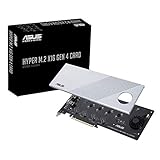
- Supports 4 NVMe M. 2 (2242/2260/2280/22110) up to 256 Gbps in one card by utilizing PCIe 4. 0 bandwidth
- PCIE 4. 0 X16 Interface with server-grade (low loss) PCB material, compatible with PCI express x8 and x16 slots
- Supports 14W power consumption SSDs for next gen latest drives
- Stylish heatsink and integrated blower style fan prevent M. 2 throttling
Rank #3

- 【7 ports PCIe USB card】 There is a 2-phase independent power supply module, which can feed one interface per output port to escape power shortage. Can operate without an external or auxiliary power supply; the seven interfaces operate independently and do not affect each other. Seven USB 3.0 Type A ports can be added externally to the PC case. Note: Not compatible with PS3/PS4.
- 【High Speed Transmission】USB3.0 theoretical speed up to 5Gbps, provides 10 times faster transmission speed than USB2.0. This usb expansion card enables quick access to files and transfer of HD movies, photos, music, etc.
- 【Stable power supply】The usb pcie card adopt NEC720201&NEC720210 chip. The USB interface can supply 5V2A power to external devices. Solid capacitors with good performance are used for low impedance, low temperature stability, and high temperature wave resistance.
- 【7 independent solid capacitors】Each interface has a stable voltage solid capacitor to ensure a stable power supply. The dielectric material of the solid capacitors is made of conductive polymer material, which has the advantages of high stability, long life, and low ESR (faster charging and discharging speed).
- 【Wide compatibility】 PCI-E X1 X4 X8 X16 compatible. Note: Not compatible with older PCI, backward compatible with USB 2.0 / 1.1, 64-bit and 32-bit Windows 11 / 10 / 8 / 7 / XP / Linux, not Mac compatible. Note: WIN8 and WIN10/11 users do not need to install the drive; XP and WIN7 users can download, unzip, install, and complete. (The corresponding installation directory for CD is DRIVERSǐ201R30230.EXE.)
Rank #2

- 【USB3.2 8 Interface】 Type-A + Type-C USB3 dual interface, can run two devices at the same time, compatible with the existing USB peripheral products. In order to make the power supply of each interface stable, the capacitor adopts the solid state patch type that can withstand the high temperature of 250 degrees.
- 【 High Quality Chip】 USB 3.2 expansion card adopts new high quality NEC720210+NEC720201 main control chip and advanced low voltage power supply process, the maximum usb3.2 Gen2 supports 10gbs(theoretical value).
- 【Security & Reliability】 When the external USB device is broken down or the current is too large, immediately cut off the power to protect the peripheral and personal computer. After the fault is rectified, the system automatically recovers. Each port is equipped with independent capacitors that do not require an external power supply, ensuring a more stable power supply. The two interfaces can operate independently and do not interfere with each other, so the operation is more stable.
- 【Stability & Heat Dissipation】 The use of alloy materials with high thermal conductivity can effectively heat dissipation, so that the expansion card is always at room temperature and the work is more stable.
What you should do
- If the computer works normally: No action is needed for this message alone. It reports Linux respecting the firmware’s ASPM policy.
- If you have a separate problem: Diagnose that symptom on its own, and check firmware notes or support information for your exact computer model. The message does not identify a model-specific BIOS setting or remedy.
- Do not force ASPM just to silence the warning: Linux documents
pcie_aspm=forceas enabling ASPM even on devices that claim not to support it, and warns: “Forcing ASPM on may cause system lockups.” Linux kernel parameters documentation
What the ASPM kernel options do
| Option | Documented behavior | What it means here |
|---|---|---|
pcie_aspm=force |
Enables ASPM even on devices that claim not to support it; Linux warns that forcing it may cause system lockups. Linux kernel parameters documentation | Not a routine fix for this firmware declaration or a way to dismiss the message. |
pcie_aspm=off |
“Don’t touch ASPM configuration at all. Leave any configuration done by firmware unchanged.” Linux kernel parameters documentation | This is not a repair for the declaration; the documented behavior is to leave firmware’s configuration alone. |
Product prices and availability are accurate as of the date/time indicated and are subject to change. Any price and availability information displayed on Amazon at the time of purchase will apply.

