
Do these 3 things before closing this tab:
1Fix the driver behind crashes, sound loss and screen glitches2Repair Windows errors before they cause bigger problems3Scan for outdated or missing drivers - takes under a minuteA crackle, a delayed note, a click at the loop point and a late first attack can sound like the same problem—but they have different causes. Crackle often points to a missed real-time audio deadline; lag is a latency trade-off; a seam click can occur in otherwise clean playback; and a clipped first transient may begin before recording is ready. Diagnose each separately before changing buffer settings or adding fades.
What kind of audio bug are you hearing?
| Symptom | Likely area to investigate |
|---|---|
| Random crackles, gaps or dropouts during playback | Real-time callback workload, buffer depth, scheduling, or the audio path |
| Notes feel delayed while playing or monitoring | Round-trip latency, buffer depth, sample-rate conversion, or the active route |
| A click exactly where a loop wraps | Waveform discontinuity or non-zero amplitude at the seam |
| The first note sounds clipped or starts late | Capture timing, controller latency, or recording-start behavior |
| Playback stops or behaves differently after a call or route change | Interruption and audio-session lifecycle handling |
These are starting points, not guarantees: more than one issue can coexist. In particular, a click at a loop boundary does not prove that the audio stream underruns.
Why does a mobile looper crackle?
Real-time audio has a deadline: the app must deliver each block of audio before the system needs it. If processing misses that deadline, the result may be an underrun or another interruption in the audio flow. Google’s Oboe guidance describes glitches as commonly associated with underruns, but buffer size is only one possible cause. Blocking work in the audio thread, excess DSP, scheduler preemption, workload-dependent clock changes, content underflows and audio-path defects can also contribute. See Oboe’s glitch mechanisms and its troubleshooting guide.
Keep the callback predictable
Android’s low-latency audio guidance warns that callbacks can arrive only a few milliseconds apart. Keep callback work bounded and avoid:
PC Slower Than It Used to Be?
A free scan shows the junk files, broken settings and background clutter dragging Windows down - then fixes them in one click.Free scan · Windows 10 & 11Crashes, No Sound, or Screen Glitches?
Random freezes, missing sound and display glitches usually trace back to one bad driver. Find and replace yours safely.Free scan · under a minute#1 Best Overall

- DIRECT MONITORING AUDIO INTERFACE — LOW-LATENCY GUITAR RECORDING: The MOMIX CAB is a direct monitoring audio interface—your guitar's clean signal is passed straight to the headphone output with zero latency while simultaneously sending to phone for recording. This means you'll always hear your unprocessed guitar in the headphones alongside any app audio. It's ideal for recording dry guitar tracks, practicing with backing tracks, or live streaming your playing. Important: The dry signal cannot be muted—this interface is not designed for real-time software amp sims or effects processing.
- PLUG & PLAY — NO CHARGING, NO DRIVERS, NO SOFTWARE: Just connect the MOMIX CAB to your phone's USB-C or Lightning port, plug in your guitar (6.35mm jack) and headphones (3.5mm jack), and start recording. No batteries, no charging, no driver installations. The signal indicator light glows green for clean signal, and turns red if your input is too hot—turn down your guitar volume to avoid distortion.
- POCKET-SIZED PORTABILITY — BACK CLIP DESIGN: Smaller than a key, the MOMIX CAB clips securely to your pocket, belt, or guitar strap for truly mobile recording. Record song ideas at the rehearsal space, capture practice sessions on video, or go live on social media—anywhere inspiration strikes. The included USB-C cable and Lightning adapter ensure wide device compatibility right out of the box.
- IMPORTANT USAGE NOTES — PLEASE READ BEFORE BUYING: (1) Use only the included USB-C cable—third-party cables may not work. (2) On Android, enable OTG in your phone settings and use the built-in Recorder app or a compatible recording app. (3) The headphone output carries both your guitar's direct signal and phone audio—this is ideal for zero-latency monitoring during recording. (4) Device compatibility varies—tested with iPhone (iOS), Google Pixel, and Samsung. Not guaranteed with all Android models.
- JOYO QUALITY & AFTER-SALES CONFIDENCE: Backed by JOYO's decade-plus reputation for crafting budget-friendly gear. Each MOMIX CAB is tested before shipping. Should you encounter connection issues, first ensure you're using the original cable and OTG is enabled on Android. For persistent problems—such as buzzing, no signal, or intermittent connection—our support team is ready to assist through your Amazon order page.
- Allocating or freeing memory
- File or network input/output
- Waiting on mutexes or other locks
- Sleeping
- Heavy one-time computations
Move non-real-time work elsewhere and design a deliberate way to pass data into the audio thread. In a looper, that includes avoiding unpredictable work when a loop is armed, a layer changes, or a recording is committed.
Use symptoms to narrow the cause
Track underrun or xrun counts where the platform exposes them, but do not treat a clean count as proof that every route is glitch-free: a device-path defect may not increment the counter. Oboe’s troubleshooting note offers useful clues: if very large buffers do not help and the problem is worse on slower devices, the workload may exceed available real-time compute. If glitches are intermittent, coincide with system activity, or ease when the buffer grows, scheduler preemption is one possibility—not a confirmed diagnosis.
How should you tune the buffer?
A deeper buffer gives the system more time to deliver audio and can reduce deadline misses, but it also delays what the player hears. For a looper, that trade-off directly affects monitoring and the feel of playing along. There is no single safe setting that guarantees both low latency and stable playback across phones and routes.
Rank #2
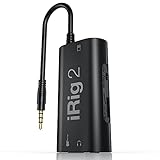
- PLUG AND PLAY SIMPLICITY ON EVERY DEVICE: Adjustable gain dial, which works with its built-in 1/8"" TRRS output connector to give you a true plug-and-play experience with your iPhone, iPad, iPod touch or Mac.
- CONNECT TO AMPLIFIER WITHOUT ADDITIONAL ACCESSORIES: iRig 2's new 1/4” output jack lets you use iRig 2 with an amplifier as a part of your live rig without the use of an adaptor.
- CONNECT TO ANY APPLE DEVICE: Use a Apple-brand USB-C to 3.5mm Headphone Jack Adapter to ensure compatibility with newer iOS devices— Easily record high-quality audio right to your mobile device. Use the built-in 1/8" headphone output or 1/4" amplifier output to listen to audio with headphones or amplifier.
- ROCK WITH iRig 2: Paired with AmpliTube CS (free) for iOS, IK's powerful guitar and bass multi-effects processor. AmpliTube CS provides you with a vast library of meticulously modeled virtual stompbox effects, amplifiers.
- EVEN BETTER: iRig 2 features a switch that lets you select between a processed signal and a clean "thru" input signal. This means you can also use your mobile device as a tuner, recorder or other tool while preserving the purity of a 100% analog signal path.
Start from the opened stream, then measure
Android’s current low-latency guide recommends tuning after opening the stream. It describes Oboe’s default usable buffer as two bursts and demonstrates setting AAudio to two burst sizes as a starting point. If a buffer that is too small causes underruns, increase it and check AAudioStream_getXRunCount(). Treat two bursts as a starting point for measurement, not a universal target.
The Tool Desk
Outbyte Driver Updater FREEScan for outdated or missing drivers - takes under a minuteDriver Scan →Outbyte PC Repair FREERepair Windows errors before they cause bigger problemsFix Now →The same Android Developers page, published in 2026, reports these OboeTester round-trip examples for particular configurations:
| Configuration in the Android Developers example | Reported round-trip latency |
|---|---|
| Following the listed recommendations | 20 ms |
| Performance mode not set to low latency | 205 ms |
| AAudio at 44.1 kHz | 160 ms |
| Oboe sample-rate conversion at 44.1 kHz | 23 ms |
Android explicitly cautions that results can vary greatly between devices. These configuration-specific figures are not predictions for a particular looper, phone, or Bluetooth route, and they are not population averages. Measure round-trip latency and glitch behavior on the devices and input/output routes you intend to support.
Rank #3

- Pro performance with great pre-amps - Achieve a brighter recording thanks to the high performing mic pre-amps of the Scarlett 3rd Gen. A switchable Air mode will add extra clarity to your acoustic instruments when recording with your Solo 3rd Gen
- Get the perfect guitar and vocal take with - With two high-headroom instrument inputs to plug in your guitar or bass so that they shine through. Capture your voice and instruments without any unwanted clipping or distortion thanks to our Gain Halos
- Studio quality recording for your music & podcasts - Achieve pro sounding recordings with Scarlett 3rd Gen’s high-performance converters enabling you to record and mix at up to 24-bit/192kHz. Your recordings will retain all of their sonic qualities
- Low-noise for crystal clear listening - 2 low-noise balanced outputs provide clean audio playback with 3rd Gen. Hear all the nuances of your tracks or music from Spotify, Apple & Amazon Music. Plug-in headphones for private listening in high-fidelity
- Everything in the box: Includes Pro Tools Intro+, Ableton Live Lite, Cubase LE, and Hitmaker Expansion: a suite of essential effects, powerful software instruments, and easy-to-use mastering tools
Why might Android ignore the audio path you requested?
A request for low-latency playback, a sample rate, or a particular stream mode does not establish that the device actually opened that path. Android recommends Oboe for the lowest possible latency; Oboe uses AAudio on Android 8.1 (API level 27) and later, and OpenSL ES on earlier Android versions. Android also recommends low-latency performance mode and exclusive sharing mode, while noting that actual stream capabilities depend on the device. Verify the opened stream and active route rather than assuming the request was honored.
Check sample rate, callback use and format
Android’s guide recommends using the device’s natural sample rate where possible—commonly 48 kHz—or using Oboe for sample-rate conversion when the app needs another rate. Framework resampling can add latency and may prevent the expected low-latency path. The Oboe FAQ also lists missing callbacks, unsupported channel counts and other stream-availability constraints among possible causes of an unexpected path.
Account for Bluetooth and stream limits
The Oboe FAQ specifically identifies unsupported Bluetooth low-latency streams and exhaustion of available low-latency streams as possible reasons a request is not honored. Test the routes your users will actually use, including Bluetooth where relevant; do not infer wired-route behavior from a Bluetooth test or vice versa. If low-latency stream availability is a constraint, one stream with in-app mixing may be more practical than opening a separate playback stream for every loop layer.
Rank #4

- High Sound Quality: Mini audio interface sound card, 24bit/48KHz high quality internal recording sound card, connects to smartphones, laptops and electric guitars and basses for live streaming. Compatible with most live streaming apps
- Perfect Sync: Low latency digital audio processing solution can be synchronized with video. Output original audio directly to your smartphone with low latency, low interference and high fidelity recording. Only recording, without edit or mix function. This is the simple audio interface for beginners. Plug & play without batteries
- Excellent Compatibility: Type-C USB for Android smartphone or laptop. Comes with lightning to Type-C adapter for iPad iPhone. The 1/4" 6.35mm jack to connect electric guitar bass and the 1/8" 3.5mm headphone output supports monitoring
- Easy to Adjust: This mobile sound card has volume buttons to adjust monitor volume. Indicator light to show the monitor volume, green means normal, red means the volume is too high and distortion
- Compact Designs: Back clip design, pocket storage, flexible and convenient, recording or live streaming anytime and anywhere. Please feel free to contact us if you have any question about it, we'd be happy to solve it for you.
What should a looper do when iOS audio is interrupted or rerouted?
On Apple platforms, interruptions and route changes are part of normal audio-session lifecycle handling, not exceptional states to ignore. An incoming call, for example, can take audio focus and pause playback. Apple’s interruption guidance says to observe audio-session notifications and update the app’s response when interruptions begin and end.
Resume only when the app’s prior state calls for it
Apple’s archived Audio Guidelines By App Type says: “When an interruption ends, don’t start playing or recording audio again unless the app was doing so prior to the interruption.” For a looper, preserve enough transport and recording state to make that decision deliberately; do not automatically restart a recording that the user had not started or that the app had not been running before the interruption.
Recheck audio properties after a route change
A route change can alter sample rate, buffer duration and latency. Query relevant audio properties again after the change and adapt the audio engine as needed. The cited Apple guide is archived, so check the current SDK documentation for the exact APIs and platform requirements in the version you ship.
Best Value

- HYBRID CONNECTIVITY: Dual USB ports with MFi-certified connectivity connect your computer and phone or iPad simultaneously. Record in GarageBand or Logic Pro, then stream or upload guitar & vocal covers directly from your mobile device. No workflow interruptions. The MAONO P2 USB-C audio interface instantly records to Mac, PC, iPhone, Android, or cameras. Perfect for creators and streamers who need total workflow freedom to record anywhere, anytime
- STUDIO-GRADE AUDIO: 56dB Dual XLR Audio Interface Compatible with Most Condenser and Dynamic Microphones. Ideal for podcasts, live streams, voiceovers, vocals, and home studio recording. Capture every vocal and guitar nuance in 24-bit/192kHz quality. Features a class-leading -130dB EIN for dead-silent recording in home studios. ASIO support deliver clean recordings and lower-latency monitoring for solo creators or music production
- STREAM AND RECORD WITHOUT THE GUESSWORK: Built for podcasters, streamers, and musician creators. Independent mute prevents unwanted noise during guitar or bass changes, while independent headphone and monitor mute controls provide greater flexibility during streaming and recording. Stream Mode sends your voice equally to both channels for a balanced listening experience
- ADVANCED CREATOR SOFTWARE PROSTUDIO 2: Record guitar tutorials, cover songs, and vocal streams with ease. Route FL Studio, Spotify, TikTok, or browser audio directly to dedicated channels without digging through complex PC settings. Add VST effects for cleaner vocals, real-time noise reduction, and studio sound. Built-in loopback captures your instrument, voice, backing tracks, and desktop audio in one seamless workflow
- HEAR EVERY DETAIL IN REAL TIME: Ideal for podcast recording and music production. Direct monitoring delivers low-latency audio, so you hear your voice or instrument without distracting delays. Independent headphone and monitor controls let creators customize monitoring levels with ease. Real-time signal indicators make it easy to track input levels, avoid clipping, and capture clean recordings every time
Handle recording permission explicitly
Request recording permission explicitly and give the user a clear recording state when access is unavailable or an interruption occurs. The archived Apple guidance recommends updating the UI during interruptions; a visible state helps distinguish a paused capture from a loop that is still recording.
Why does a looper click at the loop point?
A loop can click even when its stream has no underruns. If the waveform jumps abruptly from the loop’s end back to its start—or either edge has a non-zero amplitude—the discontinuity can be audible. Loopy Pro’s troubleshooting article on transients describes these boundary issues and product-specific fade and crossfade controls.
Make the wrap continuous without smearing the attack
Inspect the waveform at both edges. A short fade or crossfade can soften a discontinuity, but too much can blur a transient that should remain crisp. Apple’s AVFAudio sequencer example avoids clicks from a non-zero-crossing clip start by setting volume to zero and ramping it up. The example reports an approximately 5 ms render-buffer smoothing interval for that implementation; it is not a guaranteed duration on every device or audio engine.
Separate a seam click from a clipped first attack
If the problem is at the start of a newly captured loop rather than at every wrap, investigate capture and control timing before editing the seam. Loopy Pro discusses early playing and controller latency as possible causes, along with compensation and threshold-recording options in its own product context. Those are not universal mobile-platform features.
What’s actually slowing this PC down?
Pick the symptom - the matching free tool is one click away.
How do you stop repeated loops drifting out of time?
Do not assume that replaying a floating-point duration forever will keep the musical grid exact. Apple’s sequencer example manually schedules each iteration at the loop boundary rather than relying on its built-in looping option, to avoid timing drift accumulating from floating-point error. For a looper, anchor transport events to stable frame or host-time positions and test many consecutive wraps. A first cycle that sounds aligned does not establish that later cycles will stay aligned.
Quick Recap
Product prices and availability are accurate as of the date/time indicated and are subject to change. Any price and availability information displayed on Amazon at the time of purchase will apply.

